
Decarbonizing Your Home: The Complete Guide to Heat Pump Retrofits in 2026
As federal tax credits expire and new refrigerants enter the market, modern heat pumps remain the most impactful energy upgrade for residential remodels.
By Factlen Editorial Team
- Building Scientists
- Emphasize that HVAC upgrades must be paired with building envelope improvements to maximize efficiency.
- Electrification Advocates
- Argue that heat pumps are the ultimate tool for residential decarbonization and long-term utility savings.
- Consumer Analysts
- Focus on the financial friction and unequal access created by the shift to state-administered rebate programs.
What's not represented
- · HVAC Contractors
- · Natural Gas Utilities
Why this matters
Heating and cooling account for the largest portion of residential energy use. Understanding the 2026 shift in heat pump technology and state-level rebates allows homeowners to drastically cut utility bills, improve indoor comfort, and access thousands of dollars in point-of-sale discounts.
Key points
- Modern cold-climate heat pumps operate at 300 to 400 percent efficiency, outperforming gas boilers even at temperatures approaching -30°C.
- New 2026 federal regulations require all new heat pumps to use low-GWP refrigerants like R-32 and R-290, phasing out older chemicals.
- The popular 25C federal tax credit for heat pumps expired at the end of 2025 and is no longer available.
- State-administered HEAR and HOMES programs now provide up to $8,000 in point-of-sale rebates for income-qualified households.
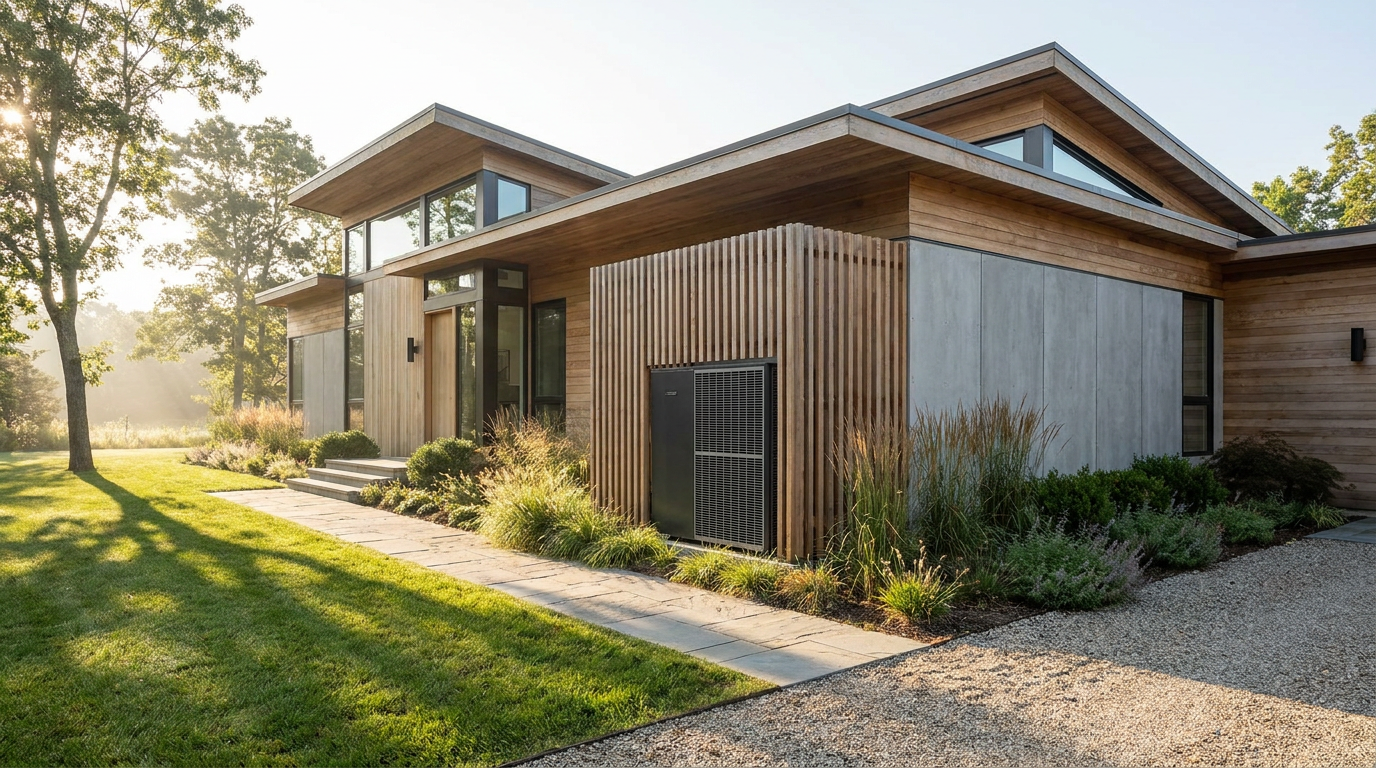
The 2026 home remodeling landscape is undergoing a quiet but profound revolution, driven not by aesthetic trends like open floor plans or quartz countertops, but by the mechanical systems humming behind the walls. At the center of this shift is the air-source heat pump, a technology that has rapidly evolved from a niche eco-upgrade into the undisputed gold standard for residential heating and cooling. As homeowners increasingly seek to decarbonize their environmental footprints and insulate themselves from volatile fossil fuel prices, the heat pump retrofit has become the defining project of the modern deep energy remodel, reshaping how we think about indoor comfort.[1][3]
To understand why this technology is transforming the remodeling industry, one must first understand its core mechanism. Unlike a traditional gas furnace or electric baseboard heater, a heat pump does not generate heat through combustion or electrical resistance. Instead, it moves heat from one location to another using a closed-loop refrigeration cycle. This process relies on a chemical refrigerant that absorbs and releases thermal energy as it cycles between liquid and gaseous states, allowing the system to capture ambient heat and relocate it to where it is needed most.[1][7]
In the summer, the system acts exactly like a standard central air conditioner, absorbing thermal energy from inside the house and expelling it outdoors to cool the living space. In the winter, a reversing valve flips the flow of the refrigerant. The system extracts ambient heat from the outdoor air—even when it feels freezing to the human touch—compresses the refrigerant to drastically increase its temperature, and pumps that concentrated heat indoors. Because there is always some thermal energy in the air down to absolute zero, the heat pump always has a source to draw from.[7]

Because moving heat requires significantly less electrical energy than creating it from scratch, heat pumps achieve remarkable operational efficiency. This efficiency is measured by the Coefficient of Performance (COP). While a brand-new, high-efficiency gas boiler might reach 95 percent efficiency (a COP of 0.95), a modern heat pump routinely operates at 300 to 400 percent efficiency (a COP of 3.0 to 4.0). In practical terms, this means the system delivers three to four units of heat energy into the home for every one unit of electricity it consumes from the grid.[1][4]
Despite these impressive numbers, a persistent myth has historically slowed heat pump adoption in northern climates: the widespread belief that air-source systems simply cannot function in extreme cold. For decades, older single-speed heat pumps did indeed struggle when temperatures dropped below freezing. As they lost efficiency in the cold, they were forced to rely on expensive, energy-heavy electric resistive backup heaters to keep the house warm. This led to exorbitant winter utility bills for early adopters in cold states, cementing a stubborn narrative that heat pumps were only suitable for mild climates like the American Sunbelt.[5]
That narrative is now definitively obsolete. A landmark study published in the peer-reviewed journal Joule analyzed raw performance data from field studies across North America and Europe to settle the debate. The researchers found that modern heat pumps significantly outperform oil and gas heating systems even at temperatures approaching -30°C (-22°F). The data proved that well below freezing, the efficiency of a cold-climate heat pump remains vastly superior to fossil fuel combustion, permanently busting the myth that the technology cannot handle severe winters.[4]

The technological breakthrough enabling this cold-weather resilience is the inverter-driven, variable-speed compressor. Unlike older models that simply toggle on and off at full blast, variable-speed compressors can continuously modulate their output. They work harder and spin faster when the temperature plummets, and dial back to a low hum during milder weather. This dynamic adaptability allows the system to maintain a high Coefficient of Performance without ever needing to trigger auxiliary emergency heat, ensuring consistent comfort regardless of the outdoor forecast.[5][6]
Field assessments rigorously corroborate the laboratory data. The American Council for an Energy-Efficient Economy (ACEEE) and the National Renewable Energy Laboratory (NREL) monitored cold-climate heat pumps installed in homes across the Midwest and the Rocky Mountains. These real-world retrofits yielded space heating energy savings of 39 to 65 percent compared to the homes' previous systems. By permanently reducing the homeowners' reliance on delivered fossil fuels like propane and heating oil, the retrofits delivered immediate and sustained reductions in monthly utility costs.[5][6]
Field assessments rigorously corroborate the laboratory data.
Beyond cold-weather performance, homeowners remodeling in 2026 must navigate a major regulatory shift in HVAC technology. On January 1, 2026, stringent new environmental regulations took effect, requiring manufacturers to phase out high-Global Warming Potential (GWP) refrigerants. For years, the industry standard was R-410A, a chemical that, while effective at transferring heat, acts as a potent greenhouse gas if it leaks into the atmosphere. The new federal mandates have forced a complete overhaul of the equipment available on the residential market, ensuring that new installations align with broader climate goals.[1]
In its place, the industry has transitioned to next-generation refrigerants such as R-32 and R-290. R-290, which is highly refined propane, is particularly revolutionary for the home remodeling sector. It boasts a near-zero Global Warming Potential and can achieve much higher flow temperatures than older refrigerants. This makes it absolutely ideal for retrofitting older homes that rely on traditional high-temperature hydronic radiators. Homeowners can now swap their aging gas boiler for an air-to-water heat pump without having to tear out their existing pipework or cast-iron radiators.[1][7]
While the environmental and performance benefits are abundantly clear, the financial landscape for heat pump retrofits has shifted dramatically in 2026. For years, the primary financial lever for homeowners was the federal 25C Energy Efficient Home Improvement Credit. This popular program provided a straightforward, predictable tax credit of up to $2,000 annually for qualifying heat pump installations. It served as the bedrock incentive for the residential electrification movement, allowing homeowners to reliably offset the premium upfront costs of high-efficiency equipment when they filed their annual tax returns.[2]
That era of predictable federal tax credits has abruptly ended. The passage of the One Big Beautiful Bill Act (OBBBA) in mid-2025 retroactively sunset several residential clean-energy credits in an effort to cut federal spending. As of December 31, 2025, the 25C federal tax credit for air-source heat pumps is officially gone. Homeowners installing systems in 2026 can no longer claim this deduction on their federal returns, forcing a massive pivot in how deep energy remodeling projects are financed, marketed by contractors, and ultimately paid for by consumers.[2]
However, the void left by the expired federal tax credit has been filled by state-administered rebate programs originally funded by the Inflation Reduction Act. These programs—specifically the Home Electrification and Appliance Rebates (HEAR) and the HOMES rebate program—have fundamentally shifted the financial incentive from a delayed tax credit to an immediate point-of-sale discount. Rather than waiting until tax season to recoup costs, homeowners now see the savings deducted directly from their contractor's invoice at the time of installation.[7]

The HEAR program is particularly lucrative, offering up to $8,000 off a heat pump installation for income-qualified households, which typically includes those earning below 150 percent of their Area Median Income. Because these are point-of-sale rebates, they immediately lower the upfront capital required to initiate a project. This structural change is critical for the remodeling industry, as it removes the primary barrier to entry that previously locked low- and moderate-income families out of deep energy retrofits, allowing a broader demographic to access high-efficiency technology and the subsequent monthly utility savings.[7]
For homeowners undertaking comprehensive, whole-house remodels, the HOMES program offers performance-based incentives that reward ambition. Rather than paying a flat rate for a specific piece of equipment, HOMES rewards the total modeled energy reduction of the entire project. If a remodel achieves 20 to 35 percent whole-home energy savings, the rebate can cover 50 percent of the total project cost, up to $4,000. Pushing those modeled savings past 35 percent can unlock even higher rebate tiers in participating states.[7]
This performance-based approach aligns perfectly with the consensus guidance of building scientists and energy auditors. The U.S. Department of Energy stresses that a high-efficiency heat pump should rarely be installed in a vacuum. A true 'Deep Energy Retrofit' begins with the building envelope. Before upgrading the mechanical systems, homeowners are heavily advised to focus on upgrading roof and wall insulation, sealing hidden air leaks in the attic and foundation, and installing high-performance thermal windows to trap the conditioned air inside the living space.[3]

By reducing the home's baseline heating and cooling loads first, homeowners can significantly downsize the required HVAC equipment. A smaller heat pump costs less to purchase, requires less refrigerant, and is cheaper to operate over its lifespan. Furthermore, properly sizing the equipment to a well-insulated envelope prevents the system from short-cycling—turning on and off too frequently—which extends the life of the compressor. On a macro level, this approach reduces the overall strain on the local electrical grid during peak winter demand periods, making the entire energy transition more sustainable.[3][7]
Navigating a heat pump retrofit in 2026 undoubtedly requires careful planning, from selecting a contractor trained in handling new low-GWP refrigerants to untangling the highly localized, sometimes confusing web of state-administered rebates. Yet, for those willing to do the research and pair their mechanical upgrades with smart envelope improvements, the transition offers a rare convergence of tangible benefits. It provides a drastically reduced household carbon footprint, superior year-round indoor comfort, and permanent insulation from the unpredictable volatility of global fossil fuel markets, making it the smartest remodeling investment of the decade.[1][7]
How we got here
August 2022
The Inflation Reduction Act is signed, allocating billions for state-level home electrification rebates.
September 2023
A landmark study in Joule confirms heat pumps maintain high efficiency even in extreme sub-zero climates.
July 2025
The One Big Beautiful Bill Act (OBBBA) is passed, retroactively sunsetting several federal tax credits.
December 2025
The 25C federal tax credit for residential heat pumps officially expires.
January 2026
New federal regulations mandate the transition to low-GWP refrigerants in all new residential HVAC equipment.
Viewpoints in depth
Electrification Advocates
Argue that heat pumps are the ultimate tool for residential decarbonization and long-term utility savings.
Proponents of rapid home electrification view the heat pump as the single most critical upgrade a homeowner can make in 2026. They point to the overwhelming empirical data showing that modern variable-speed compressors have solved the cold-weather problem, making fossil fuel combustion obsolete even in northern climates. For this camp, the transition to low-GWP refrigerants like R-290 is a massive victory that further cements the environmental superiority of the technology.
Building Scientists
Emphasize that HVAC upgrades must be paired with building envelope improvements to maximize efficiency.
Researchers and energy auditors caution against treating the heat pump as a silver bullet. They argue that dropping a high-efficiency mechanical system into a drafty, poorly insulated home is a recipe for grid strain and suboptimal performance. This camp strongly advocates for the 'Deep Energy Retrofit' approach, insisting that homeowners must invest in air sealing, upgraded insulation, and high-performance windows before sizing and installing their new HVAC equipment.
Consumer Analysts
Focus on the financial friction and unequal access created by the shift to state-administered rebate programs.
While acknowledging the benefits of point-of-sale discounts, consumer advocates highlight the confusion caused by the expiration of the federal 25C tax credit. Because the replacement HEAR and HOMES rebates are administered at the state level, access to funding in 2026 is highly unequal. A homeowner in a state with a fully deployed program might receive $10,000 in instant discounts, while a homeowner in a neighboring state with a delayed rollout might receive nothing, creating a fractured market for deep energy retrofits.
What we don't know
- How quickly individual states will fully deploy their allocated HOMES and HEAR rebate funding throughout 2026.
- Whether the electrical grid in older neighborhoods will require significant upgrades to handle the surge in whole-home electrification.
- How the phase-out of R-410A refrigerant will affect the long-term maintenance costs of legacy heat pump systems.
Key terms
- Coefficient of Performance (COP)
- A ratio measuring a heat pump's efficiency, calculated by dividing the heat output by the electrical energy input.
- Cold-Climate Air-Source Heat Pump (ccASHP)
- A specialized heat pump using variable-speed compressors to extract heat from outdoor air even at sub-zero temperatures.
- Global Warming Potential (GWP)
- A measure of how much heat a greenhouse gas traps in the atmosphere, used to regulate HVAC refrigerants.
- Deep Energy Retrofit
- A whole-home remodeling approach that combines insulation, air sealing, and HVAC upgrades to drastically reduce energy consumption.
- HEAR Rebates
- State-administered programs funded by the Inflation Reduction Act that provide point-of-sale discounts for home electrification.
Frequently asked
Do heat pumps actually work in freezing weather?
Yes. Modern cold-climate heat pumps use variable-speed compressors to operate efficiently at temperatures as low as -30°C, outperforming traditional gas boilers.
Is the $2,000 federal tax credit for heat pumps still available in 2026?
No. The 25C federal tax credit expired at the end of 2025. It has been replaced by state-administered point-of-sale rebates like the HEAR program.
What is the 2026 refrigerant transition?
New regulations require heat pumps manufactured in 2026 to use low-GWP refrigerants like R-32 or R-290 (propane), phasing out older chemicals like R-410A.
Should I insulate my home before installing a heat pump?
Yes. Building scientists highly recommend improving insulation and air sealing first, which allows you to install a smaller, less expensive heat pump.
Sources
Source coverage
7 outlets
3 viewpoints surfaced






[1]EcoHomeElectrification Advocates
2026 heat pump buyers guide: a homeowner's and pro's guide
Read on EcoHome →[2]Electrify AtlasElectrification Advocates
What happened to the federal heat pump tax credit in 2026?
Read on Electrify Atlas →[3]U.S. Department of EnergyBuilding Scientists
Deep Energy Retrofits
Read on U.S. Department of Energy →[4]JouleBuilding Scientists
Coming in from the cold: Heat pump efficiency at low temperatures
Read on Joule →[5]ACEEEBuilding Scientists
Cold Climate Air Source Heat Pump Field Assessment
Read on ACEEE →[6]National Renewable Energy LaboratoryBuilding Scientists
Field Performance of Cold-Climate Air-Source Heat Pumps
Read on National Renewable Energy Laboratory →[7]Factlen Editorial TeamConsumer Analysts
Synthesis by Factlen editorial team
Read on Factlen Editorial Team →

More in home
See all 14 stories →Mass Timber
How Engineered Wood is Replacing Steel and Concrete in the World's Newest Skyscrapers
0 sources

Home Energy
How Bidirectional Charging is Turning Electric Vehicles into Massive Home Batteries
0 sources

Heat Pumps
How Heat Pumps Conquered the Cold: The 2026 Guide to Home Heating
0 sources
Neuroaesthetics
Neuroaesthetics: How the Science of Interior Design Actively Shapes Brain Chemistry
0 sources

Every angle. Every day.
Get home stories with full source coverage and perspective breakdowns delivered to your inbox.