
How 'Drop-In' Sports Apps Are Rewiring Urban Communities and Fighting Loneliness
A new wave of technology is removing the friction from amateur athletics, turning casual pickup games into a powerful antidote for adult isolation.
By Factlen Editorial Team
- Grassroots Organizers
- Focused on removing administrative friction and making sports accessible to all skill levels.
- Public Health Advocates
- Viewing casual sports as a critical, scalable intervention for the urban loneliness epidemic.
- Sports Tech Innovators
- Seeing amateur participation as a massive, underserved market ripe for digital infrastructure.
- Casual Players
- Valuing the flexibility, low-pressure socialization, and mental escape of drop-in games.
What's not represented
- · Municipal Parks Departments
- · Traditional Sunday League Managers
Why this matters
As urban loneliness reaches epidemic levels, these platforms offer a scalable, low-cost way for adults to build real-world friendships, improve their mental health, and integrate into their local communities.
Key points
- Drop-in sports apps are solving the logistical hurdles of amateur athletics, allowing individuals to join games on demand.
- Public health experts view these platforms as a vital tool for combating the modern epidemic of urban loneliness.
- The technology removes the need for pre-formed teams, connecting 'spares' with local games that need extra players.
- Participation is surging among older adults and women, driven by the low-pressure, inclusive environment.
- Professional franchises and tech investors are increasingly funding grassroots sports infrastructure.
The modern city presents a unique paradox: never have humans lived so closely together, yet reported such profound levels of isolation. In 2026, loneliness is widely recognized by public health officials as a silent epidemic, carrying physical health risks that rival chronic disease.[6][8]
For adults navigating the pressures of work, family, and transient urban living, making new friends can feel like an insurmountable hurdle. Traditional avenues for socialization often revolve around alcohol or require significant financial and time commitments, leaving many feeling disconnected from their immediate communities.[4][8]
Team sports were once the default community builder, but participation historically plummets after people leave school or university. The reasons are nearly universal: unpredictable work schedules, the administrative nightmare of coordinating a dozen adults, and the upfront costs of joining a formal Sunday league.[1][3]
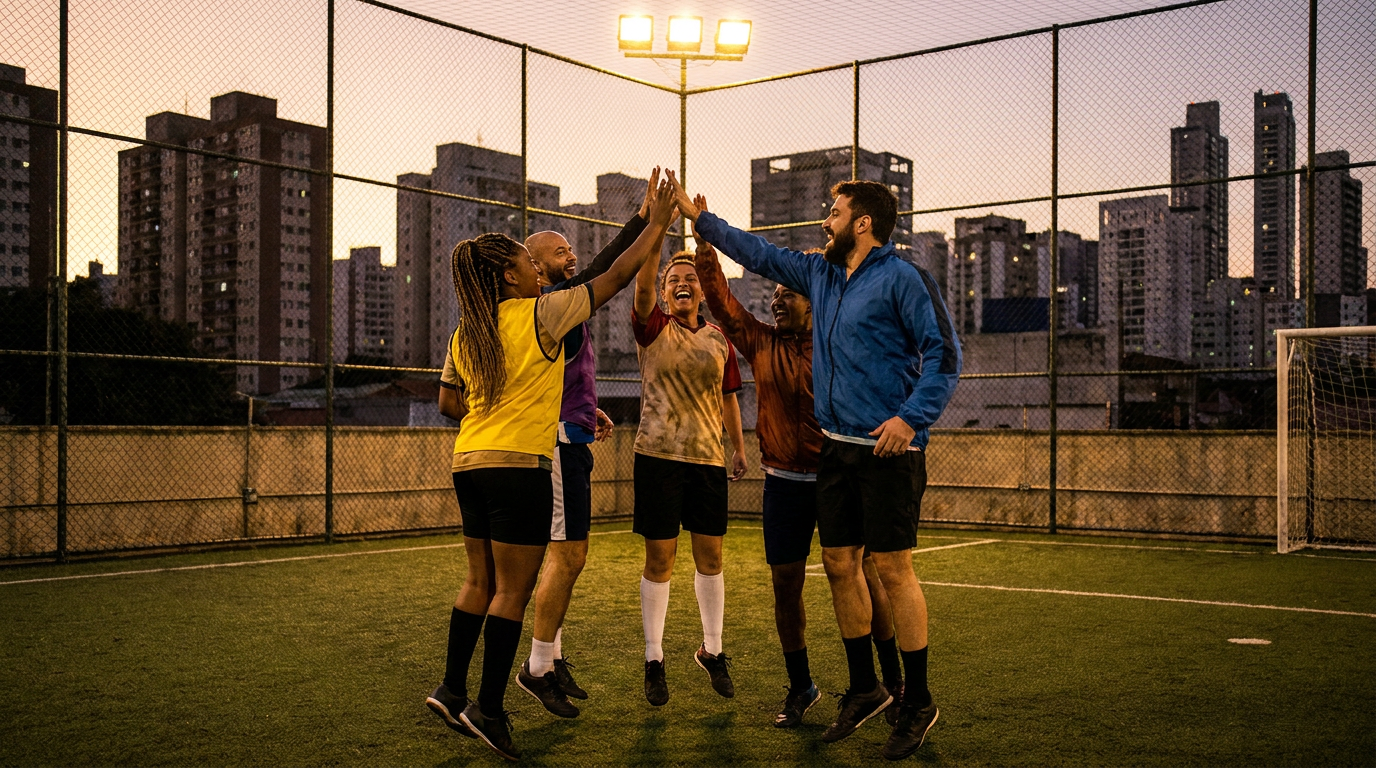
Now, a wave of "drop-in" sports applications is rewiring how urbanites connect, using technology to strip away the friction of amateur athletics. Platforms like Footy Addicts, Just Play, and Pleb are transforming empty municipal pitches into bustling social hubs.[1][4]

The mechanism is elegantly simple. Instead of requiring a pre-formed team, these apps allow individuals to sign up as "spares" for local games. If a regular squad suffers a late dropout—the bane of every grassroots organizer—the app instantly connects them with a stranger in the neighborhood who is desperate for a kickabout.[1]
"Footy Addicts was invented to solve an infuriating problem for amateur players," notes the platform's origin story. Its founder, Konstantinos Gkortsilas, built the app after moving to the UK from Greece and struggling to find a low-commitment way to play football and meet people in a new city.[1]
Today, the scale of this digital-to-physical migration is staggering. Footy Addicts alone facilitates thousands of games across the UK, boasting over 323,000 registered players. Meanwhile, in Australia, platforms like Just Play are actively marketing themselves not just as fitness tools, but as direct antidotes to adult isolation.[1][4]
Today, the scale of this digital-to-physical migration is staggering.
The psychological benefits of this specific type of socialization are profound. Unlike networking events or forced workplace mixers, casual sports offer a form of "organic therapy" through play. The shared objective of the game removes the awkwardness of small talk; players communicate through passes, defensive shifts, and shared frustration over a missed shot.[3][8]

"It's the banter that keeps him coming back," reported one 70-year-old walking football participant, highlighting how the casual environment fosters a low-pressure social network. Across community forums, players frequently report that these weekly drop-in sessions become their primary mental escape and a vital support system.[3][7]
The demographic reach of these platforms is also expanding far beyond the traditional young male demographic. Women, particularly those in their 30s and 50s, are returning to sports in record numbers, utilizing drop-in apps to bypass the intimidating atmosphere of established club hierarchies.[3]
For immigrants and expats, the pitch serves as a universal translator. A game of pickup soccer or basketball requires no shared language other than the rules of the sport, making it one of the fastest and most effective ways to integrate into a new community.[1][6]
The economic and societal value of this grassroots revival is immense. The English Football Association's Social Return on Investment report recently calculated that amateur football participation delivers £11.8 billion of value to society, including £3.2 billion in direct healthcare savings by preventing disease and improving mental health.[3]

Recognizing this impact, professional sports franchises are beginning to invest in the drop-in model. Major League Soccer's St. Louis CITY SC recently launched "Pick Up CITY," a series of informal soccer meetups specifically designed to combat loneliness and connect residents with mental health resources.[5]
"Since 2020, we spend four times more time at home than anywhere else—we are craving connection and community now more than ever," explained Matt Sebek, the club's Chief Experience Officer. By utilizing urban mini-pitches, the franchise is actively facilitating the kind of spontaneous play that builds neighborhood resilience.[5]
The tech sector is also pouring capital into the broader grassroots ecosystem. Rematch, a platform designed to capture and share highlights from amateur games, recently secured a $3.5 million funding round to expand its "media infrastructure" for local sports.[2]

This influx of investment signals a broader cultural shift: a move away from passive consumption of professional mega-events toward active, community-level participation. As one recreational player noted on a community forum, the simple act of receiving a text notification that a game is on is often enough to turn a bad day around.[2][7]
In an era defined by digital isolation, these platforms prove that technology can still be harnessed to bring people together in the physical world. By lowering the barrier to entry, drop-in sports apps are ensuring that the simple joy of play remains accessible to everyone, one impromptu match at a time.[1][4][8]
How we got here
2013
Footy Addicts launches in the UK to help individual players find local games.
2020-2022
The global pandemic exacerbates urban loneliness, prompting a surge in demand for community connection.
2024
Grassroots media platform Rematch expands into the US market to capture amateur sports highlights.
May 2025
St. Louis CITY SC launches 'Pick Up CITY' to combat isolation through informal soccer meetups.
June 2026
Drop-in sports apps report record participation numbers across multiple demographics.
Viewpoints in depth
Grassroots Organizers
Focused on removing administrative friction and making sports accessible to all.
For the people actually running local games, the primary hurdle has never been a lack of interest, but rather the logistical nightmare of coordination. Organizers argue that traditional league structures—with their upfront fees and rigid schedules—actively exclude adults with unpredictable working hours or family commitments. By utilizing drop-in technology, they can eliminate the 'late dropout' problem and ensure that pitches remain full, shifting the focus from competitive league tables to sheer participation and community building.
Public Health Advocates
Viewing casual sports as a critical intervention for the urban loneliness epidemic.
Medical professionals and public health experts increasingly view these platforms through the lens of preventative healthcare. They point to data showing that loneliness carries physical health risks comparable to smoking. From this perspective, a casual game of football or pickleball is a highly effective, scalable public health intervention. The shared objective of the sport provides 'organic therapy,' allowing individuals to build social bonds and support networks without the pressure of formal networking or traditional therapy settings.
Sports Tech Innovators
Seeing amateur participation as a massive, underserved market for digital infrastructure.
While billions of dollars flow into professional sports broadcasting, tech investors argue that the grassroots sector has been historically starved of innovation. They view the millions of amateur games played every weekend as an untapped ecosystem. By funding platforms that handle logistics, highlight-sharing, and community management, these innovators believe they can monetize the shift away from passive sports consumption toward active, everyday participation.
What we don't know
- Whether municipal infrastructure can keep pace with the surging demand for casual, small-sided pitches.
- How traditional, formal amateur leagues will adapt to the rising preference for non-committal, drop-in play.
Key terms
- Drop-in sports
- Casual, non-league athletic games where players can join on a one-off basis without committing to a full season.
- Grassroots sports
- Amateur, community-level athletic participation, distinct from professional or elite leagues.
- Social Return on Investment (SROI)
- A metric used to quantify the broader societal and economic value of an activity, such as healthcare savings generated by public exercise.
- Mini-pitch
- A small, often enclosed playing surface designed for small-sided games, frequently built in dense urban areas to maximize space.
Frequently asked
How do drop-in sports apps handle uneven skill levels?
Most platforms allow organizers to tag games with specific skill levels, from beginner to advanced. However, the culture of drop-in sports heavily prioritizes inclusivity and exercise over intense competition.
Are these apps only for soccer?
While football was the pioneer, the drop-in model has rapidly expanded to include basketball, tennis, pickleball, and volleyball through various dedicated platforms.
What happens if someone doesn't show up?
The core feature of these apps is their ability to instantly notify "spares" in the local area, allowing a waitlisted player to jump in and save the game at the last minute.
Sources
Source coverage
8 outlets
4 viewpoints surfaced








[1]The GuardianGrassroots Organizers
'You make people a bit happier': the football app building friendships in London
Read on The Guardian →[2]Pulse 2.0Sports Tech Innovators
Rematch Announces $3.5 Million Funding Round To Accelerate Grassroots Sports Media Platform
Read on Pulse 2.0 →[3]Football For AllGrassroots Organizers
Why adults stopped playing and how casual football is bringing them back
Read on Football For All →[4]Just PlayPublic Health Advocates
Why Social Sport is the Ultimate Antidote to Loneliness
Read on Just Play →[5]St. Louis CITY SCPublic Health Advocates
St. Louis CITY SC Continuing to Tackle the Struggle by Connecting St. Louisans with Informal Soccer Meetups
Read on St. Louis CITY SC →[6]MediumPublic Health Advocates
Meetup CEO David Siegel On Why We Need Community Now More Than Ever
Read on Medium →[7]Reddit CommunitiesCasual Players
The real reason Pickleball has taken off like it has - Loneliness
Read on Reddit Communities →[8]Factlen Editorial TeamCasual Players
Synthesis by Factlen editorial team
Read on Factlen Editorial Team →
Every angle. Every day.
Get sports stories with full source coverage and perspective breakdowns delivered to your inbox.