
The Rise of the 'Cozy Web': Why the Internet is Retreating into Digital Gardens
Exhausted by algorithmic feeds and AI-generated content, users are abandoning massive public platforms for private communities and personal, slow-paced websites.
By Factlen Editorial Team
- Digital Gardeners
- Advocates for personal ownership, non-linear thought, and slow creation on the web.
- Cozy Web Advocates
- Users and theorists retreating from the public internet into high-trust, private communities.
- Slow Internet Theorists
- Critics focusing on systemic changes to digital architecture and the engagement economy.
What's not represented
- · Mainstream Social Media Executives
- · Digital Advertisers and Marketers
Why this matters
As the public internet becomes increasingly saturated with algorithmic feeds and AI-generated content, understanding the shift toward private communities and digital gardens is essential for anyone looking to reclaim their digital well-being, protect their privacy, or reach audiences in the modern web.
Key points
- Users are increasingly abandoning massive, algorithmic social media platforms due to digital exhaustion and privacy concerns.
- The 'Cozy Web' offers a retreat into high-trust, private digital spaces like Discord and encrypted group chats.
- Digital gardens are replacing traditional blogs, offering non-linear, evolving personal wikis that encourage learning in public.
- The broader 'Slow Internet' movement advocates for technology that respects user well-being and intentionality over rapid engagement.
- This shift to private channels is creating a discoverability crisis for marketers, as influence moves to untrackable 'Dark Social' networks.
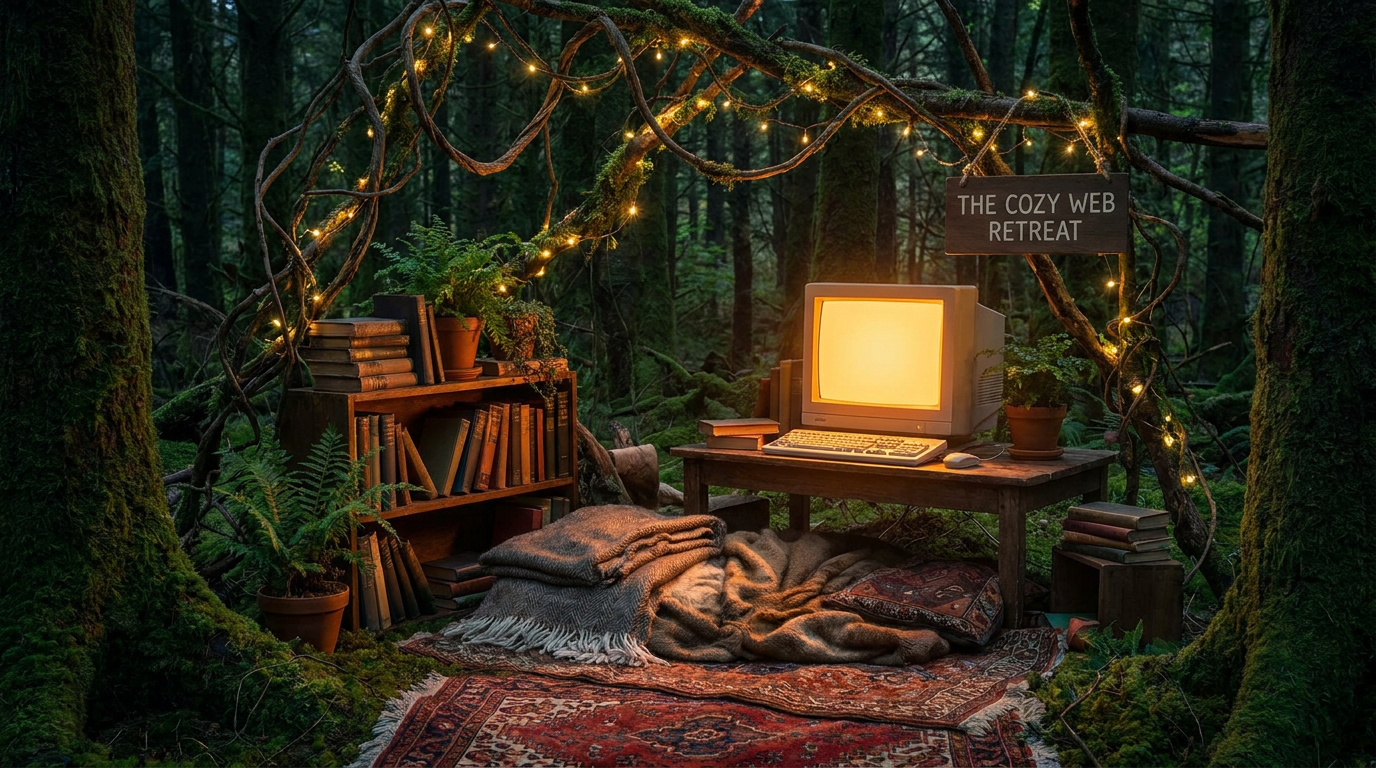
The internet of 2026 feels increasingly hostile to the average user. Flooded with AI-generated content, aggressive algorithmic personalization, and relentless engagement bait, the public web has transformed into what cultural theorists call a 'Dark Forest.' For years, the default response to this digital exhaustion was a complete digital detox—logging off entirely in an attempt to reclaim mental clarity. But a new, more sustainable movement has taken root. Users are not quitting the internet; they are quietly migrating to its hidden, more intentional corners. This shift represents a fundamental change in how we interact online, moving away from the performative public square and toward spaces that prioritize genuine connection and intellectual freedom.[3][6]
This mass migration is splitting into two distinct but complementary phenomena: the retreat into the 'Cozy Web' and the cultivation of 'Digital Gardens.' Together, they represent a widespread rejection of the engagement economy and a return to a slower, more human-centric digital life. Rather than renting space on platforms that monetize their attention, users are building and seeking out environments where they control the architecture, the audience, and the pace of consumption.[1][4]
The 'Cozy Web,' a term originally popularized by writer Venkatesh Rao, refers to the private, gatekeeper-bounded spaces of the internet. If massive platforms like X, TikTok, and Facebook are the digital equivalents of a crowded, shouting public square—loud, performative, and heavily surveilled—the Cozy Web is the digital living room. It is the informal, untracked, messily human space that bots and algorithms have not yet fully infiltrated.[2][6]
These spaces include Discord servers, WhatsApp channels, Geneva groups, and invite-only Telegram chats. Here, the architecture of the platform dictates a completely different kind of behavior. There are no algorithmic feeds designed to maximize outrage, no shadowbanning mechanics, and no viral metrics to chase. Success and value in the Cozy Web are measured by the depth of a conversation and the strength of the community, rather than the raw reach of a broadcasted post.[2][5]

For Gen Z, this shift is particularly pronounced and deeply intentional. Having grown up entirely within the panopticon of Big Social, younger users increasingly view privacy not just as a feature, but as a non-negotiable lifestyle choice. They are actively abandoning public-facing profiles in favor of ephemeral content, end-to-end encryption, and decentralized social networks that offer user-owned data and configurable, chronological feeds.[2]
But the desire for a healthier internet extends far beyond private group chats. It is also fundamentally reshaping how individuals publish, store, and share knowledge, giving rise to the modern 'Digital Garden.' As users seek to reclaim their intellectual space from scattered bookmarks and fleeting social media posts, the personal website is experiencing a quiet, powerful renaissance.[1][3]
A digital garden is a personal website or wiki that serves as a living, evolving space for ideas. Traditional blogs operate much like magazines: they are reverse-chronological, highly polished, SEO-optimized, and considered strictly 'finished' the moment the author hits publish. Digital gardens reject this rigid model entirely, opting instead for a fluid, continuous approach to public writing.[1][3]
A digital garden is a personal website or wiki that serves as a living, evolving space for ideas.
Instead of a time-bound feed, gardens organize thoughts topically using bidirectional linking, allowing readers to wander through connected concepts organically. Content is categorized explicitly by its maturity. A rough, half-formed thought is published as a 'seedling.' As the author revisits, researches, and expands the idea, it becomes 'budding,' and eventually, a polished 'evergreen' essay.[3]

This framework relieves the immense pressure of perfection that haunts traditional publishing. It encourages the practice of 'learning in public' and acknowledges that human thought is a continuous, messy process rather than a series of definitive hot takes. The barrier to entry has also plummeted, with tools like Obsidian, Notion, and static site generators making it easier than ever for non-developers to build these interconnected knowledge bases.[1][3]
Both the Cozy Web and digital gardening fall under the broader philosophical umbrella of the 'Slow Internet' movement. Much like the slow food movement that emerged in response to the industrialization of fast food, Slow Internet advocates for digital environments that respect the user's inner pace and emotional bandwidth, rather than treating them as a resource to be mined.[4][7]
The core philosophy is simple but radical: technology should serve the user's intentions, not exploit their attention. Slow Internet principles include interfaces optimized for well-being, finite scrolls, chronological feeds, and even websites with designated 'opening hours' to prevent late-night doomscrolling. It is an ethos of intentionality, aiming to restore the balance of the parasympathetic nervous system in a hyper-connected world.[4]

This cultural shift is creating a massive headache for the advertising and marketing industries. As conversations move into encrypted chats and private servers, a phenomenon known as 'Dark Social' is rapidly expanding. Analysts estimate that up to 84% of digital influence and sentiment formation now happens in these untrackable, submerged spaces, far away from the metrics dashboards of major brands.[6]
When a user shares a link in a private WhatsApp group or a niche Discord server, analytics software often misclassifies it as 'Direct' traffic, blinding creators and brands to how their content is actually spreading. The era of optimizing solely for public likes and shares is yielding diminishing returns, forcing a pivot toward building genuine, high-trust reputations within these closed networks.[6]

Ultimately, the rise of the Cozy Web and digital gardens signals the end of the 'Engagement Era' and the dawn of the 'Intentionality Era.' The early-2010s dream of a single, massive app that everyone uses for everything is fading, replaced by a demand for digital sovereignty and spaces that feel distinctly human.[2][7]
How we got here
Early 2000s
The era of the 'Indie Web' and personal homepages, where users hand-coded their own digital spaces before the rise of centralized social media.
2010s
The 'Engagement Era' dominates, with platforms like Facebook, Twitter, and Instagram centralizing the web around algorithmic feeds and viral metrics.
2019
The concept of the 'Cozy Web' is popularized by writer Venkatesh Rao, identifying a growing retreat into private messaging apps and Slack channels.
2023
The term 'Dark Forest' gains traction as generative AI and algorithmic fatigue make the public web feel increasingly hostile and noisy.
2026
The 'Intentionality Era' takes hold, marked by a mass migration of Gen Z users to decentralized platforms and a renaissance of personal digital gardens.
Viewpoints in depth
Digital Gardeners
Advocates for personal ownership, non-linear thought, and slow creation on the web.
This camp argues that the reverse-chronological blog and the algorithmic feed have stifled genuine intellectual exploration. By treating ideas as 'seedlings' that grow over time, digital gardeners prioritize the process of learning in public over the performance of polished expertise. They champion open-source tools, static site generators, and decentralized hosting to ensure their digital presence remains entirely under their own control, immune to platform decay.
Cozy Web Advocates
Users and theorists retreating from the public internet into high-trust, private communities.
Proponents of the Cozy Web view the public internet as a 'Dark Forest'—a hostile environment overrun by bots, engagement bait, and surveillance capitalism. Their solution is not to log off, but to migrate into gated communities like Discord, private Telegram groups, and invite-only forums. They value ephemeral content, chronological timelines, and deep, context-rich conversations over viral reach and follower counts.
Slow Internet Theorists
Critics focusing on systemic changes to digital architecture and the engagement economy.
This perspective looks beyond individual user habits to critique the underlying infrastructure of the web. Slow Internet theorists argue that technology should be governed by intentionality, advocating for interfaces optimized for well-being rather than endless scrolling. They propose radical design shifts—such as websites with 'opening hours' and the elimination of manipulative notification systems—to restore the emotional balance of digital life.
What we don't know
- How centralized platforms will adapt their business models as users continue to migrate toward untrackable, private communities.
- Whether the technical barrier to entry for building digital gardens will remain too high for the average internet user.
- How the rise of AI-generated content will further impact the trust and verification mechanisms within the Cozy Web.
Key terms
- Cozy Web
- The private, high-trust layer of the internet consisting of group chats, private servers, and gated communities, away from public social media.
- Digital Garden
- A personal, evolving website organized topically rather than chronologically, designed for continuous learning and interconnected ideas.
- Dark Forest Theory
- A metaphor suggesting the public internet is a hostile environment filled with trolls, bots, and trackers, prompting users to hide in private spaces.
- Bidirectional Linking
- A web design feature where linking to a page automatically creates a visible link back to the original source, allowing readers to explore connected thoughts organically.
- Dark Social
- Web traffic and content sharing that occurs in private channels, making it invisible to standard analytics and tracking tools.
Frequently asked
What is the 'Cozy Web'?
The Cozy Web refers to private, gatekeeper-bounded digital spaces like Discord servers, WhatsApp groups, and invite-only forums where users retreat from public algorithmic feeds.
How is a digital garden different from a blog?
Unlike traditional blogs that display polished posts in reverse-chronological order, digital gardens are non-linear, evolving wikis where ideas are continuously updated and connected through bidirectional links.
What does 'Dark Social' mean?
Dark Social refers to the sharing of content and influence within private, encrypted channels (like direct messages or group chats) that cannot be easily tracked by traditional marketing analytics.
What is the Slow Internet movement?
It is a philosophy advocating for digital environments that respect the user's time and well-being, prioritizing intentional design, user control, and chronological feeds over engagement-driven algorithms.
Sources
Source coverage
7 outlets
3 viewpoints surfaced







[1]The ClarionDigital Gardeners
Digital gardens: The internet's new personal renaissance
Read on The Clarion →[2]SynQ SocialCozy Web Advocates
From Scroll To Soul: Why Gen Z Is Abandoning Big Social For The Cozy Web
Read on SynQ Social →[3]MediumDigital Gardeners
Digital Gardening in 2026: The Return of the Curated Web
Read on Medium →[4]Subversion ImprintSlow Internet Theorists
Slow Internet: A Roadmap to Reclaim the Lost Promise of the Internet
Read on Subversion Imprint →[5]ArtistRackCozy Web Advocates
Beyond TikTok: 5 Emerging Social Media Platforms to Watch in 2026
Read on ArtistRack →[6]UX CollectiveCozy Web Advocates
Dark Matter of the Web: The Architectural Shift Toward Private Community Dynamics
Read on UX Collective →[7]Factlen Editorial TeamSlow Internet Theorists
Synthesis by Factlen editorial team
Read on Factlen Editorial Team →
Every angle. Every day.
Get culture stories with full source coverage and perspective breakdowns delivered to your inbox.