
Smart Ring vs. Smartwatch: The 2026 Trade-Off Analysis
As smart rings match the health-tracking capabilities of traditional wrist wearables, choosing between the two form factors comes down to a choice between passive recovery monitoring and active digital coaching.
By Factlen Editorial Team
- Passive Tracking Advocates
- Prioritize sleep, recovery, and digital minimalism without screen interruptions.
- Active Training Enthusiasts
- Demand real-time feedback, GPS, and comprehensive workout metrics.
- Clinical Researchers
- Evaluate devices based strictly on sensor accuracy and long-term data adherence.
What's not represented
- · Traditional watch enthusiasts who refuse to wear a screen on their wrist.
- · Budget-conscious consumers priced out of the $300+ wearable market.
Why this matters
Wearable technology is a multi-year investment that dictates how you interact with your personal health data. Choosing the wrong form factor often leads to device abandonment, wasted money, and missed opportunities to improve your sleep and fitness.
Key points
- Smart rings excel at passive sleep tracking, recovery metrics, and multi-day battery life.
- Smartwatches remain the superior choice for active workouts, GPS routing, and real-time feedback.
- Clinical studies show rings outperform watches by up to 10% in four-stage sleep classification.
- Wrist sensors handle erratic motion better, making watches more accurate during high-intensity exercise.
- Many users are adopting a dual-device approach, wearing watches by day and rings by night.
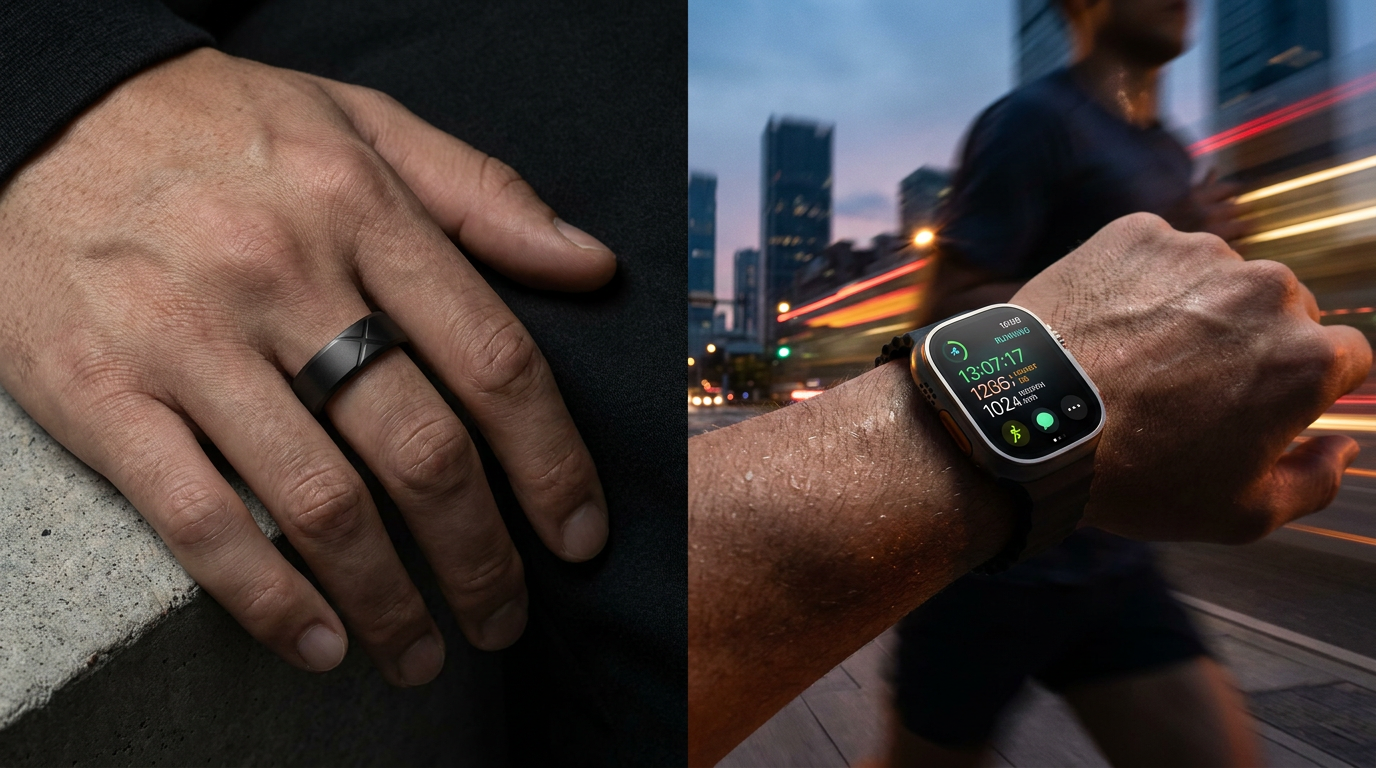
The wearable technology market has definitively split into two distinct camps in 2026, forcing consumers to choose between the wrist and the finger. For years, the smartwatch was the undisputed king of health tracking, acting as a digital extension of the smartphone. Now, smart rings have evolved from niche curiosities into credible, mainstream competitors.[1][6]
The decision between the two form factors represents a core philosophical difference in how people want to interact with their health data. Smartwatches are active digital companions, demanding attention with screens, vibrations, and real-time alerts. Smart rings, conversely, are designed for passive data collection, quietly monitoring biology without adding to daily screen time or notification fatigue.[1][4]
The case for the smart ring centers entirely on unmatched comfort and digital minimalism. Weighing as little as three grams, devices like the Oura Ring and Samsung Galaxy Ring disappear onto the body. They do not vibrate with text messages, they do not light up in a dark movie theater, and they do not require the user to navigate a tiny touchscreen.[3][4]
Furthermore, the battery life of a smart ring fundamentally changes the user experience. While most flagship smartwatches require daily charging, premium smart rings routinely last between four and seven days on a single charge. This multi-day endurance eliminates the daily anxiety of finding a charger and ensures the device is actually on the body when it matters most.[5][7]

However, the case against smart rings is equally stark when it comes to active lifestyles. Smart rings lack screens, meaning they cannot provide real-time feedback during a run or a cycling session. They also lack built-in GPS, forcing users to carry their smartphones if they want to map a route or track their exact pace.[1][6]
The clinical evidence strongly supports smart rings in one specific domain: sleep and recovery. A 2024 study from Brigham and Women's Hospital, alongside 2025 meta-analyses, demonstrated that rings consistently outperform wrist wearables in four-stage sleep classification. The Oura Ring, for example, edged out the Apple Watch by roughly five percentage points in accurately detecting light, deep, and REM sleep stages.[2]
This advantage stems from both biology and behavior. The finger offers more consistent blood flow for optical sensors than the wrist, particularly when the body is at rest. More importantly, users are far more likely to wear a lightweight ring to bed than a bulky, glowing smartwatch, leading to vastly superior long-term data adherence.[2][5]
The finger offers more consistent blood flow for optical sensors than the wrist, particularly when the body is at rest.
Conversely, the case for the smartwatch is built on comprehensive utility and real-time coaching. Devices like the Apple Watch Series 10 and Garmin Venu offer a sprawling ecosystem of applications, contactless payments, and cellular connectivity. They allow users to leave their phones at home entirely while still streaming music and receiving emergency calls.[6][7]
The primary argument against smartwatches remains their physical bulk and the relentless demand for battery power. The 18-to-36-hour battery life of most mainstream smartwatches creates a frustrating charging cadence. If a user wears the watch to bed for sleep tracking, they must find time to charge it during the day, often leading to gaps in their health data or a dead battery right before a workout.[3][4]

Yet, the clinical evidence heavily favors smartwatches during high-intensity exercise. Wrist-based sensors are significantly better equipped to handle the erratic motion of running or weightlifting. Smart rings often suffer from movement artifacts during workouts, particularly when the user is gripping a barbell or bicycle handlebars, which temporarily restricts blood flow to the finger and disrupts heart rate readings.[1][6]
Cost also plays a pivotal role in this trade-off analysis. Smartwatches typically represent a single upfront purchase, ranging from $250 to $800, with no hidden fees for data access. Smart rings often appear cheaper at retail, but companies like Oura lock their most valuable insights behind a monthly subscription fee, which can add hundreds of dollars to the total cost of ownership over a few years.[1][7]
Fortunately for consumers, the market is beginning to correct this subscription fatigue. Newer entrants like the Samsung Galaxy Ring and RingConn have adopted subscription-free models, offering full access to sleep and recovery data without a recurring monthly charge. This shift is making rings a more viable long-term investment for budget-conscious buyers.[1][4]
Ultimately, the wearable landscape in 2026 has given rise to a new demographic: the dual-wearer. Many serious athletes and health optimizers have concluded that no single device can do it all. They wear a Garmin or Apple Watch during the day for structured training and notifications, and switch to an Oura or Galaxy Ring at night for unobtrusive recovery tracking.[1][6]

A smart ring fits well when sleep tracking, resting heart rate, and overnight recovery are the absolute highest priorities. It is the ideal choice for users who want continuous health data but suffer from notification fatigue, prefer traditional mechanical watches, or simply hate the feeling of a screen strapped to their wrist.[3][4]
A smart ring does not fit when the user is a dedicated runner, cyclist, or athlete who relies on real-time heart rate zones, pace guidance, and GPS mapping. It is also a poor choice for anyone who wants to leave their smartphone behind while staying connected to messages and calls.[1][6]
How we got here
2015
The original Apple Watch launches, establishing the wrist as the dominant location for consumer health tracking.
2018
Oura releases its Gen 2 ring, proving that miniaturized sensors can accurately track sleep from the finger.
2022
Smartwatches begin incorporating advanced clinical features like ECGs and temperature sensing.
2024
Samsung launches the Galaxy Ring, signaling major tech industry investment in the smart ring form factor.
2026
Clinical studies confirm smart rings match or exceed wrist wearables in overnight sleep-stage accuracy.
Viewpoints in depth
Passive Tracking Advocates
Argue that health data should be collected invisibly without adding to daily screen time.
This camp believes that the ultimate goal of wearable technology is to fade into the background. They argue that smartwatches introduce unnecessary stress through constant notifications, battery anxiety, and the physical discomfort of wearing a screen to bed. By prioritizing digital minimalism, they point to the high long-term adherence rates of smart rings as proof that passive data collection is the most sustainable way to monitor human health.
Active Training Enthusiasts
Maintain that health tracking is only useful if it can guide behavior in real time.
For this group, a wearable must be an active coach, not just a passive observer. They argue that reviewing sleep data the next morning is less valuable than receiving real-time pace guidance, heart rate zone alerts, and GPS mapping during a grueling workout. They view the smartwatch's screen and connectivity as essential tools for athletic progression, dismissing smart rings as insufficient for anyone serious about structured physical training.
Clinical Researchers
Focus on data validity and the specific physiological advantages of different sensor placements.
Researchers emphasize that neither device is universally superior; rather, accuracy is entirely context-dependent. They note that the finger provides a stronger, more stable optical signal for resting heart rate and sleep staging due to its vascular structure. However, they caution that wrist-worn devices remain the clinical standard for ambulatory daytime monitoring, as wrist sensors are far less susceptible to the grip-related movement artifacts that plague smart rings during exercise.
What we don't know
- Whether upcoming smartwatch models will significantly reduce their physical footprint to compete with ring comfort.
- How quickly non-invasive blood glucose monitoring will be successfully integrated into either form factor.
- If the industry will standardize subscription models or move entirely toward upfront pricing.
Key terms
- Polysomnography (PSG)
- A comprehensive, medical-grade sleep study used as the clinical gold standard to test the accuracy of consumer wearables.
- Heart Rate Variability (HRV)
- The microscopic variation in time between heartbeats, used by wearables to measure physical stress and nervous system recovery.
- Four-Stage Sleep Classification
- The ability of a device to accurately categorize a user's night into awake, light, deep, and REM sleep cycles.
- Movement Artifacts
- Errors in optical sensor readings caused by physical motion, such as gripping a barbell, which temporarily restricts blood flow.
Frequently asked
Can a smart ring replace my smartwatch for running?
No. Smart rings lack built-in GPS and screens, making them poor substitutes for pacing, route mapping, and real-time workout feedback.
Which device is more accurate for heart rate?
Smart rings are highly accurate for resting heart rate due to stable finger blood flow, but smartwatches perform significantly better during active exercise where grip and movement disrupt ring sensors.
Do all smart rings require a monthly subscription?
No. While some premium brands charge a monthly fee for full data access, alternatives like the Samsung Galaxy Ring and RingConn offer comprehensive tracking with no ongoing subscription costs.
Sources
Source coverage
7 outlets
3 viewpoints surfaced







[1]Smart Ring HQPassive Tracking Advocates
Smart Ring vs Smartwatch: The Honest 2026 Comparison
Read on Smart Ring HQ →[2]Centralive HealthClinical Researchers
Ring vs. Watch for Sleep Monitoring: A Practical Comparison
Read on Centralive Health →[3]CNETPassive Tracking Advocates
I Swapped My Apple Watch for the Galaxy Ring. Here's What Happened
Read on CNET →[4]WareableClinical Researchers
Galaxy Ring vs Galaxy Watch: What's the difference?
Read on Wareable →[5]Tom's GuideClinical Researchers
Oura Ring vs Apple Watch: I wore both to bed for over a year
Read on Tom's Guide →[6]Global SourcesActive Training Enthusiasts
Smart Ring vs Smartwatch: Which Wearable is Right for You?
Read on Global Sources →[7]Garage Gym ReviewsActive Training Enthusiasts
Oura Ring vs Apple Watch Comparison
Read on Garage Gym Reviews →

Every angle. Every day.
Get shopping stories with full source coverage and perspective breakdowns delivered to your inbox.