
How AI Voice Translation is Breaking the Global Podcast Language Barrier
Advanced AI tools are now allowing podcasters to seamlessly translate their voices into dozens of languages while preserving their original emotional delivery.
By Factlen Editorial Team
- Global Creators & Networks
- Focus on the unprecedented ability to scale audiences across borders without prohibitive localization costs.
- Audio Tech Innovators
- Push the boundaries of expressive, emotionally resonant synthetic speech and real-time processing.
- Localization Professionals
- Advocate for a hybrid approach that pairs AI efficiency with human emotional intelligence.
- International Listeners
- Celebrate the democratization of knowledge and the dismantling of linguistic gatekeeping.
What's not represented
- · Deaf and hard-of-hearing audiences relying on translated transcripts
- · Copyright lawyers navigating voice IP
Why this matters
Language has always been the ultimate bottleneck for audio creators and listeners. By seamlessly translating voices while preserving human emotion, AI is democratizing access to global knowledge and entertainment, allowing anyone to learn from or connect with creators worldwide.
Key points
- AI voice translation technology now allows podcasters to dub their episodes into multiple languages while retaining their exact vocal tone and emotional delivery.
- Platforms like Spotify have integrated seamless language-switching hubs, treating translated audio tracks much like subtitle options on streaming video services.
- Visual AI advancements enable video podcasts (vodcasts) to automatically lip-sync the host's mouth movements to match the newly generated foreign language audio.
- The global podcast market is projected to reach $41.5 billion in 2026, with massive growth driven by non-English speaking regions like India and Latin America.
For over two decades, the intimacy of podcasting has been fundamentally constrained by a single, immovable barrier: language. A groundbreaking interview recorded in English, no matter how universally relevant, remained largely inaccessible to a listener in Tokyo, Mumbai, or São Paulo. These audiences were historically trapped behind the friction of reading translated transcripts or enduring jarring, emotionless voiceovers that stripped away the host's personality. In 2026, that barrier is rapidly dissolving, fundamentally altering how audio content is distributed and consumed on a global scale.[6]
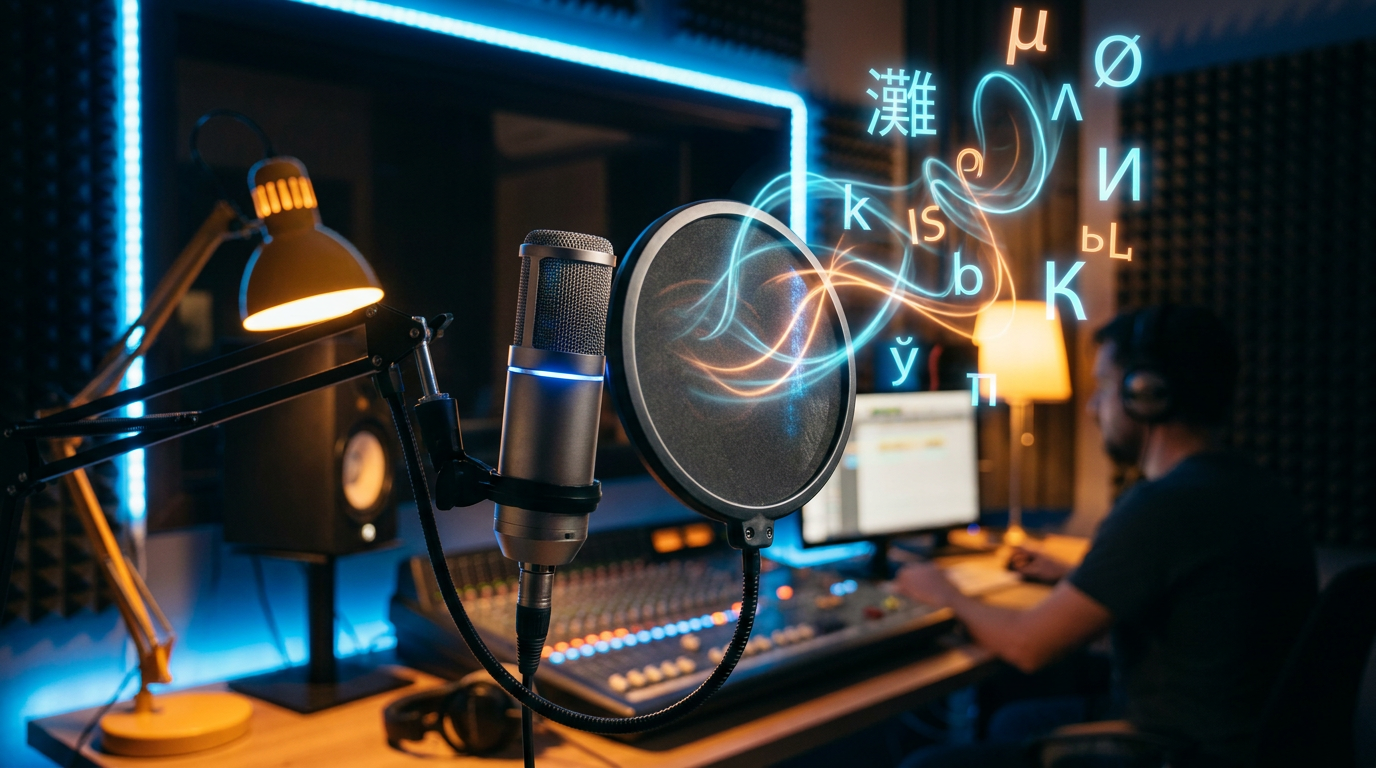
The primary catalyst for this audio revolution is a new generation of AI-powered voice translation technology that accomplishes far more than simply converting vocabulary from one language to another. Modern systems actively preserve the original speaker's unique tone, pacing, breath patterns, and emotional resonance. When a host leans into the microphone to deliver a punchline or pauses to reflect on a serious topic, the AI captures and replicates that exact human nuance, ensuring that the intimate connection defining the podcasting medium is never lost in translation.[3][4]
This technological shift effectively transforms the podcasting medium from a series of siloed, regional broadcasts into a truly borderless global conversation. Independent creators, who previously lacked the budget for international localization, and massive media networks alike are now deploying these tools to instantly localize their entire back catalogs. This allows hosts to speak fluently and authentically in dozens of languages they have never actually studied or learned, opening up entirely new demographics and revenue streams without requiring a single additional hour inside a recording booth.[3][6]
To fully grasp the magnitude of this shift, it is essential to look under the hood at the underlying mechanism powering these translations. The multi-step process begins with highly advanced speech-to-text transcription algorithms, which not only isolate the spoken words but simultaneously map the complex acoustic signature of the host's voice. This mapping forms the critical foundation of AI Voice Cloning—a sophisticated technology that analyzes a person's unique vocal tract characteristics, pitch variations, and speech cadence to generate synthetic audio that sounds virtually indistinguishable from the original human speaker.[3]

Once the original audio is accurately transcribed and mapped, specialized large language models take over to translate the text into the target language. However, engineers quickly realized that direct, literal translation often strips away the conversational nuance and humor that make podcasts engaging. To combat this, the latest AI systems are specifically trained on cultural context, allowing them to intelligently adapt regional idioms, slang, and cultural references so that the resulting translated script feels entirely natural and culturally relevant to a native speaker listening halfway across the world.[1]
The final and most impressive step in this pipeline is expressive synthesis. During this phase, the AI maps the newly translated, culturally adapted text back onto the cloned voice profile, meticulously matching the original emotional delivery of the recording. If a host laughs spontaneously, drops their volume to a dramatic whisper, or raises their voice in sudden excitement during the original English recording, the generated Spanish, Japanese, or Hindi output perfectly mirrors that exact inflection, creating a seamless and emotionally resonant listening experience.[4][5]
The final and most impressive step in this pipeline is expressive synthesis.
Spotify was one of the first major platforms to pioneer this integration at scale, launching its highly publicized Voice Translation pilot by testing the waters with top-tier, high-volume creators like Dax Shepard and Lex Fridman. By 2026, the streaming giant has massively expanded these capabilities beyond a mere pilot program, offering global listeners a dedicated, integrated hub within the app. Users can now seamlessly toggle between languages on their favorite shows with a single tap, much like changing the dubbed audio track or subtitle language on a streaming movie platform.[4][5]
Crucially, this localization technology is no longer limited strictly to audio-only formats. As video podcasts—commonly referred to within the industry as vodcasts—continue to dominate consumption on platforms like YouTube and Spotify, visual artificial intelligence has rapidly caught up to audio synthesis. Innovative platforms such as HeyGen have introduced incredibly advanced avatar and dynamic lip-sync engines that actively alter the original video feed, manipulating the host's facial movements in real-time to perfectly match the newly generated, translated audio track.[3]
In practice, this means a viewer watching a popular vodcast in Paris or New Delhi sees the original host's mouth moving in perfect synchronization with the newly generated French or Hindi audio. This visual alignment completely eliminates the jarring cognitive dissonance and uncanny valley effect traditionally associated with poorly dubbed foreign media. By aligning the visual cues with the auditory delivery, the localized content feels entirely native and bespoke to the viewer's specific region, dramatically increasing viewer retention and overall engagement metrics.[3]
The broader economic implications of this technological leap are nothing short of staggering for the global media landscape. Industry analysts project that the global podcasting market will reach a massive valuation of $41.5 billion in 2026, and is on track to exceed $185 billion over the next decade. Notably, the most explosive and sustained growth within this sector is no longer occurring in saturated North American markets, but rather in rapidly developing, non-English-speaking regions where mobile connectivity and digital audio consumption are currently skyrocketing.[2]

India serves as a prime example of this shift, now boasting over 900 million broadband subscribers who are driving a massive, unprecedented appetite for high-quality vernacular audio content. Similarly, Latin America and Southeast Asia are experiencing record-breaking surges in monthly active podcast listeners. AI translation technology allows established Western networks and independent creators to instantly tap into these highly lucrative emerging markets, completely bypassing the historically prohibitive costs associated with hiring local voice actors, booking international studio time, and managing complex global distribution logistics.[2]
Despite the rapid industry-wide adoption, the technology still faces several complex linguistic and technical hurdles. One of the most significant ongoing challenges is accurately processing code-switching—the incredibly common linguistic practice where bilingual speakers seamlessly alternate between two different languages or dialects within a single sentence. Training artificial intelligence models to instantly recognize, contextualize, and accurately translate these fluid, highly dynamic conversational shifts in real-time remains a remarkably complex engineering problem that developers are still actively working to solve.[1]

Furthermore, the meteoric rise of synthetic voices has predictably sparked intense debate and anxiety within the traditional localization industry. Veteran voice actors and established dubbing studios have expressed highly valid concerns regarding potential job displacement and the devaluation of human artistry. In response to these concerns, forward-thinking companies like Deepdub are pioneering a collaborative, hybrid approach. They utilize AI for the heavy lifting of initial translation and voice synthesis, while actively employing human audio directors to meticulously fine-tune the emotional delivery and ensure absolute cultural accuracy.[1]
Ultimately, the AI podcast translation boom of 2026 is fundamentally a story of global democratization and the dismantling of historical gatekeeping. It uniquely empowers independent creators to build massive, highly engaged global communities that were previously reserved only for multinational media conglomerates. Simultaneously, it grants listeners worldwide unprecedented access to a vast wealth of educational, scientific, and entertaining content. It definitively proves that the world's most powerful and insightful voices are no longer confined by the arbitrary borders of their native tongue.[6]
How we got here
Early 2023
Basic AI text-to-speech tools gain traction, but lack the emotional nuance required for long-form audio.
Late 2023
Spotify launches its Voice Translation pilot with select creators, utilizing OpenAI's advanced voice generation.
2024
Visual AI platforms introduce seamless lip-syncing for video podcasts, bridging the gap between audio and visual translation.
2025
Major podcast networks begin adopting hybrid AI-human localization pipelines to scale their catalogs globally.
Mid 2026
AI voice translation becomes a standard feature for top-tier creators, driving massive listener growth in non-English markets.
Viewpoints in depth
Global Creators & Networks
Focus on the unprecedented ability to scale audiences across borders without prohibitive localization costs.
For independent podcasters and major media networks, AI translation represents a paradigm shift in distribution. Previously, reaching a non-English speaking audience required hiring translation teams, voice actors, and audio engineers—a cost barrier that kept most shows strictly regional. By leveraging tools from ElevenLabs and Spotify, creators can now instantly unlock massive listener bases in Latin America, Europe, and Asia, transforming niche domestic podcasts into global intellectual properties overnight.
Localization Professionals
Advocate for a hybrid approach that pairs AI efficiency with human emotional intelligence.
Traditional dubbing studios and voice actors view the rapid rise of AI with a mix of caution and adaptation. While fully automated systems excel at literal translation, they often miss deep cultural nuances, localized humor, or the subtle emotional weight of a dramatic pause. Industry leaders argue for a 'human-in-the-loop' model, where AI handles the heavy lifting of transcription and initial synthesis, but human directors and localization experts refine the final output to ensure the content resonates authentically with the target culture.
International Listeners
Celebrate the democratization of knowledge and the dismantling of linguistic gatekeeping.
For audiences in emerging markets, the language barrier has historically restricted access to top-tier educational, scientific, and cultural audio content. The ability to listen to a complex Stanford neuroscience lecture or a deeply reported investigative series in native Hindi, Japanese, or Portuguese is a massive leap in accessibility. Listeners report that hearing the original host's cloned voice—rather than a generic overdub—creates a much more intimate and engaging parasocial connection, which is the hallmark of the podcasting medium.
What we don't know
- How international copyright law will adapt to protect the intellectual property of a creator's cloned voice across different global jurisdictions.
- Whether fully automated AI translation will ever be able to perfectly navigate the cultural nuances of highly localized comedy and deeply contextual slang.
Key terms
- AI Voice Cloning
- Technology that analyzes a person's vocal characteristics to generate synthetic speech that sounds identical to the original speaker.
- Vodcast
- A video podcast that combines traditional audio podcasting with video recording of the hosts and guests.
- Code-switching
- The practice of alternating between two or more languages or varieties of language seamlessly within a single conversation.
- Expressive Synthesis
- The ability of an AI voice model to replicate human emotions, such as laughter, whispering, or excitement, rather than just reading text flatly.
Frequently asked
Does the AI translation sound like a robot?
No. Modern AI voice cloning captures the original speaker's tone, pacing, and emotional inflections, making the translated audio sound remarkably natural and authentic.
Can AI translate video podcasts as well?
Yes. Advanced platforms now offer visual AI that adjusts the host's lip movements in the video to perfectly sync with the newly translated audio, eliminating awkward dubbing.
Which languages are currently supported?
Leading AI dubbing engines support over 175 languages, with major platforms like Spotify initially focusing on high-demand languages like Spanish, French, German, and Hindi.
Will this replace human translators?
While AI automates the bulk of the work, the industry is moving toward a hybrid model where human experts are still needed to refine cultural nuances, humor, and complex emotional delivery.
Sources
Source coverage
6 outlets
4 viewpoints surfaced



[1]Streaming MediaLocalization Professionals
Voice AI Is Becoming the Streaming Industry's Secret Weapon
Read on Streaming Media →[2]Persistence Market ResearchInternational Listeners
Podcasting Market Size and Trend Analysis 2026
Read on Persistence Market Research →[3]9cv9Global Creators & Networks
Auto-dub and translate podcasts using AI agents
Read on 9cv9 →[4]SpeechifyGlobal Creators & Networks
Embracing the Future of Podcasting with Spotify's AI Technology
Read on Speechify →[5]Janus WorldwideAudio Tech Innovators
Spotify Is Testing AI-Powered Podcast Language Translation
Read on Janus Worldwide →[6]Factlen Editorial TeamInternational Listeners
Synthesis by Factlen editorial team
Read on Factlen Editorial Team →

More in entertainment
See all 5 stories →Childhood Literacy
Dolly Parton's Imagination Library Surpasses 314 Million Books as Global Study Proves Literacy Impact
7 sources

Toy Story 5
Pixar's 'Toy Story 5' Hits Theaters, Tackling the Screen-Time Dilemma as Box Office Projections Soar
8 sources

Box Office
'Toy Story 5' Hits Theaters With Record Box Office Projections and a Timely 'Toy vs. Tech' Storyline
7 sources

Every angle. Every day.
Get entertainment stories with full source coverage and perspective breakdowns delivered to your inbox.