
How Nuclear Thermal Propulsion Could Cut the Journey to Mars in Half
NASA and DARPA are preparing to test the first nuclear thermal rocket in orbit by 2027. By using fission to heat liquid hydrogen, the DRACO mission aims to bypass the limits of chemical rockets and unlock deep-space travel.
By Factlen Editorial Team
- Space Exploration Advocates
- Focused on the necessity of nuclear propulsion to make human missions to Mars viable and safe.
- Defense & Strategic Planners
- Focused on the tactical advantages of rapid maneuverability in the space between Earth and the Moon.
- Safety & Regulatory Voices
- Concerned with the risks of launching nuclear material and the potential for radioactive space debris.
What's not represented
- · Commercial satellite operators who might utilize nuclear tugs in the future.
- · International space agencies (like ESA or JAXA) reacting to U.S. nuclear advancements.
Why this matters
For a century, humanity has been trapped by the limits of chemical rockets, making trips to Mars slow, dangerous, and heavily restricted by planetary alignments. Nuclear thermal propulsion offers a leap in efficiency that could drastically reduce astronauts' exposure to deep-space radiation and open the solar system to heavier payloads.
Key points
- NASA and DARPA plan to test the DRACO nuclear thermal rocket in orbit by 2027.
- The engine uses a fission reactor to heat liquid hydrogen, doubling the efficiency of chemical rockets.
- Nuclear propulsion could cut the travel time to Mars by up to 50%, reducing astronaut radiation exposure.
- For safety, the reactor will launch 'cold' and only activate once in a high, stable orbit.
For nearly a century, humanity’s reach into the cosmos has been strictly governed by a brutal law of physics known as the rocket equation. Traditional chemical rockets rely on combustion, requiring them to carry massive amounts of heavy fuel and oxidizer just to lift their own weight off the launch pad. This inherent inefficiency means that deep-space missions are slow, payload-constrained, and heavily dependent on rare planetary alignments. Reaching Mars with current technology takes seven to nine agonizing months, exposing astronauts to severe physical degradation and lethal cosmic radiation. To break out of Earth’s backyard and establish a sustainable presence in the solar system, aerospace engineers have long recognized that a fundamental paradigm shift is required.[1][5]
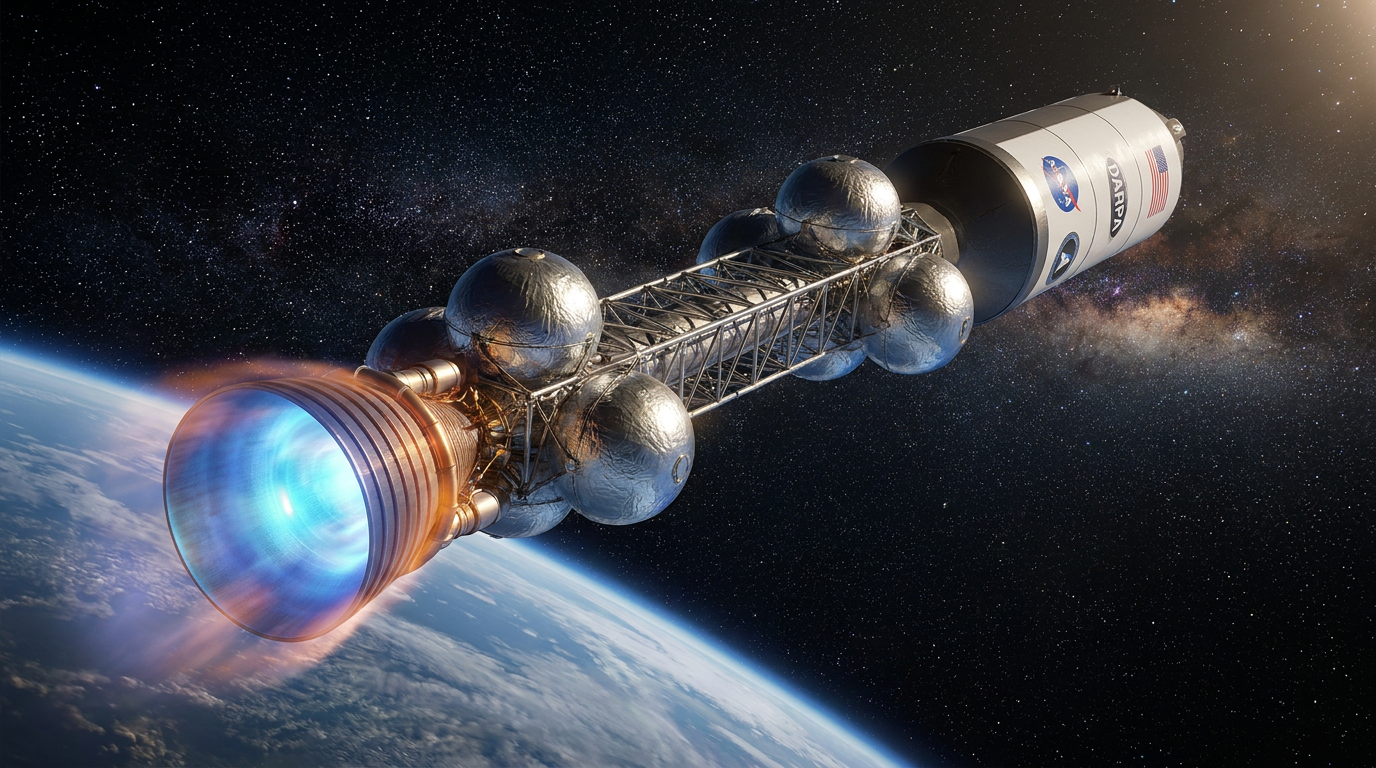
That shift is now actively taking shape under a joint initiative by NASA and the Defense Advanced Research Projects Agency (DARPA). The two agencies are collaborating on the Demonstration Rocket for Agile Cislunar Operations, or DRACO, a program designed to bypass the limits of chemical combustion entirely. Instead of burning fuel, DRACO will utilize Nuclear Thermal Propulsion (NTP)—a concept first explored in the 1960s but now revitalized with modern materials and safety protocols. By harnessing the immense energy of nuclear fission, the program aims to drastically accelerate travel through deep space.[2][4][7]
The financial and industrial weight behind the project is substantial. In mid-2023, NASA and DARPA awarded a $499 million contract to aerospace giant Lockheed Martin to design and build the DRACO spacecraft. They are partnered with BWX Technologies (BWXT), a specialized nuclear components manufacturer tasked with developing the reactor and fabricating the specialized fuel. Together, this coalition is racing toward a highly ambitious deadline: launching the first in-orbit demonstration of a nuclear thermal rocket by 2027.[4][6]
To understand why NTP represents such a massive leap, it helps to look at the mechanics of conventional thrust. In a standard chemical rocket, a fuel like liquid hydrogen is mixed with an oxidizer like liquid oxygen and ignited. The resulting explosion creates a high-pressure exhaust gas—primarily water vapor—that is forced out of a nozzle to push the rocket forward. While this provides the immense raw power needed to escape Earth's gravity, the heavy exhaust molecules limit how efficiently the propellant can be used.[3][5]

Nuclear thermal propulsion strips the combustion process out of the equation entirely. Inside an NTP engine, there is no oxidizer and no ignition. Instead, the system relies on a compact nuclear reactor built directly into the rocket. The reactor is fueled by High-Assay Low-Enriched Uranium (HALEU), a material that is safer and less proliferation-prone than the highly enriched uranium used in older military designs. As the uranium atoms split during fission, they release extraordinary amounts of thermal energy, bringing the reactor core to temperatures approaching 5,000 degrees Fahrenheit.[2][3][4]
The actual thrust is generated by pumping a single propellant—super-chilled liquid hydrogen—directly through the roaring heat of the nuclear core. As the liquid hydrogen hits the reactor, it instantly vaporizes and expands violently. This superheated gas is then channeled through a converging-diverging nozzle, accelerating out the back of the spacecraft to generate forward momentum. Because the system only requires one propellant, the spacecraft can carry significantly more of it, or dedicate that saved weight to heavier scientific payloads and crew habitats.[3][5]
The actual thrust is generated by pumping a single propellant—super-chilled liquid hydrogen—directly through the roaring heat of the nuclear core.
The true magic of this mechanism lies in the physics of the exhaust. Because hydrogen is the lightest element in the universe, it can be accelerated to much higher velocities than the heavier water vapor produced by chemical combustion. In rocketry, efficiency is measured by "specific impulse" (Isp), which is roughly equivalent to a spacecraft's miles-per-gallon rating. The most advanced chemical rockets max out at a specific impulse of about 450 seconds. Nuclear thermal rockets, by contrast, are projected to achieve a specific impulse of roughly 900 seconds—literally doubling the fuel efficiency of the vehicle.[1][3][5]
For NASA, this doubling of efficiency is the golden key to Mars. Currently, a crewed mission to the Red Planet requires waiting for a specific orbital alignment that only occurs every 26 months, followed by a sluggish multi-month transit. With the high thrust and high efficiency of an NTP engine, spacecraft could execute much more aggressive burn profiles. Engineers estimate that nuclear propulsion could cut the transit time to Mars by 25 to 50 percent, potentially reducing the journey to just a few months.[1][5][7]

Speeding up the trip is not merely a matter of convenience; it is a critical requirement for human survival. Deep space is saturated with high-energy cosmic rays and solar radiation that easily penetrate standard spacecraft hulls. Every additional week spent coasting between planets significantly increases an astronaut's lifetime cancer risk and subjects their body to the muscle-wasting effects of microgravity. By cutting the transit time in half, nuclear propulsion directly solves the most pressing health crises associated with interplanetary exploration.[3][6]
Beyond Mars, the technology offers unprecedented agility closer to home. DARPA’s primary interest in the DRACO program lies in "cislunar" space—the vast orbital theater between the Earth and the Moon. Current satellites rely on highly efficient but incredibly weak electric ion thrusters, which take days or weeks to alter an orbit. A nuclear thermal rocket provides the best of both worlds: the high immediate thrust of a chemical rocket combined with the long-term endurance of electric propulsion, allowing heavy spacecraft to maneuver rapidly across the lunar domain.[2][6][7]
Despite the immense promise, launching nuclear material naturally invites rigorous scrutiny regarding public safety and environmental protection. To mitigate the risks of a launchpad explosion or atmospheric dispersal, the DRACO mission relies on a strict "cold launch" protocol. The nuclear reactor will not be activated on Earth. Instead, the spacecraft will be packed atop a conventional chemical rocket—like a SpaceX Falcon 9 or ULA Vulcan Centaur—and launched into space completely dormant.[3][6]

The reactor contains no highly radioactive fission products at launch, meaning an accident in the atmosphere would not result in a nuclear disaster. The system is engineered so that the fission reaction can only be initiated once the spacecraft has achieved a high, stable orbit—between 700 and 2,000 kilometers above the Earth. At this altitude, even if the engine were to suffer a catastrophic failure after activation, it would take more than 300 years for the spacecraft's orbit to decay. By the time any debris re-entered the atmosphere, the radioactive isotopes would have safely decayed to harmless background levels.[2][3]
While the nuclear physics are well understood, the engineering challenges remain formidable. The most pressing hurdle is what aerospace engineers call "cryogenic fluid management." Liquid hydrogen must be kept at a staggering minus 423 degrees Fahrenheit to prevent it from boiling into a gas. Storing this highly volatile propellant in the thermal extremes of space for months at a time—without it boiling off and venting away into the vacuum—requires zero-boil-off technologies, active cooling loops, and advanced insulation that NASA is still actively developing and testing.[2][7]

If the 2027 DRACO demonstration successfully proves that a reactor can safely heat hydrogen in microgravity, it will trigger a renaissance in spacecraft design. The architecture could eventually support in-orbit refueling, where nuclear tugs remain in space permanently, shuffling cargo between Earth, the Moon, and orbital depots. By finally breaking the tyranny of the chemical rocket equation, nuclear thermal propulsion stands ready to transform the solar system from a distant frontier into a navigable, interconnected domain.[4][6][8]
How we got here
1960s
NASA tests early nuclear thermal rockets on the ground under the NERVA program before the project is ultimately canceled.
April 2021
DARPA initiates the DRACO program, awarding initial design contracts to explore modern nuclear propulsion concepts.
January 2023
NASA officially joins forces with DARPA, combining resources to accelerate the development of the nuclear rocket.
July 2023
Lockheed Martin and BWX Technologies win a joint $499 million contract to build the spacecraft and its nuclear reactor.
2027
The target date for the first in-orbit demonstration of the DRACO engine.
Viewpoints in depth
Space Exploration Advocates
Focused on the necessity of nuclear propulsion to make human missions to Mars viable and safe.
For NASA and planetary scientists, the primary appeal of nuclear thermal propulsion is human health and mission feasibility. They argue that the current 7-to-9-month transit time using chemical rockets exposes astronauts to unacceptable levels of cosmic radiation and microgravity-induced bone loss. By cutting the journey in half, NTP mitigates these biological risks while allowing spacecraft to carry heavier habitats and scientific payloads. Advocates view the technology not just as an upgrade, but as a strict prerequisite for a sustainable human presence beyond the Moon.
Defense and Strategic Planners
Focused on the tactical advantages of rapid maneuverability in the space between Earth and the Moon.
DARPA and the U.S. Space Force view the DRACO program through the lens of cislunar agility. In the modern strategic landscape, the ability to move heavy assets quickly across orbital planes is a critical national security advantage. Current satellites rely on electric ion thrusters, which are highly efficient but produce so little thrust that orbital changes take weeks. Defense planners argue that nuclear thermal rockets provide the necessary combination of high thrust and long-term fuel efficiency to outmaneuver adversaries and secure the strategic high ground of deep space.
Safety and Regulatory Voices
Concerned with the risks of launching nuclear material and the potential for radioactive space debris.
While the DRACO mission uses High-Assay Low-Enriched Uranium (HALEU) rather than weapons-grade material, non-proliferation advocates warn that expanding nuclear infrastructure in space sets a complex regulatory precedent. Environmental skeptics also point to the inherent risks of launch failures. Although the 'cold launch' protocol ensures the reactor is dormant during ascent, critics argue that a catastrophic explosion in the atmosphere could still scatter heavy metals. Furthermore, they raise concerns about the long-term accumulation of dead nuclear reactors in high Earth orbit, complicating the already severe space debris crisis.
What we don't know
- Whether engineers can successfully store liquid hydrogen in space for months without it boiling off.
- How the reactor materials will hold up to 5,000-degree temperatures in a microgravity environment over extended periods.
- The exact timeline for scaling the DRACO prototype into a full-sized crewed vehicle capable of reaching Mars.
Key terms
- Nuclear Thermal Propulsion (NTP)
- A rocket engine that uses a nuclear fission reactor to heat a liquid propellant into a gas to produce thrust, rather than relying on chemical combustion.
- Specific Impulse (Isp)
- A measure of how efficiently a rocket uses its propellant, roughly equivalent to a spacecraft's miles-per-gallon rating.
- High-Assay Low-Enriched Uranium (HALEU)
- A type of nuclear fuel that is more enriched than commercial power plant fuel but remains below weapons-grade, designed for modern space reactors.
- Cryogenic Fluid Management
- The specialized technology required to store super-cold liquids, like liquid hydrogen, in the extreme environment of space without them boiling into gas.
- Cislunar Space
- The vast area of outer space between the Earth and the Moon, increasingly viewed as a strategic domain for satellites and exploration.
Frequently asked
Will the rocket launch from Earth using nuclear power?
No. The spacecraft will launch using a conventional chemical rocket and will only activate its nuclear reactor once it is safely in orbit.
What happens if the rocket explodes on the launch pad?
Because the reactor launches 'cold' and has not yet undergone fission, it contains no highly radioactive byproducts, minimizing the risk of a nuclear disaster during an ascent failure.
Why does the engine use liquid hydrogen?
Hydrogen is the lightest element in the universe. Because it is so light, it can be accelerated out of the engine nozzle much faster than heavier gases, creating highly efficient thrust.
Sources
Source coverage
8 outlets
3 viewpoints surfaced







[1]NASASpace Exploration Advocates
Nuclear Propulsion Could Help Get Humans to Mars Faster
Read on NASA →[2]DARPADefense & Strategic Planners
DARPA, NASA Collaborate on Nuclear Thermal Rocket Engine
Read on DARPA →[3]Department of EnergySafety & Regulatory Voices
6 Things You Should Know About Nuclear Thermal Propulsion
Read on Department of Energy →[4]SpacePolicyOnlineDefense & Strategic Planners
NASA and DARPA Pick Lockheed Martin and BWXT for DRACO
Read on SpacePolicyOnline →[5]Astronomy MagazineSpace Exploration Advocates
Nuclear rockets could travel to Mars in half the time
Read on Astronomy Magazine →[6]BWX TechnologiesDefense & Strategic Planners
BWXT to begin work on cislunar nuclear rocket engine and fuel
Read on BWX Technologies →[7]EarthSkySpace Exploration Advocates
NASA, DARPA: Nuclear rocket to Mars and beyond
Read on EarthSky →[8]Factlen Editorial TeamSafety & Regulatory Voices
Synthesis by Factlen editorial team
Read on Factlen Editorial Team →
Every angle. Every day.
Get transportation stories with full source coverage and perspective breakdowns delivered to your inbox.