
How AI Tutoring is Closing the Learning Gap in K-12 Public Schools
Moving past the cheating panic of 2023, public schools are successfully integrating AI as a personalized tutoring engine, driving massive test score gains when paired with human coaching.
By Factlen Editorial Team
- EdTech Researchers
- Focusing on the unprecedented learning gains and personalization capabilities of AI.
- State Policymakers
- Viewing AI as a cost-effective mechanism to deliver high-dosage tutoring statewide.
- Implementation Analysts
- Warning that software alone cannot drive educational outcomes without human structure.
- Classroom Educators
- Valuing AI for saving administrative time so they can focus on direct student intervention.
What's not represented
- · Parents concerned about increased screen time and data privacy.
- · Special education advocates evaluating AI's accessibility features for neurodivergent learners.
Why this matters
After years of pandemic-era learning loss, AI tutoring is emerging as the first highly scalable, evidence-backed intervention capable of delivering one-on-one instruction to every student. If implemented correctly, this technology could fundamentally close the achievement gap in public education while returning hours of instructional time to overburdened teachers.
Key points
- Public school districts are moving past AI bans, integrating the technology as a personalized tutoring tool to close learning gaps.
- A 2025 randomized controlled trial found AI tutoring outperformed traditional active learning by up to 1.3 standard deviations.
- States like Arizona, Iowa, and Indiana are funding massive statewide pilots to provide AI tutors to hundreds of thousands of students.
- Teachers report saving an average of 5.9 hours per week on administrative tasks, reallocating that time to direct student intervention.
- Stanford research indicates that AI tools require structured human coaching to maintain student engagement and drive actual learning.
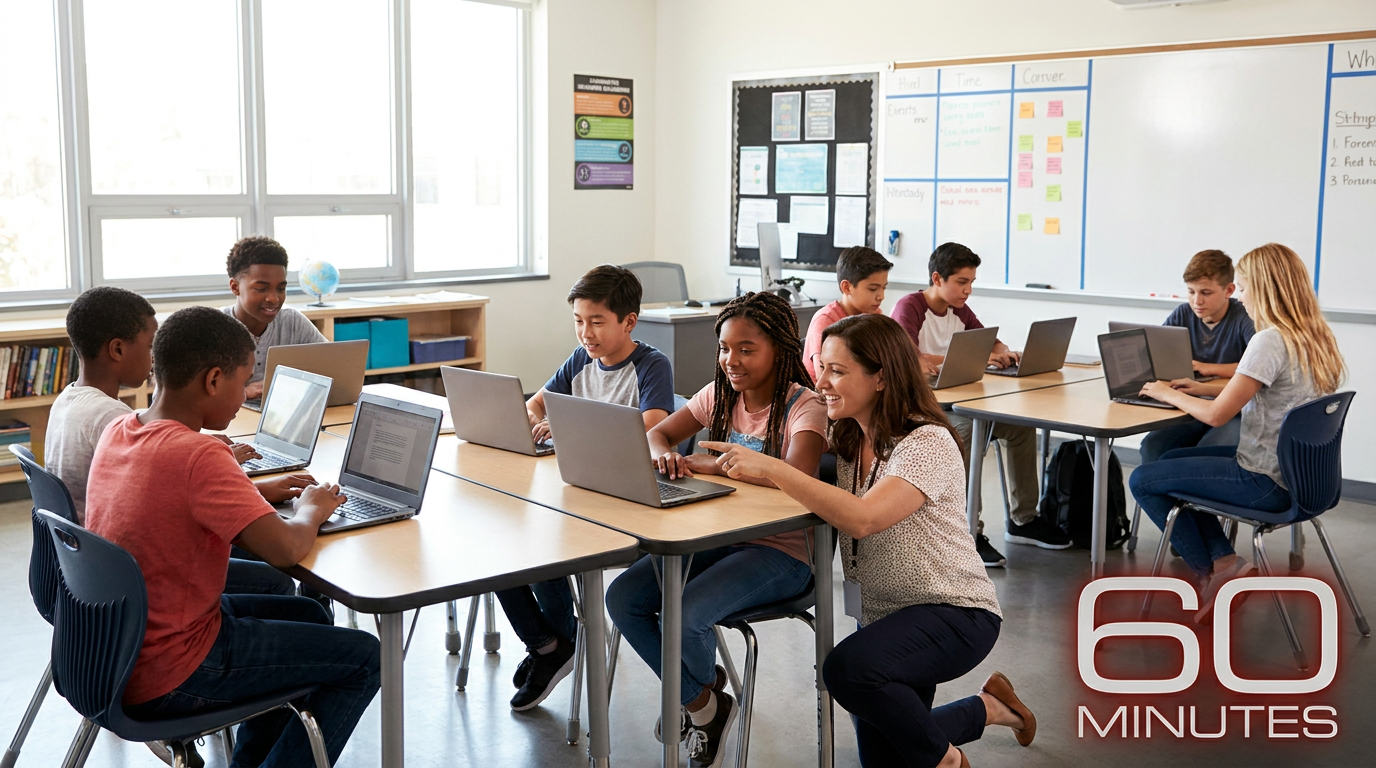
Three years ago, the arrival of generative artificial intelligence in K-12 education triggered a nationwide panic over cheating, plagiarism, and the death of the traditional essay. Today, the narrative has fundamentally flipped. Across the United States, public school districts are moving past reactionary bans and entering a phase of structured, evidence-backed integration. Artificial intelligence is no longer viewed merely as a shortcut for homework, but as a highly effective, personalized tutoring engine capable of closing persistent learning gaps. By shifting the focus from generative writing to interactive problem-solving, educators are unlocking a tool that provides the kind of individualized attention previously available only to families who could afford private tutors.[6]
The scale of this technological rollout is unprecedented for public education. Rather than leaving adoption to individual tech-savvy teachers, state governments are deploying millions of dollars to fund statewide AI tutoring pilots. In Arizona, the Department of Education has rolled out Khanmigo—an AI tool developed by Khan Academy—to 170,000 public school students, representing 16% of the state's entire student body. Iowa and Indiana have launched similar multi-million dollar initiatives aimed at providing high-dosage, personalized reading and math interventions to elementary and middle schoolers. These top-down investments signal a major policy shift, treating AI not as an experimental novelty, but as core educational infrastructure.[3]
The enthusiasm from state policymakers is anchored in a wave of compelling new empirical data. A landmark 2025 randomized controlled trial published in Scientific Reports evaluated custom AI tutors built specifically on evidence-based pedagogical principles. Unlike general-purpose chatbots that simply spit out answers, these educational systems were explicitly designed to avoid cognitive overload. They operate by revealing only one step of a problem at a time and requiring students to attempt the work themselves before receiving further help. This structured friction is the key to their success, forcing active cognitive engagement rather than passive reading.[1]

The results of that trial represent a breakthrough in educational research. The study found that AI tutoring outperformed traditional in-class active learning with an effect size between 0.73 and 1.3 standard deviations. In the context of education research, an effect size above 0.4 is generally considered highly impactful; a result exceeding 1.0 is extraordinarily rare. In practical terms, students using the AI tutor achieved more than twice the learning gains in less time compared to their peers in traditional settings, and recorded post-test scores that were 54% higher.[1]

"Discussions about AI tutoring often focus on the quality of the technology itself, but these findings suggest that implementation and student engagement may be equally important," researchers noted. The mechanism driving these massive gains is the rigorous application of Socratic prompting. Instead of dispensing immediate answers, the AI acts as a patient, untiring coach. It asks guiding questions, identifies the exact mathematical or grammatical misconception holding a student back, and tailors its feedback to that specific error. This mimics the behavior of an expert human tutor, adapting in real-time to the student's unique learning pace.[3][6]
The mechanism driving these massive gains is the rigorous application of Socratic prompting.
Beyond student outcomes, artificial intelligence is fundamentally altering the daily reality of the teaching profession. According to a 2025 RAND Corporation survey, 53% of teachers are now using AI for school-related tasks, a massive jump of more than 15 percentage points from previous years. A separate Carnegie Learning report found that 83% of K-12 educators utilize generative AI tools for lesson planning, grading, and content support. This widespread adoption is happening across demographics, with both veteran educators and new teachers leaning on the technology to manage increasingly complex classroom demands.[4][5]
This rapid integration is returning the most valuable resource to educators: time. Teachers who integrate AI tools into their weekly routines report saving an average of 5.9 hours per week. Rather than spending evenings writing differentiated lesson plans, drafting grading rubrics, or translating materials for English language learners, teachers are automating the administrative heavy lifting. Crucially, this saved time is not leading to less teaching; instead, educators are reallocating those hours toward direct student intervention, relationship-building, and facilitating complex classroom discussions that require human empathy.[6]

However, the transition from purchasing software licenses to achieving actual learning gains is not automatic. A recent study by Stanford University's SCALE Initiative highlighted a critical "implementation gap" in early AI rollouts. The research tracked elementary and middle school students across multiple after-school and daytime programs, finding that simply giving students access to an AI tutor resulted in surprisingly low organic engagement. The assumption that students would naturally gravitate toward an AI tutor the way they do toward social media algorithms proved entirely false.[2][3]
In two distinct school districts studied by Stanford, average weekly usage of the AI tool amounted to just 2.18 minutes and 5.23 minutes per student when left unstructured. Even when scheduled time was explicitly provided during the school day, only about half the students actively engaged with the platform. The data clearly indicates that software alone cannot replace the motivational and structural role of a human classroom. Without a teacher to set expectations and monitor progress, the technology sits dormant.[3]

The most successful deployments treat AI strictly as a "Human-in-the-Loop" system. When AI tutoring platforms are paired with human coaches, structured classroom routines, and guided reflection, student engagement and topic mastery increase significantly. The technology is highly effective at handling repetitive, individualized practice and diagnosing specific skill deficits. Meanwhile, the human teacher provides the emotional scaffolding, the overarching instructional strategy, and the accountability required to keep a ten-year-old focused on a challenging task.[2]
This dynamic is particularly crucial for addressing educational equity. Early data suggests that students who use AI tutors effectively are less likely to require special education services and more likely to achieve higher academic standing. But without formal training for educators—which 71% of K-12 teachers still report lacking—there is a severe risk of widening the digital divide. Well-resourced districts are investing heavily in professional development to seamlessly integrate these tools, while under-resourced schools may merely warehouse the software without the coaching necessary to make it work.[3][6]
As the 2026 school year approaches, the educational consensus is solidifying around a balanced, evidence-based approach. Artificial intelligence will not replace human teachers, nor is it a frictionless silver bullet for systemic educational challenges. Instead, it is proving to be a powerful, scalable assistant. When implemented with intention, rigorous pedagogical design, and strong human oversight, AI tutoring has the potential to provide every public school student with the personalized academic attention that was once an exclusive luxury.[6]
How we got here
Early 2023
Generative AI triggers widespread cheating concerns and temporary bans in major school districts.
Mid 2024
Early pilot programs begin testing custom-built, Socratic AI tutors in controlled classroom settings.
June 2025
Harvard researchers publish landmark RCT data showing massive learning gains from AI tutoring.
October 2025
Arizona launches a massive statewide pilot, bringing AI tutoring to 170,000 public school students.
Spring 2026
Stanford research highlights the necessity of human coaching to maintain student engagement with AI tools.
Viewpoints in depth
EdTech Researchers
Focusing on the unprecedented learning gains and personalization capabilities of AI.
Researchers emphasize that we have never had a scalable tool capable of delivering one-on-one tutoring to every student. They point to the 1.3 standard deviation effect size as proof that AI, when programmed with evidence-based pedagogical rules, can fundamentally alter the learning curve and close persistent achievement gaps faster than traditional methods.
Implementation Analysts
Warning that software alone cannot drive educational outcomes without human structure.
Analysts and researchers studying real-world classroom deployments caution against techno-solutionism. They note that without a human teacher to mandate usage, provide emotional support, and integrate the tool into a broader curriculum, students quickly lose interest. Their data shows that AI is only effective when treated as a 'Human-in-the-Loop' system.
State Policymakers
Viewing AI as a cost-effective mechanism to deliver high-dosage tutoring statewide.
Faced with stagnant test scores and teacher shortages, state education departments see AI tutoring as a rare scalable intervention. By funding statewide pilots, they hope to bypass district-level budget constraints and provide premium tutoring software to hundreds of thousands of students simultaneously, aiming for macro-level improvements in state reading and math proficiencies.
What we don't know
- The long-term impacts of AI tutoring on student critical thinking and reading stamina over a multi-year period.
- Whether under-resourced districts will receive the necessary funding for ongoing teacher training, rather than just software licenses.
- How data privacy regulations will evolve as AI systems ingest increasingly granular student performance data.
Key terms
- Intelligent Tutoring System (ITS)
- Software that provides immediate, customized instruction or feedback to learners, now powered by large language models.
- Socratic Prompting
- An AI design constraint where the system asks guiding questions rather than providing direct answers, forcing the student to think.
- Effect Size
- A statistical metric used in education research to measure the magnitude of a teaching intervention's impact.
- High-Dosage Tutoring
- Intensive, frequent tutoring (usually three or more times a week) proven to accelerate learning, which AI is now helping to scale.
Frequently asked
Does AI tutoring just give students the answers?
No. Modern educational AI is explicitly programmed using Socratic methods to provide hints and ask guiding questions, requiring the student to solve the problem themselves.
Will AI replace human teachers in the classroom?
Evidence shows the opposite. AI is most effective when used as a tool by human teachers, who provide the necessary motivation, emotional support, and structured routines.
How much does AI tutoring cost public schools?
Many states are funding statewide pilots using federal or state grants, providing the software to districts at no direct cost to students or parents.
Sources
Source coverage
6 outlets
4 viewpoints surfaced






[1]Scientific ReportsEdTech Researchers
AI tutoring outperforms in-class active learning: an RCT introducing a novel research-based design in an authentic educational setting
Read on Scientific Reports →[2]Stanford UniversityImplementation Analysts
AI meets the classroom: When do large language models harm learning?
Read on Stanford University →[3]K-12 DiveState Policymakers
Merely offering AI tutoring tools isn't enough to improve reading outcomes, study finds
Read on K-12 Dive →[4]RAND CorporationClassroom Educators
Teachers' and Students' Use of AI in 2025
Read on RAND Corporation →[5]Carnegie LearningClassroom Educators
2025-2026 Education Insights Report
Read on Carnegie Learning →[6]Factlen Editorial TeamImplementation Analysts
Synthesis by Factlen editorial team
Read on Factlen Editorial Team →
Every angle. Every day.
Get education stories with full source coverage and perspective breakdowns delivered to your inbox.