
How Small Language Models Are Moving AI From the Cloud to Your Laptop
Compact, highly optimized AI models are now running directly on consumer hardware, offering absolute data privacy and zero cloud costs.
By Factlen Editorial Team
- Open-Source Developers
- Advocates for decentralized, community-driven AI development and absolute user privacy.
- Enterprise Architects
- Corporate IT leaders focused on cost-efficiency, data sovereignty, and practical deployment.
- Hardware & Edge Innovators
- Engineers pushing AI capabilities to mobile phones and embedded devices.
What's not represented
- · Cloud Infrastructure Providers
- · AI Safety Regulators
Why this matters
By running artificial intelligence directly on your own devices, you eliminate monthly subscription fees, guarantee absolute data privacy, and gain the ability to use powerful AI tools completely offline.
Key points
- Small Language Models (SLMs) under 7 billion parameters now offer production-grade AI capabilities directly on consumer hardware.
- Quantization techniques compress model weights, allowing complex neural networks to run on laptops with just 8GB to 16GB of RAM.
- Local inference guarantees absolute data privacy, making it ideal for healthcare, legal, and enterprise deployments.
- Running models locally eliminates recurring cloud API costs, changing the financial calculus for high-volume AI applications.
- While powerful, local models are constrained by smaller context windows and lack the encyclopedic reasoning of massive cloud systems.
For years, the artificial intelligence industry operated under a single, expensive assumption: bigger is always better. The pursuit of frontier capabilities required massive data centers, thousands of specialized processors, and continuous cloud connectivity. But in 2026, a quiet revolution has inverted that paradigm. The most consequential shift in AI is no longer happening in remote server farms, but directly on the devices sitting on desks and in pockets.[8]
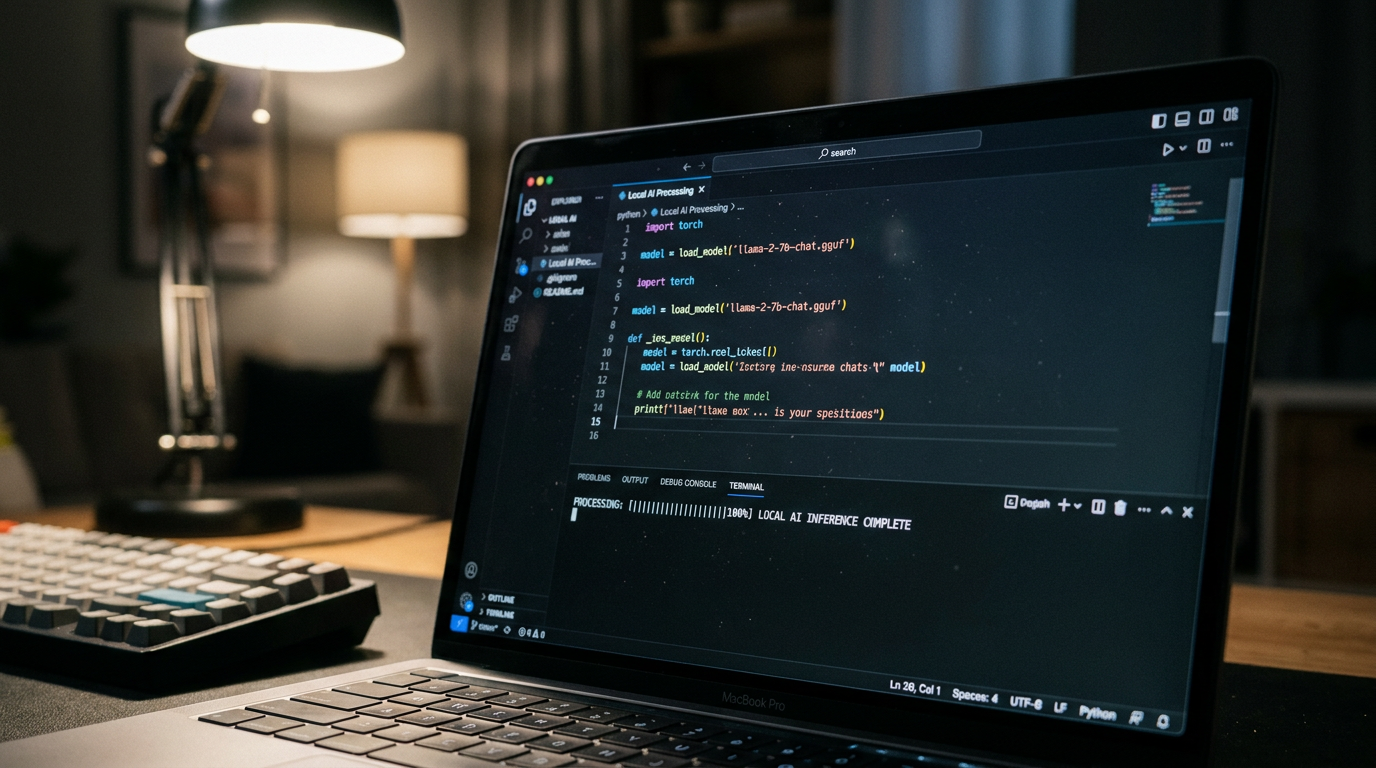
The rise of Small Language Models (SLMs) has transformed local inference from a hobbyist experiment into a production-ready enterprise strategy. These compact neural networks, typically ranging from a few million to roughly seven billion parameters, are designed to run efficiently on consumer-grade hardware without requiring an internet connection. By sacrificing the encyclopedic breadth of massive cloud models, they achieve ultra-low latency, absolute data privacy, and zero recurring API costs.[1][4]
To understand how this is possible, one must look at the mechanics of neural networks. A language model's "knowledge" is stored in parameters—the internal numeric weights and biases adjusted during the training process. When a user inputs text, the model runs these parameters through complex mathematical operations to predict the next logical word. While frontier models like GPT-4 operate with over a trillion parameters across a mixture-of-experts architecture, SLMs prove that for specific, bounded tasks, massive scale is unnecessary.[4]
The breakthrough that allowed these models to fit on local devices is a mathematical technique called quantization. In their raw state, neural network weights are typically stored as 16-bit or 32-bit floating-point numbers, which consume enormous amounts of memory. Quantization compresses these weights into smaller 8-bit or even 4-bit integers. While this compression introduces a slight loss in precision, it drastically reduces the memory footprint. A 7-billion parameter model, which would normally require over 14 gigabytes of memory, can be compressed to run comfortably on a standard laptop with just 8 gigabytes of RAM.[4][5]

Hardware manufacturers have aggressively adapted to this new reality. Apple's M-series architecture, particularly the M4 Pro with its 48 gigabytes of unified memory, has become a gold standard for local inference because the CPU and GPU share the same memory pool, eliminating data transfer bottlenecks. Concurrently, Intel's Core Ultra 300 series, built on the 2-nanometer Panther Lake process, was explicitly designed to run large AI models directly on laptops without cloud reliance.[3][6]
For desktop users and enterprise workstations, the economics of local AI have been reshaped by the secondary hardware market. The price collapse of older enterprise-grade graphics cards, such as the NVIDIA RTX 3090, has democratized access to high-memory inference. With 24 gigabytes of video RAM available for under $800 on the used market, developers can now run highly capable models locally at speeds that rival cloud APIs, avoiding the steep costs of modern server hardware.[3]
The software ecosystem has matured alongside the hardware, experiencing what industry analysts call a "Homebrew for AI" moment. Tools like Ollama and LM Studio have abstracted away the complex command-line configurations that previously gatekept local AI. Today, deploying a model requires a single terminal command or a few clicks in a visual interface, instantly spinning up a local server that exposes a REST API compatible with existing software frameworks.[5]
The software ecosystem has matured alongside the hardware, experiencing what industry analysts call a "Homebrew for AI" moment.
The models themselves have evolved rapidly, driven by open-weights releases from major technology companies. Google's Gemma 4 family, including a highly efficient 12-billion parameter variant, can execute complex agentic coding tasks entirely offline. Meta's Llama 3.2 series offers 1-billion and 3-billion parameter models specifically tuned for mobile and edge deployments, trading broad knowledge for extreme efficiency.[1][7]

Microsoft's Phi-3.5 Mini, operating at just 3.8 billion parameters, has become a foundational tool for developers building local retrieval-augmented generation (RAG) systems. Because it supports extensive context windows, it can ingest and analyze entire technical manuals or legal documents locally, ensuring that sensitive information never leaves the host machine.[1]
Alibaba's Qwen 3 architecture has pushed the boundaries even further into the mobile space. Their specialized 600-million and 1.7-billion parameter models are optimized for smartphones and embedded devices like the Raspberry Pi. These ultra-lightweight models enable real-time chatbots and low-latency applications on devices with severe power and thermal constraints.[6]
The commercial implications of this shift are profound, particularly regarding data privacy. In sectors like healthcare, finance, and legal services, regulatory compliance often prohibits sending sensitive client data to third-party cloud providers. Local SLMs solve this by guaranteeing data sovereignty; a portable ultrasound machine can now perform real-time image analysis in the field, or a legal workstation can draft contracts based on proprietary case law, with zero risk of data leakage.[8]
The financial calculus has also flipped. Cloud API pricing for large models typically ranges from pennies to dimes per thousand tokens, which scales linearly with usage. A high-volume customer support system can easily generate tens of thousands of dollars in monthly API fees. Conversely, an SLM running on a local server incurs only the fixed cost of the hardware and electricity, making the marginal cost of each query effectively zero.[1]

Despite these advantages, local AI is not without significant limitations and uncertainties. The most glaring constraint is context length. While cloud models can process hundreds of thousands of tokens simultaneously, local setups are practically constrained by video memory limits, often capping out between 8,000 and 32,000 tokens. This makes local models less suitable for analyzing massive datasets or book-length documents in a single pass.[3]
Furthermore, small models inherently lack the broad, encyclopedic knowledge and advanced reasoning capabilities of frontier cloud models. They are highly susceptible to "hallucinations" when asked about niche topics outside their immediate training data. Multi-modal tasks, such as complex visual reasoning or processing long-form video, also remain firmly in the domain of massive cloud infrastructure, as local vision-language models still lag behind their proprietary counterparts.[3][8]
The responsibility of deployment also shifts entirely to the user. Cloud providers implement extensive safety filters and guardrails to prevent the generation of malicious code or harmful content. When running an open-weights model locally, those guardrails are often removed or easily bypassed, placing the burden of safety and ethical use squarely on the individual developer or enterprise.[8]

Ultimately, the AI landscape of 2026 is defined by a hybrid approach. Organizations are increasingly using local SLMs as the default routing for routine tasks, data extraction, and privacy-sensitive operations, reserving expensive cloud APIs only for complex reasoning that exceeds local capabilities. This local-first architecture represents a maturing industry—one where the novelty of artificial intelligence has given way to practical, sustainable, and empowering engineering.[1][8]
How we got here
2017
Google researchers publish 'Attention Is All You Need,' introducing the foundational Transformer architecture.
Early 2023
Meta leaks the original LLaMA weights, inadvertently sparking the open-source local AI movement.
Late 2023
Quantization techniques like GGUF become standard, allowing large models to run on standard laptops.
2024
Microsoft releases the Phi family, proving that models under 4 billion parameters can achieve high reasoning capabilities.
Early 2026
Hardware manufacturers release chips specifically optimized for local AI, such as Intel's Panther Lake and Apple's M4 series.
Mid 2026
Local-first routing becomes a standard enterprise architecture to minimize cloud API costs.
Viewpoints in depth
Open-Source Developers
Advocates for decentralized, community-driven AI development.
This community views local AI as a necessary counterweight to the monopolization of intelligence by a few massive technology corporations. They argue that open-weights models and tools like Ollama democratize access to computing power, allowing anyone to build and experiment without paying gatekeepers. Their primary focus is on optimizing inference engines and sharing fine-tuned models that run on everyday hardware, prioritizing accessibility and absolute user privacy over frontier-level benchmark scores.
Enterprise Architects
Corporate IT leaders focused on cost, security, and practical deployment.
For enterprise leaders, the appeal of local AI is strictly mathematical and regulatory. They view cloud API fees as an unsustainable operational expense at scale, and third-party data processing as a massive compliance risk. This camp advocates for 'local-first' routing architectures, where cheap, on-premise SLMs handle 80% of routine queries, and expensive cloud models are only invoked as a fallback. Their evidence rests on immediate ROI calculations and the ability to guarantee data sovereignty to their clients.
Hardware & Edge Innovators
Engineers pushing AI capabilities to mobile phones and embedded devices.
This group is focused on the physical constraints of computing—battery life, thermal limits, and memory bandwidth. They argue that the future of AI is ambient and ubiquitous, requiring models that can run on smartwatches, industrial sensors, and portable medical equipment. They point to the rapid advancement of specialized Neural Processing Units (NPUs) and extreme quantization techniques as proof that AI will soon be an invisible, offline utility rather than a destination application.
What we don't know
- How quickly hardware manufacturers will increase base RAM configurations to accommodate larger local models as a standard feature.
- Whether open-source SLMs will eventually hit a capability wall, or if synthetic data training will continue to yield exponential improvements.
- How regulatory bodies will address the safety and moderation challenges of uncensored, open-weights models running locally without cloud guardrails.
Key terms
- Small Language Model (SLM)
- A compact artificial intelligence model, typically under 7 billion parameters, designed to run efficiently on consumer hardware.
- Parameter
- The internal numeric weights and biases a neural network learns during training, representing its stored knowledge.
- Quantization
- A mathematical compression technique that reduces the memory footprint of an AI model by lowering the precision of its weights.
- Inference
- The process of a trained AI model generating an output or prediction based on new user input.
- Retrieval-Augmented Generation (RAG)
- A technique where an AI model searches a specific local database or document to ground its answers in factual context.
- Unified Memory
- A hardware architecture where the CPU and GPU share the same pool of RAM, drastically speeding up AI processing.
Frequently asked
Do I need an internet connection to use a local AI model?
No. Once the model weights and the inference software are downloaded to your device, the AI runs entirely offline.
Can a local model replace ChatGPT or Claude?
For routine tasks like drafting emails, summarizing documents, or basic coding, yes. However, for highly complex reasoning or specialized knowledge, frontier cloud models are still superior.
What kind of computer do I need to run these models?
A modern laptop with at least 8GB of RAM can run smaller 1B to 3B parameter models. For highly capable 7B models, 16GB of RAM or a dedicated GPU is recommended.
Is my data safe when using local AI?
Yes. Because the processing happens entirely on your device's hardware, your prompts and sensitive documents are never transmitted to a third-party server.
Sources
Source coverage
8 outlets
3 viewpoints surfaced






[1]Machine Learning MasteryEnterprise Architects
Top 7 Small Language Models You Can Run on a Laptop
Read on Machine Learning Mastery →[2]BentoMLOpen-Source Developers
The Best Open-Source Small Language Models (SLMs) in 2026
Read on BentoML →[3]Local-LLM NetworkOpen-Source Developers
The State of Local AI in 2026
Read on Local-LLM Network →[4]Cogitx AIEnterprise Architects
What Are Small Language Models?
Read on Cogitx AI →[5]MindStudioEnterprise Architects
Running Local AI Models with Ollama in 2026
Read on MindStudio →[6]Enclave AIHardware & Edge Innovators
The start of 2026 has brought a wave of exciting developments for local AI
Read on Enclave AI →[7]PinggyOpen-Source Developers
Why Run LLMs Locally in 2026?
Read on Pinggy →[8]Factlen Editorial TeamHardware & Edge Innovators
Synthesis by Factlen editorial team
Read on Factlen Editorial Team →


Every angle. Every day.
Get ai stories with full source coverage and perspective breakdowns delivered to your inbox.