
OLED vs. Mini-LED in 2026: Which Display Technology Wins?
As OLED panels achieve unprecedented brightness and Mini-LEDs master near-perfect black levels, the 2026 television market is defined by the 'Great Convergence.' We break down the exact trade-offs, evidence, and room conditions that dictate which display technology is right for you.
By Factlen Editorial Team
- Home Theater Purists
- Prioritize perfect black levels, infinite contrast, and pixel-level precision for cinematic movie viewing in dark rooms.
- Bright-Room Viewers
- Value extreme peak brightness, glare reduction, and large screen sizes for daytime sports and casual viewing without burn-in anxiety.
- Competitive Gamers
- Focus on instantaneous response times, input lag, and motion clarity for fast-paced gaming.
- Industry Analysts
- Focus on market trends, manufacturing scalability, and the convergence of display technologies in 2026.
What's not represented
- · Budget-Conscious Buyers
- · Environmental Regulators
Why this matters
Choosing between OLED and Mini-LED is the most expensive and consequential decision when upgrading your home entertainment setup in 2026. Understanding how these converging technologies perform in your specific living room lighting will prevent a costly case of buyer's remorse.
Key points
- OLED technology delivers perfect black levels and infinite contrast by turning off individual pixels, making it ideal for dark home theaters.
- Mini-LED utilizes thousands of backlight dimming zones to achieve massive peak brightness, overpowering glare in sun-drenched living rooms.
- The 2026 market is defined by convergence, with Tandem OLEDs boosting brightness by 50% and RGB Mini-LEDs significantly reducing blooming.
- OLED remains the undisputed champion for competitive gaming due to its near-instantaneous sub-millisecond response times.
- Mini-LED scales much more efficiently in manufacturing, offering massive 85-inch to 115-inch screens at a fraction of the cost of large OLEDs.
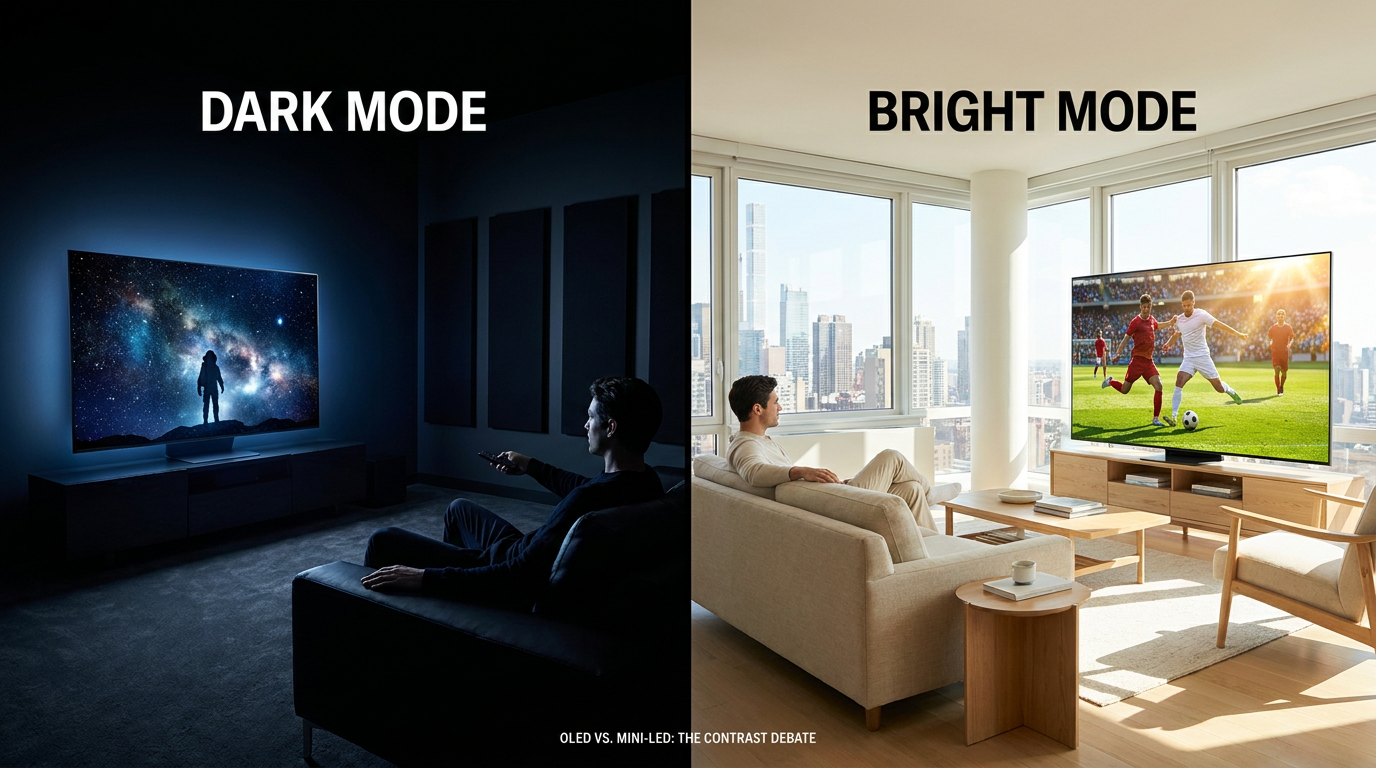
Choosing a premium television in 2026 has become a high-stakes decision defined by what industry analysts are calling the "Great Convergence." For years, the technological divide was simple and absolute: OLED dominated dark, dedicated home theaters with its perfect contrast, while LED variants ruled bright, sunlit living rooms with their superior brightness. Today, that gap has narrowed significantly. OLED panels are achieving unprecedented brightness levels thanks to new panel structures, while Mini-LED technology has refined its backlight control to mimic true black with startling accuracy. Yet, despite this convergence in marketing specifications, the underlying physics of how these screens generate light means they still excel in fundamentally different environments, forcing buyers to carefully weigh their specific viewing habits.[2]
The core distinction between the two formats lies in exactly how the pixels are illuminated on the screen. OLED, which stands for Organic Light-Emitting Diode, is a self-emissive technology. This means every single pixel generates its own light and color, and crucially, can turn off completely independently of its neighbors. Mini-LED, conversely, is a highly advanced evolution of traditional LCD technology. It relies on a backlight composed of thousands of microscopic LEDs divided into specific "local dimming zones." These zones brighten or darken based on the image being displayed, shining light through a liquid crystal layer and a color filter to produce the final picture. Because the pixels cannot light themselves, the TV must constantly manage this complex backlight system.[1][3]
For OLED, the primary advantage remains absolute, pixel-level light control. Because each of the 8.3 million individual pixels on a standard 4K display can shut off entirely, the technology delivers mathematically infinite contrast. This creates a picture with unparalleled depth, realism, and three-dimensionality, particularly in dark or mixed-lighting scenes. There is absolutely zero "haloing" or light bleed around bright objects placed against dark backgrounds. This is a crucial factor when watching letterboxed movies with bright white subtitles, or when viewing starfields in science fiction films, where every star can shine brilliantly while the space around it remains perfectly, inky black.[1][5]

Against OLED, the historical drawbacks have been lower full-screen brightness and the lingering anxiety of permanent image retention, commonly known in the industry as burn-in. Because the organic compounds used in the panels degrade over time as they emit light, leaving static elements like news tickers, sports scoreboards, or video game heads-up displays on the screen for thousands of hours can leave a permanent ghost image. Furthermore, while OLEDs can produce intense specular highlights in very small areas of the screen, their full-screen brightness drops significantly. When displaying bright, snowy landscapes, hockey rinks, or bright commercials, an automatic brightness limiter kicks in to protect the panel, dimming the entire image.[4]
Evidence from 2026 testing shows that manufacturers are aggressively and successfully tackling these historical weaknesses. The latest flagship models from major brands utilize "Tandem OLED" or stacked panel architectures, which layer multiple light-emitting materials on top of each other. This innovation boosts peak brightness by up to 50 percent without driving the individual pixels harder, thereby mitigating the risk of burn-in while increasing output. Independent testing by display experts confirms that these new panels can hit near 2,000 nits of brightness in small windows, making them far more versatile and capable in moderately lit rooms than the notoriously dim OLEDs of the past decade.[1][2]
For Mini-LED, the undeniable and overwhelming advantage is sheer, unadulterated luminance. These televisions are quite literally built to overpower the sun. In a bright living room with massive windows, skylights, and uncontrolled ambient light, a Mini-LED screen maintains its intense color saturation and contrast where an OLED might look washed out or act as a dark mirror reflecting the room. Additionally, because the technology relies on inorganic LED backlights rather than degrading organic compounds, there is absolutely zero risk of permanent burn-in. This offers complete peace of mind for users who leave the television on all day as background noise or watch the same news channel for hours on end.[3][5]
Against Mini-LED, the primary trade-off is the reliance on those local dimming zones. Even with thousands of zones packed behind the screen, a single zone is still illuminating thousands of pixels at once. When a bright object moves across a dark background, the backlight must turn on behind it, inevitably causing a faint glow or "bloom" to bleed into the surrounding dark pixels. Furthermore, Mini-LED panels—particularly those utilizing VA (Vertical Alignment) LCD technology to maximize contrast—suffer from narrower viewing angles. This means colors can shift, contrast degrades, and blooming becomes significantly more obvious if you are sitting off to the side of the screen rather than dead center.[1]

Against Mini-LED, the primary trade-off is the reliance on those local dimming zones.
Evidence of Mini-LED's rapid evolution is highly visible in the 2026 rollout of "RGB Mini-LED" technology. High-end models from industry leaders have begun removing traditional color filters entirely, utilizing dedicated red, green, and blue microscopic LEDs directly in the backlight array. This breakthrough allows these displays to push past an astonishing 3,000 nits of peak brightness while delivering purer, more accurate color volume. While blooming is not entirely eradicated by this method, the processing algorithms controlling the dimming zones have become so sophisticated that the artifact is nearly invisible to the untrained eye in most standard viewing conditions.[2][3]
When evaluating these technologies for video gaming, the trade-offs become highly specific to the player's habits and preferred genres. OLED holds the undisputed crown for competitive gaming due to its near-instantaneous pixel response time, which often measures well below one millisecond. This physical characteristic completely eliminates motion blur during rapid camera movements in first-person shooters or fast-paced sports games, providing a level of motion clarity that LCDs simply cannot match. The technology also boasts incredibly low input lag, ensuring that controller inputs translate to on-screen actions instantly, giving competitive players a tangible edge in multiplayer environments.[1][2]
Mini-LED fights back in the gaming space with extreme HDR punch and durability, making the colorful, sun-drenched worlds of open-world role-playing games look absolutely spectacular. The blinding highlights of explosions or magical effects in HDR are rendered with a physical intensity that OLED cannot replicate. More importantly for many gamers, Mini-LED completely removes the anxiety of leaving static game menus, health bars, or minimaps on the screen during a long pause or a marathon gaming session. Players can leave their consoles running for hours without constantly worrying about panel degradation, making it the superior choice for casual, all-day gaming setups.[3][4]
The final, and often most decisive, factor in this trade-off analysis is scale and value. Manufacturing flawless, self-emissive OLED panels becomes exponentially more difficult and expensive as the screen size increases. While 55-inch and 65-inch OLEDs are now competitively priced against high-end LCDs, stepping up to 83 inches or larger carries a massive, often prohibitive premium. Mini-LED technology scales much more efficiently in manufacturing, making massive 85-inch, 98-inch, and even 115-inch televisions surprisingly affordable for the average consumer in 2026. For buyers looking to replicate a true cinematic scale in their living rooms, Mini-LED offers a price-to-size ratio that OLED simply cannot touch, dominating the rapidly growing ultra-large screen market.[2][3]
Ultimately, OLED fits well when your viewing environment is light-controlled, such as a dedicated home theater, a basement, or a living room where you primarily watch television at night. It is the definitive choice for cinephiles who prioritize perfect black levels, infinite contrast, and accurate shadow detail above all else. It also fits perfectly for competitive gamers who demand the absolute best motion clarity and lowest input lag, and for living rooms with wide seating arrangements where off-axis viewing angles are critical to ensuring everyone gets a great picture. If your goal is to watch moody, atmospheric prestige television or 4K Blu-rays exactly as the director intended, OLED remains the undisputed reference standard.[5][6]
Conversely, OLED does not fit well when your primary viewing space is a sun-drenched room with direct light hitting the screen, as the panel will struggle to overcome the glare. It is also a poor choice for households that use the television as constant background noise, leaving it tuned to a single news network with static banners for eight hours a day, as this maximizes the risk of long-term burn-in. Finally, it does not fit buyers looking to maximize screen size on a strict budget, as the "OLED tax" on screens over 77 inches remains steep. For those who want an 85-inch screen for under two thousand dollars, OLED is simply not an option in the current market landscape.[4][6]

Mini-LED fits well when you need a television that can effortlessly overpower daytime glare in a bright, open-concept living room. It is the ideal choice for sports fans who watch daytime games with the blinds open, families who want a massive 85-inch screen without taking out a second mortgage, and casual gamers who prefer punchy, blinding HDR highlights over absolute motion clarity. It is the ultimate "peace of mind" television for mixed, heavy usage, allowing anyone in the house to leave the TV on any channel without a second thought. If your television serves as the central hub of a busy, brightly lit household where content ranges from morning cartoons to afternoon football and evening sitcoms, Mini-LED provides the versatility and durability required.[5][6]
However, Mini-LED does not fit well when you are a home theater purist who watches science fiction or horror movies in pitch-black rooms. If you are highly sensitive to light bleed around subtitles or letterbox bars, the inherent limitations of local dimming will eventually distract you, no matter how advanced the algorithms have become. It also does not fit well in wide, shallow rooms where viewers are forced to sit at extreme angles, as the picture quality, color saturation, and contrast will noticeably degrade for anyone not sitting directly in front of the screen. For those who demand absolute pixel-level perfection and watch content that relies heavily on deep shadows and pinpoint highlights, the minor blooming artifacts of a Mini-LED will always serve as a reminder that the screen is backlit.[1][6]
How we got here
2013
The first commercial OLED TVs launch, offering perfect blacks but struggling with low brightness and high burn-in risk.
2019
Mini-LED technology enters the consumer market, bridging the gap between traditional LCDs and OLEDs with thousands of dimming zones.
2024
OLED panels introduce Micro Lens Array (MLA) technology, pushing peak brightness past the 1,000-nit barrier for the first time.
2026
The 'Great Convergence' occurs as Tandem OLEDs hit 2,000 nits and RGB Mini-LEDs eliminate color filters, bringing the two technologies closer than ever.
Viewpoints in depth
Home Theater Purists
Prioritize perfect black levels and pixel-level contrast for cinematic viewing.
This camp argues that any amount of blooming or light bleed ruins the cinematic experience, especially when watching letterboxed movies or content with dark, moody cinematography. They maintain that while Mini-LED has improved, the mathematical perfection of self-lit pixels remains the only acceptable standard for true reference-quality viewing in a light-controlled room.
Bright-Room Viewers
Prioritize sheer brightness, glare reduction, and zero burn-in risk.
For this group, OLED's perfect blacks are entirely irrelevant if the screen acts as a dark mirror reflecting sunlight during the day. They argue that the massive peak brightness of Mini-LED provides a more impactful HDR experience in real-world living rooms, and they highly value the peace of mind that comes with leaving the TV on all day without fear of panel degradation.
Competitive Gamers
Focus entirely on motion clarity, response times, and input lag.
Gamers in this camp point out that OLED's sub-millisecond response times physically eliminate motion blur during fast camera pans in first-person shooters, providing a tangible competitive advantage. While they acknowledge Mini-LED's punchy colors, they argue that the slight smearing caused by LCD pixel transitions makes it inferior for high-level, fast-paced gameplay.
What we don't know
- Whether Micro-LED technology will eventually scale down in price enough to replace both OLED and Mini-LED in the consumer market.
- How the long-term durability of the new 2026 Tandem OLED panels will hold up after tens of thousands of hours of real-world use.
- If future algorithmic improvements can completely eliminate the physical blooming limitations inherent to Mini-LED local dimming zones.
Key terms
- Tandem OLED
- A display technology that stacks multiple light-emitting layers to increase overall brightness and lifespan without raising the risk of burn-in.
- Local Dimming Zones
- Specific areas of a Mini-LED backlight that can independently dim or turn off to improve contrast and create deeper blacks.
- Blooming (Haloing)
- A visual artifact where light bleeds from a bright object into the surrounding dark areas of the screen, common on backlit TVs.
- Nits
- A unit of measurement for luminance, used to quantify how bright a TV screen or display can get.
Frequently asked
Does OLED burn-in still happen in 2026?
While the risk is significantly reduced thanks to pixel-shifting and Tandem OLED technology, permanent image retention is still possible if static elements are displayed for thousands of hours.
What is RGB Mini-LED?
It is a 2026 backlight technology that replaces traditional white LEDs and color filters with individual red, green, and blue LEDs, resulting in purer colors and higher brightness.
Why are OLED TVs so expensive at larger sizes?
Manufacturing flawless self-lit pixel panels becomes exponentially more difficult and costly as the screen size exceeds 77 inches, giving Mini-LED a massive price advantage at 85 inches and above.
Which TV is better for PS5 and Xbox Series X?
OLED is generally preferred for its near-instantaneous response times and motion clarity, though Mini-LED offers punchier HDR highlights for colorful open-world games.
Sources
Source coverage
6 outlets
4 viewpoints surfaced






[1]RTINGSHome Theater Purists
Mini LED vs. OLED TVs: Which One Is The Best?
Read on RTINGS →[2]ElectronicsHubCompetitive Gamers
OLED vs Mini LED TV Comparison Guide for 2026
Read on ElectronicsHub →[3]CurrysBright-Room Viewers
Mini LED vs OLED TVs: which should you buy in 2025?
Read on Currys →[4]PaklapBright-Room Viewers
OLED vs Mini-LED Displays in 2026: Are They Worth It?
Read on Paklap →[5]Jeff RauseoHome Theater Purists
OLED vs. Mini-LED vs. QLED: What's the Best TV for You In 2025?
Read on Jeff Rauseo →[6]Factlen Editorial TeamIndustry Analysts
Synthesis by Factlen editorial team
Read on Factlen Editorial Team →
More in shopping
See all 6 stories →Wearable Tech
Do Smart Rings Actually Track Sleep Accurately? A Review of the Clinical Evidence
8 sources
Display Tech
OLED vs. Mini-LED in 2026: The Great Convergence in Premium TVs
6 sources
Nursery Gear
Smart Bassinets vs. Traditional Bassinets: Weighing the Costs and Benefits for Newborn Sleep
6 sources

Modular Tech
Modular Electronics Go Mainstream: The 2026 Shopper's Guide to Repairable Tech
9 sources
Every angle. Every day.
Get shopping stories with full source coverage and perspective breakdowns delivered to your inbox.