
What Actually Works for Detecting AI Content in 2026: An Evidence Pack
As generative AI models become indistinguishable from human output, researchers have abandoned text-based detection in favor of behavioral signals, while video and audio verification tools continue to successfully identify deepfakes.
By Factlen Editorial Team
- Behavioral Analysts
- Focus on the metadata and distribution patterns rather than the content itself.
- Forensic Technologists
- Focus on advancing passive detection models for audio and visual media.
- Provenance Advocates
- Focus on cryptographic verification at the point of creation.
What's not represented
- · Independent content creators whose authentic work is penalized by false-positive AI detection algorithms.
- · Legal scholars debating the admissibility of deepfake detection scores in court.
Why this matters
Understanding which detection tools actually work prevents panic over deepfakes and equips readers, educators, and voters to critically evaluate the media they consume during high-stakes election cycles.
Key points
- Text-based AI detection is no longer considered viable due to high miss rates and false positives.
- Fact-checkers now rely on behavioral signals like posting velocity to spot AI text campaigns.
- Video and audio detection tools remain highly effective, achieving up to 99% accuracy.
- Forensic models analyze biological impossibilities like unnatural blinking and inconsistent lighting.
- Cryptographic provenance is emerging as the gold standard for verifying media at the source.
The narrative that the public can no longer trust anything they see or read has dominated early 2026. But inside the digital forensics laboratories and newsrooms tasked with verifying information, the reality is far more structured and optimistic. The arms race between generative AI and detection tools has not been lost; it has simply split into distinct battlegrounds, with defenders adapting their strategies to match the technology.[7]
For fact-checkers and platform moderators, the most significant shift of the past year is the formal abandonment of text-based AI detection. The consensus among researchers is that identifying AI-generated text through linguistic analysis is no longer a viable primary strategy.[1]
The data backs up this retreat. Comprehensive benchmarks conducted in early 2026 across top language models reveal that even the most advanced text detectors miss between 15% and 30% of machine-generated content. As models optimize for human-like prose, the linguistic tells of early AI—such as robotic phrasing and repetitive structures—have vanished.[2]
More troublingly, these text-analysis tools generate false positives at a rate of 3% to 12%. This disproportionately flags human-written content produced by non-native English speakers or technical writers whose prose naturally exhibits predictable sentence structures, penalizing authentic human effort.[2]

Instead of analyzing the text itself, the industry has successfully pivoted to behavioral signals. Platforms now look at posting velocity, network coordination, and account history to identify coordinated inauthentic behavior, allowing them to flag disinformation campaigns before the text is even read by the public.[1]
While text detection has faltered, the fight against audio and video deepfakes is yielding highly successful countermeasures. Multimodal detection models deployed in newsrooms are currently achieving 94% to 99% accuracy across various attack vectors, providing a robust shield against visual manipulation.[5]
While text detection has faltered, the fight against audio and video deepfakes is yielding highly successful countermeasures.
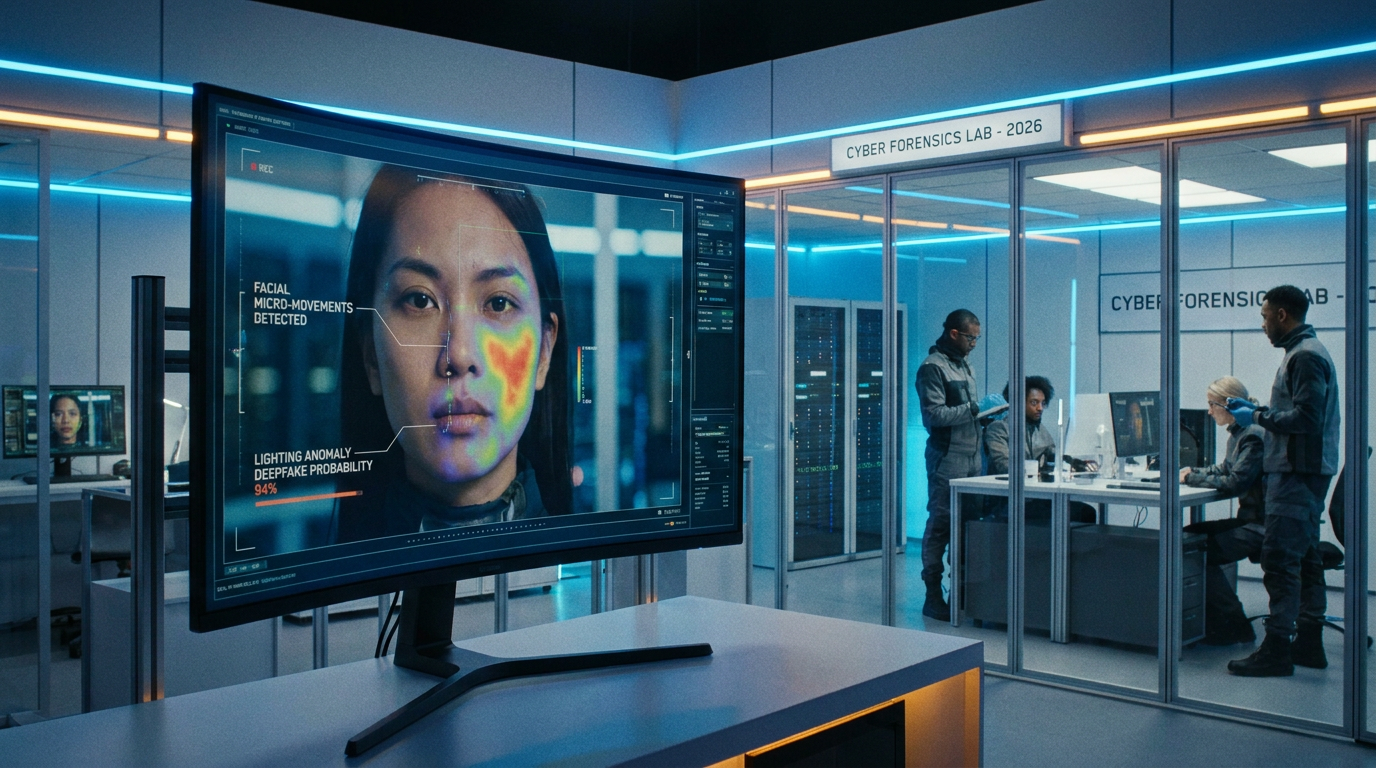
These systems do not rely on the naked eye. They analyze spatio-temporal cues, such as unnatural eye-blinking patterns, inconsistent lighting across frames, and micro-movements of the head that generative video models still struggle to replicate consistently.[7]
Academic institutions are democratizing these capabilities for the public. In June 2026, researchers at National Yang Ming Chiao Tung University released 'Co-Insight AI Eye,' a free platform that secured a top-five finish at the premier CVPR 2026 computer vision conference.[4]
The university's system utilizes a quality-aware deepfake detection framework that remains highly effective even when a video has been heavily compressed, reposted across social media, or deliberately degraded in quality by malicious actors attempting to hide their digital tracks.[4]

Audio deepfakes, which require less computational power to generate than video, have also met robust resistance. New deep-learning architectures are introducing complex-domain embeddings to differentiate between natural human voice recordings and synthetic clones.[3]
One such system, StreamMark, operates by embedding semi-fragile audio watermarks into recordings. These watermarks survive benign edits like standard audio compression but shatter immediately when the audio undergoes semantics-altering manipulations, such as AI voice cloning.[3]
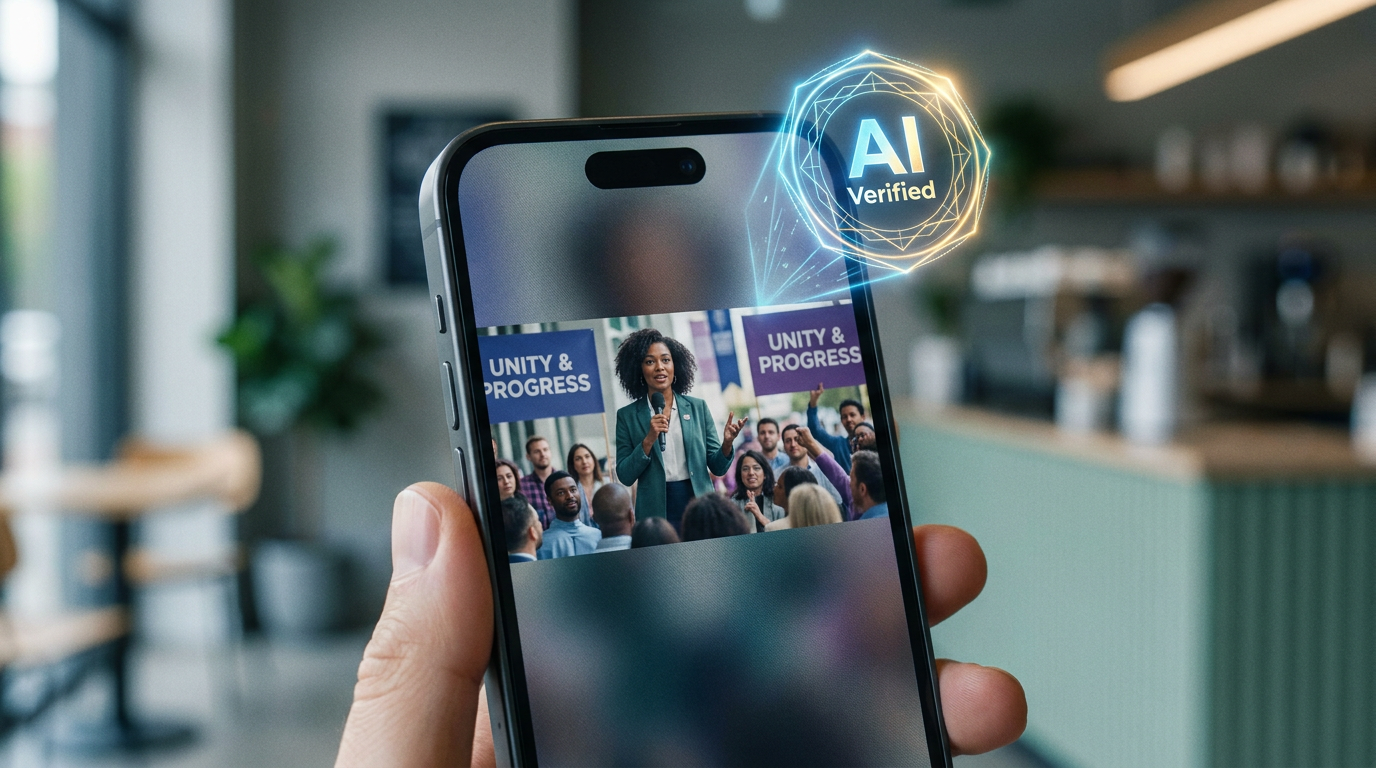
This points to the ultimate gold standard in the 2026 fact-checking ecosystem: cryptographic provenance. Rather than guessing if a file is authentic after the fact, provenance systems embed verifiable, tamper-evident data at the exact moment of creation.[6]

Initiatives like the Coalition for Content Provenance and Authenticity allow cameras and software to attach a secure manifest to an image or video, recording exactly who made it, what device was used, and what edits were subsequently applied.[6]
The challenge with provenance is not technological, but adoption. While major tech companies and news organizations are integrating these standards, open-source models and bad actors routinely strip metadata, meaning passive detection tools will remain a necessary and highly effective layer of defense for the foreseeable future.[6][7]
How we got here
2024
Early AI text detectors achieve high accuracy against first-generation language models.
2025
Researchers note a sharp decline in text detection reliability as models optimize for human-like prose.
Early 2026
Major benchmarks confirm text detection is no longer viable, prompting a shift toward behavioral analysis.
June 2026
Advanced video detection frameworks demonstrate high resilience against deepfakes at the CVPR 2026 conference.
Viewpoints in depth
Behavioral Analysts
Focus on the metadata and distribution patterns rather than the content itself.
This camp argues that the arms race to detect AI-generated text is a lost cause. Because large language models are now mathematically optimized to mimic human writing perfectly, any text-based detector will inevitably generate unacceptable false positives. Instead, they advocate for 'velocity-first' detection: identifying coordinated bot networks, unnatural posting frequencies, and account histories to flag disinformation campaigns before the text is even read.
Forensic Technologists
Focus on advancing passive detection models for audio and visual media.
Researchers building tools like NYCU's 'Co-Insight AI Eye' maintain that while text may be untraceable, audio and video still leave digital fingerprints. They focus on the physical limitations of generative models, training systems to spot biological impossibilities—such as inconsistent blood flow patterns in a face, unnatural blinking, or lighting artifacts that fail basic physics tests. They argue these passive tools are essential because bad actors will never voluntarily use watermarks.
Provenance Advocates
Focus on cryptographic verification at the point of creation.
This group, heavily represented by the C2PA initiative and major publishers, believes the internet must shift from a 'detect the fake' model to a 'prove the real' model. They argue that as deepfakes become flawless, the only mathematically sound defense is hardware-level watermarking. By embedding secure, tamper-evident manifests into photos and videos the moment they are captured, consumers can instantly verify the origin of a piece of media, rendering unmarked deepfakes inherently suspicious.
What we don't know
- How quickly open-source models will develop the capability to automatically strip cryptographic watermarks from media.
- Whether major social media platforms will eventually mandate content credentials for all uploaded video and audio.
Key terms
- Spatio-temporal cues
- Inconsistencies in movement or lighting over time in a video, such as unnatural blinking or shifting shadows, used to detect deepfakes.
- Cryptographic provenance
- A secure, tamper-evident digital manifest attached to a file that proves who created it and what edits were made.
- False positive
- When a detection tool incorrectly flags authentic, human-created content as being generated by artificial intelligence.
- Burstiness
- The variation in sentence length and structure; human writing typically has high burstiness, while older AI models produced highly uniform sentences.
Frequently asked
Can AI text detectors reliably catch ChatGPT?
No. As of 2026, the best text detectors miss 15% to 30% of AI-generated content and frequently flag human writing as fake, making them unreliable for definitive proof.
How do experts spot video deepfakes?
Forensic tools analyze biological and physical inconsistencies that the naked eye misses, such as irregular blood flow patterns, unnatural micro-movements, and lighting errors.
What is a content credential?
It is a secure digital watermark embedded in a photo or video at the time of creation, allowing viewers to verify its origin and see if it has been altered.
Sources
Source coverage
7 outlets
3 viewpoints surfaced







[1]Rolli AI ResearchBehavioral Analysts
The Disinformation Landscape: Why Text Detection is Dead
Read on Rolli AI Research →[2]Digital AppliedBehavioral Analysts
2026 AI Detection Benchmark: False Positives and Accuracy Limits
Read on Digital Applied →[3]arXivForensic Technologists
StreamMark: A Deep Learning-Based Semi-Fragile Audio Watermarking for Proactive Deepfake Detection
Read on arXiv →[4]National Yang Ming Chiao Tung UniversityForensic Technologists
NYCU Develops Co-Insight AI Eye for Deepfake Detection
Read on National Yang Ming Chiao Tung University →[5]Resemble AIForensic Technologists
Deepfake Detector for Journalists and Media Outlets
Read on Resemble AI →[6]MDPIProvenance Advocates
Deepfake Mitigation: Passive Detection, Provenance, and Authentication
Read on MDPI →[7]Factlen Editorial TeamProvenance Advocates
Synthesis by Factlen editorial team
Read on Factlen Editorial Team →
More in news politics
See all 8 stories →Middle East Truce
Israel-Hezbollah Ceasefire Takes Effect as Fragile U.S.-Iran Truce Faces Immediate Tests
8 sources

U.S.-Iran Deal
Israel and Hezbollah Agree to Ceasefire as U.S.-Iran Swiss Talks Face Delays
8 sources
Middle East Diplomacy
U.S.-Iran Talks Stall as Israel-Hezbollah Ceasefire Faces Immediate Violations
8 sources

U.S.-Iran Deal
U.S. and Iran Sign 60-Day Truce to Reopen Strait of Hormuz, but Israel Defies Lebanon Ceasefire
7 sources

Every angle. Every day.
Get news politics stories with full source coverage and perspective breakdowns delivered to your inbox.