
Memory stocks are having their best year ever. Why do they still look so cheap?
AI-driven demand for High Bandwidth Memory has pushed semiconductor earnings to record highs, yet top players are trading at surprisingly low multiples. The disconnect highlights a fierce debate over whether this is a traditional boom-bust cycle or a permanent structural shift in tech economics.
By Factlen Editorial Team
- Supercycle Bulls
- Believe AI and HBM have fundamentally altered the industry's economics, creating sustained, geometric demand that justifies much higher valuations.
- Value Trap Skeptics
- Argue that memory is inherently cyclical and current low multiples correctly price in an inevitable supply glut and earnings collapse.
- Hyperscaler Customers
- Focused purely on securing enough memory supply to fuel their AI data centers, regardless of the cyclical cost.
What's not represented
- · Retail investors holding index funds
- · Consumer electronics manufacturers facing higher memory costs
Why this matters
Understanding how the market prices memory stocks is a masterclass in value investing versus cyclical traps. For anyone investing in tech or AI, recognizing the difference between a genuine bargain and a looming earnings cliff is essential for protecting your portfolio.
Key points
- Memory semiconductor companies are posting record revenues driven by AI data center demand.
- Despite record profits, top memory stocks trade at unusually low price-to-earnings multiples.
- Historically, low multiples in the chip sector signal a 'value trap' just before a cyclical crash.
- Bulls argue this cycle is different due to the geometric demand for High Bandwidth Memory (HBM).
- HBM's complex 3D manufacturing process creates structural supply constraints that prevent easy overproduction.
- Hyperscalers are locking in memory supply with multi-year contracts, providing unprecedented earnings visibility.
The artificial intelligence revolution has minted a new class of undisputed winners, but you wouldn't know it by looking at their valuation multiples. Memory semiconductor companies are currently posting the highest revenues in their histories, driven by the voracious data demands of modern AI data centers. Yet, despite this unprecedented financial performance, the stocks of the industry's largest players are trading at price-to-earnings ratios that look more like distressed value traps than cutting-edge tech darlings. This glaring disconnect has sparked a fierce debate on Wall Street: is the market correctly anticipating a classic cyclical crash, or has AI fundamentally rewritten the economic rules of the memory chip industry?[1][6]
The raw numbers present a staggering paradox. Top-tier memory manufacturers have seen their stock prices surge over the past year, with some valuations multiplying several times over as the AI boom took hold. Micron Technology, for example, has experienced a historic rally, fueled by its strategic position in the AI hardware supply chain. Yet, despite this massive price appreciation, the company's stock trades at roughly 14 times its projected 2026 earnings, and an even lower multiple for the following year. In a tech sector where high-growth AI software and hardware companies routinely command multiples of 40, 50, or even 100 times earnings, the memory sector appears ludicrously cheap.[4]
To the untrained eye, this looks like the greatest value investment of the decade—a rare opportunity to buy into hyper-growth AI infrastructure at bargain-bin prices. But to Wall Street veterans, quantitative analysts, and institutional investors, these low multiples trigger immediate alarm bells rather than buying frenzies. They understand the golden rule of valuing cyclical hardware companies: a low price-to-earnings (P/E) ratio is often a massive red flag. In the boom-and-bust world of semiconductors, a single-digit multiple usually signals that the broader market believes the current record-breaking profits are a temporary illusion that will soon evaporate.[5][6]
To understand this skepticism, one must understand the traditional "semiconductor cycle." Historically, memory chips like standard DRAM and NAND flash have been pure commodities. When demand from PC makers or smartphone manufacturers spikes, supply tightens, prices soar, and the chipmakers print money. During these boom times, profit margins can expand dramatically, pushing earnings to record highs.[5]

But those peak profits inevitably sow the seeds of their own destruction. Flush with cash, the memory manufacturers embark on massive capital expenditure cycles, spending tens of billions of dollars to build new fabrication plants. Because these advanced facilities take years to construct and equip, the new supply usually hits the market just as consumer demand begins to cool. The result is a sudden supply glut, a collapse in chip prices, and a brutal compression of profit margins.[5][6]
This dynamic creates what investment bankers call "peak earnings risk." At the very top of the cycle, a company's earnings are artificially inflated. Because the "E" in the P/E ratio is so high, the overall multiple looks incredibly low and attractive. But buying a cyclical stock at a low P/E often means buying right before the earnings collapse. The market is currently pricing memory stocks with the assumption that this historical gravity still applies, and that a brutal downturn is lurking just over the horizon.[5]
However, a growing chorus of industry analysts and bullish investors argues that the market is fundamentally misjudging the current moment. They contend that the artificial intelligence supercycle is not just another temporary spike in demand, but a permanent, structural shift in how computing hardware is designed and consumed. At the center of this argument is a physical engineering constraint known as the "Memory Wall."[4][6]
However, a growing chorus of industry analysts and bullish investors argues that the market is fundamentally misjudging the current moment.
The Memory Wall is the single most important concept for understanding the current AI hardware landscape. Modern AI processors, such as Nvidia's advanced GPUs, are incredibly fast at performing complex mathematical calculations. However, they can only process data as quickly as it is fed to them from the system's memory. Traditional DRAM simply cannot move data fast enough to keep the GPUs fed, leaving these expensive processors sitting idle while they wait for information.[6]
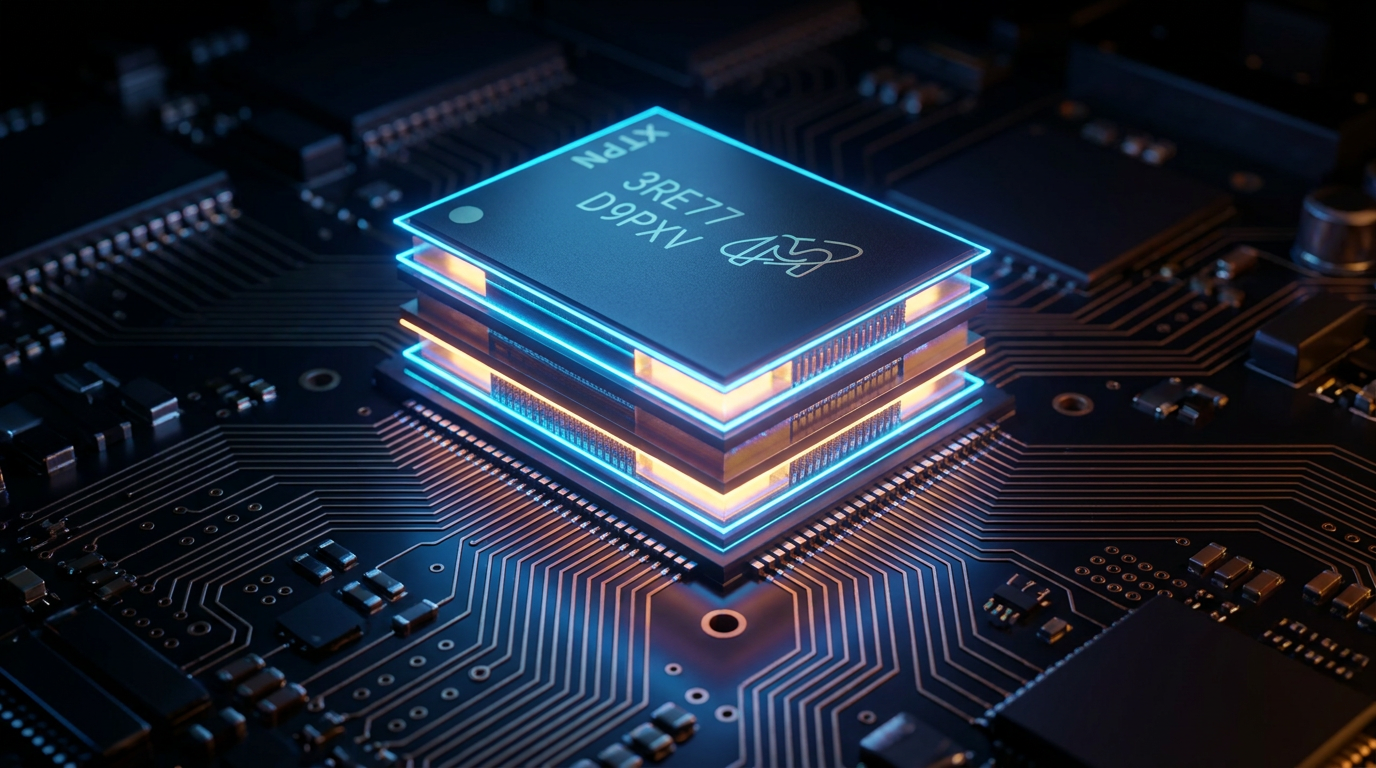
To break through this bottleneck, the industry has turned to a specialized technology called High Bandwidth Memory (HBM). Unlike traditional memory chips, which are laid out flat next to the processor, HBM stacks multiple memory dies vertically—typically 12 to 16 layers high. These layers are connected by microscopic vertical copper wires known as through-silicon vias (TSVs), creating a massive, multi-lane superhighway for data transfer.[3][6]
This 3D architecture allows massive amounts of data to flow simultaneously, making HBM the critical enabler for training and running complex large language models. The demand for this specialized memory is not growing at a steady, linear pace; it is expanding geometrically as AI models become exponentially larger. Industry estimates project that the total addressable market for High Bandwidth Memory will reach between $52 billion and $56 billion in 2026 alone. With overall HBM demand growing by roughly 70% year-over-year, the memory sector is experiencing a growth vector that is entirely detached from the traditional PC and smartphone upgrade cycles that historically governed its fortunes.[2][3]

Crucially, HBM is not a simple commodity that can be easily overproduced. The manufacturing process is incredibly complex and capacity-intensive. Because of the intricate packaging and stacking requirements, producing one bit of HBM effectively displaces several bits of conventional DRAM output. This complexity creates a structural supply constraint that cannot be quickly solved simply by throwing money at new factories.[3][6]
This manufacturing difficulty has consolidated power into an effective oligopoly. Only three companies globally—SK Hynix, Samsung, and Micron—currently possess the advanced capabilities required to produce the leading-edge HBM required for the world's most powerful AI systems. This concentrated supply base gives the memory makers unprecedented pricing power and leverage over their customers.[2][3]
Furthermore, the customers buying this memory are not price-sensitive consumers; they are the world's largest technology companies. Hyperscalers like Microsoft, Meta, and Alphabet are engaged in an existential arms race to build AI infrastructure. To ensure their multi-billion-dollar data centers do not sit idle waiting for memory, these tech giants are locking in supply through binding, multi-year contracts.[4][6]
This dynamic provides the memory manufacturers with a level of forward visibility that is entirely unprecedented in the sector's history. Micron, for instance, has reportedly pre-sold its entire HBM output through the entirety of 2026. Bulls argue that this guaranteed revenue stream fundamentally de-risks the companies' earnings profiles, meaning they should no longer be valued with the steep discounts traditionally applied to cyclical commodities.[4]

Despite these compelling arguments, significant uncertainty remains, which is why the market continues to hedge its bets. The entire HBM supercycle is predicated on the assumption that AI monetization will eventually catch up to the massive infrastructure investments currently being made. If the hyperscalers fail to generate sufficient returns on their AI products, they could abruptly halt their data center buildouts, triggering a sudden evaporation of demand.[1][6]
Additionally, the sheer scale of capital being poured into new fabrication plants cannot be ignored. While HBM is difficult to manufacture today, production yields will inevitably improve over time. The tens of billions of dollars currently being deployed to expand capacity could eventually overwhelm even AI's voracious appetite, triggering the exact supply glut that the market's low P/E ratios are currently anticipating.[5][6]
For now, retail and institutional investors alike are left staring at a historic valuation disconnect. The memory semiconductor industry has reached a fascinating crossroads where past precedent and future innovation are in direct conflict. Either the broader market is correctly anticipating a classic, painful cyclical bust, or it is fundamentally mispricing the most important hardware paradigm shift of the decade.[1][6]
How we got here
Pre-2023
Memory chips operate primarily as traditional commodities tied to PC and smartphone sales cycles.
Late 2023
The generative AI boom begins, creating sudden, massive demand for specialized HBM chips.
2024–2025
HBM demand vastly outstrips supply, leading to record revenue and margin expansion for top memory manufacturers.
Early 2026
Memory stocks hit record highs, yet forward P/E ratios remain compressed due to persistent cyclical fears.
2027 and Beyond
The critical window where new fabrication plants will come online, testing whether AI demand can absorb the massive new supply.
Viewpoints in depth
Value Trap Skeptics
The belief that the laws of semiconductor gravity have not been suspended.
This camp points to decades of history where "this time is different" narratives ended in tears. They argue that the massive capital expenditures currently underway by Samsung, SK Hynix, and Micron will inevitably lead to overcapacity by 2027 or 2028. From this perspective, the low P/E ratios are a rational warning sign, not a buying opportunity, because today's record earnings are a cyclical peak that will soon compress.
Supercycle Bulls
The argument that AI has permanently transformed memory from a commodity into a strategic asset.
Bulls emphasize that HBM is structurally different from past memory products. Because it is incredibly difficult to manufacture and requires custom packaging with GPUs, it cannot be easily overproduced. Furthermore, with hyperscalers signing binding, multi-year contracts to secure supply, bulls argue that earnings visibility is unprecedented, meaning these stocks deserve premium valuations rather than cyclical discounts.
Hyperscaler Customers
The tech giants buying the memory are focused on supply security, not market cycles.
For companies like Microsoft, Meta, and Alphabet, the cost of memory is secondary to the cost of losing the AI race. Their primary concern is the "Memory Wall"—the physical bottleneck where GPUs sit idle waiting for data. They view HBM as a critical strategic resource and are willing to fund the memory makers' expansion through massive pre-orders to ensure their data centers do not run dry.
What we don't know
- Whether the massive capital expenditures currently underway will eventually lead to a supply glut.
- How quickly next-generation HBM4 technology will render current memory inventories obsolete.
- The exact point at which hyperscaler AI infrastructure spending might plateau.
Key terms
- High Bandwidth Memory (HBM)
- A specialized type of computer memory that stacks chips vertically to drastically increase the speed at which data is fed to AI processors.
- Price-to-Earnings (P/E) Ratio
- A valuation metric that measures a company's current share price relative to its per-share earnings.
- Semiconductor Cycle
- The historical boom-and-bust pattern of the chip industry, driven by alternating periods of supply shortages and overproduction.
- Memory Wall
- The performance bottleneck that occurs when a processor is faster than the memory feeding it data, leaving the processor idle.
- Through-Silicon Vias (TSVs)
- Microscopic vertical copper connections that pass completely through a silicon wafer, used to link stacked chips in HBM.
Frequently asked
Why do memory stocks have such low P/E ratios right now?
The market treats them as cyclical stocks at their peak. Investors expect earnings to drop in the future due to oversupply, so they are unwilling to pay a high multiple for current profits.
What makes High Bandwidth Memory different from regular memory?
HBM stacks memory chips vertically rather than placing them side-by-side, creating a massive, multi-lane pathway for data that is essential for keeping fast AI processors fed with information.
Could the memory market still crash?
Yes. If tech giants reduce their AI infrastructure spending, or if the massive new factories currently being built produce too much supply, prices and profits could plummet.
Sources
Source coverage
6 outlets
3 viewpoints surfaced






[1]MarketWatchValue Trap Skeptics
Memory stocks are having their best year ever. Why do they still look so cheap?
Read on MarketWatch →[2]The Diligence StackSupercycle Bulls
High Bandwidth Memory: The $54 Billion Market
Read on The Diligence Stack →[3]PatSnap InsightsSupercycle Bulls
A Market Transformed by AI Demand
Read on PatSnap Insights →[4]QuentinvestSupercycle Bulls
Memory Stocks Are Ludicrously Cheap
Read on Quentinvest →[5]IB Interview QuestionsValue Trap Skeptics
Valuing Cyclical Semiconductor Companies
Read on IB Interview Questions →[6]Factlen Editorial TeamHyperscaler Customers
Synthesis by Factlen editorial team
Read on Factlen Editorial Team →



Every angle. Every day.
Get finance stories with full source coverage and perspective breakdowns delivered to your inbox.