
Israel and Hezbollah Renew Ceasefire After Deadly Flare-Up Delays U.S.-Iran Peace Talks
A fragile ceasefire took effect in Lebanon on Friday after intense fighting killed dozens and forced the postponement of U.S.-Iran implementation talks in Switzerland.
By Factlen Editorial Team
- U.S. & Western Mediators
- Focused on preserving the broader U.S.-Iran peace framework, viewing the Lebanon ceasefire as a critical prerequisite for advancing diplomatic talks.
- Israeli Security Establishment
- Argues that Israel must maintain its buffer zone in southern Lebanon and respond forcefully to any Hezbollah attacks to protect its northern border.
- Lebanese & Regional Voices
- Highlights the severe civilian toll of Israeli airstrikes and views Israeli military presence in southern Lebanon as an ongoing violation of sovereignty.
- Iranian Diplomatic Stance
- Insists that regional hostilities, particularly in Lebanon, must cease before engaging in direct implementation talks with the U.S.
What's not represented
- · Lebanese civilians displaced by the fighting in the southern border region
- · Commercial shipping companies navigating the newly reopened Strait of Hormuz
Why this matters
The durability of this ceasefire directly impacts the historic U.S.-Iran peace framework, which recently reopened the Strait of Hormuz to global shipping. If the border conflict escalates, it could derail the 60-day negotiation process and plunge the region back into a broader war.
Key points
- Israel and Hezbollah agreed to a renewed ceasefire effective 4:00 p.m. Friday after intense overnight fighting.
- Israeli airstrikes killed at least 47 people in Lebanon following a Hezbollah attack that killed four Israeli soldiers.
- The violence prompted the postponement of U.S.-Iran implementation talks scheduled to take place in Switzerland.
- Iran suspended its delegation's trip, demanding a halt to the Lebanon hostilities before negotiations proceed.
- The broader U.S.-Iran memorandum has already reopened the Strait of Hormuz to international shipping.
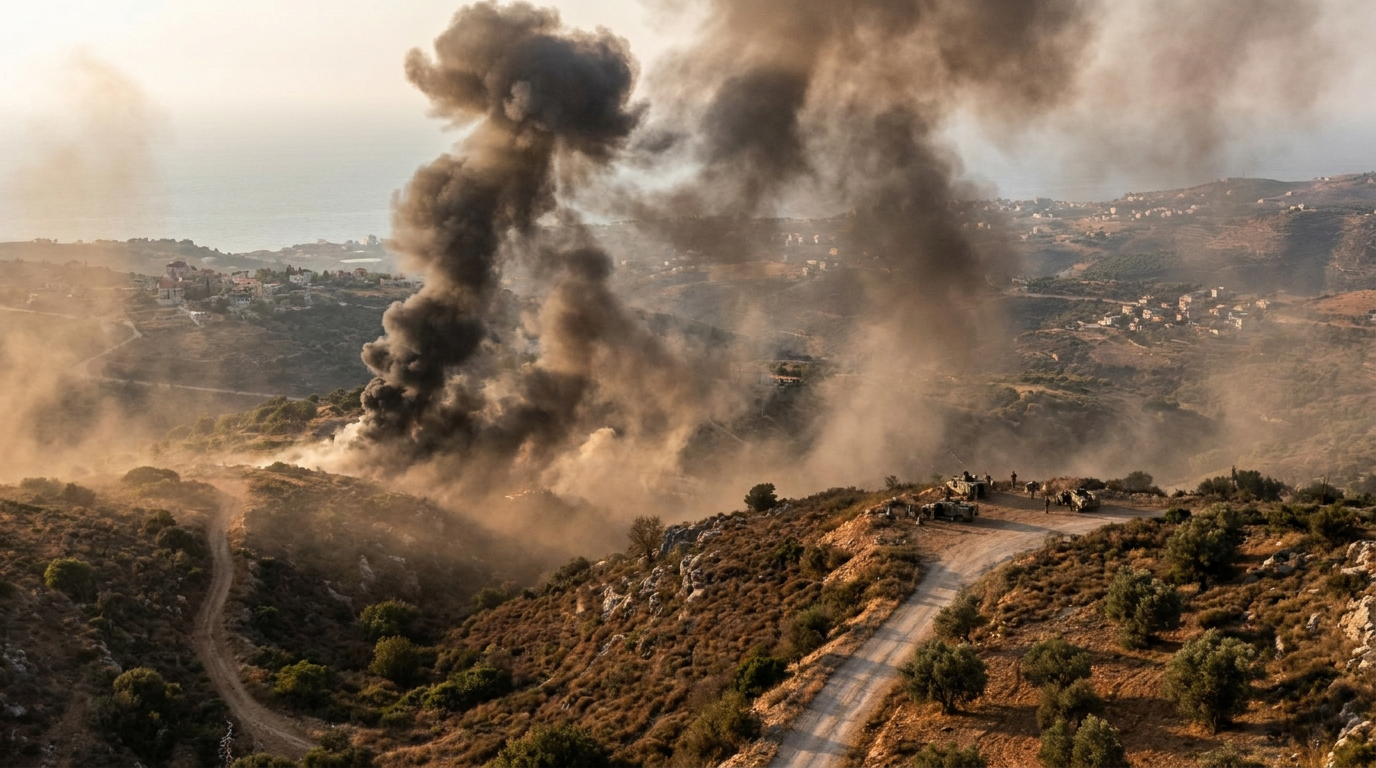
A fragile ceasefire between Israel and Hezbollah went into effect late Friday afternoon, halting a deadly flare-up that threatened to derail a historic peace agreement between the United States and Iran. The renewed truce, mediated by the U.S., Qatar, and Iran, aims to stabilize Lebanon's southern border after intense overnight fighting tested the durability of the broader regional framework.[3][4]
The violence erupted when an explosive drone and anti-tank fire struck an Israeli tank near the Lebanese village of Kfar Tebnit, killing four Israeli soldiers, including a battalion commander. In response, Israel launched a wave of retaliatory airstrikes targeting Hezbollah infrastructure across southern Lebanon and the Bekaa Valley, vowing to exact a heavy price for the attack.[3][7]
The human toll of the brief but intense escalation was severe. Lebanese health officials reported that the Israeli bombardment killed at least 47 people and wounded nearly 100 others within hours. Hezbollah claimed its initial strikes were a direct response to Israeli forces attempting to advance on the strategic Ali al-Taher hilltop overlooking Nabatiyeh, accusing Israel of violating previous understandings.[2][7]

The sudden border escalation immediately impacted broader global diplomacy, forcing the postponement of highly anticipated U.S.-Iran talks in Switzerland. Vice President JD Vance canceled his planned departure for the Bürgenstock resort, where delegations were scheduled to discuss the technical implementation of the newly signed "Islamabad Memorandum of Understanding."[5][8]
The sudden border escalation immediately impacted broader global diplomacy, forcing the postponement of highly anticipated U.S.-Iran talks in Switzerland.
Signed digitally earlier in the week by U.S. President Donald Trump and Iranian President Masoud Pezeshkian, the 14-point memorandum aims to end the war that began in late February. The agreement successfully reopened the Strait of Hormuz to international shipping, prompting the U.S. to lift its naval blockade and allowing Gulf oil producers like Iraq to rapidly scale up crude exports.[1][8]

However, Iranian officials suspended their delegation's trip to Switzerland, insisting that the fighting in Lebanon must stop before any technical talks could proceed. The Swiss Foreign Ministry confirmed the postponement of the Friday meetings, stating that preparatory work would continue while the parties worked to stabilize the situation on the ground.[5][8]
Despite agreeing to the 4:00 p.m. ceasefire, Israeli officials maintained a hardline posture regarding their military presence. Prime Minister Benjamin Netanyahu stated that Israel would not tolerate attacks on its soldiers, and military officials confirmed that Israeli troops would remain in their six-mile security buffer zone inside southern Lebanon for as long as required.[3][6]

The durability of the Friday afternoon ceasefire remains the immediate test for the U.S.-Iran framework. If the guns remain silent across the Blue Line, mediators hope to quickly reschedule the Swiss talks to solidify the 60-day negotiation process and prevent the region from sliding back into a broader, multi-front conflict.[1][4][7]
How we got here
Feb 28, 2026
War breaks out involving the U.S., Israel, and Iran, leading to a U.S. naval blockade.
June 17, 2026
President Trump and President Pezeshkian digitally sign a memorandum to end the conflict.
June 18, 2026
The Strait of Hormuz reopens to international shipping as the U.S. lifts its blockade.
June 19, 2026 (Morning)
Fighting erupts in Lebanon, killing 4 Israeli soldiers and 47 Lebanese, delaying Swiss talks.
June 19, 2026 (4:00 PM)
A renewed ceasefire between Israel and Hezbollah goes into effect.
Viewpoints in depth
Israeli Security Establishment
Israel maintains that its forces must remain in the southern Lebanon buffer zone to protect its northern communities.
Officials argue that Hezbollah's drone and anti-tank attacks are blatant violations of regional stability. They assert that disproportionate military responses are justified to deter future aggression, secure the border, and ensure that Israeli troops can safely maintain the six-mile buffer zone established during the conflict.
Lebanese & Regional Voices
Regional commentators emphasize the devastating civilian toll of the Israeli airstrikes and the ongoing occupation of southern Lebanon.
Lebanese officials point to the dozens of casualties inflicted in a matter of hours as evidence of disproportionate force. They view the continued presence of Israeli troops in southern Lebanon as an ongoing occupation and a persistent trigger for hostilities, arguing that true peace requires a full Israeli withdrawal rather than a heavily enforced buffer zone.
U.S. & Western Mediators
Western diplomats are laser-focused on decoupling the Lebanon border skirmishes from the broader U.S.-Iran peace framework.
Mediators view the 60-day negotiation window as a fragile but historic opportunity to end the wider war and secure global shipping lanes. They treat the local ceasefire in Lebanon as a necessary prerequisite to get all parties to the table in Switzerland, fearing that unchecked border violence will unravel the hard-won Islamabad Memorandum of Understanding.
What we don't know
- Whether the 4:00 p.m. ceasefire will hold through the weekend without further retaliatory strikes.
- When the postponed U.S.-Iran implementation talks in Switzerland will be officially rescheduled.
- How Hezbollah will respond to Israel's continued military presence within the six-mile buffer zone in southern Lebanon.
Key terms
- Islamabad Memorandum of Understanding
- The preliminary 14-point peace agreement signed by the U.S. and Iran to end their military conflict.
- Strait of Hormuz
- A crucial waterway between the Persian Gulf and the Gulf of Oman, essential for global oil shipping.
- Blue Line
- The United Nations-published boundary separating Lebanon and Israel.
Frequently asked
Why were the U.S.-Iran talks in Switzerland delayed?
The talks were postponed because intense fighting broke out between Israel and Hezbollah in Lebanon. Iran suspended its delegation's trip, insisting the violence must stop before negotiations could begin.
What is the Islamabad Memorandum of Understanding?
It is a 14-point preliminary peace agreement digitally signed by U.S. President Donald Trump and Iranian President Masoud Pezeshkian to end their conflict and reopen the Strait of Hormuz.
Did the ceasefire in Lebanon hold?
A renewed ceasefire went into effect at 4:00 p.m. local time on Friday, though the situation remains highly volatile with both sides warning they will respond to any attacks.
Sources
Source coverage
8 outlets
4 viewpoints surfaced








[1]Fox NewsIsraeli Security Establishment
Israel–Hezbollah ceasefire becomes first test of Trump Iran framework after talks delay
Read on Fox News →[2]Al JazeeraLebanese & Regional Voices
Israel continues attacks on Lebanon despite agreeing to ceasefire
Read on Al Jazeera →[3]The Washington PostU.S. & Western Mediators
Israel, Hezbollah agree to renewed ceasefire after deadly flare-up
Read on The Washington Post →[4]CBS NewsU.S. & Western Mediators
Israel and Hezbollah agree to a ceasefire, diplomat briefed on the deal says
Read on CBS News →[5]South China Morning PostIranian Diplomatic Stance
US-Iran talks in Switzerland delayed, White House says Vance still ready to go
Read on South China Morning Post →[6]The Jerusalem PostIsraeli Security Establishment
Israel enters into ceasefire, source confirms
Read on The Jerusalem Post →[7]Associated PressU.S. & Western Mediators
Israel and Hezbollah renew ceasefire after U.S. and Iran call off talks over fighting in Lebanon
Read on Associated Press →[8]Anadolu AgencyLebanese & Regional Voices
US-Iran talks scheduled for Friday canceled: Swiss Foreign Ministry
Read on Anadolu Agency →

More in news politics
See all 5 stories →

Every angle. Every day.
Get news politics stories with full source coverage and perspective breakdowns delivered to your inbox.