
Andy Burnham Wins Makerfield By-Election, Setting Stage for Labour Leadership Challenge
Greater Manchester Mayor Andy Burnham has secured a decisive victory in the Makerfield by-election, returning to Parliament and paving the way for a potential challenge to Prime Minister Keir Starmer.
By Factlen Editorial Team
- Labour "Change" Faction
- Argues that Burnham's victory demonstrates the need for new leadership to reconnect with working-class voters and revive the party's momentum.
- Labour Leadership Loyalists
- Maintains that Keir Starmer holds a legitimate mandate from the 2024 general election and that an internal leadership challenge risks destabilizing the government.
- Reform UK Supporters
- Views the result as a disappointment caused by tactical voting and vote-splitting on the right, while maintaining they are the primary challengers to Labour.
- Hard-Right Insurgents
- Argues that Reform UK is failing to capitalize on conservative grievances, positioning themselves as a more uncompromising alternative on immigration and economics.
What's not represented
- · Conservative Party voters in Makerfield
- · Green Party and Liberal Democrat tactical voters
Why this matters
Burnham's victory provides him with the parliamentary seat required to mount a formal leadership challenge against Keir Starmer. Because Labour holds a majority in the House of Commons, a change in party leadership would automatically result in a new UK prime minister without a general election.
Key points
- Andy Burnham won the Makerfield by-election with 54.8% of the vote.
- The victory provides Burnham with the parliamentary seat needed to challenge Keir Starmer.
- Reform UK finished second with 34.5%, hindered by tactical voting and a fractured right-wing electorate.
- Starmer has vowed to fight any leadership challenge, citing his 2024 general election mandate.
- Burnham must secure the backing of 81 Labour MPs to formally trigger a leadership contest.
- Burnham's return to Westminster will trigger a mayoral by-election in Greater Manchester.
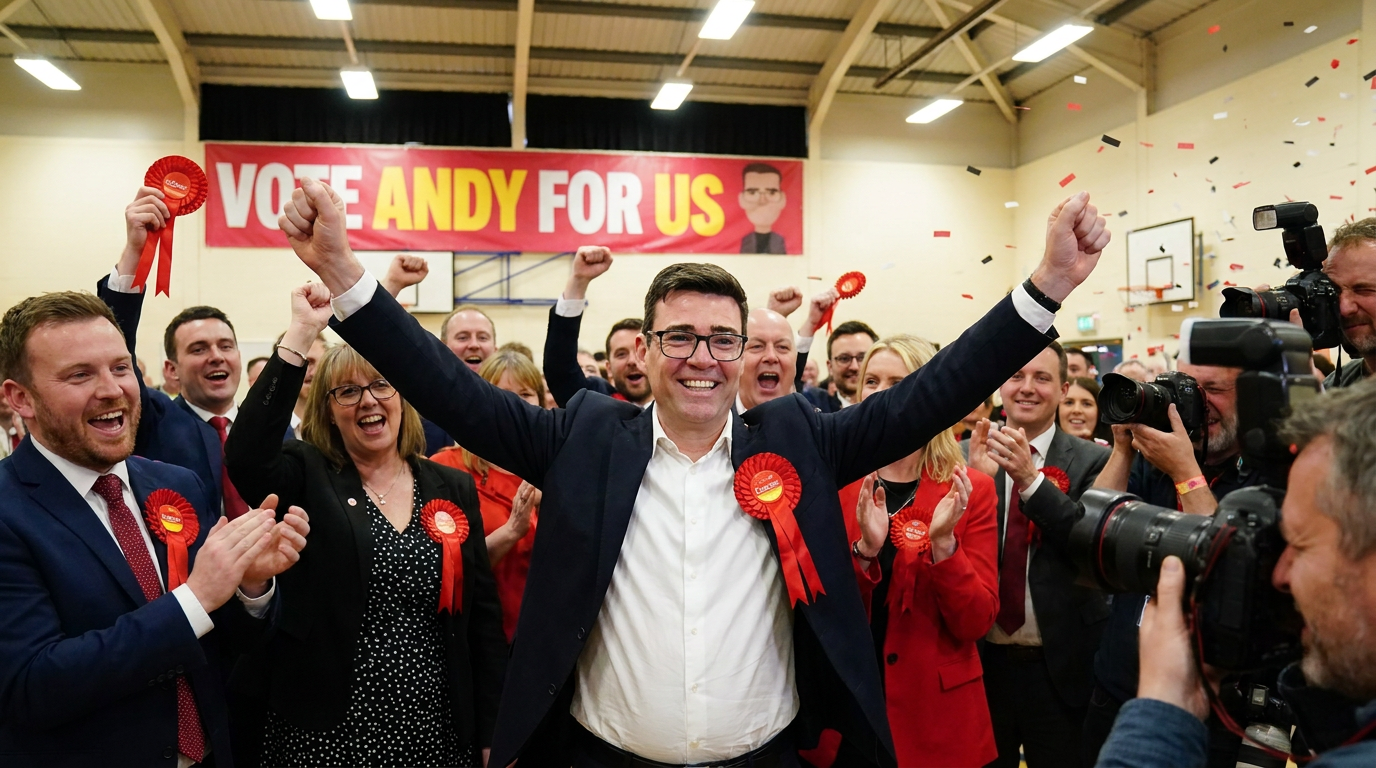
Greater Manchester Mayor Andy Burnham has secured a decisive victory in the Makerfield by-election, returning to the House of Commons after a nine-year absence and setting the stage for a high-stakes challenge to Prime Minister Keir Starmer. Burnham, who previously served as a cabinet minister under Tony Blair and Gordon Brown, won the seat with 54.8% of the vote, comfortably defeating candidates from Reform UK and the newly formed Restore Britain party. The by-election was triggered in May when incumbent Labour MP Josh Simons resigned specifically to provide Burnham with a parliamentary seat—a strict prerequisite under Labour Party rules for mounting a formal leadership challenge.[1][2][8]
The contest drew intense national and international attention, widely viewed as a proxy battle over Starmer's future following Labour's heavy losses in the May local elections. Burnham's margin of victory significantly exceeded polling expectations, delivering a powerful mandate for his anticipated leadership bid. He secured 24,927 votes, giving him a commanding majority of 9,231 over Reform UK's Robert Kenyon, who finished second with 34.5%. Turnout was unusually high for a by-election at 58.7%, marking the highest participation rate for a parliamentary by-election in nearly seven years and reflecting the intense public interest in the race.[2][5][7][8]
In his victory speech in the early hours of Friday morning, Burnham framed the result as a demand for national renewal and a rejection of the political status quo. "Everyone knows that politics isn't working. Everyone can feel that the country isn't where it should be," he told cheering supporters at the Life convention centre in Wigan. "Tonight could, just could, be the turning point." He warned that Labour had a "final chance to change" and promised to champion policies that prioritize neglected regions, rebuild the industrial north, and end "trickle-down economics."[1][3][7]

The victory places immense and immediate pressure on Keir Starmer, who has faced mounting calls from within his own party to set a timetable for his departure following a string of poor electoral performances. Because the Labour Party holds a commanding majority in the House of Commons, a change in party leadership would automatically make Burnham the United Kingdom's next prime minister without the need for a general election. Starmer publicly congratulated Burnham on social media, writing that the voters of Makerfield "chose Labour's campaign of hope and optimism over division and hate." Despite the public pleasantries, the underlying tension between the two political heavyweights remains palpable as the party braces for a potential civil war.[2][3][4]
However, the prime minister reiterated his determination to remain in office, telling reporters that he would not "walk away" from the mandate he won in the 2024 general election. "If there is a contest, just to be clear with you, then, yes, I will run," Starmer stated, signaling his intent to fight any attempt to oust him. To formally trigger a leadership contest, Burnham must secure the backing of at least 81 Labour MPs, which represents 20% of the parliamentary party.[1][4][7]

"If there is a contest, just to be clear with you, then, yes, I will run," Starmer stated, signaling his intent to fight any attempt to oust him.
Allies of the Greater Manchester mayor have indicated that he already has the necessary support lined up, though some senior Labour figures are urging Starmer to agree to an "orderly and managed transition" to avoid a bruising and highly public internal battle. The prospect of a protracted leadership fight has raised concerns about government stability, with business leaders and financial markets watching closely for signs of prolonged political chaos. Burnham is expected to travel to London to be sworn in as a Member of Parliament as early as Monday, at which point he will likely hold meetings with parliamentary colleagues to solidify his coalition.[2][4][7]
The Makerfield result also delivered a significant setback to Nigel Farage's Reform UK. Despite leading in national polls and performing strongly in the Wigan area during recent local elections, the party failed to capture the seat. Farage expressed disappointment with the outcome, acknowledging that the party had been "hoisted with our own petard" as voters prioritized backing Burnham to force a change in national leadership. Reform's campaign was further complicated by the emergence of Restore Britain, a hard-right party founded by former Reform MP Rupert Lowe following a bitter public dispute with Farage.[1][6][8]

Restore Britain candidate Rebecca Shepherd secured 6.8% of the vote, enough to keep her deposit but far short of challenging the frontrunners. Farage urged Restore voters to "think again," arguing that fracturing the right-wing vote only serves to benefit the Labour Party. Polling analysts noted that Burnham's victory was heavily bolstered by significant tactical voting across the political spectrum. The Liberal Democrat and Green Party candidates saw their vote shares collapse to a combined 1%, down from 11% in the 2024 general election, suggesting that progressive and centrist voters coalesced behind Burnham to ensure Reform UK did not win the seat.[1][5][8]
The Makerfield vote coincided with two other highly scrutinized parliamentary by-elections in Scotland, which were triggered by Scottish National Party MPs moving to the Scottish Parliament. In Aberdeen South, the Scottish Conservatives secured a historic victory, marking their first by-election gain in Scotland since 1967, while the SNP successfully held onto the coastal seat of Arbroath and Broughty Ferry. Meanwhile, Burnham's triumphant return to Westminster will require him to officially step down as Mayor of Greater Manchester, a position he has held and defined since 2017. His departure will trigger a massive mayoral by-election in the region later this summer, setting off yet another intense political contest in the north of England.[4][8]
How we got here
May 2026
Labour MP Josh Simons resigns his Makerfield seat to allow Andy Burnham to run.
May 2026
Labour suffers significant losses in local elections, increasing pressure on Keir Starmer.
June 18, 2026
Voters in Makerfield cast their ballots in the highly anticipated by-election.
June 19, 2026
Andy Burnham is declared the winner with 54.8% of the vote.
Viewpoints in depth
The case for Burnham's leadership
Supporters argue Burnham is uniquely positioned to unite the country and halt the rise of populist right-wing parties.
Advocates for Andy Burnham point to his decisive victory in Makerfield as proof of his broad electoral appeal. By securing nearly 55% of the vote in a constituency where Reform UK recently dominated local elections, Burnham demonstrated an ability to win back working-class voters who have grown disillusioned with the current Labour leadership. His supporters argue that his 'place-first' politics and focus on regional inequality offer a compelling alternative to Keir Starmer's administration, which they view as overly London-centric and lacking a clear vision. They contend that a swift, orderly transition of power is necessary to prevent further electoral losses and to deliver the economic changes promised in 2024.
The case for Starmer's continuity
Loyalists maintain that the Prime Minister earned a mandate in 2024 and that a leadership contest would cause unnecessary instability.
Defenders of Keir Starmer emphasize that he led the Labour Party to a landslide general election victory just two years ago, securing a mandate that should not be discarded due to mid-term unpopularity. They warn that plunging the governing party into a protracted leadership contest would distract from the business of running the country and project an image of chaos to the public and financial markets. Starmer's allies argue that the government needs time to implement its agenda and that capitulating to internal pressure would set a dangerous precedent, undermining the stability of the parliamentary system.
Reform UK's electoral ceiling
Analysts and party officials debate whether the Makerfield result exposes the limits of Reform UK's momentum.
For Reform UK, the Makerfield by-election was a critical test of their ability to translate strong national polling into parliamentary seats. Despite increasing their vote share from the 2024 general election, the party fell significantly short of victory. Observers suggest that Reform's momentum was blunted by a combination of tactical voting from progressive electors and the emergence of the rival Restore Britain party, which siphoned off nearly 7% of the right-wing vote. Nigel Farage and his allies argue that the result was skewed by voters prioritizing the removal of Keir Starmer, but critics contend that Reform's failure to win a highly favorable demographic seat indicates a structural ceiling to their support.
What we don't know
- Whether Keir Starmer will ultimately agree to an orderly transition of power or force a protracted leadership contest.
- How quickly Andy Burnham will secure the 81 MP signatures required to formally trigger the challenge.
- Who will emerge as the Labour candidate to replace Burnham as Mayor of Greater Manchester.
Key terms
- By-election
- An election held in a single political constituency to fill a vacancy that arises between general elections.
- Leadership challenge
- A formal process within a political party to unseat the current leader, which in Labour requires the backing of 20% of the party's MPs.
- Tactical voting
- When voters support a candidate who is not their first choice in order to prevent a less preferred candidate from winning.
- Trickle-down economics
- An economic theory that financial benefits provided to the wealthy and corporations will eventually benefit poorer members of society.
Frequently asked
Why did Andy Burnham run in Makerfield?
Under Labour Party rules, a candidate must be a sitting Member of Parliament to mount a leadership challenge. Burnham ran for the Makerfield seat to return to Westminster and position himself to challenge Keir Starmer.
Can Burnham become Prime Minister without a general election?
Yes. Because the Labour Party holds a majority in the House of Commons, whoever leads the party automatically becomes Prime Minister without the need for a national vote.
How did Reform UK perform in the by-election?
Reform UK candidate Robert Kenyon finished second with 34.5% of the vote. While this was an increase from the 2024 general election, the party failed to win the seat despite strong national polling.
What is Restore Britain?
Restore Britain is a hard-right political party founded in early 2026 by former Reform UK MP Rupert Lowe. The party secured 6.8% of the vote in Makerfield, splitting the right-wing electorate.
Sources
Source coverage
8 outlets
4 viewpoints surfaced








[1]The GuardianLabour "Change" Faction
Andy Burnham has set up a potential showdown with Keir Starmer after convincingly winning the Makerfield byelection
Read on The Guardian →[2]Washington PostLabour Leadership Loyalists
Burnham, the mayor of Greater Manchester, is now positioned to challenge Prime Minister Keir Starmer
Read on Washington Post →[3]Al JazeeraReform UK Supporters
Greater Manchester mayor's victory in Makerfield clears path for bid to unseat Starmer as prime minister
Read on Al Jazeera →[4]ITV NewsLabour Leadership Loyalists
Can Andy Burnham oust Starmer? How a Labour leadership contest would work
Read on ITV News →[5]PA MediaReform UK Supporters
Makerfield by-election result: Key numbers and historical trends
Read on PA Media →[6]Byline TimesLabour "Change" Faction
Rejecting the Politics of Rage: Andy Burnham Wins Makerfield By-Election
Read on Byline Times →[7]PBS NewsLabour "Change" Faction
Starmer plans to take on rival Burnham in challenge for UK Labour leadership
Read on PBS News →[8]WikipediaHard-Right Insurgents
2026 Makerfield by-election
Read on Wikipedia →
More in news politics
See all 5 stories →Climate Grants
Federal Judge Rules EPA's Cancellation of $2.8 Billion Climate Justice Grant Program Unlawful
7 sources
Crowdsourced Moderation
Does Crowdsourced Fact-Checking Actually Work? The Evidence on Community Notes
6 sources

Middle East Peace
Israel and Hezbollah agree to renewed ceasefire, saving fragile US-Iran peace deal
7 sources
Every angle. Every day.
Get news politics stories with full source coverage and perspective breakdowns delivered to your inbox.