
President Trump Outlines Post-War Agenda, Labels AI Firm Anthropic a 'National Security Threat'
In a sweeping interview, President Trump detailed his administration's foreign policy following the Iran war resolution and signaled a stark escalation in federal oversight of artificial intelligence.
By Factlen Editorial Team
- Executive Branch Advocates
- View the president's aggressive posture on AI and foreign policy as necessary decisive action to protect American interests.
- Tech Industry Leaders
- Express alarm over the politicization of artificial intelligence and the chilling effect of national security threat labels on private enterprise.
- Diplomatic Observers
- Scrutinize the administration's claims of averting global depression and urge caution regarding sudden policy shifts toward Cuba.
What's not represented
- · Cuban government officials
- · Anthropic executive board
Why this matters
The president's remarks indicate a major shift in how the federal government will treat leading AI laboratories, potentially subjecting them to strict defense controls, while signaling aggressive new diplomatic postures toward Cuba following the Iran war resolution.
Key points
- President Trump gave a sweeping 45-minute interview outlining his post-war agenda.
- He revealed he recently viewed AI lab Anthropic as a 'national security threat.'
- The president claimed his Iran war resolution averted a global economic depression.
- Trump signaled upcoming diplomatic shifts regarding Cuba, comparing it to Venezuela.
- The tech industry is expressing alarm over the potential for heavy-handed federal AI regulation.
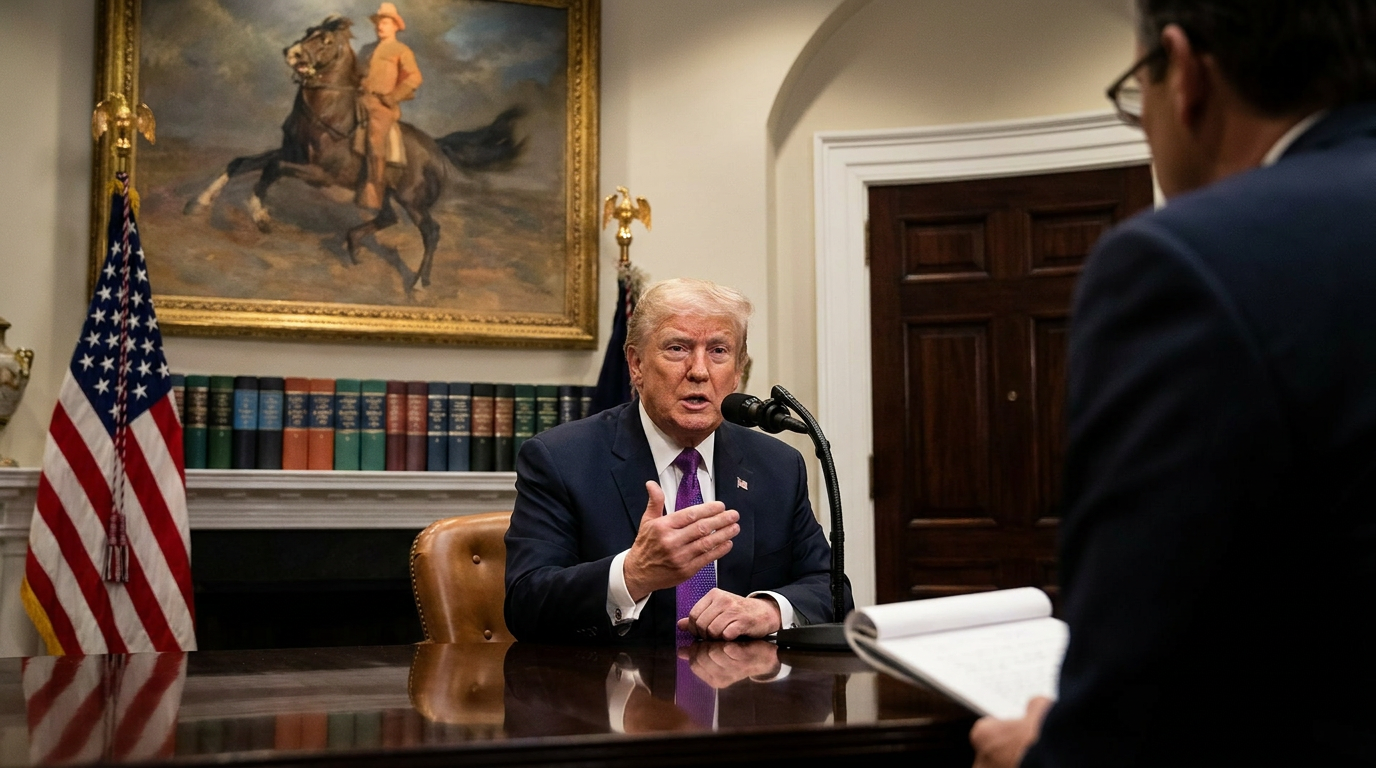
In a sweeping 45-minute interview from the Roosevelt Room, President Trump outlined an expansive vision for his post-war administration, detailing major shifts in foreign policy and signaling a stark escalation in federal oversight of artificial intelligence. The conversation with Axios touched on the recent resolution of the Iran war, future plans for Cuba, and the limits of executive power.[1][2]
The most immediate shockwave came from the president's characterization of Anthropic, one of the world's leading artificial intelligence laboratories. Trump revealed that just last week, he viewed the company as a "national security threat," citing a mix of geopolitical vulnerabilities and internal personality clashes at the highest levels of the tech industry.[2][4]
While Trump noted that relations with Anthropic have since improved, the explicit use of national security framing represents a dramatic escalation in how the White House handles Silicon Valley's AI pioneers. Industry analysts note that designating a domestic AI lab as a security threat could open the door to aggressive federal interventions, including defense-production mandates or strict export controls on underlying models.[5][7]

The tech sector has reacted with a mix of caution and alarm. Observers point out that the administration is increasingly viewing artificial general intelligence not just as a commercial frontier, but as a critical weapons system in the broader geopolitical race. The friction with Anthropic underscores the fragile relationship between the federal government and the private labs building frontier models.[5][7]
Beyond technology, the president used the interview to frame his recent diplomatic and military maneuvers in the Middle East. Trump asserted that his administration's deal to end the conflict in Iran successfully averted a "global depression," claiming that the stabilization of energy markets was a direct result of his negotiating tactics.[1][3]
Beyond technology, the president used the interview to frame his recent diplomatic and military maneuvers in the Middle East.
Foreign policy watchdogs and critics have scrutinized these claims, noting that while the cessation of hostilities in the Strait of Hormuz did calm Brent crude prices, the long-term stability of the region remains precarious. Nonetheless, the White House is heavily leaning into the Iran resolution as a cornerstone of its second-term mandate.[4][6]

Emboldened by the Middle East resolution, Trump signaled that his attention is turning southward. He suggested that Cuba could soon receive the "same treatment as Venezuela," hinting at a potential mix of aggressive sanctions relief tied to political concessions, or conversely, a tightening of the economic embargo depending on Havana's alignment with foreign adversaries.[1][6]
Woven throughout the 45-minute exchange was a clear articulation of how the president views his own authority. Following the wartime footing of the past year, Trump described a presidency with expansive, largely unchecked powers, particularly in matters of national security and foreign diplomacy.[2][4]
Conservative commentators have praised the interview as a demonstration of decisive leadership, arguing that the administration's willingness to play hardball with both foreign adversaries and domestic tech giants is exactly what the current geopolitical climate requires.[3]
As the transcript of the interview circulates through Washington and Silicon Valley, lawmakers and corporate boards are bracing for the translation of these remarks into official policy. Whether the friction with Anthropic results in formal executive orders or remains a rhetorical warning shot will likely dictate the trajectory of US AI development for the remainder of the decade.[4][5]

How we got here
Early 2026
The US and Iran reach a diplomatic resolution to end active hostilities.
June 12, 2026
Internal White House discussions reportedly frame Anthropic as a potential security risk.
June 19, 2026
President Trump publicly details his views on AI, Iran, and Cuba in a 45-minute Axios interview.
Viewpoints in depth
The Administration's Stance
Supporters argue that strong executive action is required to manage emerging global threats.
Allies of the administration view the president's rhetoric as a necessary reassertion of American power in a volatile era. By explicitly linking artificial intelligence to national security, the White House is signaling that it will not allow private corporations to dictate the pace of a technology that could alter the global balance of power. Similarly, the administration's framing of the Iran deal as an economic savior is intended to solidify its mandate for aggressive, unilateral deal-making.
Silicon Valley's Alarm
Tech leaders fear that national security designations will stifle innovation and lead to government overreach.
For the technology sector, the president's casual labeling of a leading AI lab as a national security threat is a worst-case scenario realized. Industry advocates argue that treating AI development like weapons manufacturing will slow down domestic progress, potentially allowing foreign adversaries to close the technological gap. They worry that personality clashes and political grievances are increasingly driving federal regulatory threats, creating an unstable environment for capital investment and research.
Foreign Policy Analysts
Diplomatic experts urge caution regarding the administration's sweeping claims of global stabilization.
While acknowledging that the end of the Iran conflict stabilized oil prices, foreign policy watchdogs warn against premature declarations of victory. Analysts point out that the underlying tensions in the Middle East remain unresolved. Furthermore, the casual suggestion that Cuba might receive the 'Venezuela treatment' has left diplomats scrambling to understand whether the administration is planning a sudden easing of sanctions or a new wave of economic pressure, highlighting the unpredictable nature of the current executive branch.
What we don't know
- Whether the White House will issue formal executive orders restricting Anthropic or other AI labs.
- The specific policy mechanisms the administration plans to use regarding Cuba.
- How the broader tech industry will alter its lobbying efforts in response to the national security framing.
Key terms
- National Security Threat Designation
- A formal or informal classification by the federal government indicating that an entity poses a risk to the country, often opening the door to strict regulatory or defense controls.
- Artificial General Intelligence (AGI)
- A theoretical form of AI that can understand, learn, and apply knowledge across a wide range of tasks at a level equal to or beyond human capability, increasingly viewed as a geopolitical asset.
Frequently asked
Why did Trump call Anthropic a national security threat?
The president cited a combination of geopolitical concerns regarding AI development and internal personality clashes, though he noted that relations with the company have recently improved.
What did the president say about the Iran war?
Trump claimed that his administration's deal to end the conflict successfully averted a global economic depression by stabilizing volatile energy markets.
How might US policy toward Cuba change?
Trump suggested Cuba could receive the "same treatment as Venezuela," implying a potential shift in sanctions or diplomatic engagement, though specific policy mechanisms were not detailed.
Sources
Source coverage
7 outlets
3 viewpoints surfaced






[1]AxiosDiplomatic Observers
Exclusive: President Trump talks Iran, Cuba, Israel, AI, and power on "The Axios Show"
Read on Axios →Exclusive: Trump tells "The Axios Show" that Anthropic was a national security threat
Read on Axios →[3]Fox NewsExecutive Branch Advocates
Trump touts historic Iran peace deal, warns AI giants on national security in wide-ranging interview
Read on Fox News →[4]The New York TimesDiplomatic Observers
In Axios Interview, Trump Claims Sweeping Mandate After Iran Deal and Targets AI Firm
Read on The New York Times →[5]The Wall Street JournalTech Industry Leaders
Trump's 'National Security' Warning to Anthropic Sends Shockwaves Through Tech Sector
Read on The Wall Street Journal →[6]ReutersDiplomatic Observers
Trump floats Cuba policy shift, claims Iran deal averted global depression
Read on Reuters →[7]WiredTech Industry Leaders
What Trump's Clash With Anthropic Means for the Future of AI Regulation
Read on Wired →

More in news politics
See all 7 stories →PEPFAR Cuts
U.S. to Phase Out HIV/AIDS Funding for South Africa Over Policy Dispute
6 sources

School Choice
Supreme Court Rules Federal Education Funds Can Follow Students to Private Schools
7 sources
US-Iran Peace Deal
US and Iran sign historic agreement to end 110-day war, triggering Israel-Hezbollah ceasefire
7 sources

Voting Rights
Supreme Court Upholds Strict State Deadlines for Mail-In Ballots Ahead of 2026 Midterms
7 sources
Every angle. Every day.
Get news politics stories with full source coverage and perspective breakdowns delivered to your inbox.