
How Neuroaesthetics is Turning Interior Design into a Science of Well-Being
Emerging research in neuroscience reveals that interior design choices—from lighting to room shape—trigger measurable biological responses, transforming how we build spaces for mental health.
By Factlen Editorial Team
- Evidence-Based Designers
- Architects and interior designers applying neurological findings to real-world spaces.
- Clinical Neuroscientists
- Researchers focused on the empirical, biological data of how the brain reacts to spatial stimuli.
- Design Synthesizers
- Editorial voices bridging the gap between raw scientific data and holistic, accessible living spaces.
What's not represented
- · Low-Income Housing Advocates
- · Facilities Managers
Why this matters
With modern humans spending up to 90 percent of their lives indoors, the physical spaces we inhabit are no longer just aesthetic choices—they are active drivers of our physiological and mental health. Understanding neuroaesthetics empowers you to make simple, evidence-based changes to your home that can measurably lower stress and improve cognitive focus.
Key points
- Neuroaesthetics is the scientific study of how the built environment affects brain chemistry, emotions, and behavior.
- Clinical data shows that thoughtfully designed spaces can lower heart rates and reduce the stress hormone cortisol by up to 20 percent.
- Biodynamic lighting that mimics the sun's natural progression is crucial for regulating circadian rhythms and improving sleep.
- Curvilinear furniture and biophilic design elements actively stimulate the brain's pleasure and reward centers.
- The field is shifting interior design from an intuition-based art form into an evidence-based practice focused on preventive mental healthcare.
For decades, interior designers have relied on a mysterious sixth sense to explain why certain rooms simply feel right. A client walks into a sunlit, wood-paneled living room and immediately exhales, their shoulders dropping as they declare that the space feels "peaceful." Historically, this phenomenon was chalked up to artistic intuition or subjective taste. But modern science is rewriting that narrative, proving that our bodies undergo measurable, biological changes in response to our physical environments. The feeling of comfort is not just an aesthetic preference; it is a neurological event. Welcome to the emerging field of neuroaesthetics, a discipline that is rapidly transforming how we build, decorate, and inhabit our homes.[2][3]
Neuroaesthetics—and its spatial cousin, neuroarchitecture—is the scientific study of how the built environment affects brain chemistry, emotions, and behavior. By combining the rigorous metrics of neuroscience with the creative principles of interior design, researchers are discovering exactly how elements like light, color, acoustics, and spatial layout influence our central nervous system. The implications are profound: the spaces we live in are not passive backdrops to our lives. They are active participants that can either elevate our cognitive performance and soothe our anxieties, or quietly elevate our stress hormones.[1][4]
The origins of this interdisciplinary field trace back to the 1990s, when neurobiologist Semir Zeki first coined the term "neuroaesthetics." Zeki utilized emerging brain-scanning technology to observe how the human mind reacts to visual art, discovering that the perception of beauty reliably activates specific reward centers in the brain. Over time, this research expanded beyond the canvas to encompass the three-dimensional spaces we inhabit. But the foundational anecdote of neuroarchitecture actually belongs to Dr. Jonas Salk, the virologist who developed the polio vaccine.[2][6]
In the 1950s, Salk found himself paralyzed by a mental block while working in a dark, cramped basement laboratory in Pittsburgh. Seeking a reset, he traveled to Assisi, Italy, where he spent time wandering through the city's expansive, light-filled 13th-century monasteries. The architectural shift profoundly altered his mental state, clearing his block and allowing him to conceptualize the breakthrough that would lead to the vaccine. Convinced that the physical environment had catalyzed his cognitive leap, Salk later partnered with architect Louis Kahn to design the Salk Institute in California—a facility explicitly built to optimize the brain function of the scientists working inside.[2][6]
Today, we no longer have to rely on anecdotal evidence to understand what happened to Salk's brain. Functional magnetic resonance imaging (fMRI) and electroencephalogram (EEG) technology allow researchers to observe the neurological mechanics of spatial perception in real time. According to researchers at the Penn Center for Neuroaesthetics, human-building interactions are governed by three distinct neural networks: the sensory-motor system, the knowledge-meaning system, and the emotion-valuation system. When we enter a room, these networks instantly collaborate to assess the environment, triggering a cascade of physiological responses before we even consciously register the decor.[4][6]

The biological markers of these responses are striking. When individuals are placed in thoughtfully designed, aesthetically pleasing spaces, clinical monitors record a measurable drop in heart rate and blood pressure. Cortisol, the hormone primarily responsible for stress, decreases by as much as 15 to 20 percent. Simultaneously, the brain increases its release of serotonin and dopamine, the neurotransmitters associated with mood regulation and pleasure. In other words, a well-designed living room acts as a mild, non-pharmacological intervention for the nervous system.[3][6]
One of the most potent tools in the neuroaesthetic arsenal is lighting. For the vast majority of human history, our circadian rhythms were strictly governed by the rising and setting of the sun. Modern indoor living, characterized by static, artificial fluorescent lighting, severely disrupts this biological clock. Neuroarchitecture advocates for "biodynamic lighting"—systems that emulate the natural progression of sunlight, shifting from cool, blue-toned light in the morning to stimulate alertness, to warm, amber tones in the evening to promote the release of melatonin. Studies indicate that optimizing daylight exposure directly improves sleep quality and cognitive focus.[1][7]

One of the most potent tools in the neuroaesthetic arsenal is lighting.
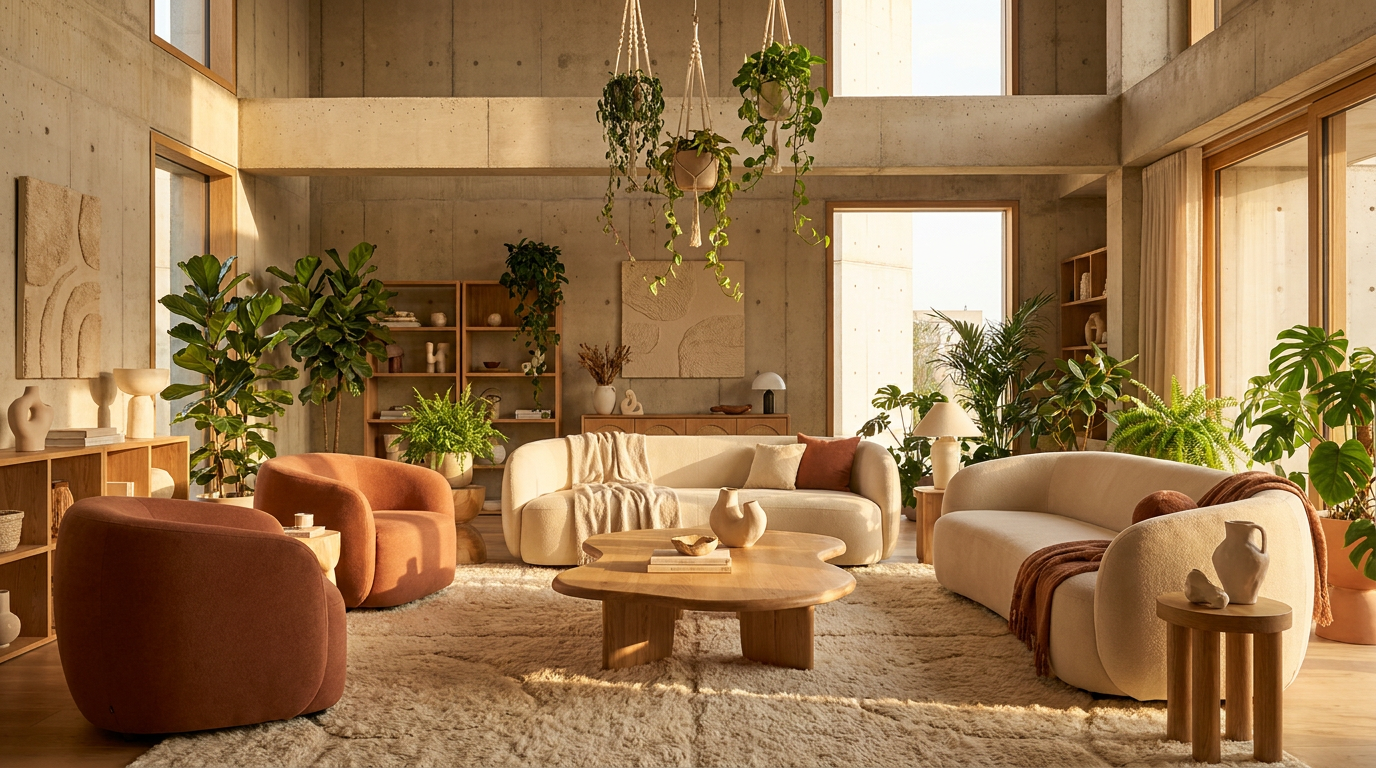
Geometry and spatial layout also play a surprisingly outsized role in our neurological comfort. fMRI studies have demonstrated that curvilinear spaces—rooms featuring rounded edges, soft arches, and circular furniture—actively stimulate the brain's pleasure and reward centers. Sharp, jagged angles, conversely, can trigger the amygdala, the brain's threat-detection center. This evolutionary quirk suggests that our brains associate sharp edges with danger (like thorns or teeth) and smooth curves with safety and organic growth. Incorporating curved sofas or arched doorways is a scientifically backed method for softening a room's psychological impact.[4][6]
This evolutionary perspective is the driving force behind biophilic design, a core pillar of neuroaesthetics. Biophilia is the innate human instinct to connect with nature. When interior designers bring natural elements indoors—through abundant houseplants, exposed wood grain, stone textures, and water features—they are hacking the brain's evolutionary programming. Visual access to greenery has been shown to lower anxiety, improve working memory, and accelerate physical healing. Even the tactile sensation of touching natural wood or woven fabrics stimulates the somatosensory cortex, producing deep-seated feelings of belonging and refuge.[4][5]
Color psychology, long a staple of traditional interior design, has also been validated and refined by neurological data. It is now understood that color stimulates specific areas of the brain related to emotional processing. Soft, natural tones like greens and blues are highly effective at calming the nervous system and reducing anxiety, making them optimal choices for bedrooms and restorative spaces. Conversely, warm, vibrant tones like yellow and red stimulate energy and attention, which can be strategically deployed in kitchens or collaborative workspaces to foster dynamic interaction.[1][2]
Acoustics represent the invisible dimension of neuroaesthetics. While a room might look visually serene, poor acoustic design can entirely negate its positive neurological effects. Unpredictable, harsh noises elevate cortisol levels and maintain the brain in a heightened state of alert. Neuroaesthetic design mitigates this through the use of sound-absorbing materials like acoustic panels, heavy drapery, and textured rugs. By intentionally separating noisy activities from quiet zones and introducing pleasant ambient sounds—like a small indoor water feature—designers can significantly reduce stress markers.[3][6]
Despite these exciting advancements, researchers acknowledge the inherent uncertainties and limitations of applying universal biological rules to interior design. The "knowledge-meaning" network of the brain relies heavily on personal memories, cultural background, and individual experiences. A minimalist, biophilic space that registers as biologically optimal on an fMRI scan might still feel cold or alienating to someone whose cultural definition of "home" involves vibrant maximalism and dense, historical layering. Neuroaesthetics provides a powerful baseline, but it cannot entirely replace the subjective, deeply personal nature of human taste.[4][6]
Nevertheless, the shift from intuition-based design to evidence-based design is accelerating rapidly. In the commercial sector, certifications like the WELL Building Standard are making neuroaesthetic principles mandatory for modern offices, hospitals, and schools. Data shows that employees in biophilic offices report 15 percent higher productivity and significantly lower fatigue, while students in classrooms with dynamic daylighting exhibit enhanced concentration and emotional stability. As these benefits become undeniable in public spaces, the principles are inevitably trickling down into residential interior design.[2][5]

The global events of the early 2020s acted as a massive catalyst for this movement. The sudden shift to remote work and prolonged periods of social isolation forced millions of people to confront the psychological impact of their domestic environments. With the World Health Organization estimating that modern humans spend between 80 and 90 percent of their waking lives indoors, the home is no longer viewed merely as a functional shelter. It is increasingly recognized as a primary engine of preventive mental healthcare, where every design choice either contributes to or detracts from our collective resilience.[1][2]

Ultimately, neuroaesthetics bridges the long-standing gap between art and science, proving that beauty is not a frivolous luxury. It is a biological necessity. By understanding how our brains process the spaces around us, we can intentionally craft homes that heal, empower, and connect us. The future of interior design is not just about making a room look good; it is about ensuring that the space fundamentally supports the human mind, one thoughtful detail at a time.[3][6]
How we got here
1950s
Dr. Jonas Salk travels to Assisi, Italy, realizing that the architecture of the 13th-century monasteries helped clear his mental block.
1965
The Salk Institute opens in California, designed by Louis Kahn specifically to optimize the cognitive function of its researchers.
1990s
Neurobiologist Semir Zeki coins the term 'neuroaesthetics' after using brain scans to study how humans perceive beauty.
2014
The WELL Building Standard is launched, creating the first architectural certification focused exclusively on human health and wellness.
2020
The global pandemic forces a mass shift to indoor living, rapidly accelerating public interest in how home environments impact mental health.
Viewpoints in depth
Clinical Neuroscientists
Researchers focused on the empirical, biological data of how the brain reacts to spatial stimuli.
This camp relies on fMRI scans, EEG readings, and hormonal swabs to quantify the human experience of architecture. They argue that aesthetic responses are not purely subjective but are deeply rooted in evolutionary biology and neural networks. By isolating variables like light temperature or the degree of a curve, neuroscientists aim to create a universal, data-driven baseline for what constitutes a healthy human habitat, moving design away from guesswork and into the realm of preventive medicine.
Evidence-Based Designers
Architects and interior designers applying neurological findings to real-world spaces.
For these practitioners, neuroaesthetics is a practical toolkit rather than an abstract science. They focus on translating clinical data into actionable design choices—such as specifying biodynamic lighting systems, sourcing tactile biophilic materials, and optimizing floor plans for acoustic comfort. This camp argues that since humans spend up to 90 percent of their lives indoors, designers have an ethical obligation to prioritize the physiological and psychological well-being of the occupants over purely visual trends.
Cultural Aesthetes
Critics and traditional designers who emphasize the subjective, cultural, and personal dimensions of space.
While acknowledging the biological benefits of natural light and good acoustics, this perspective cautions against reducing interior design to a purely clinical exercise. They argue that the "knowledge-meaning" network of the brain is heavily influenced by personal memories, cultural heritage, and individual idiosyncrasies. A space optimized perfectly for cortisol reduction might lack the soul, friction, and historical layering that makes a house truly feel like a home, reminding us that human comfort is as much about personal identity as it is about biology.
What we don't know
- How to perfectly balance universal biological design principles with the highly subjective, culturally driven nature of personal taste.
- The long-term neurological impacts of emerging, highly immersive smart-home technologies that constantly alter a room's sensory environment.
- How to scale neuroaesthetic design principles affordably so they can be integrated into low-income and public housing projects.
Key terms
- Neuroaesthetics
- The scientific study of how the brain processes and responds to beauty, art, and visual stimuli.
- Biophilic Design
- An approach to architecture and interior design that seeks to connect occupants more closely to nature through the use of natural lighting, ventilation, landscape features, and organic materials.
- Circadian Rhythm
- The natural, internal process that regulates the sleep-wake cycle and repeats roughly every 24 hours, heavily influenced by light and dark.
- Cortisol
- A hormone produced by the adrenal glands that is often referred to as the 'stress hormone' because its levels rise in response to tension and anxiety.
- Somatosensory Cortex
- The part of the brain that receives and processes sensory information from across the body, such as touch, temperature, and pain.
Frequently asked
What is the difference between neuroaesthetics and neuroarchitecture?
Neuroaesthetics is the broader study of how the brain responds to beauty and art. Neuroarchitecture is the specific application of these principles to the built environment, focusing on how buildings and rooms affect our biology.
Do I need to buy expensive furniture to apply neuroaesthetics?
Not at all. Many neuroaesthetic principles are highly accessible, such as maximizing natural light, incorporating inexpensive houseplants, and using soft, natural color palettes to calm the nervous system.
How does lighting actually change brain chemistry?
Light exposure directly regulates the body's circadian rhythm. Cool, blue-toned light suppresses melatonin to increase alertness, while warm, amber light promotes melatonin production, signaling to the brain that it is time to rest.
Can interior design really lower my stress levels?
Yes. Clinical studies show that environments utilizing biophilic design and curvilinear shapes can actively lower heart rates, reduce blood pressure, and decrease cortisol levels by up to 20 percent.
Sources
Source coverage
7 outlets
3 viewpoints surfaced







[1]NeurotecturaEvidence-Based Designers
What Is Neuroarchitecture?
Read on Neurotectura →[2]Connections by FinsaEvidence-Based Designers
Neuroaesthetics: in search of physical and mental wellbeing
Read on Connections by Finsa →[3]Science in DesignEvidence-Based Designers
The Convergence of Neuroscience and Interior Design
Read on Science in Design →[4]Penn Center for NeuroaestheticsClinical Neuroscientists
The Neuroaesthetics of Architectural Spaces
Read on Penn Center for Neuroaesthetics →[5]Building and Environment JournalClinical Neuroscientists
Clever classrooms: Summary report of the HEAD project
Read on Building and Environment Journal →[6]Factlen Editorial TeamDesign Synthesizers
Synthesis by Factlen editorial team
Read on Factlen Editorial Team →[7]Journal of Clinical Sleep MedicineClinical Neuroscientists
Impact of windows and daylight exposure on overall health and sleep quality
Read on Journal of Clinical Sleep Medicine →

Every angle. Every day.
Get home stories with full source coverage and perspective breakdowns delivered to your inbox.