
OLED vs. Mini-LED: The 2026 Television Buyer's Guide
As television technologies converge in 2026, the choice between OLED and Mini-LED is no longer about finding a clear winner, but matching the display's physics to your living room.
By Factlen Editorial Team
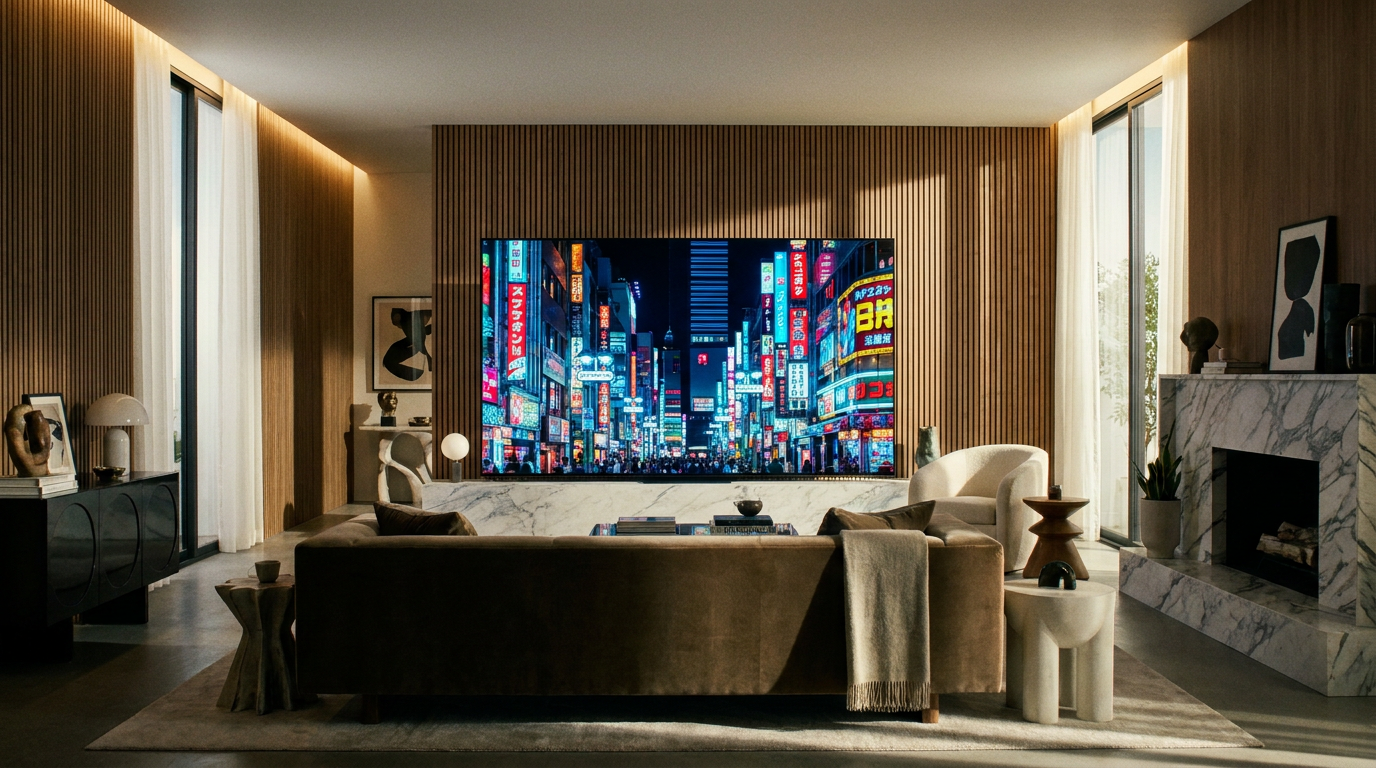
- Home Theater Purists
- Cinephiles who prioritize absolute picture accuracy and infinite contrast.
- Bright Room Viewers
- Consumers with sun-drenched living rooms who need displays that can overpower glare.
- Competitive Gamers
- Players who demand absolute motion clarity and low input lag.
- Value Maximizers
- Buyers looking for the largest possible screen size and longevity per dollar.
What's not represented
- · Environmental Regulators concerned with the high power consumption of 5,000-nit Mini-LED displays.
- · Interior Designers focused on the aesthetic integration of ultra-thin OLEDs versus thicker Mini-LED chassis.
Why this matters
Televisions are long-term investments that dictate how you experience films, sports, and games. Choosing the wrong panel technology for your room's lighting can lead to washed-out images, distracting glare, or permanent screen damage.
Key points
- OLED panels offer perfect black levels and infinite contrast by turning off individual pixels.
- Mini-LED televisions use thousands of dimming zones to achieve massive brightness up to 5,000 nits.
- OLEDs are susceptible to burn-in and use dimming algorithms that reduce brightness in sunlit rooms.
- Mini-LEDs are immune to burn-in but can exhibit blooming or halo effects around bright objects.
- The introduction of RGB Mini-LED and Tandem OLED in 2026 has significantly narrowed the performance gap.
The television market in 2026 is defined by a technological collision that industry analysts call the "Great Convergence" [1]. For years, consumers faced a stark choice between the perfect contrast of OLED and the raw brightness of LED displays. Today, those traditional boundaries have collapsed. OLED panels have become significantly brighter to compete in sunlit rooms, while Mini-LED televisions have gained enough local dimming precision to mimic the deep black levels once exclusive to organic displays [1]. As manufacturers release their flagship models, the decision between the two dominant panel types is no longer about finding a clear winner, but rather matching the underlying physics of the screen to the specific environment of the living room [2].[1][2]
The core technological divide remains rooted in how the two panels generate light. OLED, or Organic Light-Emitting Diode, is a self-emissive technology where every single pixel produces its own light and can turn off completely independently [2]. This eliminates the need for a backlight, allowing for incredibly thin television chassis and infinite contrast ratios [2]. Conversely, Mini-LED relies on an inorganic backlight system divided into thousands of microscopic dimming zones that illuminate a liquid crystal display [2]. While Mini-LED cannot control light at the individual pixel level, its inorganic structure allows it to be driven with massive amounts of electrical current without degrading [7].[2][7]
The case for OLED centers entirely on precision and cinematic accuracy. Because each of the eight million pixels in a 4K display operates autonomously, an OLED television can place a blindingly bright star directly next to the pitch-black vacuum of space without any light bleeding between the two [2]. This per-pixel dimming creates a sense of depth and three-dimensionality that traditional backlights struggle to replicate [4]. Furthermore, OLED panels offer exceptionally wide viewing angles, ensuring that colors remain perfectly saturated even for viewers sitting on the far edges of a wide horseshoe-shaped sofa [5].[2][4][5]

The argument against OLED involves its inherent biological limitations and the software designed to protect it. Because the pixels are carbon-based organic compounds, they are susceptible to heat and differential aging, commonly known as burn-in [4]. To prevent this, OLED televisions employ an Auto Brightness Limiter (ABL), a protective algorithm that aggressively dims the entire screen if a bright, static image is displayed for too long [4]. If a viewer is watching a daytime sports broadcast featuring a massive field of bright green grass or white ice, the television will eventually pull back its luminance to keep the organic pixels cool [2, 4].[2][4]
Evidence from 2026 testing shows that OLED manufacturers have made massive strides in mitigating these drawbacks. The latest Tandem OLED and QD-OLED panels utilize advanced pixel structures and heavy-duty heatsinks to push peak brightness to between 2,000 and 3,000 nits in small highlights [3, 6]. However, independent measurements confirm that while these screens can produce blinding specular highlights, their full-screen sustained brightness still hovers around 250 to 300 nits [4]. This means that while explosions in a dark movie look spectacular, a brightly lit daytime broadcast will still trigger the protective dimming algorithms [4].[3][4][6]
The case for Mini-LED is built on raw, unconstrained power and absolute peace of mind. By utilizing thousands of microscopic LEDs, these televisions can punch through the worst daytime glare in sun-drenched living rooms [7]. Because the backlight is inorganic, there is zero risk of permanent burn-in, allowing owners to leave 24-hour news channels, sports tickers, or static video game menus on the screen indefinitely [2]. Furthermore, Mini-LED technology scales much more cost-effectively, allowing consumers to purchase massive 85-inch, 98-inch, or even 115-inch displays for the price of a standard 65-inch premium OLED [7].[2][7]

The case for Mini-LED is built on raw, unconstrained power and absolute peace of mind.
The argument against Mini-LED focuses on the physical limitations of zone-based backlighting. Even with high-end models boasting up to 20,000 local dimming zones, a single zone still illuminates hundreds of pixels at once [2]. When a bright object moves across a dark background—such as white subtitles on a black cinematic letterbox—the backlight must illuminate the area around the text, creating a faint, glowing halo effect known as blooming [2, 5]. Additionally, the liquid crystal layer inherently restricts viewing angles, meaning the picture can lose contrast and color saturation for anyone not sitting directly in front of the screen [5].[2][5]
Evidence for Mini-LED's rapid advancement in 2026 centers on the introduction of RGB Mini-LED technology. Rather than relying on a conventional white backlight shining through color filters, the newest flagship models use separate red, green, and blue Mini-LEDs to generate color directly [3]. This architectural shift has allowed manufacturers to claim peak brightness levels of 3,500 to 5,000 nits, while significantly improving color purity and volume [3, 6]. Reviewers note that in brightly lit showrooms, the sheer luminous flux of an RGB Mini-LED can make an adjacent OLED look comparatively dull [3].[3][6]
When evaluating the trade-offs for video games, the metrics diverge sharply. OLED panels offer a near-instantaneous pixel response time of roughly 0.03 milliseconds, providing competitive esports players with absolute motion clarity and zero ghosting during fast-paced action [4]. Mini-LED panels, while slower at roughly 1 millisecond, counter with sustained brightness for high-dynamic-range gaming and immunity to the static heads-up displays (HUDs) that can cause differential aging on organic screens [4]. For players logging thousands of hours in a single title, the inorganic durability of Mini-LED often outweighs the microscopic speed advantage of OLED [4].[4]

Ultimately, OLED fits well when the television is placed in a room with controlled lighting, such as a dedicated home theater or a basement media room [2]. It is the definitive choice for cinephiles who demand perfect black levels, accurate shadow detail, and the precise reproduction of film grain [7]. It also fits well for competitive gamers who prioritize absolute motion clarity, and for living rooms with wide, scattered seating arrangements where off-angle viewing is a necessity [5].[2][5][7]
Conversely, OLED does not fit well when the display is installed in a sun-drenched living room with massive windows, where ambient light will wash out the perfect blacks and trigger the screen's protective dimming [2]. It is also a poor fit for households that primarily consume 24-hour news networks with static lower-third graphics, or for buyers looking to maximize their screen size beyond 77 inches on a strict budget [2, 7].[2][7]

Mini-LED fits well when the television must serve as a multi-purpose entertainment hub in a bright, open-concept living space [7]. It is the superior choice for daytime sports viewing, where the screen must sustain a full field of bright color without dimming [7]. It also fits well for casual gamers who leave static menus on screen for hours, and for consumers seeking the immersive scale of an 85-inch or larger display without paying an astronomical premium [7].[7]
Mini-LED does not fit well when the viewer is highly sensitive to blooming artifacts, particularly when watching dark, atmospheric films with bright subtitles [5]. It is also less ideal for tight, wide seating arrangements where viewers are forced to watch from sharp angles, as the liquid crystal display will exhibit color shift and reduced contrast [5]. In 2026, there is no single superior television technology; there is only the correct engineering solution for a specific room [1, 2].[1][2][5]
How we got here
2013
The first large-format OLED televisions enter the consumer market, offering perfect blacks but low peak brightness.
2021
Mini-LED technology is introduced to mainstream televisions, dramatically increasing the number of local dimming zones.
2024
QD-OLED and Micro Lens Array (MLA) technologies push OLED peak brightness past the 1,000-nit barrier.
2026
The 'Great Convergence' arrives as RGB Mini-LEDs hit 5,000 nits and Tandem OLEDs reach 3,000 nits.
Viewpoints in depth
Home Theater Purists
Cinephiles who prioritize absolute picture accuracy and infinite contrast.
For dedicated home theater owners, OLED remains the undisputed champion. This camp argues that raw brightness is secondary to perfect black levels and per-pixel light control, which are essential for accurately reproducing the director's intent in dark, atmospheric films. They view the blooming artifacts of Mini-LEDs as a dealbreaker for serious cinematic viewing.
Bright Room Viewers
Consumers with sun-drenched living rooms who need displays that can overpower glare.
This perspective prioritizes sheer luminous output and durability. Viewers in open-concept, well-lit homes argue that OLED's perfect blacks are entirely washed out by ambient daylight. They champion Mini-LED for its ability to sustain massive full-screen brightness during daytime sports broadcasts and its immunity to burn-in from static news tickers.
Competitive Gamers
Players who demand absolute motion clarity and low input lag.
Gamers are uniquely divided by the technology. Competitive esports players heavily favor OLED for its near-instantaneous 0.03-millisecond response time, which eliminates motion blur. However, players who log thousands of hours in single titles with static heads-up displays (HUDs) often lean toward Mini-LED to avoid the anxiety of permanent image retention.
What we don't know
- How the long-term durability of the new 2026 Tandem OLED panels will compare to traditional single-stack OLEDs over a five-year lifespan.
- Whether manufacturers will successfully eliminate the blooming artifacts in Mini-LEDs through future algorithmic updates.
Key terms
- Auto Brightness Limiter (ABL)
- A protective software algorithm in OLED TVs that dims the entire screen during bright scenes to prevent the organic pixels from overheating.
- Blooming
- A visual artifact on Mini-LED TVs where light bleeds into dark areas around bright objects, creating a faint halo effect.
- Nits
- A unit of measurement for screen brightness; one nit is roughly equivalent to the light of a single candle per square meter.
- Local Dimming Zones
- Specific areas of a Mini-LED backlight that can be independently dimmed or brightened to improve contrast.
- Tandem OLED
- A new panel architecture that stacks multiple OLED layers to dramatically increase brightness and lifespan.
Frequently asked
Will an OLED TV get burn-in from playing video games?
While modern OLEDs have advanced protective features, leaving static elements like health bars on screen for thousands of hours still carries a slight risk of permanent image retention.
Is Mini-LED the same as MicroLED?
No. Mini-LED uses tiny LEDs as a backlight for an LCD screen, while MicroLED is a vastly more expensive, self-emissive technology where the microscopic LEDs are the actual pixels.
Which TV is better for a bright living room?
Mini-LED is significantly better for bright rooms, as it can sustain much higher full-screen brightness to cut through daytime glare without dimming.
Do I need an 8K TV in 2026?
For the vast majority of consumers, no. 4K remains the standard, and investing in a high-quality 4K OLED or Mini-LED will provide a better picture than a cheaper 8K model.
Sources
Source coverage
7 outlets
4 viewpoints surfaced







[1]Data Wire SolutionsBright Room Viewers
Best TVs for 2026: 10 OLED and Mini-LED Picks by Room, Brightness, and Install Reality
Read on Data Wire Solutions →[2]Pocket-lintHome Theater Purists
OLED vs Mini-LED: Which TV technology is best for you?
Read on Pocket-lint →[3]What Hi-Fi?Value Maximizers
Hisense UR9 vs Sony Bravia 8 II: can RGB Mini LED defeat the best OLED TV around?
Read on What Hi-Fi? →[4]Display NinjaCompetitive Gamers
Mini LED vs OLED Displays
Read on Display Ninja →[5]RTINGSHome Theater Purists
The Best TVs Of 2026
Read on RTINGS →[6]TechRadarValue Maximizers
The best TVs of CES 2026: brighter OLEDs, 130-inch screens, and RGB mini-LED everywhere
Read on TechRadar →[7]100% AppliancesBright Room Viewers
OLED vs Mini LED: Key Differences
Read on 100% Appliances →
Every angle. Every day.
Get meta stories with full source coverage and perspective breakdowns delivered to your inbox.