
How AI and Computer Vision Are Finally Fixing Boxing's Scoring Problem
New artificial intelligence systems are tracking fighters' biomechanics in real-time to eliminate subjective bias and modernize how boxing matches are judged.
By Factlen Editorial Team
- Sports Technologists
- AI developers believe computer vision can eliminate corruption and human error by providing 100% objective data.
- Regulatory Bodies
- Governing federations see AI as a necessary tool to restore trust and secure boxing's Olympic future, but insist on human oversight.
- Boxing Analysts
- Media and analysts are using the data to audit controversial decisions, though some worry about losing the sport's human element.
What's not represented
- · Traditionalist Boxing Judges
- · Amateur Boxers
Why this matters
For centuries, boxing has been plagued by controversial judging that erodes fan trust and ruins fighters' careers. The integration of AI scoring systems in 2026 promises to eliminate human bias, potentially saving the sport's Olympic future and democratizing elite analytics for local gyms.
Key points
- Boxing has historically struggled with controversial, subjective judging that damages the sport's credibility.
- New computer vision AI systems can track 50 biomechanical parameters per fighter using standard cameras.
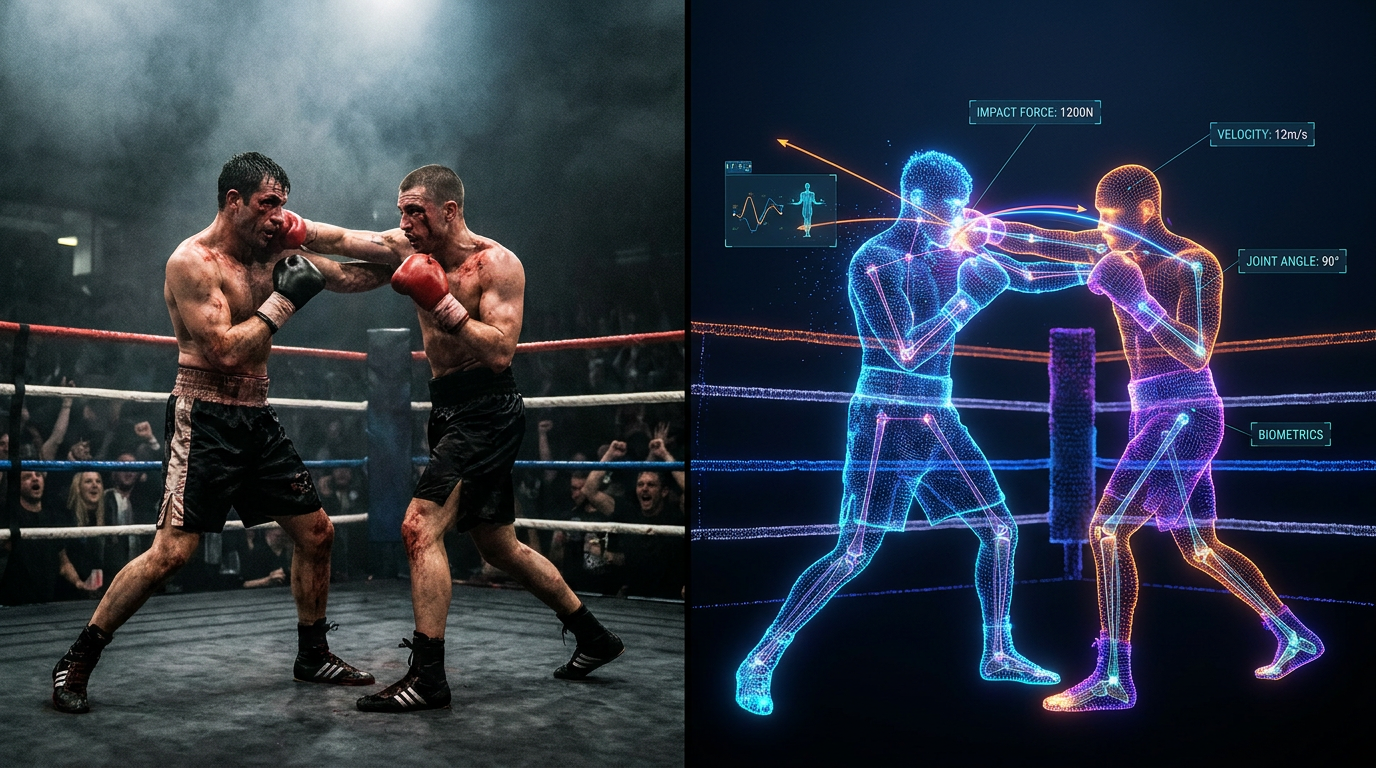
- The AI maps joint angles, punch quality, and spatial pressure to predict highly accurate, objective scorecards.
- The International Boxing Association (IBA) announced the use of AI as a support tool for officiating in 2026.
- The technology is accessible enough to be used in local gyms for training and automated video production.
- Critics argue AI may struggle to accurately score defensive mastery and psychological 'ring generalship'.
For as long as boxing has existed, the sport has been haunted by the specter of the "robbery." From local club fights to the Olympic stage, the subjective nature of human judging has routinely produced scorecards that leave fighters devastated and fans crying foul. The traditional 10-point must system relies on three individuals ringside attempting to process lightning-fast exchanges, defensive nuances, and ring generalship in real-time. It is a system ripe for human error, unconscious bias, and historically, corruption. But in 2026, the "sweet science" is undergoing a radical, data-driven transformation.[6]
The catalyst for this shift is the rapid advancement of computer vision and artificial intelligence. After years of development and testing, AI is stepping out of the research lab and into the arena. In April 2026, the International Boxing Association (IBA) formally announced the introduction of AI as a supporting tool to enhance transparency and operational efficiency in its competitions. The move is designed to address objective officiating errors and restore credibility to a sport that has faced intense scrutiny on the global stage.[2]
The push for technological intervention is not limited to the IBA. World Boxing, the breakaway federation vying for International Olympic Committee (IOC) recognition ahead of the 2028 Los Angeles Games, is also evaluating AI to review bouts and fix the sport's scoring system. For these governing bodies, solving the judging crisis is not just about fairness; it is an existential requirement to keep boxing in the Olympic program.[3]
At the forefront of this technological revolution is Jabbr, a Copenhagen-based startup that recently secured $5 million in seed funding to scale its computer vision platform, DeepStrike. DeepStrike is billed as the world's first computer vision AI built specifically for combat sports. Unlike traditional sports analytics that require human operators to manually tag events, DeepStrike operates autonomously using stationary cameras to capture and process millions of data points during a bout.[1][4]

The mechanism behind DeepStrike is a marvel of modern sports science. The AI tracks 50 distinct parameters for each fighter in real-time. It does not merely count punches; it analyzes the biomechanics of every strike. By monitoring key joint angles at impact and extension—specifically the elbow, shoulder, and wrist—the system assesses the quality and power transfer of a punch. A glancing blow that grazes a glove is mathematically differentiated from a flush, high-impact cross to the chin.[1][6]
Beyond punch metrics, the computer vision models evaluate the more elusive elements of boxing. The AI tracks footwork, balance, distance management, and stance, measuring these variables in one-second intervals. It quantifies "aggression" and "pressure" by calculating which fighter is dictating the spatial dynamics of the ring. This granular level of detail allows the software to build a comprehensive, objective profile of a round that no human eye could simultaneously process.[1]
Beyond punch metrics, the computer vision models evaluate the more elusive elements of boxing.
The most ambitious application of this technology is its ability to predict and generate scorecards. In a landmark 2026 research paper presented at the MIT Sloan Sports Analytics Conference, developers detailed how they mapped AI-generated fight stats from over 7,000 professional rounds to the scorecards of 500 human officials. By weighing impact categories and pressure metrics against historical judging patterns, the AI can output a predicted round score that is fully transparent and reproducible.[1]
Boxing analysts and journalists have already begun utilizing these AI scorecards to review controversial matches, finding that the data often provides a clearer narrative than the official judges' tallies. When a fighter lands fewer punches but connects with significantly higher impact, the AI's histogram distribution of power-commit can objectively justify why that fighter won the round, removing the emotional sway of a cheering crowd.[5]
The implications extend far beyond the professional and Olympic ranks. Because the system relies on standard camera hardware rather than expensive wearable sensors, it is highly accessible. Gyms and amateur clubs can deploy the technology as a "plug-and-play" solution, giving up-and-coming fighters access to the kind of elite biomechanical feedback previously reserved for world champions. It effectively acts as a virtual corner coach, highlighting specific technical flaws, such as a dropping lead hand or poor distance management.[4]

Furthermore, the software automates video production. By recognizing the most significant moments of a bout, the AI can instantly generate highlight reels and overlay broadcast-quality graphics. This capability democratizes sports media, allowing local promoters and amateur tournaments to stream their events with a level of polish that rivals major television networks, all at a fraction of the cost.[4][6]
Despite the widespread enthusiasm, the integration of AI into boxing scoring is not without its skeptics and inherent uncertainties. The primary debate centers on the concept of "ring generalship"—a traditional scoring criterion that evaluates who is controlling the pace and style of the fight. While AI can measure spatial dominance, critics argue that it cannot fully capture the psychological warfare of a bout, such as a fighter successfully feinting to neutralize an opponent's offense without throwing a single punch.[6]
There is also the question of defensive mastery. A slipped punch or a subtly rolled shoulder might register as a missed strike for the attacker, but does the AI adequately reward the defensive brilliance of the fighter who evaded it? Boxing is a deeply nuanced art form, and reducing it entirely to kinematic data points risks stripping away the human element that makes the sport so compelling to watch.[6]

Recognizing these limitations, regulatory bodies are treading carefully. The IBA's 2026 mandate explicitly states that while AI will be used to enhance transparency, human oversight will remain responsible for final decision-making. The technology is currently positioned as a powerful "support tool" rather than an autonomous robotic judge. It serves as an objective reference point to audit human scorecards and flag egregious anomalies.[2]
As boxing navigates this transitional era, the marriage of the sweet science and artificial intelligence represents one of the most significant milestones in the sport's history. By putting hard numbers on subjective art, AI is forcing a centuries-old discipline to modernize. Whether it ultimately replaces ringside judges or simply keeps them honest, the technology is ensuring that the future of boxing will be decided by what actually happens in the ring, rather than how it is perceived through the ropes.[6]
How we got here
2024
Controversial judging at the Paris Olympics accelerates calls for scoring reform in international boxing.
October 2025
Jabbr raises $5 million to scale its DeepStrike AI platform for combat sports.
March 2026
AI boxing scoring research is presented as a finalist at the MIT Sloan Sports Analytics Conference.
April 2026
The IBA officially announces the introduction of AI as a support tool for officiating.
Viewpoints in depth
Sports Technologists' view
AI developers believe computer vision can eliminate corruption and human error by providing 100% objective data.
Proponents argue that human eyes simply cannot process the biomechanics of a high-speed boxing exchange accurately. By tracking 50 parameters—including joint angles, impact quality, and spatial pressure—systems like DeepStrike remove the emotional sway of a cheering crowd or unconscious bias. They view AI not just as a scoring tool, but as a democratizing force that gives local gyms access to elite, TV-quality analytics.
Regulatory Bodies' view
Governing federations see AI as a necessary tool to restore trust and secure boxing's Olympic future, but insist on human oversight.
Organizations like the IBA and World Boxing are under immense pressure from the International Olympic Committee to clean up the sport's judging controversies. They view AI as a critical auditing mechanism to flag egregious scoring anomalies and improve transparency. However, they maintain that boxing's nuances require human referees to remain the ultimate decision-makers, using the AI strictly as a 'support tool.'
Traditionalists' view
Boxing purists worry that algorithms cannot quantify the psychological and defensive nuances of the sweet science.
Skeptics argue that boxing is an art form that defies pure statistical breakdown. They question whether a computer can accurately score 'ring generalship'—the subtle ways a fighter controls the pace, uses feints to neutralize offense, or demonstrates defensive mastery without throwing punches. For traditionalists, reducing a fight to kinematic data points risks fundamentally changing how boxers train and compete, potentially prioritizing volume over craft.
What we don't know
- Whether the International Olympic Committee will fully endorse AI scoring for the 2028 Los Angeles Games.
- How fighters might alter their styles to specifically 'game' the algorithm's scoring metrics.
- If AI can ever truly be trained to recognize and reward subtle defensive maneuvers that don't result in counter-punches.
Key terms
- 10-point must system
- The standard scoring method in boxing where the winner of a round is typically awarded 10 points and the loser 9 or fewer.
- Computer vision
- A field of artificial intelligence that enables computers to derive meaningful information from digital images and videos.
- Ring generalship
- A subjective scoring criterion based on which fighter is controlling the pace, style, and spatial dynamics of the bout.
- Kinematic data
- Information relating to the motion of objects or bodies, such as velocity, acceleration, and joint angles, without considering the forces that cause the motion.
Frequently asked
Will AI replace human boxing judges completely?
Not currently. Governing bodies like the IBA are introducing AI as a "support tool" to audit decisions and enhance transparency, while keeping human oversight for final rulings.
Do boxers need to wear sensors for the AI to work?
No. Modern systems like Jabbr's DeepStrike use computer vision via standard stationary cameras to track movement, requiring no wearable technology.
How does the AI measure punch power without sensors?
The AI analyzes biomechanics, tracking key joint angles (elbow, shoulder, wrist) at the moment of impact and extension to calculate the quality and force transfer of the strike.
Sources
Source coverage
6 outlets
3 viewpoints surfaced






[1]Jabbr.aiSports Technologists
DeepStrike AI: The world's first computer vision AI built for combat sports
Read on Jabbr.ai →[2]InsideTheGamesRegulatory Bodies
IBA introduces artificial intelligence as a supporting tool to enhance transparency
Read on InsideTheGames →[3]The Indian ExpressRegulatory Bodies
World Boxing looks at Artificial Intelligence to review bouts, fix scoring system
Read on The Indian Express →[4]Arctic StartupSports Technologists
Copenhagen-based startup Jabbr has raised $5 million in seed funding to bring artificial intelligence to combat sports
Read on Arctic Startup →[5]BoxingSceneBoxing Analysts
Evaluating matches judged by DeepStrike, an artificial intelligence boxing scoring system
Read on BoxingScene →[6]Factlen Editorial TeamBoxing Analysts
Synthesis by Factlen editorial team
Read on Factlen Editorial Team →
More in sports
See all 8 stories →Cycling Science
The Invisible Wall: How Aerodynamic Science is Transforming Amateur Cycling
6 sources

Injury
Liam Pitchford Returns to Table Tennis at US Smash Following Career-Saving Hip Surgery
5 sources
Premier League
Gary O'Neil Set to Take Over as Ipswich Town Head Coach Following Kieran McKenna's Departure
6 sources

Standings
Global Parity Surges in WTT Standings as Mid-Season Race Heats Up
6 sources
Every angle. Every day.
Get sports stories with full source coverage and perspective breakdowns delivered to your inbox.