
The Magic of Midsummer: How the Nordic World Celebrates the Longest Day of the Year
As the summer solstice brings the Midnight Sun to the Northern Hemisphere, Sweden and its neighbors mark Midsummer with maypoles, feasts, and ancient folklore. The celebration remains a profound cultural anchor, welcoming the light after a long, dark winter.
By Tara Reddy

In short
- Midsummer Eve 2026 falls on Friday, June 19, marking the peak of the Nordic summer.
- The holiday originated as a pagan fertility rite before being merged with St. John the Baptist's Day.
- Swedish traditions center around raising a decorated maypole and singing traditional folk songs.
Today is Friday, June 19, 2026. Across Sweden and much of the Nordic region, major cities are quietly emptying out. The destination is the countryside, the archipelago, or any available patch of green space. It is Midsummer Eve, a holiday that rivals—and for many, surpasses—Christmas in its cultural importance and emotional resonance.
At its core, Midsummer is a celebration of the summer solstice and the triumph of light over darkness. Due to the tilt of the Earth's axis, the Northern Hemisphere leans closest to the sun around June 21. In the northernmost reaches of Scandinavia, this results in the "Midnight Sun," a phenomenon where daylight lingers around the clock, banishing the long, dark winter.[2][4]
In Sweden, the scheduling of the holiday is strictly protected. Midsummer Eve is always celebrated on a Friday between June 19 and June 25. While Midsummer Day on Saturday is the official public holiday, the true festivities, the feasting, and the dancing all take place on the Eve.[3]
The origins of Midsummer stretch back to pre-Christian, agrarian societies. For early farmers, the solstice marked a critical turning point in the growing season. It was a time to welcome fertility, ensure a bountiful autumn harvest, and honor the life-giving power of the sun.[4]
When Christianity spread through Scandinavia, the church sought to absorb these deeply rooted pagan rituals. The holiday was rebranded to coincide with the feast of St. John the Baptist, whose birthday was calculated as June 24. Yet, despite centuries of Christian influence, the celebration remains overwhelmingly secular and deeply tied to nature.[2]
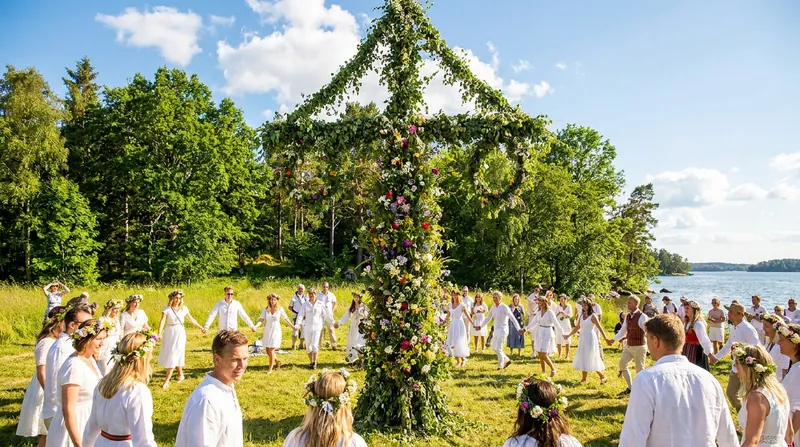
The undisputed centerpiece of the Swedish celebration is the maypole, or midsommarstång. Believed to have been introduced from Germany in the Middle Ages, the tall wooden pole is meticulously decorated with green birch leaves and vibrant wildflowers. Raising the pole requires a coordinated community effort, signaling the official start of the festivities.[1]
Once the pole is secured, the dancing begins. People of all ages, often wearing handmade flower crowns, form concentric rings around the pole. Traditional folk songs, including the famous "Små grodorna" (The Little Frogs), are sung while participants playfully mimic the movements of animals—a tradition that bridges generations with shared laughter.
Food is a cornerstone of the Midsummer experience, serving as a testament to the Nordic summer harvest. The traditional outdoor buffet features pickled herring (sill) in various marinades, boiled new potatoes dusted with fresh dill, and generous dollops of sour cream with chives.[3]
The meal is punctuated by shots of spiced schnapps, known locally as nubbe, with each round accompanied by a rousing drinking song. For dessert, the undisputed star is the first harvest of Swedish strawberries, often served with fresh cream or layered into a classic midsummer cake.
Historically, Midsummer Night was considered a time of potent, unpredictable magic, when the boundary between the human world and the supernatural blurred. Folklore suggested that water turned to wine, ferns bloomed into magnificent flowers, and the morning dew possessed profound healing properties.[1]
One of the most enduring pieces of Midsummer folklore involves romantic divination. Tradition dictates that if a person picks seven—or in some regions, nine—different species of wildflowers in absolute silence and places them under their pillow on Midsummer Eve, they will dream of their future spouse.[1][3]
While Sweden is famous for its maypoles, other Nordic countries celebrate the solstice with their own distinct flair. In Norway and Denmark, the holiday is known as Sankthansaften, and the focus shifts to massive coastal bonfires originally designed to ward off evil spirits. Finland, celebrating Juhannus, combines lakeside bonfires with the deeply ingrained national pastime of sauna bathing.[2][4]
Today, Midsummer serves as the unofficial kickoff to the Swedish summer vacation period. Major cities become remarkably quiet as residents flock to summer cottages. For those who remain in urban centers, public parks like Skansen in Stockholm or Slottsskogen in Gothenburg host massive, multi-day public celebrations.[1][3]
Ultimately, Midsummer is a collective sigh of relief. After enduring months of freezing temperatures and profound darkness, the Nordic people seize the longest day of the year to revel in the fleeting, fragile beauty of the summer. It is a testament to human resilience and an enduring connection to the rhythms of the natural world.[4]
Terms to know
- Midsommarstång
- The Swedish maypole, a tall wooden cross decorated with birch leaves and wildflowers, serving as the centerpiece of the celebration.
- Midnight Sun
- A natural phenomenon occurring north of the Arctic Circle during the summer solstice, where the sun remains visible for 24 hours a day.
- Sankthansaften
- The Norwegian and Danish name for Midsummer Eve, traditionally celebrated with large bonfires to ward off evil spirits.
- Nubbe
- A small shot of spiced schnapps or aquavit, traditionally consumed during the Midsummer feast alongside drinking songs.
- Små grodorna
- Translated as 'The Little Frogs,' it is the most famous traditional song and dance performed around the Swedish maypole.
Questions readers ask
When is Midsummer celebrated in Sweden?
Midsummer Eve is always celebrated on a Friday between June 19 and June 25. In 2026, it falls exactly on June 19.
Why do Swedes dance around a maypole?
The maypole, or midsommarstång, is a symbol of fertility and growth that likely arrived from Germany in the Middle Ages. Dancing around it is a community ritual to welcome the summer.
What is the traditional Midsummer food?
The classic feast includes pickled herring, boiled new potatoes with dill, sour cream, chives, and fresh strawberries, often accompanied by spiced schnapps.
Do other Nordic countries celebrate Midsummer?
Yes, though traditions vary. While Sweden focuses on the maypole, Norway and Denmark celebrate Sankthansaften with massive coastal bonfires, and Finland combines bonfires with sauna traditions.
Different angles
The Historical View
Tracing the holiday from pagan fertility rites to a Christianized feast day.
Historians emphasize that Midsummer is a palimpsest of beliefs. Originally an agrarian pagan ritual designed to appease nature gods like the Finnish thunder deity Ukko, the solstice was a critical juncture for ensuring a successful autumn harvest. When the Catholic Church expanded into Scandinavia, it overlaid the festival with the nativity of St. John the Baptist. Yet, the core elements—fire, water, and greenery—remained entirely secular and rooted in the earth's natural cycles.
The Folklore View
Understanding the magical properties historically attributed to the solstice night.
For centuries, the Midsummer night was viewed not just as a seasonal marker, but as a tear in the veil between the mundane and the supernatural. Folklore dictated that the intense light of the Midnight Sun imbued plants and water with healing properties. The tradition of picking seven different wildflowers in absolute silence to dream of a future spouse is a direct descendant of these ancient beliefs, transforming what was once serious divination into a playful modern romance.
The Modern Cultural View
How Midsummer functions as the psychological starting gun for the Nordic summer.
Today, tourism boards and cultural institutions view Midsummer as the ultimate expression of the Nordic lifestyle. It marks the beginning of the 'industrisemester'—the traditional industrial vacation period where cities empty out and citizens reconnect with nature. The emphasis has shifted from agrarian survival to mental well-being, offering a collective, nationwide exhale after the grueling, dark winter months.
- Folklore & Traditions Analysts
- Focus on synthesizing the astronomical, historical, and cultural threads of the solstice.
- Cultural Historians
- Focus on the pagan and Christian origins, and the evolution of the holiday over centuries.
- Tourism & Heritage Boards
- Focus on the modern celebration, attracting visitors, and showcasing the beauty of the Nordic summer.
Perspectives this story doesn't cover
- Agricultural Workers
- Indigenous Sámi Communities
Sources
Source coverage
4 outlets
3 viewpoints surfaced




- [1]SkansenTourism & Heritage Boards
Midsummer celebration at Skansen
Read on Skansen → - [2]Encyclopedia BritannicaCultural Historians
Midsummer: holiday
Read on Encyclopedia Britannica → - [3]Gothenburg OfficialTourism & Heritage Boards
Midsummer in Gothenburg
Read on Gothenburg Official → - [4]Factlen Editorial TeamFolklore & Traditions Analysts
Synthesis by Factlen editorial team
Read on Factlen Editorial Team →
More in Culture
See all →Global Heritage
UNESCO Adds 24 New World Heritage Sites, Highlighting Nelson Mandela's Legacy and Rome's Via Appia
3 sources
Heritage Protection
Israeli Airstrike Damages Tyre's World Heritage Site, Triggering Global Heritage Protection Protocols
4 sources
Cultural Heritage
The Global Revival of Kintsugi: How the Ancient Art of Repair Became a Modern Movement
6 sources

Solstice Traditions
The Science and History of Midsummer: How Ancient Solstice Traditions Thrive Today
3 sources
Comments
Every angle. Every day.
Get Culture stories with full source coverage and perspective breakdowns, free every day.