
One-Bag Travel: The Ultimate Comparison of Travel Backpacks vs. Rolling Carry-Ons
As airlines aggressively increase baggage fees in 2026, travelers are forced to choose between the frictionless mobility of a backpack and the physical comfort of a rolling suitcase.
By Factlen Editorial Team
- One-Bag Minimalists
- Advocates for maximum mobility, hands-free travel, and avoiding all airline baggage fees.
- Comfort-First Travelers
- Prioritizes physical ease, structured packing, and zero weight on the body during transit.
- Hybrid Pragmatists
- Believes the choice should be dictated entirely by the specific terrain and friction of the itinerary.
What's not represented
- · Travelers with physical disabilities who rely exclusively on specific luggage formats
- · Families traveling with infants who must balance multiple bags and strollers
Why this matters
With gate-check penalties routinely hitting $70 and overhead bin space shrinking, your choice of luggage directly dictates how much you pay to fly and how physically exhausted you feel upon arrival.
Key points
- Travel backpacks offer unmatched mobility for stairs, cobblestones, and public transit.
- Rolling carry-ons provide superior physical comfort and structured packing on smooth surfaces.
- Backpacks require strategic packing and compression cubes to maximize volume.
- Rigid suitcases are more likely to be gate-checked on regional jets because they cannot compress.
- Hybrid wheeled backpacks generally fail at both tasks due to excess weight and poor ergonomics.
- The best choice depends entirely on the specific friction points of your itinerary.
As global airlines continue to unbundle fares in 2026, the cost of bringing luggage has reached a new premium. With gate-check penalties for oversized bags now routinely hitting $45 to $70 on budget carriers, a movement known as "one-bag travel" has surged into the mainstream. This shift has ignited a fierce debate over the ultimate piece of travel gear: the modern clamshell travel backpack versus the traditional rolling carry-on. For travelers preparing for summer itineraries, choosing the right vessel is no longer just a matter of style, but a critical decision that dictates how they will physically move through the world.[4][5]
The core of this comparison rests on a fundamental trade-off between mobility and physical comfort. A suitcase is engineered around stability and structure, designed to hold its shape and effortlessly transport weight across flat surfaces. A travel backpack is built around agility, designed to move fluidly with the human body and adapt to unpredictable environments. Understanding the specific advantages, drawbacks, and evidence behind each option is essential for avoiding the quiet frustrations that the wrong luggage can introduce to a carefully planned trip.[2][6]
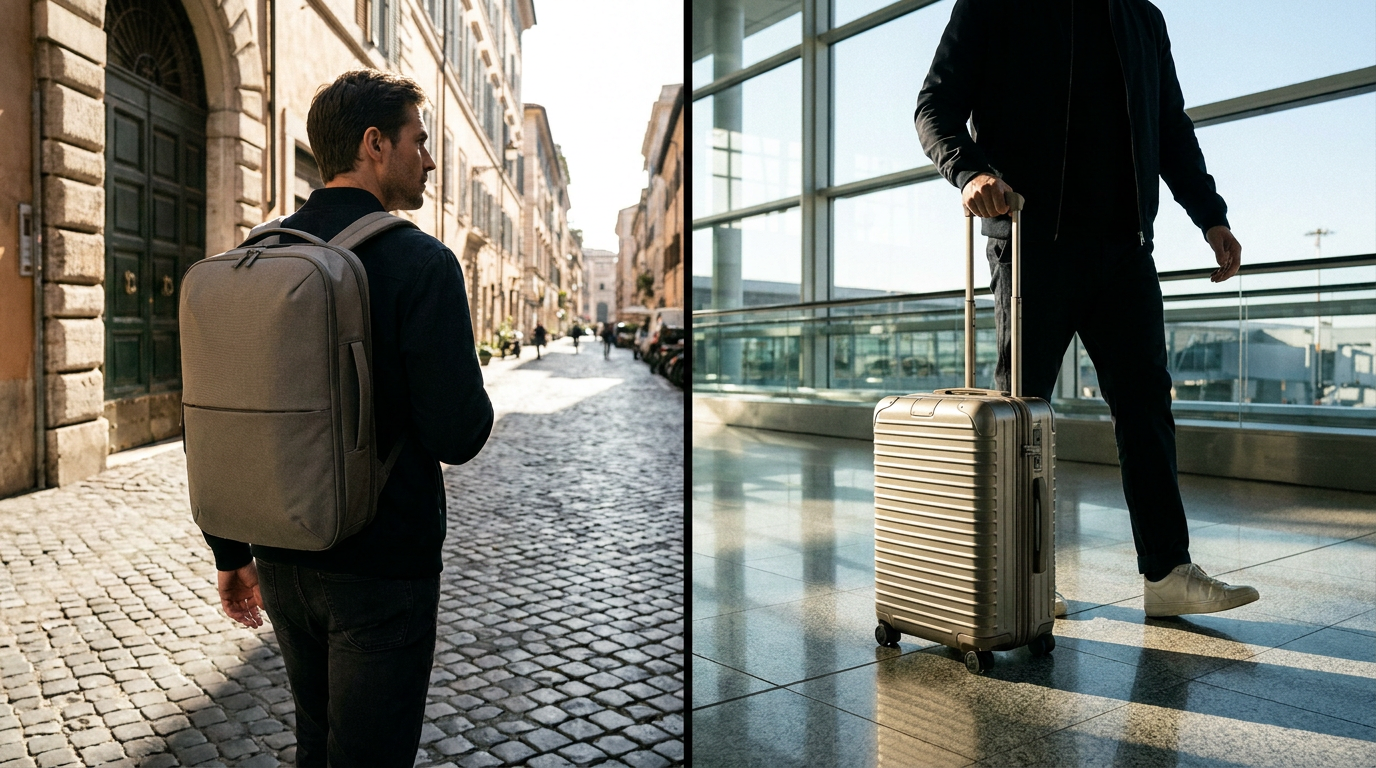
The case for the travel backpack centers entirely on frictionless mobility. By keeping the load on the shoulders and the hands completely free, travelers can navigate complex environments without breaking stride. Whether boarding a crowded train, climbing five flights of stairs to a boutique hotel, or walking across uneven terrain, a backpack eliminates the physical barriers that wheels introduce. This agility allows travelers to treat transit days as an extension of the adventure, rather than a logistical hurdle to be managed.[1][3]
Furthermore, the argument for the backpack extends to logistical and financial efficiency. A soft-sided backpack in the 35-to-40-liter range easily conforms to the overhead bin dimensions of nearly all major airlines, and can often be compressed to fit into the smaller sizers used by strict budget carriers. By guaranteeing the bag stays in the cabin, travelers eliminate checked baggage fees, bypass the carousel wait upon arrival, and completely neutralize the risk of lost luggage.[4][5]

However, the argument against the travel backpack focuses on the undeniable physical toll of wearing your belongings. Carrying 20 to 30 pounds of gear on your back is genuine physical work. In warm climates, it guarantees a sweaty back, and during long transit delays, the constant donning and doffing of a heavy pack can brutalize the shoulders. For travelers who overpack or lack the discipline to curate their wardrobe, a backpack quickly transforms from a symbol of freedom into an exhausting burden.[1][6]
The evidence regarding backpack comfort points directly to harness design and packing strategy. Ergonomic data shows that a high-quality travel backpack must feature a padded hip belt and load-lifter straps to transfer weight from the shoulders to the stronger pelvic bones. Furthermore, packing heavy items—like laptops, shoes, and dense toiletry kits—as close to the spine as possible dramatically improves the center of gravity. Without these features and techniques, the ergonomic benefits of a backpack collapse.[1][4]
Conversely, the case for the rolling carry-on is built on the luxury of zero physical strain. A well-designed polycarbonate spinner allows travelers to glide 30 pounds of luggage through an airport terminal with the push of a single finger. For individuals with back issues, or those who simply wish to arrive at their destination without needing a shower, the rolling suitcase offers an unparalleled level of transit comfort. It preserves energy for the actual vacation.[2][3]
The argument for the rolling carry-on also highlights superior packing efficiency and protection. The rigid structure of a suitcase naturally protects fragile souvenirs and electronics, while keeping tailored clothing relatively wrinkle-free. Suitcases often maximize the exact 22-by-14-by-9-inch dimensions allowed by airlines, providing a cavernous, perfectly rectangular space that requires less strategic tetris to fill. For travelers who prefer to live out of their bag rather than unpacking at the hotel, the suitcase acts as a convenient portable closet.[2][5]

The argument for the rolling carry-on also highlights superior packing efficiency and protection.
The primary argument against the rolling carry-on is its severe vulnerability to friction and terrain. A suitcase is only as good as the surface beneath it. The moment a traveler encounters a historic European cobblestone street, a sandy path, or a broken elevator in a subway station, the rolling bag becomes a massive liability. Dragging a rigid, bouncing box over rough pavement not only destroys the wheels over time but also requires awkward, asymmetrical lifting that can strain the lower back.[1][2]
The evidence surrounding rolling luggage constraints also extends to the airplane cabin. Because hard-sided suitcases cannot compress, they are frequently the first items targeted by gate agents on full flights or smaller regional jets. If a roller is even half an inch too thick, it will not fit into the sizing sizer, resulting in an immediate gate-check mandate. This strips the traveler of their carefully planned carry-on advantage and subjects the bag to the rough handling of the cargo hold.[4][5]
When comparing the packing strategies required for both, the evidence heavily favors modular organization for backpacks. To maximize a 40-liter pack, travelers must utilize compression packing cubes and roll their clothing, a technique that data shows saves 20 to 30 percent of internal volume. Rolling suitcases are more forgiving, allowing for traditional folding and the inclusion of bulkier items like thick sweaters or multiple pairs of rigid shoes, though packing cubes remain highly recommended for both formats.[1][6]

From a financial perspective, the cost comparison reveals that backpacks generally offer a lower barrier to entry for premium quality. Top-tier, durable travel backpacks from respected brands typically range from $150 to $350. In contrast, premium rolling carry-ons featuring aerospace-grade polycarbonate, silent spinner wheels, and robust telescopic handles often start at $300 and can easily exceed $800.[3][6]
It is also crucial to address the evidence against hybrid "wheeled backpacks." While they seem to offer the best of both worlds, they generally fail at both tasks. The addition of a wheel chassis and a telescopic handle consumes valuable packing space and adds significant empty weight. When worn as a backpack, the rigid frame digs into the spine, and the wheels inevitably transfer street dirt directly onto the traveler's clothing.[4][6]
Ultimately, the travel backpack fits well when the itinerary is dynamic and unpredictable. It is the definitive choice for multi-city European tours, trips that rely heavily on public transportation, and journeys involving budget airlines with strict dimensional limits. It thrives when the traveler prioritizes speed, agility, and the ability to seamlessly transition from an airplane to a crowded subway to a neighborhood café without missing a beat.[1][2][6]
The travel backpack does not fit well when the traveler has pre-existing shoulder or back issues, or when the packing list requires formal business attire that cannot be tightly rolled. It is also an unnecessary compromise for travelers heading to a single resort destination where the bag will simply be transported from the trunk of a taxi directly to a bellhop's cart.[3][4]

The rolling carry-on fits well when the travel route is highly controlled and paved. It is the superior choice for domestic business trips, point-to-point resort vacations, and itineraries where the primary modes of transport are airplanes, elevators, and rideshares. It excels when the traveler values physical comfort during transit and requires the maximum possible volume for a diverse, structured wardrobe.[2][3][6]
The rolling carry-on does not fit well when the destination is famous for its historic, pedestrian-only infrastructure, or when the trip involves frequent island-hopping on small ferries. It is a distinct disadvantage for travelers who want to explore a city for several hours before their hotel check-in time, as dragging a suitcase across town quickly drains the joy from the experience.[1][4]
There is no universal winner in the debate between the travel backpack and the rolling carry-on. The smartest travelers do not blindly align with one philosophy; instead, they analyze the specific friction points of their upcoming itinerary. By matching the luggage to the terrain, the transit methods, and their own physical preferences, travelers can ensure that their gear serves as a silent facilitator of their journey, rather than a constant, rolling obstacle.[2][6]
How we got here
Pre-2010s
Rolling suitcases dominate the travel landscape, with backpacks largely reserved for wilderness hikers and budget backpackers.
2015–2019
The rise of digital nomadism and unbundled airline fares sparks the creation of purpose-built, clamshell travel backpacks.
2020–2023
Airlines aggressively increase checked baggage fees, pushing mainstream vacationers toward carry-on-only travel strategies.
2026
Budget carriers begin strictly enforcing 'personal item' dimensions, intensifying the debate between maximum-size rollers and compressible backpacks.
Viewpoints in depth
One-Bag Minimalists
Advocates for maximum mobility and avoiding all airline baggage fees.
This camp argues that modern travel is defined by friction—crowded terminals, budget airline weight limits, and unpredictable urban terrain. By keeping all belongings in a single 40-liter backpack, travelers bypass check-in desks, baggage carousels, and the physical limitations of wheels. They rely heavily on compression packing cubes and minimalist wardrobes, viewing the physical effort of carrying the bag as a fair trade for absolute transit freedom.
Comfort-First Travelers
Prioritizes physical ease and structured packing over all-terrain mobility.
Proponents of the rolling carry-on argue that vacations should not double as endurance events. They emphasize that in highly developed transit corridors—from airport lounges to paved sidewalks to hotel elevators—wheels completely eliminate physical strain. This perspective values the rigid protection a suitcase provides for electronics and tailored clothing, arguing that arriving at a destination without a sweat-soaked shirt is the ultimate travel luxury.
Hybrid Pragmatists
Believes the choice should be dictated entirely by the specific terrain of the itinerary.
This analytical camp rejects the idea of a universal 'best' bag. Instead, they audit the specific logistics of an upcoming trip. If the itinerary involves multiple train transfers in Europe or fifth-floor walk-up apartments, they deploy the backpack. If the trip is a direct flight to a corporate conference or a paved resort, they opt for the roller. They view luggage strictly as a tool to mitigate the specific friction points of a given route.
What we don't know
- Whether major international carriers will eventually lower the weight limits for carry-on backpacks, forcing more travelers to check bags regardless of size.
- How the next generation of ultra-lightweight materials might eventually solve the empty-weight problem of hybrid wheeled backpacks.
Key terms
- Clamshell Opening
- A backpack design that unzips completely and opens flat like a suitcase, allowing for full visibility and easy packing.
- One-Bag Travel
- A minimalist travel philosophy where a passenger takes only a single carry-on bag, avoiding checked luggage fees and carousel waits.
- Load Lifters
- Adjustable straps at the top of a backpack's shoulder straps that pull the weight closer to the body's center of gravity.
- Compression Cubes
- Small, zippered fabric organizers that use a secondary zipper to squeeze out excess air, shrinking the volume of packed clothing.
Frequently asked
Can a travel backpack fit as much as a rolling carry-on?
Generally, a rolling carry-on holds slightly more due to its rigid, rectangular shape maximizing airline sizer limits. However, a 40-liter backpack can hold a comparable amount if the traveler uses compression packing cubes and rolls their clothing.
Are wheeled backpacks a good compromise?
Most experts advise against them. The wheel chassis adds significant empty weight and consumes internal space, while the rigid frame makes them uncomfortable to wear as a backpack. Furthermore, the wheels can transfer street dirt onto your clothing.
Will a 40-liter backpack count as a free personal item?
It depends on the airline. While a 40L bag easily fits in overhead bins as a standard carry-on, strict budget carriers require personal items to fit under the seat (typically around 30L). A soft-sided 40L bag can sometimes pass if it is under-packed and compressed.
Sources
Source coverage
6 outlets
3 viewpoints surfaced






[1]The Consumers GuideHybrid Pragmatists
Travel Backpack vs. Rolling Carry-On: Which Should You Choose?
Read on The Consumers Guide →[2]The Trendy SuitcaseComfort-First Travelers
Backpack vs. Suitcase: Which Is the Better Choice for Travelers?
Read on The Trendy Suitcase →[3]Eskimo TravelComfort-First Travelers
Travel Backpack vs Suitcase: Best Choice for Solo Travelers
Read on Eskimo Travel →[4]Choose PackOne-Bag Minimalists
The 7-Step Decision Framework for Choosing a One Bag Travel Backpack
Read on Choose Pack →[5]Nayo SmartOne-Bag Minimalists
One Bag Travel: 2026 Standard Free Carry-On Size Limits
Read on Nayo Smart →[6]Factlen Editorial TeamHybrid Pragmatists
Synthesis by Factlen editorial team
Read on Factlen Editorial Team →



Every angle. Every day.
Get shopping stories with full source coverage and perspective breakdowns delivered to your inbox.