
How Adaptive Hardware and Inclusive Design Are Opening Video Games to Everyone
Driven by modular controllers and innovative software, the gaming industry is dismantling physical barriers to entry, offering profound psychological and social benefits to millions of players with disabilities.
By Factlen Editorial Team
- Disabled Gamers & Community
- Focuses on the lived experience of gaming, emphasizing the autonomy, social connection, and mental health benefits that accessible design provides.
- Accessibility Advocates & Engineers
- Prioritizes the technical challenges of bridging the gap between standard hardware and specialized needs, while advocating for lower costs.
- Academic & Clinical Researchers
- Analyzes the psychological and rehabilitative impacts of gaming through frameworks like Self-Determination Theory.
- Game Developers & Publishers
- Views accessibility as both a moral imperative and a significant market expansion opportunity driven by cloud technology and inclusive design.
What's not represented
- · Independent developers struggling with accessibility implementation costs
- · Players in developing nations without access to specialized hardware
Why this matters
Video games are a primary engine of modern social connection and entertainment. By standardizing accessible hardware and software, the tech industry is ending the isolation of millions of individuals with motor or cognitive disabilities, allowing them to participate fully in global digital culture.
Key points
- Adaptive hardware hubs allow players to build custom controllers using external switches and joysticks.
- Software features like co-pilot mode and button remapping bypass physical barriers.
- Accessible gaming fulfills core psychological needs for autonomy, competence, and social connection.
- 94% of disabled gamers report experiencing mental or physical health benefits from playing.
- The high cost of specialized external switches remains a significant barrier for many players.
- Cloud gaming is democratizing access by removing the need for expensive local consoles.
Video games are a universal cultural touchstone, offering sprawling digital worlds where players can race cars, explore alien planets, or build entire cities. Yet, for decades, the gateway to these experiences was a rigid piece of plastic. Standard controllers, with their tightly clustered buttons and dual analog sticks, demand a high degree of fine motor control, inadvertently locking millions of people out of the medium.[1][7]
Over the last several years, the gaming industry has undergone a quiet but profound revolution. Accessibility has transitioned from an afterthought—or a niche modding community endeavor—into a core pillar of blockbuster game development and hardware design. This shift is not merely about adding a few extra options to a settings menu; it represents a fundamental rethinking of how humans interface with digital environments.[1][7]
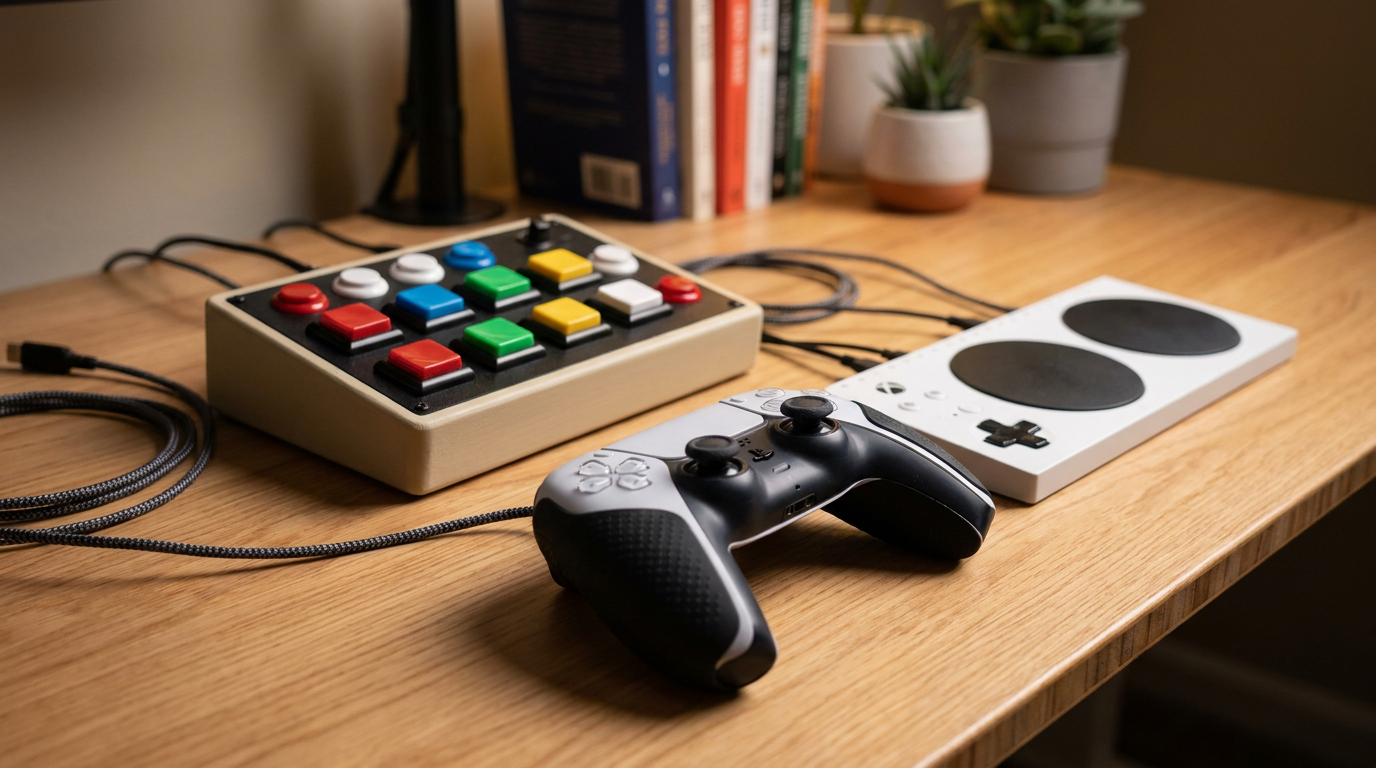
The hardware landscape began to shift dramatically with the introduction of modular devices designed specifically for players with limited mobility. Microsoft set the modern standard in 2018 with the Xbox Adaptive Controller, a flat, rectangular hub featuring two large, programmable buttons and a row of 3.5-millimeter jacks along the back. These jacks allow players to plug in an array of external switches, foot pedals, and specialized joysticks, effectively letting them build a custom controller mapped to their unique physical capabilities.[8]

Sony followed suit, releasing the PlayStation Access controller in late 2023. Designed as a highly customizable circular pod, it allows players to swap out button caps, adjust the joystick's distance, and orient the device in a full 360 degrees. Rehabilitation engineers and occupational therapists have praised these devices for bridging the gap between standard gaming hardware and the specialized needs of players with spinal cord injuries, muscular dystrophy, or limb differences.[2]
But hardware is only half the equation. Software developers have simultaneously overhauled how games are coded, introducing granular settings that bypass physical barriers. Features like "co-pilot mode" allow two separate controllers to act as a single input, enabling a friend or family member to handle complex button combinations while the primary player focuses on movement and strategy.[1][8]
Other software innovations include the ability to remap every button, toggle options that replace the need to hold down a trigger for extended periods, and auto-aim features that reduce the need for precise joystick tracking. For players with visual or auditory impairments, developers now routinely include high-contrast rendering modes, scalable user interfaces, and directional closed captioning that visualizes off-screen sound effects.[7]
The rise of cloud gaming has further democratized access. Platforms that stream games directly to browsers or smart TVs eliminate the need for expensive local consoles or high-end PCs. Because cloud gaming offloads the processing power to remote servers, players can use lightweight devices and specialized web-based overlays, lowering the barrier to entry for those who rely on custom input setups.[6]

Platforms that stream games directly to browsers or smart TVs eliminate the need for expensive local consoles or high-end PCs.
The impact of these inclusive designs extends far beyond mere entertainment. Academic researchers studying the intersection of gaming and disability frequently point to Self-Determination Theory (SDT) to explain the profound psychological benefits of accessible play. SDT posits that human well-being relies on fulfilling three core psychological needs: autonomy, competence, and relatedness.[3][4]
For individuals whose daily lives may be heavily structured around medical care or physical limitations, accessible video games provide a rare and vital space for autonomy. In a digital world, a player has complete control over their avatar's choices, movements, and destiny. This sense of agency fosters competence—the feeling of mastering a skill or overcoming a challenge—which can be deeply empowering.[3][4]
Crucially, gaming also fulfills the need for relatedness. Multiplayer environments serve as vital social lifelines, allowing players to connect, cooperate, and compete on an even playing field. Voice chat and cooperative gameplay strip away physical differences, enabling individuals to build communities and friendships based entirely on shared interests and teamwork.[4]
The clinical benefits are equally striking. Surveys of disabled gamers have found that an overwhelming 94 percent report experiencing physical or mental health benefits from playing. The most frequently cited advantages include significant stress relief, mood improvement, and a powerful distraction from chronic pain or disability-related anxieties. For some, the precise inputs required by adaptive setups even serve as a form of engaging physical therapy, improving manual dexterity and coordination over time.[5]

Despite this progress, significant hurdles remain. The most pressing issue is cost. While the base adaptive hubs from major console manufacturers are priced similarly to standard controllers, the external switches and specialized joysticks required to complete a setup can be prohibitively expensive. A fully customized rig tailored to a specific severe mobility impairment can easily cost hundreds of dollars, placing a heavy financial burden on a demographic that frequently lives on fixed incomes.[7]
Furthermore, while major game studios now boast dedicated accessibility teams, smaller independent developers often lack the budget and resources to implement complex inclusive features. The industry is still working toward standardizing accessibility tools so that developers can easily plug them into any game engine without having to build them from scratch.[1]
The commercial incentive to solve these problems is growing rapidly. Market analysts project that the global online accessible games sector will reach nearly $1.5 billion by 2034. With an estimated one billion people worldwide living with some form of disability, the audience for inclusive digital experiences is vast and largely untapped.[6]

Looking ahead, emerging technologies promise even greater strides. Artificial intelligence and machine learning are being explored to create dynamic difficulty systems that automatically adjust to a player's real-time motor fatigue. Eye-tracking technology and voice-activated commands are slowly making their way from experimental PC setups into mainstream console ecosystems.[6]
Ultimately, the push for video game accessibility is a testament to the medium's unique power. By tearing down the physical barriers to entry, the industry is ensuring that the joy, community, and triumph found in digital worlds are truly available to everyone. It is a clear demonstration that when technology is designed with empathy, it has the capacity to profoundly elevate the human experience.[1]
How we got here
2018
Microsoft releases the Xbox Adaptive Controller, setting a new industry standard for accessible hardware.
2020
The Last of Us Part II launches with over 60 accessibility settings, becoming a benchmark for inclusive software design.
Dec 2023
Sony launches the PlayStation Access controller, offering a highly customizable circular hub for PS5 players.
2024
Major cloud gaming platforms integrate voice navigation and eye-tracking support.
2026
The accessible gaming market sees rapid growth, driven by AI-assisted dynamic difficulty and cloud streaming.
Viewpoints in depth
Disabled Gamers & Community
Focuses on the lived experience of gaming, emphasizing autonomy and social connection.
For players with disabilities, accessible gaming is rarely just about entertainment; it is a vital tool for independence. Community advocates emphasize that digital worlds offer a space where physical limitations do not dictate capability. The ability to customize a control scheme means the difference between isolation and participating in a global cultural phenomenon. However, this community also frequently highlights the ongoing frustration of high costs for specialized peripherals, arguing that true accessibility cannot exist behind a paywall.
Accessibility Advocates & Engineers
Prioritizes the technical challenges of bridging the gap between standard hardware and specialized needs.
Rehabilitation engineers and occupational therapists view game controllers as assistive technology. Their focus is on modularity—creating base hubs that can accept any number of third-party switches, sip-and-puff tubes, or foot pedals. This camp advocates for universal design standards across the industry, ensuring that an expensive custom joystick bought for a PlayStation will work seamlessly on an Xbox or a PC, thereby reducing the financial burden on the end user.
Game Developers & Publishers
Views accessibility as both a moral imperative and a significant market expansion opportunity.
For major studios and hardware manufacturers, inclusive design has shifted from a philanthropic side project to a core business strategy. With an estimated one billion people worldwide living with disabilities, creating accessible games opens up a massive, previously underserved market. Developers are increasingly integrating accessibility into the earliest stages of game design, utilizing cloud streaming and AI to lower hardware barriers and automate complex inclusive features.
What we don't know
- How quickly universal cross-platform compatibility for adaptive switches will be adopted by all major console manufacturers.
- Whether the cost of specialized third-party external switches will decrease as the market expands.
- How effectively AI-driven dynamic difficulty systems will be able to respond to real-time player motor fatigue.
Key terms
- Self-Determination Theory (SDT)
- A psychological framework suggesting that human well-being depends on fulfilling three core needs: autonomy, competence, and relatedness.
- Co-pilot mode
- A software accessibility feature that allows two separate game controllers to control a single player character simultaneously.
- Adaptive switch
- A specialized, often oversized button or trigger designed to be easily pressed by players with limited fine motor control.
- Cloud gaming
- A technology that streams video games from remote servers directly to a device, eliminating the need for powerful local hardware.
- Sip-and-puff device
- An assistive technology that allows users to send input signals to a computer or console by inhaling or exhaling into a tube.
Frequently asked
What is an adaptive controller?
An adaptive controller is a highly customizable gaming hub that allows players to plug in external switches, pedals, and joysticks to replace standard controller buttons.
How does co-pilot mode work?
Co-pilot mode is a software feature that links two separate controllers so they act as a single input, allowing two people to share the controls of a single character.
Are adaptive controllers compatible across different consoles?
Generally, they are designed for specific ecosystems like Xbox or PlayStation, though third-party adapters and PC compatibility offer some cross-platform flexibility.
Why are adaptive gaming setups so expensive?
While the base hubs are priced similarly to standard controllers, the specialized external switches and custom joysticks required for a complete setup are produced in smaller quantities, driving up costs.
Sources
Source coverage
8 outlets
4 viewpoints surfaced







[1]Factlen Editorial TeamAccessibility Advocates & Engineers
Synthesis by Factlen editorial team
Read on Factlen Editorial Team →[2]Sony Interactive EntertainmentGame Developers & Publishers
Game Changers: The Impact of the Access Controller
Read on Sony Interactive Entertainment →[3]Frontiers in PsychologyAcademic & Clinical Researchers
Video Games and Disability: A Self-Determination Theory Perspective
Read on Frontiers in Psychology →[4]Taylor & FrancisAcademic & Clinical Researchers
Exploring barriers and benefits of gaming for students with disabilities
Read on Taylor & Francis →[5]IEEE Computer SocietyAcademic & Clinical Researchers
Helping Disabled Gamers: The Current State of Affairs
Read on IEEE Computer Society →[6]Stats Market ResearchGame Developers & Publishers
Global Online Accessible Games Market Size, Share 2026
Read on Stats Market Research →[7]AbleGamersDisabled Gamers & Community
Includification: A Practical Guide to Game Accessibility
Read on AbleGamers →[8]MicrosoftGame Developers & Publishers
Xbox Adaptive Controller
Read on Microsoft →
Every angle. Every day.
Get gaming esports stories with full source coverage and perspective breakdowns delivered to your inbox.