
How "Enhanced Geothermal" is Unlocking 24/7 Clean Energy Anywhere on Earth
By borrowing horizontal drilling techniques from the oil and gas industry, next-generation geothermal systems are creating artificial underground reservoirs to harvest the Earth's limitless heat. With major commercial plants coming online in 2026, the technology promises to solve the grid's biggest problem: reliable, carbon-free baseload power.
By Factlen Editorial Team
- Geothermal Developers
- Believe EGS is the scalable, 24/7 clean energy silver bullet that can power the AI boom.
- Grid Operators
- Desperate for firm, dispatchable clean power to balance intermittent solar and wind.
- Fossil Fuel Transitioners
- View EGS as a lifeline that repurposes their drilling expertise for a zero-carbon future.
- Energy Economists
- Warn that high capital costs and steep parasitic loads make EGS a risky financial bet.
What's not represented
- · Local communities near drilling sites concerned about induced seismicity
- · Environmental groups debating the water usage of artificial reservoirs
Why this matters
As the world electrifies and AI data centers demand massive amounts of electricity, the grid desperately needs power sources that run 24/7 without burning fossil fuels. Next-generation geothermal could provide the ultimate 'invisible battery,' offering limitless clean energy without the massive land footprint of solar or wind farms.
Key points
- Next-generation geothermal uses oil and gas drilling techniques to create artificial underground reservoirs.
- The technology provides 24/7 clean baseload power, solving the intermittency problem of solar and wind.
- Fervo Energy's 500-megawatt Cape Station project in Utah will begin delivering commercial power in October 2026.
- Tech companies are heavily investing in geothermal to power energy-dense AI data centers.
- High capital costs and the energy required to run surface pumps remain significant economic hurdles.
The world’s transition to clean energy has a massive blind spot: what happens when the sun sets and the wind stops blowing? While solar and wind power are cheap and abundant, their intermittency requires grid operators to maintain backup power sources. Historically, that "firm" baseload power has come from coal, natural gas, or nuclear plants. But a new generation of energy startups is racing to unlock a carbon-free alternative that runs 24/7: the near-limitless heat trapped beneath the Earth's crust.[2]
Traditional geothermal energy has been utilized for over a century, but it has always been constrained by a geological lottery. Conventional plants require a rare combination of three elements naturally occurring in the exact same place: extreme heat, underground water, and highly permeable rock. Because these conditions are typically only found near volcanic fault lines—such as in Iceland, Kenya, or parts of California—geothermal currently supplies less than 1% of global electricity.[2][8]
Enter Enhanced Geothermal Systems (EGS). Rather than hunting for perfect natural reservoirs, engineers are now manufacturing them. By borrowing the exact technologies that sparked the shale oil and gas revolution—specifically horizontal directional drilling and hydraulic fracturing—companies can now drill into hot, dry, impermeable rock and engineer the pathways needed to extract heat.[5][8]
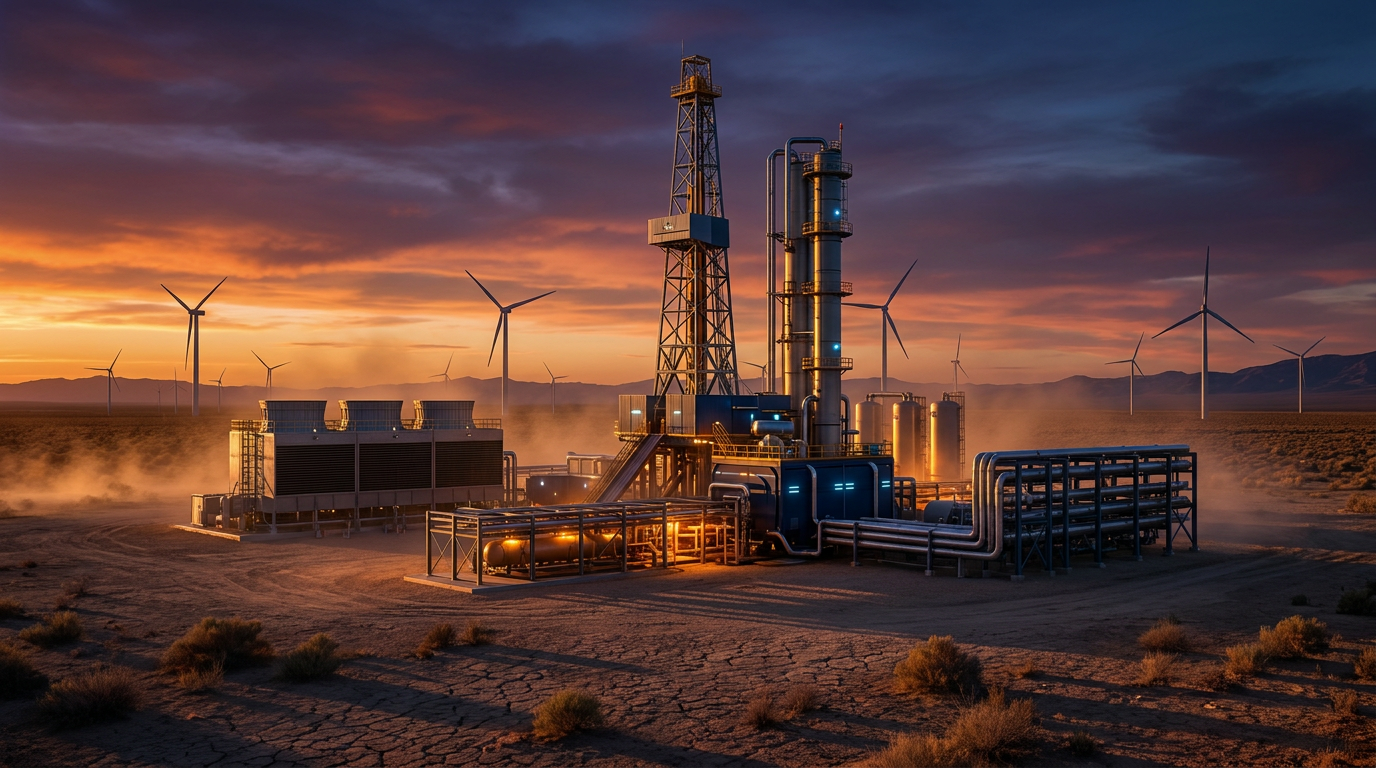
The mechanism is straightforward but technically daunting. Developers drill thousands of feet straight down into hot granite, then turn the drill bit 90 degrees to bore horizontally for miles. They pump water down at high pressure to create a network of micro-fractures in the rock. Cold water is injected into one well, travels through the newly fractured hot rock to absorb the Earth's heat, and is drawn up a second well as superheated fluid to spin a surface turbine.[2][5]

Because the Earth’s crust is universally hot if you drill deep enough, EGS effectively untethers geothermal energy from its geographic constraints. The United States Department of Energy estimates that next-generation geothermal could expand the country's capacity from a mere 4 gigawatts today to 90 gigawatts by 2050. Other industry estimates suggest the technology could unlock up to 150 gigawatts of reliable clean energy in the American Southwest alone.[2][8]
This concept is rapidly moving from theoretical white papers to commercial reality. In southwest Utah, a Houston-based startup named Fervo Energy is currently building Cape Station, a massive 500-megawatt EGS facility. The project's initial 100-megawatt phase is scheduled to begin delivering power to the grid in October 2026, marking the first time a commercial-scale enhanced geothermal plant will supply firm power to the public grid.[4][5][6][8]

This concept is rapidly moving from theoretical white papers to commercial reality.
The financial momentum behind the sector is accelerating. In late 2025, Fervo closed a $462 million Series E funding round, backed heavily by tech giants like Google. A few months later, the company secured an additional $421 million in project-level financing. Silicon Valley's intense interest is driven by the explosive growth of artificial intelligence; tech companies are desperate for round-the-clock clean energy to power their massive, energy-dense data centers without violating their corporate climate pledges.[4][6]
The scientific community is also validating the safety and viability of these engineered reservoirs. In April 2026, geophysicists from the Lawrence Berkeley National Laboratory announced a major breakthrough at the Cape Station site. For seven continuous months, researchers successfully monitored the microseismic activity of the artificial fractures nearly 7,000 feet underground, where temperatures reached a blistering 338°F.[1]
"Such high-temperature measurements are critical for geothermal energy production, and as far as we know, this is the world's longest recorded measurement at this temperature," noted a Berkeley Lab staff scientist. The successful monitoring proves that EGS reservoirs can be safely managed at scale, mitigating fears of induced seismicity that have plagued earlier geothermal experiments.[1]
Beyond the technology, EGS offers a unique socioeconomic bridge for the energy transition. The industry relies on the exact same skillsets—rig operators, drilling engineers, and geologists—that currently power the fossil fuel sector. For oil and gas workers, next-generation geothermal represents a seamless pivot to the clean energy economy, utilizing their existing expertise to harvest zero-carbon heat instead of hydrocarbons.[5]

Despite the optimism, the technology faces steep economic hurdles. Drilling miles into hard, abrasive granite is significantly more expensive and time-consuming than drilling into soft sedimentary shale. According to BloombergNEF, a next-generation geothermal project requires roughly $8.7 million per megawatt in capital expenditure, compared to just $1.1 million for a solar plant. The high upfront costs and exploration risks mean these projects face a weighted average cost of capital around 15%, triple that of conventional renewables.[3]
There are also engineering inefficiencies to overcome. Pumping millions of gallons of water through miles of artificial underground fractures requires immense pressure and energy. Industry analysts note that some EGS plants suffer from a high "parasitic load," potentially using up to 40% of the electricity they generate just to run their own surface pumps and operations.[5]

To solve these efficiency issues, researchers are already looking past EGS toward the next frontier: "Superhot Rock" geothermal. Teams at MIT and startups like Quaise Energy are developing millimeter-wave drilling technology—using microwave energy to vaporize rock—to reach depths where temperatures exceed 400°C. At these supercritical temperatures, water behaves as both a liquid and a gas, potentially multiplying the energy output of a single well tenfold.[9]
While superhot rock remains in the laboratory phase, the commercialization of EGS in 2026 represents a watershed moment for the grid. If developers can ride the learning curve, drive down drilling costs, and prove the longevity of their artificial reservoirs, enhanced geothermal could become the ultimate baseload power source—a massive, invisible battery humming quietly beneath our feet.[7][9]
How we got here
2023
Fervo Energy completes 'Project Red' in Nevada, proving that horizontal drilling and artificial reservoirs can successfully generate geothermal electricity.
Late 2025
Fervo raises $462 million in Series E funding, backed by tech giants like Google, to scale its operations.
February 2026
Lawrence Berkeley National Lab completes a record-breaking 7-month high-temperature seismic monitoring test at the Cape Station site.
October 2026
The first 100 megawatts of the Cape Station project are scheduled to come online, marking the first commercial-scale EGS plant.
2028
Cape Station is slated to reach its full 500-megawatt capacity, becoming one of the largest geothermal facilities in the world.
Viewpoints in depth
Geothermal Developers
Next-generation geothermal is the missing piece for a 100% clean energy grid.
Companies like Fervo Energy argue that by applying proven oil and gas drilling techniques, geothermal can scale infinitely. They point to the massive energy demands of AI data centers as proof that intermittent solar and wind are not enough, positioning EGS as the only carbon-free baseload solution that can be deployed anywhere.
Grid Operators
The grid desperately needs firm, dispatchable clean power to maintain stability.
Utilities and grid managers view EGS as a critical stabilizing force. As more intermittent renewables flood the grid, operators struggle with the 'duck curve'—the mismatch between peak midday solar generation and peak evening demand. They value geothermal because it provides predictable, round-the-clock power without relying on weather conditions or massive battery installations.
Fossil Fuel Transitioners
Geothermal offers a seamless pivot for the oil and gas workforce.
For drilling engineers, roughnecks, and geologists, EGS represents a lifeline. They argue that the clean energy transition shouldn't mean abandoning the expertise built during the shale revolution. By repurposing horizontal drilling and hydraulic fracturing for heat extraction, they see a way to maintain high-paying industrial jobs while decarbonizing the economy.
Energy Economists
High capital costs and engineering hurdles make EGS a risky financial bet.
Financial analysts caution that drilling into hard granite is vastly more expensive than drilling for oil. They point to the $8.7 million per megawatt price tag and the high 'parasitic load' of running surface pumps as major economic headwinds. Skeptics remind investors of the 'graveyard' of past geothermal startups that failed to overcome the harsh realities of deep subsurface engineering.
What we don't know
- Whether the artificial fracture networks will degrade or close up over decades of continuous operation.
- If the high capital costs of deep drilling can be reduced enough to compete with cheap solar and wind paired with batteries.
- Whether 'Superhot Rock' geothermal can successfully be commercialized using experimental millimeter-wave drilling.
Key terms
- Enhanced Geothermal Systems (EGS)
- A technology that generates electricity by pumping water into artificially created fractures in deep, hot rock to extract the Earth's heat.
- Baseload Power
- The minimum amount of electric power needed to be supplied to the electrical grid at any given time, traditionally provided by coal, gas, or nuclear plants.
- Parasitic Load
- The amount of electricity a power plant consumes to run its own operations, such as the massive pumps required to circulate water in a geothermal system.
- Superhot Rock Geothermal
- An experimental next-generation technology that aims to drill deep enough to reach supercritical temperatures above 400°C, drastically increasing energy output.
- Horizontal Drilling
- A technique where a well is drilled vertically deep into the ground and then turned 90 degrees to run horizontally, maximizing contact with the target rock formation.
Frequently asked
What is the difference between traditional and enhanced geothermal?
Traditional geothermal relies on naturally occurring underground reservoirs of hot water and steam. Enhanced Geothermal Systems (EGS) create artificial reservoirs by drilling into dry, hot rock and injecting water to extract the heat.
Does enhanced geothermal use fracking?
Yes, EGS uses hydraulic fracturing techniques borrowed from the oil and gas industry to create micro-fractures in deep granite, allowing water to circulate and absorb the Earth's heat.
Can enhanced geothermal be built anywhere?
Theoretically, yes. Because the Earth's crust is universally hot if you drill deep enough, EGS can be deployed in many regions that lack the volcanic activity required for traditional geothermal plants.
Why is geothermal energy so expensive to build?
Drilling miles deep into hard, abrasive igneous rock is technically difficult and time-consuming, leading to high upfront capital expenditures compared to surface-level solar or wind farms.
Sources
Source coverage
9 outlets
4 viewpoints surfaced









[1]Lawrence Berkeley National Laboratory
Custom sensor monitors seismicity for months straight more than a mile below ground
Read on Lawrence Berkeley National Laboratory →[2]World Resources InstituteGrid Operators
The Promise of Next-Generation Geothermal
Read on World Resources Institute →[3]BloombergNEFEnergy Economists
Next-generation geothermal technology has considerable advantages over other renewables
Read on BloombergNEF →[4]Canary MediaGeothermal Developers
Fervo nabs $462M to complete massive next-gen geothermal project
Read on Canary Media →[5]OrenniaFossil Fuel Transitioners
Will this clean power startup with oil and gas roots change the electricity landscape?
Read on Orennia →[6]Carbon CreditsGeothermal Developers
A New Role for Geothermal in the Energy Transition
Read on Carbon Credits →[7]ThinkGeoEnergyEnergy Economists
New technologies, steady hope, and cautious realism
Read on ThinkGeoEnergy →[8]Switchgear MagazineGrid Operators
Enhanced geothermal systems may unlock up to 150 GW of reliable clean energy
Read on Switchgear Magazine →[9]MIT
Next-generation geothermal energy
Read on MIT →


Every angle. Every day.
Get guides stories with full source coverage and perspective breakdowns delivered to your inbox.