
How Hall Effect Sensors Finally Cured Joystick Drift
The gaming hardware industry is abandoning traditional mechanical joysticks in favor of frictionless magnetic sensors, permanently solving the stick drift epidemic while boosting precision.
By Factlen Editorial Team
- Hardware Engineers
- Focuses on the physics, the elimination of mechanical wear, and the 5-million cycle lifespan.
- Competitive Gamers
- Focuses on the 12-bit resolution, 1000Hz polling rates, and the need for adjustable tension rings.
- Consumer Advocates
- Focuses on the end of planned obsolescence and the reduction of e-waste from discarded controllers.
What's not represented
- · Console Manufacturers (Sony/Microsoft/Nintendo)
Why this matters
Stick drift has forced gamers to spend hundreds of dollars replacing broken controllers over the last decade. The industry-wide shift to contactless magnetic sensors permanently solves this hardware failure while unlocking unprecedented precision for competitive play.
Anyone who has played a modern video game knows the creeping dread of stick drift. You take your thumb off the joystick, but your character continues to walk slowly toward the edge of a cliff, or your sniper crosshair drifts lazily away from the target. It is a hardware failure that ruins matches and frustrates players across every major console ecosystem.[3]
For years, this degradation was treated as an inevitable tax on gamers. Major console manufacturers faced class-action lawsuits, and players routinely spent $70 every few months to replace failing gamepads. But in 2026, the gaming hardware industry has fully embraced a permanent, physics-based solution: the Hall Effect sensor.[1][2]
To understand why Hall Effect controllers are revolutionary, you first have to understand why traditional controllers fail. Standard gamepads rely on decades-old technology called potentiometers. Inside a traditional joystick housing, a conductive metal wiper physically scrapes across a curved carbon track to measure the stick's position.[3]
This physical contact is the root of the problem. Every time you sprint, aim, or steer, that metal wiper grinds against the carbon. Over hundreds of hours of gameplay, friction scrapes away the material, leaving behind conductive dust. The track wears unevenly, the electrical resistance fluctuates, and the controller begins reading phantom inputs—the dreaded stick drift.[3]

Hall Effect technology bypasses mechanical friction entirely by using magnets. The underlying physics principle was discovered in 1879 by American physicist Edwin Hall. He observed that when a magnetic field is applied perpendicular to the flow of an electric current, it deflects the electrons, creating a measurable voltage difference across the conductor.[4]
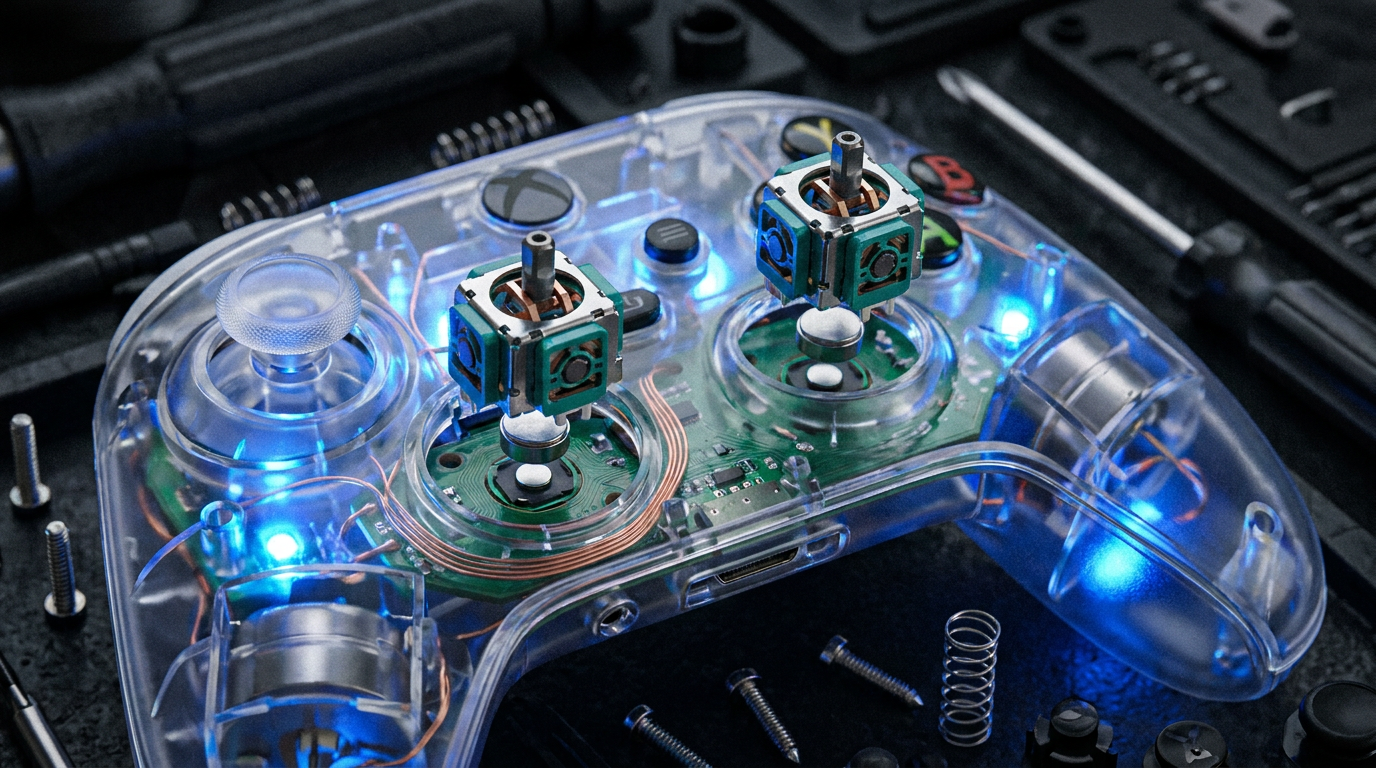
In a modern gaming controller, this principle is miniaturized. A small magnet is mounted directly to the base of the joystick shaft. Just below it, sitting on the circuit board, is a semiconductor Hall element. As you tilt the joystick, the magnet shifts, altering the magnetic field passing through the sensor.[5][6]
In a modern gaming controller, this principle is miniaturized.
The sensor detects these microscopic changes in the magnetic field and converts them into a "Hall voltage," which the controller's firmware translates into precise X and Y coordinates. Because the magnet and the sensor never physically touch, there is zero friction. No scraping means no wear, and no wear means stick drift is effectively eliminated at the hardware level.[3][5]
Durability is only half the story; the contactless design also unlocks massive performance upgrades. Traditional potentiometers typically operate at an 8-bit resolution, meaning they can detect 256 distinct positions along an axis. Modern Hall Effect sensors operate at a 12-bit resolution, breaking that same axis down into 4,096 microscopic steps.[1][6]
For competitive players, this granular precision is transformative. It allows for incredibly minute aiming adjustments in first-person shooters and smoother steering inputs in racing simulators. Because the sensors are so accurate, manufacturers can reduce the controller's "deadzone"—the software-mandated area in the center of the stick that ignores tiny inputs—to virtually zero.[6]

This precision is increasingly paired with ultra-fast 1000Hz polling rates. While older wireless controllers updated their position to the console 125 times per second, modern Hall Effect gamepads report their status 1,000 times per second over a wired or 2.4GHz connection, dropping input latency to a blistering one millisecond.[1][2]
However, the transition to magnetic sensors has introduced new engineering challenges. Because Hall Effect sticks lack the physical friction of a potentiometer wiper, they feel noticeably "looser" or lighter under the thumb. For players conditioned by years of standard Xbox or PlayStation controllers, this lack of resistance can initially make aiming feel slippery.[2]
Hardware manufacturers have developed clever workarounds for this tactile shift. Premium controllers now feature adjustable physical tension rings around the base of the joysticks. By twisting the ring, players can manually tighten the stick's resistance, perfectly simulating the heavier feel of a traditional controller while keeping the frictionless magnetic sensors underneath.[2]

Engineers also have to account for "centering jitter." Without friction to lock the stick perfectly into place, a Hall Effect joystick might return to a coordinate of 0.0002 instead of absolute zero when released. To prevent the camera from vibrating on screen, controller firmware now uses advanced filtering algorithms to smooth out these microscopic resting fluctuations.[7]
What began as a niche feature for $200 premium gamepads has rapidly democratized. In 2026, Hall Effect technology is the baseline standard. With budget-friendly controllers offering drift-proof magnetic sticks for under $50, the era of the disposable, potentiometer-based gamepad is finally coming to an end—saving gamers money and keeping millions of broken controllers out of landfills.[1][2][7]
How we got here
1879
Edwin Hall discovers the Hall Effect, noting how magnetic fields deflect electric currents.
Early 2000s
Hall Effect sensors see widespread adoption in automotive anti-lock braking systems and industrial motors.
2022-2023
Third-party manufacturers begin releasing premium gamepads featuring magnetic joysticks to combat widespread stick drift.
2026
Hall Effect technology becomes the industry standard, appearing in both $200 competitive controllers and $50 budget models.
Viewpoints in depth
Hardware Engineers
Focuses on the physics and durability of the technology.
For electrical engineers and peripheral designers, the shift to Hall Effect is a triumph of applied physics over mechanical limitation. By replacing friction-based potentiometers with solid-state semiconductors and magnets, manufacturers have eliminated the primary point of failure in gamepads. This camp emphasizes that the technology isn't just about fixing drift—it's about achieving a 5-million-cycle lifespan that makes controllers genuinely durable goods.
Competitive Gamers
Focuses on latency, resolution, and tactile feel.
Esports professionals and competitive players view the technology through the lens of pure performance. While they celebrate the death of stick drift, their primary focus is on the 1000Hz polling rates and 12-bit resolution that allow for pixel-perfect aiming. However, this camp is also the most critical of the 'loose' frictionless feel, driving the demand for adjustable physical tension rings to maintain the tactile feedback required for high-level muscle memory.
Consumer Advocates
Focuses on the end of planned obsolescence and e-waste.
For right-to-repair advocates and budget-conscious consumers, the widespread adoption of Hall Effect sensors is a massive victory against planned obsolescence. Traditional controllers were essentially consumable items, guaranteed to fail and end up in landfills. This perspective highlights that drift-proof technology, now available in sub-$50 controllers, protects consumers from hidden replacement taxes and significantly reduces electronic waste.
What we don't know
- Whether first-party console manufacturers will fully abandon potentiometers in their base-model pack-in controllers for the next console generation.
- How long the tension-ring mechanisms in premium controllers will last before suffering their own mechanical wear.
Key terms
- Stick Drift
- A hardware failure where a controller registers movement even when the joystick is untouched, usually caused by internal wear and tear.
- Potentiometer
- A traditional mechanical sensor that measures position by scraping a metal wiper across a resistive carbon track.
- Hall Voltage
- The tiny electrical charge generated when a magnetic field deflects electrons inside a semiconductor, used to calculate the joystick's position.
- Deadzone
- A software setting that ignores small joystick movements near the center to prevent accidental inputs or mask minor stick drift.
- Polling Rate
- The number of times per second a controller sends its input data to the console or PC, measured in Hertz (Hz).
Frequently asked
Do Hall Effect controllers ever get stick drift?
They eliminate drift caused by mechanical wear, which is the primary killer of standard controllers. While extreme temperature shifts or external magnets could theoretically interfere, they remain drift-free under normal gaming conditions.
Why do Hall Effect joysticks feel looser than normal ones?
Because they use magnets instead of physical contact points, there is no internal friction to resist your thumb's movement. Many premium models now include adjustable tension rings to simulate that missing resistance.
Do I need to install special software to use them?
Most Hall Effect controllers are plug-and-play on their respective consoles or PCs. However, downloading the manufacturer's app allows you to customize deadzones, polling rates, and button mapping.
Sources
Source coverage
7 outlets
3 viewpoints surfaced







[1]PC GamerCompetitive Gamers
The best PC controller in 2026
Read on PC Gamer →[2]BGRCompetitive Gamers
Best gaming controllers in 2026
Read on BGR →[3]Turtle BeachHardware Engineers
Hall Effect Controllers Explained: The Stick Drift Solution
Read on Turtle Beach →[4]CircuitBreadHardware Engineers
Hall Effect Sensors: Working Principle and Applications
Read on CircuitBread →[5]LenovoHardware Engineers
Gaming Controller with Hall Effect Joystick: A Comprehensive Guide
Read on Lenovo →[6]PowerAHardware Engineers
Hall Effect Sensor Technology
Read on PowerA →[7]Factlen Editorial TeamConsumer Advocates
Synthesis by Factlen editorial team
Read on Factlen Editorial Team →
Every angle. Every day.
Get gaming esports stories with full source coverage and perspective breakdowns delivered to your inbox.