
How the 2026 Rivian R2 and Tesla Model Y Compare on Price, Range, and Utility
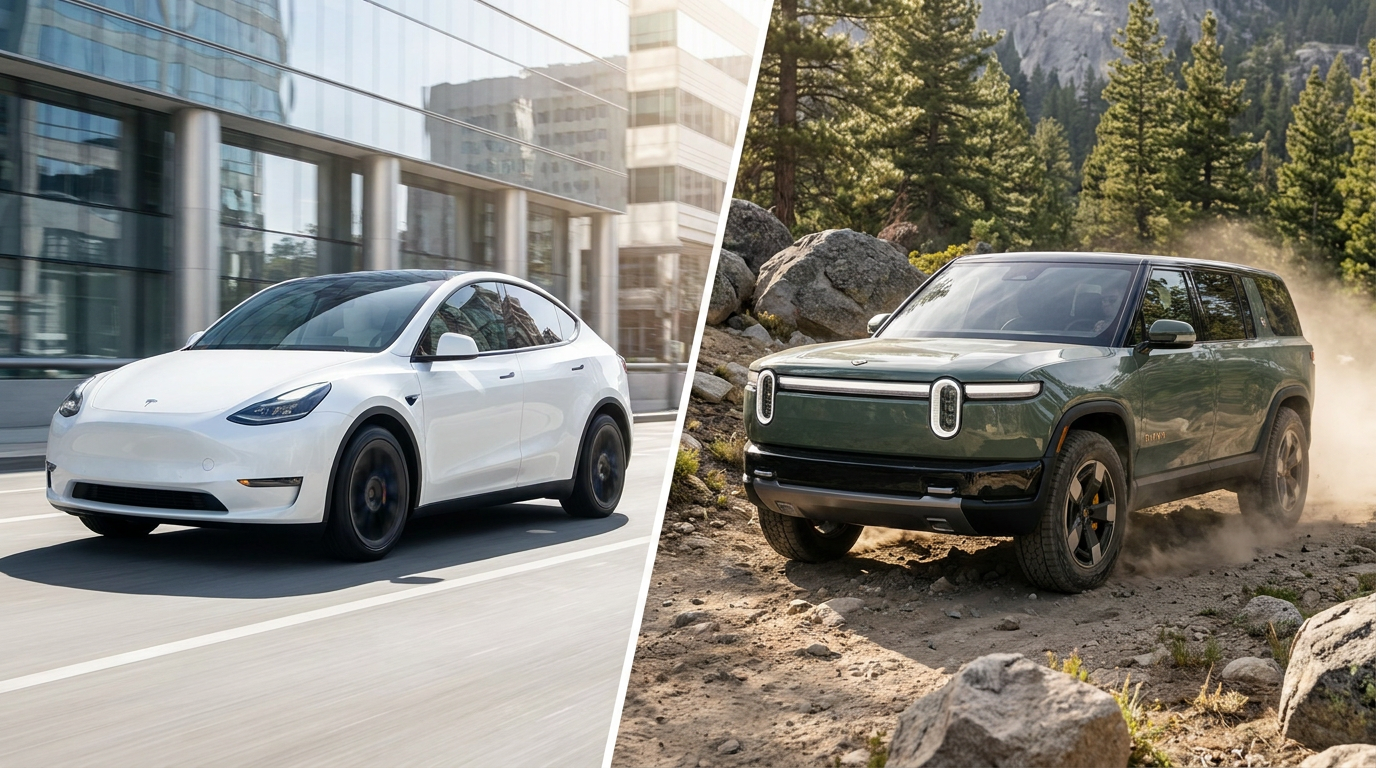
The Rivian R2 arrives in 2026 to challenge the best-selling Tesla Model Y, offering buyers a choice between rugged off-road utility and aerodynamic highway efficiency.
By Factlen Editorial Team
- Value-Conscious Commuters
- Buyers focused on minimizing upfront costs and maximizing daily efficiency.
- Adventure & Utility Seekers
- Drivers who require maximum cargo space and genuine off-pavement capability.
- Tech & Performance Enthusiasts
- Early adopters focused on software integration and hands-free driving systems.
What's not represented
- · Traditional legacy automakers losing market share to these two EV-only brands.
- · European and Asian market consumers who face different pricing structures and import tariffs for these American-made SUVs.
Why this matters
For the hundreds of thousands of buyers entering the EV market this year, choosing between these two midsize SUVs dictates not just their monthly payment, but whether their vehicle is optimized for efficient commuting or rugged outdoor utility. This analysis clarifies the exact compromises required before signing a $50,000 contract.
Key points
- The 2026 Tesla Model Y starts at $41,630, significantly undercutting the Rivian R2's $55,485 initial launch price.
- Rivian's R2 offers 90.1 cubic feet of cargo space and 9.6 inches of ground clearance, prioritizing off-road utility.
- The Model Y delivers superior aerodynamic efficiency, achieving 327 miles of range from a smaller 75 kWh battery pack.
- Both vehicles feature native NACS charging ports, granting them equal access to the extensive Tesla Supercharger network.
- The Model Y offers an optional third row for seven passengers, while the R2 is strictly a five-seat vehicle.
The midsize electric SUV segment in 2026 is no longer a one-horse race. For years, the Tesla Model Y has dominated American driveways, moving hundreds of thousands of units annually by offering a compelling blend of range, technology, and aggressive pricing. But the arrival of the highly anticipated Rivian R2 has fundamentally altered the calculus for prospective buyers. While both vehicles aim to replace the traditional internal combustion family hauler, they represent entirely different philosophies on what a modern utility vehicle should be. The Model Y leans into aerodynamic efficiency and minimalist tech, whereas the R2 banks on rugged capability, boxy aesthetics, and premium tactile materials.[1][8]
The most immediate point of comparison—and the most significant divergence—is pricing and availability. Tesla has aggressively positioned the 2026 Model Y to capture the value-conscious buyer, with the base Rear-Wheel Drive model starting at an accessible $41,630. Upgrading to the Long Range All-Wheel Drive pushes the price to approximately $50,630. Rivian, meanwhile, is launching the R2 with its higher-tier trims first. The R2 Performance Launch Edition commands $59,485, while the Premium AWD variant lands at $55,485. Although Rivian has promised a $45,000 base model, that version will not reach consumers until 2027, making the Model Y the undisputed winner for buyers strictly constrained by budget in the current model year.[4][6]
When evaluating the argument for the Tesla Model Y, the evidence heavily favors aerodynamic efficiency and established infrastructure. The Model Y’s sleek, teardrop profile allows it to cut through the air with minimal resistance. This translates to an impressive 327 miles of EPA-estimated range for the Premium AWD trim on a 75-kilowatt-hour battery pack. Furthermore, Tesla’s integration of its proprietary software with the vehicle’s hardware ensures that energy consumption remains remarkably low, often testing at around 26.8 kWh per 100 miles. For the daily commuter who prioritizes low running costs and maximum miles per kilowatt, the Model Y presents an airtight case.[5][7]

Conversely, the argument against the Model Y centers on its ubiquitous, somewhat sterile design and its lack of true off-road utility. With a ground clearance of just 6.0 to 6.6 inches, the Tesla is strictly a pavement-dwelling crossover. Its suspension is tuned for sporty on-road handling rather than absorbing trail impacts, and its sloping roofline—while excellent for aerodynamics—compromises rear cargo height. Additionally, Tesla’s insistence on routing nearly all vehicle controls through a single 15-inch central touchscreen continues to alienate drivers who prefer tactile buttons or a dedicated instrument cluster directly in their line of sight.[3][9]
Another critical distinction in utility is passenger capacity. The Tesla Model Y remains one of the only vehicles in the compact-to-midsize electric segment to offer an optional third row. While this $2,000 addition is notoriously cramped and suitable only for small children on short trips, it provides a seven-passenger lifeline that some families absolutely require. The Rivian R2, conversely, is strictly a five-seater. Rivian chose to optimize the second-row legroom—which sits at a comfortable 40.4 inches—and maximize the rear cargo floor rather than squeezing in a pair of jump seats.[3][7]
The argument for the Rivian R2 is built entirely around adventure-ready utility and maximizing interior volume. Rivian opted for a traditional, boxy two-box SUV silhouette. The evidence of this advantage is immediately apparent in the cargo metrics: the R2 offers a cavernous 90.1 cubic feet of total storage space with the seats folded, including a generously sized front trunk. This represents nearly a 19 percent increase in cargo volume over the Model Y’s 76 cubic feet. For buyers who regularly haul camping gear, large dogs, or bulky sporting equipment, the R2’s upright rear hatch and fold-flat seating in both rows provide vastly superior packaging.[1][2]

The argument for the Rivian R2 is built entirely around adventure-ready utility and maximizing interior volume.
Beyond sheer space, the R2’s evidence for off-road supremacy is quantified by its stance. The Rivian boasts 9.6 inches of ground clearance—a massive 60 percent increase over the Model Y. Combined with 25-degree approach and 26-degree departure angles, the R2 is genuinely trail-capable. It features specific drive modes for sand and rally conditions, and its suspension is engineered to articulate over uneven terrain. Inside, Rivian provides a 12.3-inch digital gauge cluster behind the steering wheel, complementing the 15.6-inch main display, and utilizes premium open-pore wood and durable vegan leather that feels distinctly more upscale than Tesla’s minimalist cabin.[1][3]
However, the argument against the Rivian R2 highlights the inherent trade-offs of its rugged design. Pushing a tall, blunt object through the air requires significantly more energy. To achieve its 330-mile range in the Premium AWD trim, the R2 relies on a larger, heavier battery pack—estimated at nearly 88 kilowatt-hours. This makes the vehicle roughly 370 pounds heavier than the Model Y, impacting overall efficiency. Furthermore, while the R2 features a native NACS port granting access to Tesla’s Supercharger network, its peak DC fast-charging rate is capped at 210 kilowatts, slightly lagging behind the Model Y’s 250-kilowatt peak capability.[1][4]
Performance metrics reveal that both vehicles offer more acceleration than the average driver will ever need, though they deliver it differently. The Tesla Model Y Performance, priced around $59,630, rockets from zero to 60 mph in a blistering 3.5 seconds. Rivian’s equivalently priced R2 Performance Launch Edition answers with a tri-motor setup producing 656 horsepower, achieving the same 60 mph sprint in 3.6 seconds. Yet, the driving dynamics diverge sharply: the Model Y feels like a heavy sports sedan with stiff cornering, while the R2 maintains the commanding, slightly softer ride of a traditional SUV, absorbing road imperfections with greater compliance.[4][6]
The technological battleground also presents distinct philosophies. Tesla’s Autopilot and optional Full Self-Driving suites remain the industry benchmarks for advanced driver-assistance systems, offering point-to-point navigation capabilities that are constantly refined via over-the-air updates. Rivian is countering with its new Autonomy+ system, which utilizes a suite of high-resolution cameras and radar to offer hands-free highway driving. While Rivian’s system shows immense promise and is included as a lifetime subscription on Launch Edition models, it lacks the billions of miles of real-world training data that Tesla has accumulated over the past decade.[4][9]

Warranty and long-term ownership costs also play a role in the trade-off analysis. Both manufacturers offer a standard four-year or 50,000-mile basic warranty, alongside an eight-year battery and drive unit warranty that guarantees at least 70 percent capacity retention. However, Tesla’s massive global service network and established parts supply chain provide a safety net that Rivian, still scaling its physical service centers, cannot yet match. Buyers in rural areas may find Tesla’s mobile service fleet more accessible than Rivian’s growing, but still concentrated, support infrastructure.[5][8]
Ultimately, choosing between these two electric SUVs requires buyers to honestly assess their daily driving habits and lifestyle needs. The Tesla Model Y fits perfectly when the primary use case involves long-distance highway commuting, navigating tight urban environments, and maximizing financial value. It is the logical choice for buyers who want the most efficient, proven electric powertrain on the market and who appreciate a minimalist, tech-forward aesthetic. Its lower starting price and immediate availability across all trim levels make it the pragmatic default for the masses.[8][9]
The Rivian R2 does not fit well for buyers who prioritize maximum aerodynamic efficiency, those who want a low step-in height, or those shopping strictly under a $50,000 budget in 2026. However, the R2 fits exceptionally well when the buyer views their vehicle as a tool for outdoor recreation. It is the superior choice for drivers who frequently encounter unpaved roads, deep snow, or trails, and for those who simply need the maximum possible cargo volume in a midsize footprint. The R2 justifies its premium pricing by offering a tangible sense of adventure, a more luxurious cabin, and a design that stands out in a sea of teardrop crossovers.[3][9]
How we got here
2020
Tesla begins deliveries of the Model Y, which quickly becomes the best-selling electric vehicle globally.
March 2024
Rivian officially unveils the R2 midsize SUV, generating over 68,000 reservations in the first 24 hours.
Early 2026
Rivian begins deliveries of the high-end R2 Performance Launch Edition, priced at $59,485.
Late 2026
The Rivian R2 Premium AWD trim arrives at $55,485, directly competing with the Model Y Long Range.
Summer 2027
The highly anticipated $45,000 base model Rivian R2 Standard is scheduled to reach consumers.
Viewpoints in depth
Value-Conscious Commuters
Buyers focused on minimizing upfront costs and maximizing daily efficiency.
This camp heavily favors the Tesla Model Y. They point to the nearly $14,000 gap in base pricing between the currently available 2026 trims as an insurmountable advantage. For these drivers, the Model Y's superior aerodynamic efficiency—consuming just 26.8 kWh per 100 miles—and its proven track record make it the ultimate pragmatic appliance. They view the Rivian's off-road hardware as unnecessary weight that penalizes daily highway driving.
Adventure & Utility Seekers
Drivers who require maximum cargo space and genuine off-pavement capability.
This perspective champions the Rivian R2. They argue that the crossover market has become too homogenized and that the Model Y is essentially a lifted sedan. By citing the R2's 9.6 inches of ground clearance, fold-flat seating, and 90.1 cubic feet of storage, this camp values the ability to haul gear, navigate rutted trails, and camp inside the vehicle. They are willing to pay the $55,000+ premium for a vehicle that supports an active, outdoor-heavy lifestyle.
Tech & Performance Enthusiasts
Early adopters focused on software integration and hands-free driving systems.
This group is split but leans toward Tesla due to its established track record. They value Tesla's Full Self-Driving beta and the seamless integration of the vehicle's infotainment ecosystem. However, a growing subset within this camp is intrigued by Rivian's Autonomy+ system and its inclusion of a dedicated driver display—a feature Tesla famously omits. They argue that Rivian's software-defined architecture is rapidly closing the gap with Tesla's legacy systems.
What we don't know
- Whether Rivian can scale its manufacturing quickly enough to meet the massive pre-order demand for the R2 without production delays.
- How the real-world highway range of the boxy Rivian R2 will hold up in extreme cold weather compared to the highly aerodynamic Model Y.
- If Tesla will introduce a significant 'Juniper' design refresh for the Model Y in late 2026 to counter the R2's launch.
Key terms
- NACS (North American Charging Standard)
- The charging plug design originally developed by Tesla, which has now been adopted by most major automakers, including Rivian, for seamless access to the Supercharger network.
- MPGe (Miles Per Gallon Equivalent)
- A metric used by the EPA to compare the energy efficiency of electric vehicles to traditional gas-powered cars.
- Approach and Departure Angles
- Measurements that indicate how steep an obstacle a vehicle can climb over or descend from without the front or rear bumpers scraping the ground.
- Over-the-Air (OTA) Updates
- Software updates delivered wirelessly to a vehicle via cellular or Wi-Fi connections, allowing manufacturers to add features or improve performance after purchase.
Frequently asked
When will the $45,000 Rivian R2 be available?
Rivian plans to release the base R2 Standard model, priced around $45,000, in the first half of 2027. The 2026 launch year is restricted to the more expensive Performance and Premium trims.
Can the Rivian R2 use Tesla Superchargers?
Yes. The Rivian R2 is built with a native NACS (North American Charging Standard) port, allowing it to plug directly into Tesla Superchargers without needing an adapter.
Which vehicle has more cargo space?
The Rivian R2 offers significantly more room, providing 90.1 cubic feet of total storage (including the front trunk) compared to the Tesla Model Y's 76 cubic feet.
Does the Rivian R2 have a third row of seats?
No, the Rivian R2 is strictly a five-passenger vehicle. The Tesla Model Y offers an optional, albeit small, third row to seat up to seven passengers.
Sources
Source coverage
9 outlets
3 viewpoints surfaced









[1]ElectrekAdventure & Utility Seekers
Rivian R2 vs Tesla Model Y spotted side-by-side: Detailed size comparison
Read on Electrek →[2]CarsDirect
Compare the 2027 Rivian R2 to the 2026 Tesla Model Y
Read on CarsDirect →[3]CarConfectionsAdventure & Utility Seekers
Who is best within 2027 Rivian R2 vs. 2026 Tesla Model Y?
Read on CarConfections →[4]Car and DriverValue-Conscious Commuters
2027 Rivian R2: What We Know So Far
Read on Car and Driver →[5]EdmundsValue-Conscious Commuters
2026 Tesla Model Y Review
Read on Edmunds →[6]CarBuzzTech & Performance Enthusiasts
2026 Tesla Model Y Price and Competition
Read on CarBuzz →[7]TrueCarValue-Conscious Commuters
2026 Tesla Model Y Specs & Features
Read on TrueCar →[8]ev.careTech & Performance Enthusiasts
Rivian Automotive R2 vs Tesla Model Y — full head-to-head
Read on ev.care →[9]AutoNocionAdventure & Utility Seekers
Is the Rivian R2 actually competing with the Tesla Model Y?
Read on AutoNocion →
Every angle. Every day.
Get automotive stories with full source coverage and perspective breakdowns delivered to your inbox.