
How AI and Autonomous Labs Are Compressing Decades of Materials Science into Months
Generative AI models and robotic 'self-driving labs' are discovering and synthesizing millions of novel materials, accelerating the development of next-generation batteries and clean energy technologies.
By Factlen Editorial Team
- Computational Chemists
- Focus on the power of generative AI and graph neural networks to rapidly map unexplored chemical spaces and predict stable structures.
- Experimental Material Scientists
- Emphasize the 'synthesizability gap' and the critical need for autonomous robotic labs to physically validate AI predictions.
- Clean Energy Researchers
- Value AI primarily as a tool to accelerate the discovery of sustainable, low-lithium battery alternatives for the energy transition.
What's not represented
- · Industrial Manufacturing Engineers
- · Mining and Resource Economists
Why this matters
The transition to clean energy is currently bottlenecked by the physical limits of known materials. By using AI to compress the discovery timeline from decades to months, scientists are rapidly unlocking the next generation of cheaper, safer, and more powerful batteries.
Key points
- Generative AI models have predicted millions of new, theoretically stable crystal structures.
- AI screening compressed the discovery of a new low-lithium battery material from decades to months.
- Autonomous robotic labs are now synthesizing and testing hundreds of AI-designed materials per day.
- The technology is unlocking entirely new classes of materials, such as porous structures for multivalent-ion batteries.
- Researchers are working to close the 'synthesizability gap' by training AI to predict exact manufacturing recipes.
For more than a century, the discovery of new materials has been defined by Thomas Edison’s famous brute-force method: test thousands of variations in a laboratory until one finally works. This trial-and-error approach has historically meant that bringing a new material from a conceptual idea to commercial reality takes between ten and twenty years.[7]
But in the mid-2020s, a profound paradigm shift has taken hold across the physical sciences. Artificial intelligence has moved beyond generating text and images, entering the physical world to design the atomic structures of tomorrow. The stakes for this acceleration are immense, as the transition to clean energy relies entirely on discovering better battery chemistries, more efficient solar cells, and novel carbon-capture materials.[7]
The first major breakthrough in this new era has been the ability of generative AI to map the vast, unexplored "chemical space" and predict which atomic combinations will be stable. In late 2023, Google DeepMind unveiled GNoME, a deep learning tool that predicted the structures of 2.2 million new crystals.[1]
To put that number in perspective, GNoME expanded the catalog of known stable materials by an order of magnitude, identifying 380,000 structures that are theoretically stable enough to be synthesized. The system achieved this by using graph neural networks, which treat atoms as nodes and chemical bonds as edges, allowing the AI to discern complex patterns in how elements bind together.[1]

While predicting millions of materials is a triumph of computation, the true test is whether AI can solve specific, urgent engineering problems. A landmark collaboration between Microsoft and the Pacific Northwest National Laboratory (PNNL) demonstrated exactly how this targeted discovery works in practice.[2]
The PNNL team was searching for a new solid-state battery electrolyte that could reduce reliance on lithium. Using an AI model, they screened 32 million theoretical candidate materials, winnowing the list down to just 18 promising options in a mere 80 hours.[2][4]
Traditional physics calculations would have taken decades to sort through a list of that magnitude. Instead, within nine months, the researchers successfully synthesized one of the AI-selected candidates—a novel mixture of lithium, sodium, yttrium, and chloride ions—and built a working battery prototype that uses 70 percent less lithium than conventional designs.[2][4]
Traditional physics calculations would have taken decades to sort through a list of that magnitude.
However, computational predictions are only half the battle. A persistent bottleneck in materials science is the "synthesizability gap"—the reality that a crystal structure that looks perfect on a computer screen might be incredibly difficult to actually cook up in a physical laboratory.[7]

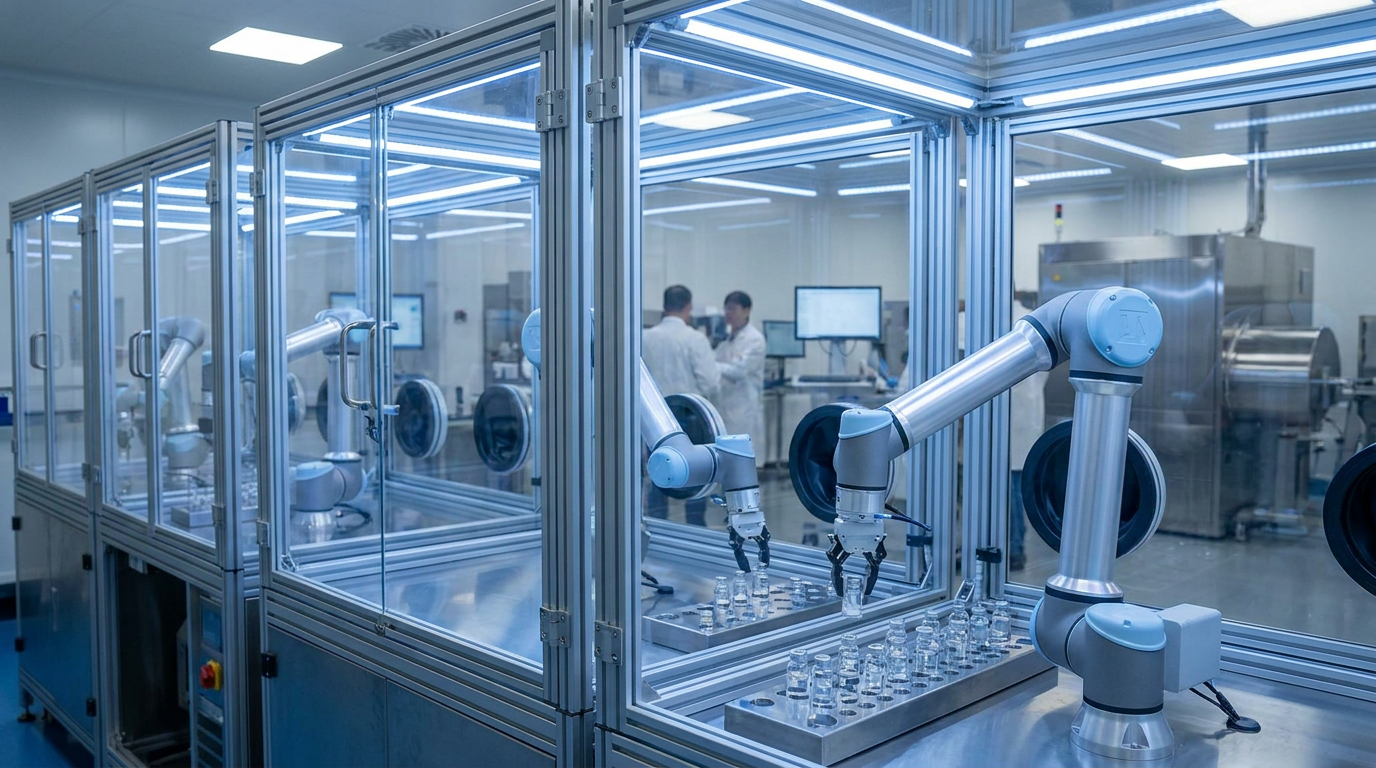
To close this loop, research institutions are increasingly deploying "autonomous laboratories" or "self-driving labs." These facilities pair AI algorithms directly with robotic chemistry equipment, allowing the system to propose a recipe, mix the chemicals, test the results, and learn from its failures without human intervention.[6]
At the Massachusetts Institute of Technology, researchers have built a fully autonomous platform capable of inventing and testing up to 700 new polymer blends every single day. The system uses a genetic algorithm to intelligently design the blends, sending the instructions to a robotic platform that conducts the physical experiments and feeds the performance data back into the model.[6]
Similar robotic acceleration is transforming government research hubs. At the Argonne National Laboratory, scientists utilized AI and robotics to conduct more than 6,000 experiments on organic redox flow battery chemicals in just five months. The laboratory noted that such a monumental effort would have taken five to eight years using traditional manual experimentation.[3]
Beyond mere speed, AI is proving capable of unlocking entirely new classes of materials that human intuition might naturally overlook. Because human chemists are trained on historical precedents, they tend to explore variations of known compounds, whereas AI models can suggest highly unconventional atomic arrangements.[7]

For example, researchers at the New Jersey Institute of Technology recently used generative AI to discover five entirely new porous transition metal oxide structures. These materials feature large, open channels that are perfectly suited for multivalent-ion batteries—next-generation energy storage systems that use abundant elements like magnesium or zinc instead of lithium.[5]
Multivalent ions carry two or three positive charges, meaning they can store significantly more energy than single-charge lithium ions, but their bulky size makes it difficult for them to move through traditional battery materials. The AI-discovered porous structures solve this exact physical constraint, offering a viable path forward for these high-capacity batteries.[5]
Despite these rapid successes, the field still faces significant challenges. The primary hurdle remains translating AI-generated structures into reliable synthesis recipes. While models can predict that a material will be stable, they do not always know the precise temperatures, pressures, or precursor chemicals required to forge it in a furnace.[7]

To address this, the next frontier of AI materials research involves training models specifically on synthesis pathways, teaching the AI not just what to make, but exactly how to make it. As these closed-loop systems mature, humanity is steadily moving from a paradigm of discovering materials by accident to designing them on demand.[7]
How we got here
Nov 2023
Google DeepMind publishes the GNoME project, predicting 2.2 million new crystal structures.
Jan 2024
Microsoft and PNNL announce the synthesis of a low-lithium battery material discovered via AI screening.
Jul 2025
MIT researchers unveil an autonomous robotic platform capable of testing 700 new polymer blends a day.
Jan 2026
Argonne National Laboratory completes 6,000 automated battery chemical experiments in just five months.
Viewpoints in depth
The Computational View
Mapping the theoretical boundaries of chemical space.
For computational chemists, the breakthrough lies in overcoming the sheer mathematical scale of atomic combinations. By utilizing graph neural networks—which represent atoms as nodes and bonds as edges—researchers can simulate millions of potential crystal structures in a fraction of the time it takes to run traditional Density Functional Theory (DFT) calculations. This camp views the AI as a high-powered sieve, capable of filtering out thermodynamically unstable materials before a human ever steps foot in a lab.
The Experimentalist View
Closing the loop between digital predictions and physical reality.
Experimental scientists caution against treating digital predictions as finished products, pointing to the 'synthesizability gap.' A crystal structure may be theoretically stable, but if it requires impossible temperatures or pressures to forge, it remains useless. This camp champions 'self-driving labs'—robotic platforms that take AI-generated recipes, physically mix the precursors, and test the results. By feeding the physical failure data back into the model, these autonomous systems teach the AI the practical constraints of real-world chemistry.
The Clean Energy View
Racing to replace critical minerals before supply chains break.
For researchers focused on the energy transition, AI is a tool to solve immediate geopolitical and environmental bottlenecks. The global reliance on lithium, cobalt, and nickel for battery production presents severe supply chain risks. This camp prioritizes using AI to discover solid-state electrolytes and multivalent-ion batteries that utilize abundant, cheap elements like sodium, magnesium, and zinc, drastically compressing the timeline to commercialize next-generation grid storage.
What we don't know
- How quickly the millions of AI-predicted crystal structures can be physically synthesized and validated in real-world laboratories.
- Whether AI-discovered materials can be manufactured at an industrial scale cost-effectively, beyond small laboratory prototypes.
- How long it will take for AI models to reliably predict the exact synthesis recipes (temperatures, pressures, precursors) for complex novel materials.
Key terms
- Density Functional Theory (DFT)
- A quantum mechanical modeling method used in physics and chemistry to investigate the electronic structure of atoms and molecules.
- Graph Neural Network (GNN)
- A type of artificial intelligence designed to process data represented as graphs, ideal for analyzing molecules where atoms are nodes and bonds are edges.
- Autonomous Laboratory
- A facility where AI algorithms are paired with robotic equipment to design, execute, and analyze physical experiments without human intervention.
- Solid-State Electrolyte
- A solid material that conducts ions between a battery's electrodes, offering a safer and potentially more energy-dense alternative to traditional liquid electrolytes.
- Multivalent-ion Battery
- A next-generation battery that uses elements like magnesium or zinc, whose ions carry multiple positive charges, allowing them to store more energy than single-charge lithium ions.
Frequently asked
How does AI discover new materials?
AI models analyze vast databases of known chemical structures to learn the rules of atomic bonding. They then generate millions of novel combinations and predict which ones will be physically stable.
Are these AI-discovered materials real?
While millions exist only as computer predictions, hundreds have already been successfully synthesized in physical laboratories, including new battery electrolytes and solar cell materials.
Why is reducing lithium in batteries important?
Lithium is expensive, environmentally taxing to mine, and subject to global supply chain bottlenecks. Finding alternative materials ensures a more sustainable and scalable energy transition.
What is the 'synthesizability gap'?
It is the difference between predicting that a material is stable on a computer and actually figuring out the physical recipe—temperatures, pressures, and precursor chemicals—needed to create it in a lab.
Sources
Source coverage
7 outlets
3 viewpoints surfaced







[1]Google DeepMindComputational Chemists
Millions of new materials discovered with deep learning
Read on Google DeepMind →[2]Science NewsClean Energy Researchers
A new battery material was discovered by AI and supercomputing
Read on Science News →[3]Argonne National LaboratoryExperimental Material Scientists
Autonomous discovery-driven Argonne study inspires paradigm shift in battery research
Read on Argonne National Laboratory →[4]Live ScienceClean Energy Researchers
Scientists used AI to build a low-lithium battery from a new material that took just hours to discover
Read on Live Science →[5]EurekAlertClean Energy Researchers
AI breakthrough unlocks 'new' materials to replace lithium-ion batteries
Read on EurekAlert →[6]NotebookCheckExperimental Material Scientists
MIT's autonomous AI lab invents and tests 700 new materials a day
Read on NotebookCheck →[7]CyprisComputational Chemists
AI-accelerated materials discovery
Read on Cypris →

More in ai
See all 5 stories →EU AI Act
The EU AI Act's August 2026 Enforcement Cliff: What the 'Digital Omnibus' Delay Means for Enterprises
7 sources

Medical AI
AI Turns Routine 10-Second ECGs Into Predictive Scans for Heart Disease and Diabetes
6 sources

Local AI
The 2026 Guide to Local AI: How to Run Powerful LLMs on Your Own Hardware
8 sources

Every angle. Every day.
Get ai stories with full source coverage and perspective breakdowns delivered to your inbox.