
The 2026 Guide to Local AI: How to Run Powerful LLMs on Your Own Hardware
Running large language models locally has become the standard for privacy-conscious users and enterprises in 2026. With tools like Ollama and Apple's Unified Memory, consumer hardware can now run GPT-4-class AI entirely offline.
By Factlen Editorial Team
- Privacy & Security Advocates
- Views local AI as a mandatory safeguard against data harvesting and corporate surveillance.
- Open-Source Developers
- Values the democratization of AI, focusing on the freedom to build without API rate limits or gatekeepers.
- Hardware Enthusiasts & Architects
- Treats local AI as an optimization challenge, focusing on memory bandwidth, silicon architecture, and quantization.
What's not represented
- · Cloud AI Providers
- · Hardware Manufacturers
Why this matters
Running AI locally gives you absolute control over your data, eliminates recurring subscription fees, and allows you to work offline. It transforms AI from a rented cloud service into a private tool you own and operate.
Key points
- Local AI allows users to run powerful language models entirely offline, ensuring complete data privacy.
- Enterprise adoption of on-premises AI inference has surged to 55% in 2026.
- Tools like Ollama and LM Studio have made installing and running local models as easy as downloading an app.
- VRAM capacity is the most critical hardware specification for running local AI smoothly.
- Apple Silicon's Unified Memory architecture allows Macs to run massive models that would otherwise require expensive enterprise GPUs.
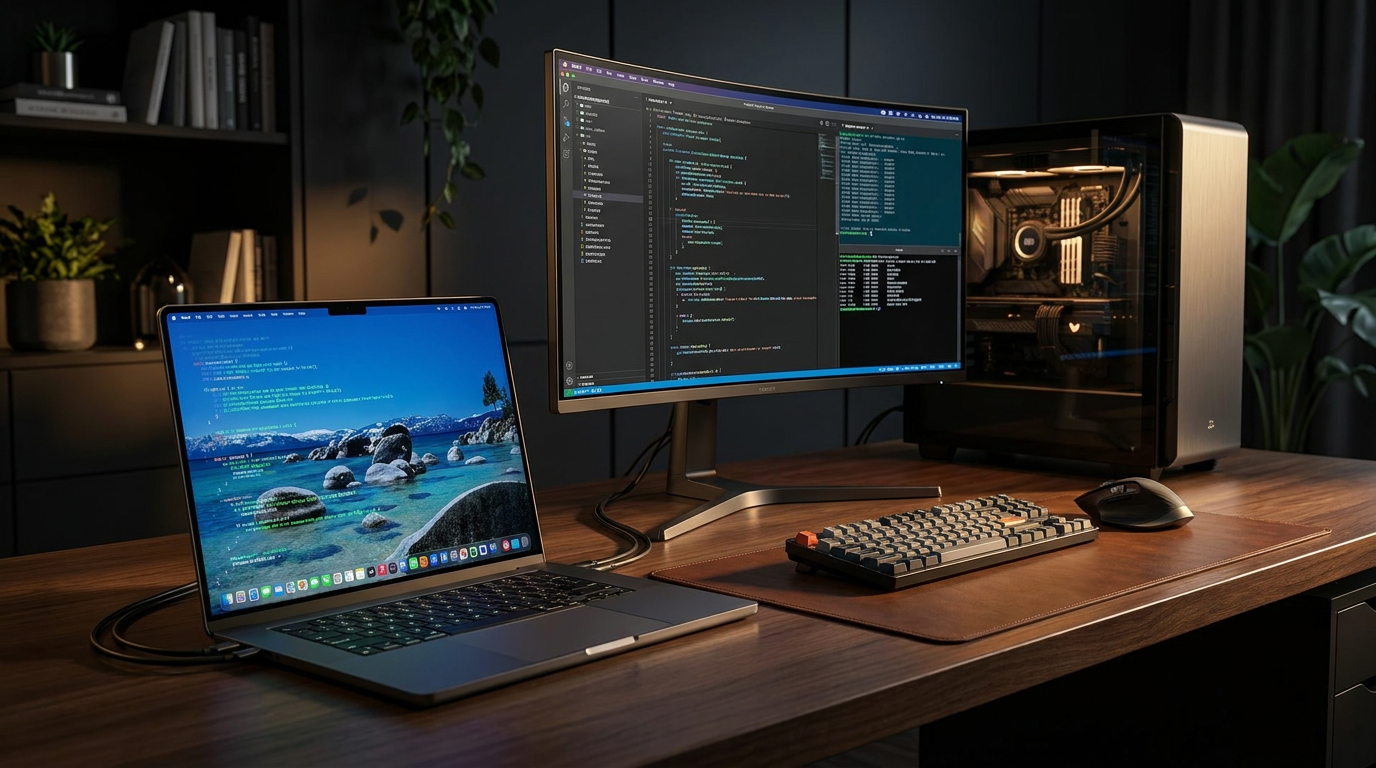
For the past three years, interacting with artificial intelligence meant sending your data to a remote server and waiting for a response. In 2026, that paradigm has fundamentally fractured. A quiet but rapid revolution has moved generative AI out of massive cloud data centers and directly onto consumer laptops, gaming rigs, and office workstations. This shift, known as local AI, allows users to run powerful large language models entirely on their own hardware. It represents a profound democratization of technology, shifting control from centralized cloud providers back to individual users and independent developers.[3]
The scale of this migration is staggering, driven largely by enterprise adoption. In 2023, a mere 12 percent of enterprise AI inference happened on-premises or at the edge. By mid-2026, that figure has surged to 55 percent. Companies are realizing that while cloud APIs are excellent for general-purpose queries, they introduce unacceptable risks when handling proprietary codebases, sensitive client communications, or regulated medical data. The local AI ecosystem has matured to meet this demand, offering tools that are as easy to install as a standard desktop application.[1][5]
The primary catalyst for this shift is data sovereignty. When you run a language model locally, your prompts, documents, and outputs never leave your physical machine. There are no network calls to intercept, no server logs storing your queries, and no terms-of-service agreements granting a third-party provider the right to train future models on your intellectual property. For regulated industries like healthcare and finance, this is not merely a convenience—it is a strict legal requirement that makes AI adoption possible.[1][5]

Beyond the absolute guarantee of privacy, local execution fundamentally alters the economics of artificial intelligence. Cloud-based AI incurs recurring API costs that scale linearly with usage; a company processing millions of tokens a day can easily spend tens of thousands of dollars a month. Running models locally requires an upfront hardware investment, but the marginal cost of generating a token drops to zero. Furthermore, local inference eliminates the 200 to 800 milliseconds of network latency inherent in cloud requests, enabling instantaneous code completion and real-time voice interactions.[3][5]
Two years ago, running a capable large language model required deep technical expertise, complex Python environments, and a high tolerance for troubleshooting. Today, the barrier to entry has entirely collapsed thanks to highly polished software layers. Two tools currently dominate the local AI landscape: Ollama and LM Studio. Both rely on the same highly optimized open-source inference engine—known as llama.cpp—but they cater to entirely different types of users.[7]
Ollama operates as a developer-first command-line tool that wraps the underlying inference engine into a seamless background service. It allows users to download and run complex models with a single terminal command, automatically handling hardware acceleration and memory management. LM Studio, conversely, provides a polished graphical user interface that is often described as the "Spotify for LLMs." It allows non-technical users to browse a directory of models, download them with a click, and interact via a familiar chat window without ever touching a line of code.[7]
The true architectural brilliance of tools like Ollama lies in their interoperability. Ollama automatically exposes an OpenAI-compatible API on the user's local machine. This means that any existing application, browser extension, or coding copilot designed to communicate with ChatGPT can be seamlessly redirected to a local model. Developers simply change the API base URL to their local host address, instantly transforming cloud-dependent software into a private, offline-capable tool with zero code rewrites.[1][7]
The true architectural brilliance of tools like Ollama lies in their interoperability.
While the software is free and accessible, the physical hardware dictates the absolute ceiling of what is possible. The single most critical specification for local AI is not the speed of the processor, but the capacity of the VRAM—Video Random Access Memory. An AI model is essentially a massive collection of mathematical weights. To achieve acceptable generation speeds, these weights must reside entirely within the high-bandwidth memory of a graphics processing unit.[4][6]
If a model's size exceeds the available VRAM, the system is forced to offload the excess data to the computer's standard system RAM. This creates a severe "performance cliff." Because system RAM is significantly slower than VRAM, generation speeds can plummet from a fluid 40 tokens per second to a sluggish one or two tokens per second. Consequently, matching the model size to the available hardware memory is the foundational rule of local AI deployment.[6]
To fit massive, highly capable models onto consumer-grade hardware, the industry relies heavily on a mathematical compression technique known as quantization. At full precision, a 7-billion parameter model requires roughly 14 gigabytes of memory. Through quantization—specifically the popular 4-bit or "Q4" format—the precision of the model's neural weights is reduced. This shrinks the memory footprint by approximately 75 percent, allowing the same model to run comfortably in just 4 to 5 gigabytes of VRAM, with an almost imperceptible drop in reasoning quality.[5][6]
In the hardware arms race to support these models, Apple Silicon has emerged as an unexpected and dominant powerhouse. Traditional Windows PCs suffer from the "PCIe bottleneck," where the central processor and the graphics card maintain entirely separate memory pools. Apple's M-series chips, however, utilize a Unified Memory architecture. This design allows the integrated GPU to directly access the system's massive, high-bandwidth RAM pool as if it were dedicated video memory.[2][4]

Because of this unified architecture, high-end Macs have become the default servers for massive local AI workloads. A Mac Studio configured with 192 gigabytes or even 512 gigabytes of unified memory can run colossal frontier models—such as the 671-billion parameter DeepSeek-V3 or Meta's Llama 3.1 405B. Running models of this scale on traditional PC architecture would require a cluster of enterprise-grade NVIDIA GPUs costing tens of thousands of dollars, making Apple's hardware uniquely cost-effective for AI researchers.[2]

For PC users, NVIDIA remains the undisputed king of raw token generation speed, provided the user selects a card with sufficient VRAM. The RTX 4060 Ti 16GB has become the universally recommended budget sweet spot, offering enough memory to comfortably run 13-billion parameter models. Meanwhile, used RTX 3090 graphics cards, which boast a massive 24 gigabytes of VRAM, remain highly sought after by AI power users who want to run 32-billion parameter models at blistering speeds.[4]
The open-weight models available for download in 2026 have closed the capability gap with proprietary cloud services. Models like Meta's Llama 4 Scout, Alibaba's Qwen 3, and Google's Gemma 4 offer reasoning, coding, and summarization capabilities that match or exceed the GPT-4 benchmarks of just a year ago. These models are highly optimized, allowing a standard laptop to serve as a world-class coding assistant or document analyzer without ever connecting to the internet.[1]

Ultimately, the smartest technological architecture for 2026 is a hybrid approach. Developers and enterprises are increasingly using local models as their default engine for routine tasks, document analysis, and privacy-critical data processing. They fall back to expensive cloud APIs only when a specific query requires absolute frontier-level intelligence. This local-first strategy offers the best of both worlds: the speed, privacy, and cost-efficiency of on-device hardware, backed by the limitless scale of the cloud when genuinely needed.[3][8]
How we got here
2023
Only 12% of enterprise AI inference happens on-premises.
Early 2024
llama.cpp and Ollama launch, dramatically simplifying local AI installation for developers.
Late 2025
Apple releases M4 Max chips with 546 GB/s memory bandwidth, cementing Macs as premier local AI workstations.
Mid 2026
Local AI adoption reaches 55% of enterprise inference workloads, driven by privacy and cost concerns.
Viewpoints in depth
Privacy & Security Advocates
This camp views local AI as a mandatory safeguard against data harvesting and corporate surveillance.
For healthcare providers, financial institutions, and enterprise software developers, sending proprietary data to third-party cloud APIs represents an unacceptable security risk. Privacy advocates argue that on-device inference is the only architecture that guarantees true data sovereignty. By keeping prompts and documents entirely on local hardware, organizations bypass GDPR gray areas, eliminate the risk of API data breaches, and ensure that their intellectual property is never used to train a vendor's future models.
Open-Source Developers
This camp values the democratization of AI, focusing on the freedom to build without gatekeepers.
Developers champion local LLMs because they remove the friction of API rate limits, subscription costs, and sudden terms-of-service changes. Tools like Ollama allow engineers to rapidly prototype, fine-tune, and deploy AI agents without relying on a centralized provider. This camp views the open-weight ecosystem as a critical counterbalance to corporate monopolies, ensuring that frontier-level reasoning capabilities remain accessible to independent researchers and startups.
Hardware Enthusiasts & Architects
This camp treats local AI as an optimization challenge, focusing on memory bandwidth, silicon architecture, and quantization.
For hardware architects, the local AI revolution is fundamentally a physics problem centered on memory bandwidth. They analyze the "performance cliff" that occurs when a model spills out of VRAM and into slower system RAM. This group closely tracks the divergent strategies of NVIDIA's raw compute dominance versus Apple Silicon's massive unified memory pools, constantly testing new quantization formats like GGUF to squeeze the largest possible models onto consumer-grade silicon.
What we don't know
- Whether future frontier models will grow too large for even maxed-out consumer hardware to run locally.
- How cloud AI providers will adjust their pricing models as more users migrate to free local inference.
- If upcoming dedicated AI chips (NPUs) will eventually replace GPUs for local model execution.
Key terms
- Local LLM
- A large language model that runs entirely on a user's own hardware rather than on a remote cloud server.
- VRAM
- Video Random Access Memory; the dedicated memory on a graphics card where AI model weights must be loaded for fast processing.
- Quantization
- A mathematical compression technique that reduces the precision of a model's neural weights (e.g., from 16-bit to 4-bit) to save memory.
- Unified Memory
- Apple's hardware architecture where the CPU and GPU share a single, massive pool of high-bandwidth RAM.
- llama.cpp
- The underlying open-source C/C++ inference engine that powers most local AI tools, enabling models to run efficiently on consumer hardware.
Frequently asked
Do I need an internet connection to use a local LLM?
No. Once the model file is downloaded to your machine, all processing happens entirely offline, ensuring complete privacy.
Are local AI models free to use?
Yes. Tools like Ollama and LM Studio are free, and open-weight models from companies like Meta, Google, and Mistral have no subscription or API costs.
Can I run a local LLM on a Mac?
Yes. Apple Silicon Macs are highly capable for local AI due to their Unified Memory architecture, which allows the GPU to access massive amounts of system RAM.
What is quantization?
Quantization is a compression technique that shrinks the mathematical precision of an AI model's weights, allowing massive models to fit into consumer hardware with minimal quality loss.
Sources
Source coverage
8 outlets
3 viewpoints surfaced







[1]TechsyOpen-Source Developers
Run LLMs Locally 2026: The 5-Minute Setup for Any GPU
Read on Techsy →[2]Local AI MasterHardware Enthusiasts & Architects
Apple Silicon changed the calculus for local AI
Read on Local AI Master →[3]AI MagicxPrivacy & Security Advocates
Why On-Device AI Is Having Its Moment
Read on AI Magicx →[4]ModemGuidesHardware Enthusiasts & Architects
Best Hardware for Running Local AI Models in 2026
Read on ModemGuides →[5]EmeliaPrivacy & Security Advocates
Why Run AI Locally in 2026
Read on Emelia →[6]Decodes FutureHardware Enthusiasts & Architects
The Physics of LLM Hardware: Memory, Bandwidth, and Precision
Read on Decodes Future →[7]ContaboOpen-Source Developers
Ollama vs LM Studio: Which Local LLM Tool is Right for You?
Read on Contabo →[8]Factlen Editorial TeamOpen-Source Developers
Synthesis by Factlen editorial team
Read on Factlen Editorial Team →

More in ai
See all 5 stories →Language AI
New On-Device AI Model Brings Real-Time Translation to 400 Indigenous Languages
8 sources
EU AI Act
The EU AI Act's August 2026 Enforcement Cliff: What the 'Digital Omnibus' Delay Means for Enterprises
7 sources

Medical AI
AI Turns Routine 10-Second ECGs Into Predictive Scans for Heart Disease and Diabetes
6 sources

Every angle. Every day.
Get ai stories with full source coverage and perspective breakdowns delivered to your inbox.