
How Hydrofoils and AI Are Quietly Revolutionizing Recreational Boating
Advances in hydrofoil technology and autonomous docking systems are transforming the boating industry, promising a future of silent, zero-emission, and stress-free navigation.
By Factlen Editorial Team
- Marine Tech Innovators
- Argue that overcoming water density via hydrofoils and automating docking will lower the barrier to entry and revolutionize the boating experience.
- Environmental Advocates
- Focus on the urgent need to phase out combustion engines on inland lakes and coastal waters to stop hydrocarbon pollution and noise disruption.
- Boating Industry & Enthusiasts
- Emphasize the practical benefits of the new technology while highlighting the infrastructural challenges of upgrading marina electrical grids.
What's not represented
- · Small Marina Owners
- · Traditional Engine Mechanics
Why this matters
Recreational boating is transitioning from a loud, polluting, and often stressful activity into a clean, silent, and highly automated experience. For consumers, this means lower maintenance costs and easier operation, while fragile aquatic ecosystems benefit from the elimination of toxic fuel discharges and noise pollution.
Key points
- Hydrofoil technology allows electric boats to 'fly' above the water, reducing drag by 80% and enabling long-range travel.
- Advances in LFP and blade cell batteries are making marine power systems safer, more durable, and faster to charge.
- Autonomous docking systems like Navico's AutoCaptain use stereo cameras and AI to completely take over the helm in tight marinas.
- Older combustion marine engines are a significant source of localized water pollution, discharging unburned fuel and NOx.
- The primary hurdle for mass adoption remains the high upfront cost of the vessels and the need for upgraded marina charging infrastructure.
For decades, the recreational boating experience has been defined by a familiar set of sensory inputs: the roar of a combustion engine, the smell of diesel or gasoline fumes, and the bone-jarring slam of a hull hitting choppy water. But heading into the summer of 2026, the maritime industry is undergoing a quiet, fundamental transformation. A convergence of aerospace engineering, advanced battery chemistry, and artificial intelligence is reshaping what it means to spend a day on the water.
The push for marine electrification is driven by a pressing environmental mandate. While cars have faced strict emissions regulations for years, marine engines have historically operated under looser standards. Traditional two-stroke outboard motors are notoriously inefficient; studies show they can discharge up to 30 percent of their fuel unburned directly into the water, introducing highly toxic hydrocarbons into fragile aquatic ecosystems. Even modern four-stroke engines, while significantly cleaner, still emit nitrogen oxides (NOx) that contribute to ground-level ozone and water acidification.[6]
However, electrifying boats presents a unique physics problem that automakers never had to solve: water is incredibly dense. Pushing a conventional hull through water requires massive amounts of continuous energy, which historically limited electric boats to slow speeds and short ranges. To achieve the range and speed that recreational boaters demand, engineers had to figure out how to stop fighting the water and start flying over it.[1][5]
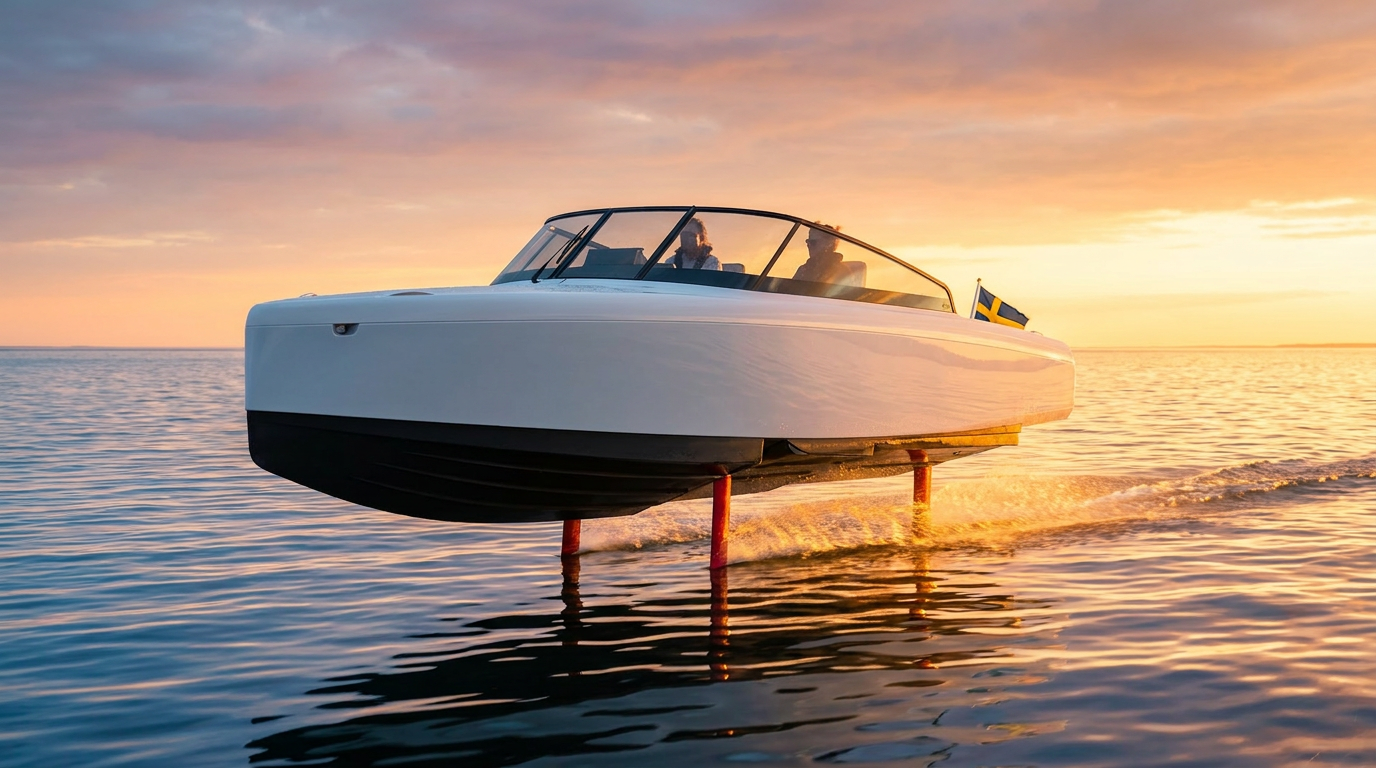
The breakthrough solution has come in the form of hydrofoil technology, pioneered in the consumer market by companies like the Swedish manufacturer Candela. By deploying submerged, wing-like structures beneath the hull, these vessels generate lift as they accelerate. Once the boat reaches a certain speed, the entire hull rises above the surface, effectively turning the vessel into a low-flying aircraft.[1][2]
The efficiency gains of hydrofoiling are staggering. By eliminating the friction of the hull dragging through the water, energy consumption drops by up to 80 percent. This drastic reduction in drag allows hydrofoiling boats to achieve long ranges using battery packs that are a fraction of the size required for conventional electric vessels. The Candela C-8, the flagship of this new era, utilizes a 69 kWh lithium-ion battery—borrowed from electric automaker Polestar—to deliver a range of up to 57 nautical miles at a cruising speed of 22 knots.[1][2][5]

These are no longer just theoretical prototypes. In recent months, hydrofoiling electric boats have proven their seaworthiness through grueling real-world tests. A Candela C-8 successfully completed a 150-nautical-mile round trip across the Baltic Sea in a single day, utilizing fast-charging infrastructure along the route. In 2025, the same model completed the first all-electric crossing of the Mediterranean Sea, traveling from Spain to North Africa in just over an hour.[2]
Beyond efficiency, hydrofoils fundamentally alter the ride quality. Because the hull flies above the surface, it ignores the chop and turbulence of the waves below. Sensors and onboard computers adjust the angle of the foils up to one hundred times per second, acting like an aircraft stabilizer to keep the boat perfectly level. The result is a silent, completely smooth ride that eliminates the slamming and seasickness associated with traditional powerboats.[1][2]
Beyond efficiency, hydrofoils fundamentally alter the ride quality.
But the hydrofoil is only half of the electric boating equation; the other half lies deep within the hull. Marine battery technology is advancing rapidly to meet the specific demands of the water. In 2026, the industry is seeing a massive shift toward Lithium Iron Phosphate (LFP) chemistry, which offers superior thermal stability and non-flammability compared to traditional lithium-ion cells.[7]
Furthermore, manufacturers are adopting "blade cell" battery architectures. Unlike traditional cylindrical cells, blade cells are long, flat, and layered, allowing for denser packing and improved heat dissipation. Crucially for marine environments, this format provides stronger resistance to the constant vibration and pounding of offshore conditions, while fitting more easily into the space-constrained bilges of smaller watercraft.[7]

Yet, even with advanced batteries, the transition to electric boating faces a significant infrastructural hurdle: the marina. Traditional shore power pedestals were designed to keep a boat's lights on and refrigerators running, not to rapidly recharge massive propulsion batteries. As electric adoption accelerates, marinas are being forced to upgrade their electrical grids, installing DC fast-charging stations capable of replenishing a vessel in under two hours. Industry analysts predict that boaters will soon choose their home ports based entirely on the availability and reliability of fast-charging infrastructure.[1][5][7]
While propulsion technology solves the environmental and efficiency challenges, another major innovation is tackling the psychological barrier of boating: docking. For many recreational boaters, maneuvering a heavy vessel into a tight slip amid crosswinds and strong currents is an intensely stressful experience. In response, major marine electronics companies are bringing automotive-grade autonomy to the helm.[3]
Brunswick Corporation's Navico Group recently commercialized its AutoCaptain system, a technology that delivers true autonomous docking. Unlike previous systems that merely offered joystick assistance, AutoCaptain is designed to take complete control of the vessel's propulsion and steering to execute perfect docking maneuvers without human intervention.[3][4]
The system relies on a network of stereo cameras mounted on the boat's hardtop, providing real-time, 360-degree situational awareness. These cameras feed data into an onboard computer that maps the surrounding environment—identifying docks, pilings, and neighboring boats—and calculates the optimal approach. The algorithm, trained on over 100,000 real-world images, dynamically adjusts the boat's throttles and thrusters to counteract wind and current in real time.[4]

Crucially, AutoCaptain does not rely on pre-mapped GPS coordinates. It can autonomously dock a boat in a marina it has never visited before, simply by "seeing" the slip and reacting to the physical environment. The captain initiates the sequence via a touchscreen display and oversees the process, retaining the ability to instantly override the system by grabbing the wheel or throttle. Once in the slip, the system holds the boat firmly against the dock, allowing the crew to casually step off and secure the mooring lines.[3][4]
Despite these massive technological leaps, the electric boating market remains segmented. Hydrofoils, while incredibly efficient, are complex and expensive, making them ideal for coastal commuting and premium leisure, but less suited for shallow lakes or beaching. For water sports and rugged inland use, a parallel market of high-power, conventional-hull electric boats is emerging, relying on massive battery packs and brute force rather than aerodynamic lift.[5]
The ultimate barrier to mass adoption remains cost. The advanced carbon-fiber construction of hydrofoils and the sheer size of marine battery packs keep initial purchase prices high. However, the total cost of ownership tells a different story. Electric motors require virtually no maintenance—no oil changes, no winterization, no exhaust manifolds to replace—and the cost of electricity is a fraction of marina-priced marine diesel. As battery prices continue to fall and autonomous features make boating accessible to novices, the water is poised to become quieter, cleaner, and vastly more intelligent.[1][2][5]
How we got here
2019
Brunswick Corporation announces its ACES (Autonomous, Connected, Electrified, Shared) strategy to modernize boating.
2023
Candela launches serial production of the C-8, the world's first long-range high-speed electric hydrofoil boat.
2024
The first all-electric hydrofoil ferry service begins operation in Stockholm, drastically cutting commute times and emissions.
May 2025
A Candela C-8 completes the first all-electric hydrofoil crossing of the Mediterranean Sea.
Late 2025
Navico Group officially unveils the AutoCaptain autonomous docking system at the Fort Lauderdale International Boat Show.
Viewpoints in depth
Electric Marine Innovators
Focus on the engineering triumphs of overcoming water density via hydrofoils and the push for full autonomy to lower the barrier to entry for new boaters.
For marine tech innovators, the transition to electric boating is about fundamentally redesigning the vessel from the ground up, rather than just swapping a gas tank for a battery. Companies like Candela argue that hydrofoiling is the only viable path to long-range electric boating, as it solves the core physics problem of water resistance. Similarly, developers of autonomous systems view docking anxiety as the primary bottleneck preventing new consumers from entering the boating lifestyle. By automating the hardest parts of navigation and eliminating the noise and maintenance of combustion engines, they believe boating can become a mass-market, stress-free leisure activity.
Environmental Advocates
Focus on the urgent need to phase out combustion engines on inland lakes and coastal waters to stop hydrocarbon pollution and noise disruption to marine life.
Environmental researchers point out that recreational boating has long enjoyed a regulatory blind spot compared to the automotive industry. They emphasize that traditional two-stroke engines dump massive amounts of unburned fuel directly into the water, creating toxic slicks that harm aquatic vegetation and marine organisms. Furthermore, the underwater noise pollution generated by conventional propellers disrupts the communication and migration patterns of marine life. For these advocates, the shift to silent, zero-emission electric propulsion—especially low-wake hydrofoils—is a critical step in preserving fragile coastal and lake ecosystems.
Marina Operators & Infrastructure Planners
Focus on the logistical challenges of upgrading aging dockside electrical grids to support high-amperage DC fast charging for the coming wave of electric vessels.
While the boats themselves are advancing rapidly, the infrastructure required to support them is lagging behind. Marina operators point out that most existing docks are wired only for low-amperage 'hotel loads'—enough to run a boat's lights and air conditioning, but woefully inadequate for rapidly charging a 70 kWh propulsion battery. Upgrading these facilities requires massive capital investment, trenching new high-voltage lines, and negotiating with local utility companies for increased grid capacity. Industry planners warn that without a coordinated effort to build out marine fast-charging networks, the electric boating revolution could stall at the dock.
What we don't know
- How quickly small, independent marinas will be able to afford the massive electrical grid upgrades required for DC fast charging.
- Whether the cost of carbon-fiber hydrofoil construction will drop enough to make these vessels accessible to the middle-class boating market.
- How marine insurance companies will adjust premiums for boats equipped with fully autonomous docking systems.
Key terms
- Hydrofoil
- A submerged, wing-like structure that lifts a boat's hull out of the water as it accelerates, drastically reducing drag and energy consumption.
- LFP Battery
- Lithium Iron Phosphate battery chemistry, favored in marine environments for its thermal stability, long cycle life, and safety.
- Blade Cell
- A long, flat battery cell design that allows for denser packing and better resistance to vibration than traditional cylindrical cells.
- Stereo Cameras
- A camera system with two or more lenses that can perceive depth and distance, used by autonomous systems to map environments in real time.
- ACES Strategy
- An industry framework standing for Autonomous, Connected, Electrified, and Shared access, guiding the modernization of recreational boating.
Frequently asked
Can electric hydrofoil boats handle rough seas?
Yes. Because the hull flies above the surface, hydrofoils actually provide a smoother ride in choppy water than conventional boats, as onboard computers constantly adjust the wings to maintain stability.
How long does it take to charge an electric boat?
It depends on the infrastructure. A standard marina shore-power connection may take overnight, but modern DC fast-charging stations can replenish a marine battery in under two hours.
Does autonomous docking require pre-mapped GPS data?
No. Advanced systems like AutoCaptain use real-time stereo cameras to "see" the environment, allowing them to autonomously dock in marinas the boat has never visited before.
Sources
Source coverage
7 outlets
3 viewpoints surfaced






[1]Boote MagazinBoating Industry & Enthusiasts
Candela C-8: Is this the electric future?
Read on Boote Magazin →[2]Volta YachtsMarine Tech Innovators
The Baltic Crossing: A Notable Achievement in Electric Boating
Read on Volta Yachts →[3]Lakeland BoatingBoating Industry & Enthusiasts
Artificial intelligence and automation... AutoCaptain
Read on Lakeland Boating →[4]Boating MagBoating Industry & Enthusiasts
Navico Group Introduces AutoCaptain
Read on Boating Mag →[5]EVWorldMarine Tech Innovators
The electric boat industry has entered a decisive new phase
Read on EVWorld →[6]Motorboat MuseumEnvironmental Advocates
Environmental challenges posed by different types of motorboat engines
Read on Motorboat Museum →[7]Helios MarineMarine Tech Innovators
Current Innovations in Marine Battery Technology for 2026
Read on Helios Marine →
Every angle. Every day.
Get automotive stories with full source coverage and perspective breakdowns delivered to your inbox.