
How Plug-In 'Balcony Solar' is Democratizing Renewable Energy for Renters
A new generation of portable, plug-and-play solar panels is allowing apartment dwellers to generate their own electricity without roof access or landlord permission. As safety standards improve and regulations ease, the European trend is rapidly expanding to the US.
By Factlen Editorial Team
- DIY & Renter Advocates
- Argue that plug-in solar democratizes clean energy and bypasses landlord restrictions.
- Grid & Safety Regulators
- Focus on interconnection safety and preventing unauthorized grid backfeeding.
- Solar Hardware Manufacturers
- View balcony solar as a massive new consumer electronics category.
What's not represented
- · Traditional Rooftop Solar Installers
- · Homeowners Associations (HOAs)
Why this matters
For decades, generating home solar power required owning a roof and spending tens of thousands of dollars. Plug-in solar kits break that barrier, allowing millions of renters and apartment dwellers to lower their utility bills and participate in the clean energy transition for under $1,000.
Key points
- Balcony solar systems consist of 1-4 portable panels that plug directly into a standard wall outlet.
- The systems use microinverters to convert DC solar power into household AC electricity.
- They are designed to offset a home's "base load," such as refrigerators and Wi-Fi routers, saving 15-25% on bills.
- Because they require no drilling or permanent wiring, they are fully accessible to renters.
- New UL 3700 safety standards ensure the plug prongs instantly lose power if disconnected.
- Several US states are now passing laws to exempt these small systems from heavy utility permitting.
For decades, the financial and environmental benefits of solar energy have been locked behind a rigid barrier to entry: homeownership. If you did not own a roof—or lacked the thousands of dollars required for a permanent, hardwired installation—generating your own clean electricity was simply out of reach. Renters, condo owners, and apartment dwellers were relegated to being passive consumers of grid power, vulnerable to fluctuating utility rates and geopolitical energy shocks. But a quiet rebellion has been brewing on the apartment terraces of Europe, and it is fundamentally rewriting the rules of renewable energy access. It relies on a technology so straightforward that it bypasses contractors, permits, and landlords entirely.
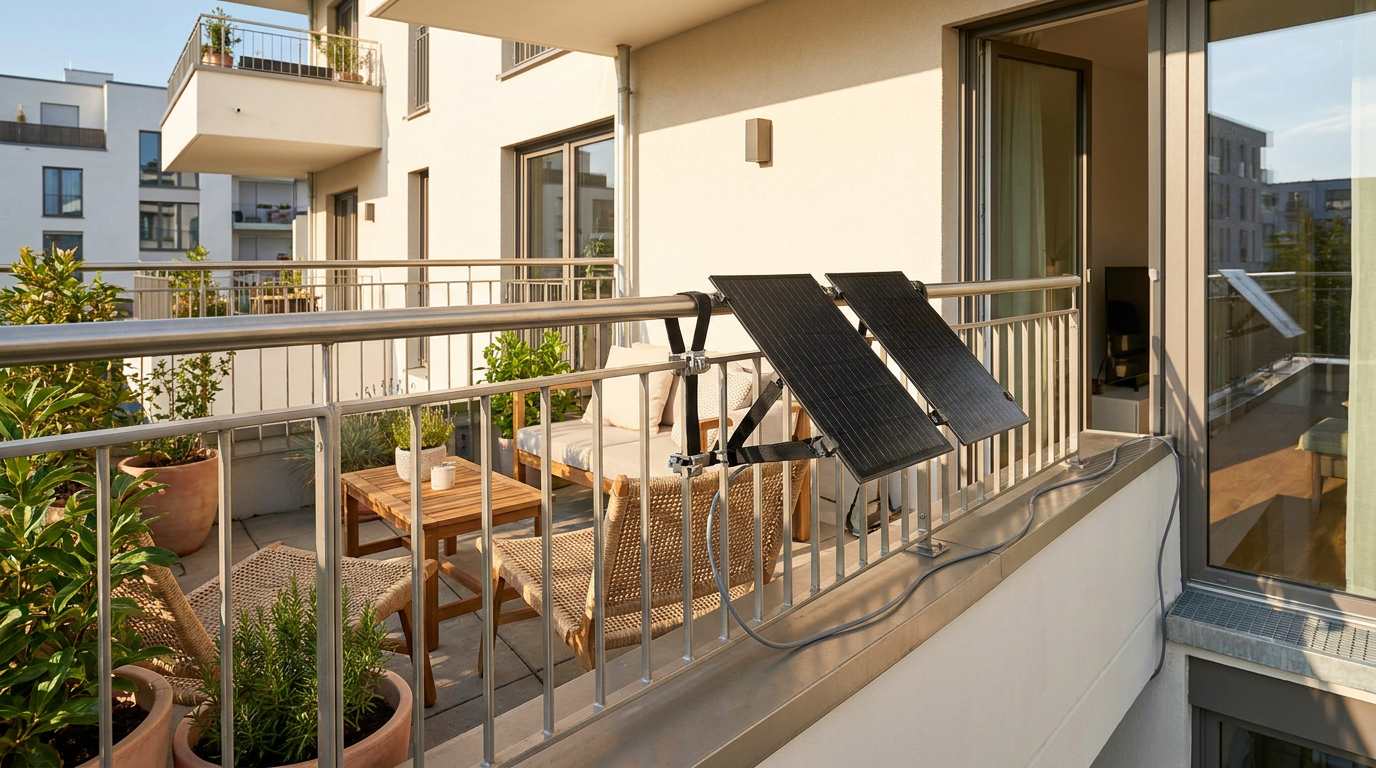
The solution is known as "balcony solar," or plug-in photovoltaics. Instead of a massive array bolted to a roof, these systems consist of just one to four lightweight solar panels that strap onto a balcony railing, mount on a patio, or stand in a small garden. The true breakthrough, however, is not the panels themselves, but how they connect to the home. Rather than requiring a licensed electrician to wire the system directly into a main breaker panel, balcony solar kits are designed to be plugged directly into a standard household wall outlet. It is a literal plug-and-play approach that treats a solar array less like a power plant and more like a household appliance.[3][6]
The epicenter of this movement is Germany, where the systems are affectionately known as "Balkonkraftwerk"—literally, balcony power plants. Fueled by a combination of high electricity prices following the invasion of Ukraine and a cultural eagerness to adopt green technology, the German market has exploded. By the end of 2025, an estimated four million plug-in solar systems had been installed across the country. The trend has rapidly spilled over into neighboring nations like Spain, France, and the United Kingdom, transforming the urban landscape as sleek black panels become a standard feature of city apartment buildings.[1][3]
To understand how a solar panel can safely plug into a wall socket, one must look at the "microinverter." Solar panels naturally generate direct current (DC) electricity, which is incompatible with the alternating current (AC) used by household appliances. In a balcony setup, a compact microinverter is mounted directly behind the panels. This device instantly converts the DC power into grid-synchronized AC power. When the user plugs the system into their outdoor or indoor outlet, the microinverter pushes that AC electricity into the home's existing circuitry, making it available to any device drawing power on that circuit.[5][6]

Because electricity follows the path of least resistance, the solar power generated on the balcony is consumed by the home's closest active appliances before any power is pulled from the external utility grid. Balcony solar is not designed to spin a meter backward or generate a lucrative surplus; rather, it is engineered to offset a home's "base load." Every household has a continuous, baseline energy draw from always-on devices: the refrigerator compressor, the Wi-Fi router, smart home hubs, and electronics in standby mode. By covering this base load during daylight hours, the plug-in system quietly shaves the top off the monthly utility bill.[6]
The economics of this localized power generation are highly compelling, particularly for those who have been priced out of traditional solar. A standard rooftop installation can easily cost between $15,000 and $30,000. In contrast, a complete balcony solar kit typically retails for between $400 and $1,500, depending on the wattage and the inclusion of smart monitoring features. While an 800-watt system will not run a central air conditioning unit, it can reliably cover 15 to 25 percent of a typical apartment's energy needs. At current electricity rates, most users see their initial investment pay for itself in three to six years.[3][5]
For renters, the most revolutionary aspect of balcony solar is its portability. Because the panels are secured with heavy-duty straps or weighted floor stands rather than lag bolts, they require no structural modifications to the building. There is no drilling, no permanent wiring, and no damage to repair upon moving out. When a lease ends, the tenant simply unplugs the microinverter, unclips the panels, and packs the entire power plant into the back of a car. This mobility finally gives renters a financial incentive to invest in renewable energy, knowing the asset moves with them.[5]
For renters, the most revolutionary aspect of balcony solar is its portability.
Despite the obvious consumer benefits, the rise of plug-in solar has been met with intense scrutiny from utility companies and safety regulators, particularly in the United States. The primary concern has been the risk of electrocution: if a solar panel is generating power and the user unplugs the cord from the wall, could the exposed metal prongs deliver a lethal shock? Furthermore, utilities worried about "islanding"—the danger of a plug-in system feeding power back into the broader grid during a blackout, potentially electrocuting line workers attempting to repair downed cables.[2][4]

Technology and standardization have rapidly evolved to neutralize these risks. Modern microinverters are equipped with advanced rapid-shutdown and anti-islanding safety protocols. If the system detects that grid power has dropped—whether due to a neighborhood blackout or simply because the user pulled the plug out of the socket—the microinverter severs the power flow in a fraction of a second. The exposed prongs instantly go dead. In early 2026, UL Solutions codified these safety mechanisms with the introduction of the UL 3700 standard, providing a rigorous "gold standard" certification specifically for plug-in solar devices in the North American market.[4]
Even with the hardware proven safe, bureaucratic red tape has historically stifled adoption outside of Europe. In the United States, utility interconnection rules were written for massive rooftop arrays, requiring extensive permitting, engineering reviews, and grid-tie agreements. Applying these onerous requirements to a 600-watt balcony panel was akin to requiring a building permit to plug in a toaster oven. Consequently, early adopters in the US often operated in a legal gray area, utilizing the systems without officially notifying their power companies.[2]
That regulatory landscape is now undergoing a seismic shift. Recognizing the absurdity of applying power-plant regulations to household appliances, lawmakers are stepping in. In 2025, Utah became the first US state to pass comprehensive "Plug-and-Play" legislation, carving out a specific legal exemption for plug-in solar systems up to 1.2 kilowatts. Under the new framework, residents can purchase certified kits and plug them in without seeking utility approval or paying exorbitant interconnection fees. As of mid-2026, more than 30 other states have introduced similar legislation, signaling a nationwide pivot toward decentralized energy access.[4]
As the legal barriers fall, the hardware itself is entering a second generation of innovation. The most significant recent development is the integration of modular micro-batteries. Companies are now offering compact lithium-iron-phosphate (LiFePO4) battery units that sit between the solar panels and the microinverter. During peak sunlight hours, when the panels are generating more power than the apartment's base load requires, the excess energy is diverted into the battery rather than being wasted or pushed back into the utility grid.[5]

This battery integration solves one of the lingering friction points with utility companies: unauthorized backfeeding. By storing the surplus, the system ensures that 100 percent of the generated solar power is consumed "behind the meter." Once the sun goes down, the battery slowly discharges its stored energy through the microinverter, continuing to offset the home's base load well into the evening. This hybrid approach maximizes the return on investment and turns the balcony setup into a 24-hour energy management system.[2]
Despite the enthusiasm, energy experts caution that balcony solar is not a silver bullet for household energy independence. The systems have strict physical limitations. They require adequate sun exposure—ideally a south-facing, unshaded balcony or patio—to generate meaningful power. A north-facing apartment in a dense, shadowed urban corridor will see a drastically reduced yield, stretching the payback period from a few years to potentially over a decade. Furthermore, these systems are strictly grid-tied; they will not provide backup power during a blackout, as the safety mechanisms force them to shut down when the grid goes dark.[6]
Nevertheless, the psychological impact of plug-in solar is perhaps as significant as its electrical output. It transforms passive ratepayers into active participants in the energy transition. Users frequently report a newfound awareness of their energy consumption, checking smartphone apps to monitor their real-time solar yield and adjusting their habits—such as running the dishwasher during peak sunlight—to maximize their free electricity. It fosters a tangible connection to renewable energy that was previously reserved for property owners.[5][6]

The democratization of solar power is no longer a distant theoretical goal; it is actively unfolding on millions of apartment railings worldwide. By stripping away the need for contractors, permits, and roof ownership, balcony solar has unlocked a massive new demographic for clean energy. As regulations catch up to the technology and battery integration becomes standard, the humble wall outlet is being reimagined not just as a place to consume power, but as a gateway to generating it.[7]
How we got here
2019
Germany streamlines utility connection rules, sparking the initial 'Balkonkraftwerk' boom.
2024
Germany passes 'Solarpaket I,' raising the legal limit for plug-in microinverters to 800 watts.
2025
Utah becomes the first US state to pass comprehensive 'Plug-and-Play' legislation for systems up to 1.2 kilowatts.
Early 2026
UL Solutions launches the UL 3700 safety certification, establishing a gold standard for US plug-in solar safety.
Viewpoints in depth
DIY & Renter Advocates
Argue that plug-in solar democratizes clean energy and bypasses landlord restrictions.
Advocacy groups and DIY enthusiasts view balcony solar as a crucial tool for energy equity. For years, renters have subsidized the grid while homeowners reaped the financial rewards of solar tax credits and net metering. Advocates argue that treating small solar setups as portable household appliances removes the landlord veto and eliminates the need for expensive professional installation, finally allowing lower-income and transient populations to lower their utility bills.
Grid & Safety Regulators
Focus on interconnection safety and preventing unauthorized grid backfeeding.
Utility companies and electrical regulators approach plug-in solar with caution, prioritizing grid stability and worker safety. Their primary concern is 'islanding'—the risk that a DIY system might continue feeding power into the grid during a blackout, potentially electrocuting line workers. While modern UL-certified microinverters have built-in fail-safes to prevent this, regulators argue that widespread, unregistered plug-in solar makes it difficult for utilities to balance local grid loads and ensure all equipment meets strict safety codes.
Solar Hardware Manufacturers
View balcony solar as a massive new consumer electronics category.
Companies producing microinverters and portable power stations see plug-in solar not just as an energy product, but as the next major consumer electronics boom. By integrating smart meters, smartphone apps, and modular micro-batteries, manufacturers are turning simple solar panels into comprehensive home energy management systems. They are heavily lobbying state legislatures to ease interconnection rules, knowing that a 'plug-and-play' legal framework is the key to unlocking a multi-billion dollar market.
What we don't know
- How quickly utility companies in all 50 US states will update their interconnection rules to accommodate plug-and-play systems.
- Whether the addition of micro-batteries will significantly increase the lifespan and ROI of balcony setups.
- How landlords and homeowners associations will adapt their aesthetic guidelines as the panels become more common.
Key terms
- Microinverter
- A small device attached to solar panels that converts direct current (DC) into alternating current (AC) for household use.
- Base Load
- The continuous minimum amount of electricity a home uses for 'always-on' devices like refrigerators and Wi-Fi routers.
- Islanding
- A dangerous condition where a solar system continues to feed power into the utility grid during a blackout.
- UL 3700
- A safety standard for plug-in solar systems ensuring the plug prongs instantly lose power if disconnected from the wall.
- Balkonkraftwerk
- The German term for 'balcony power plant,' referring to the massive trend of plug-in solar in Europe.
Frequently asked
Can I plug a solar panel directly into a wall outlet?
Yes, provided the system uses a certified microinverter that safely syncs the generated AC power with your home's electrical grid.
Will a balcony solar system work during a power outage?
No. Standard grid-tied microinverters automatically shut down during outages to prevent backfeeding power into lines that utility workers might be repairing.
Do I need my landlord's permission to install one?
Because they require no permanent wiring or drilling, they are generally treated as household appliances, though checking your lease regarding balcony attachments is recommended.
Will this zero out my electricity bill?
No. Balcony systems are small and designed to offset your continuous 'base load,' typically reducing an apartment bill by 15 to 25 percent.
Sources
Source coverage
7 outlets
3 viewpoints surfaced







[1]The GuardianSolar Hardware Manufacturers
Balcony solar panels: the DIY technology that's taking off in Europe
Read on The Guardian →[2]HackadayGrid & Safety Regulators
Balcony Solar is Bringing Power to the People
Read on Hackaday →[3]WikipediaGrid & Safety Regulators
Balcony solar power system
Read on Wikipedia →[4]Solar United NeighborsDIY & Renter Advocates
Plug-in solar
Read on Solar United Neighbors →[5]EcoFlowSolar Hardware Manufacturers
Is Balcony Solar Worth It? Costs, Laws, and ROI Explained
Read on EcoFlow →[6]Switch TogetherDIY & Renter Advocates
Balcony, Mini and Plug‑In PV Explained
Read on Switch Together →[7]Factlen Editorial Team
Synthesis by Factlen editorial team
Read on Factlen Editorial Team →
Every angle. Every day.
Get home stories with full source coverage and perspective breakdowns delivered to your inbox.