
Induction vs. Gas Cooktops: The 2026 Efficiency and Performance Comparison
As induction technology becomes more affordable and powerful in 2026, the debate between magnetic heating and traditional gas flames has shifted. We break down the trade-offs in efficiency, safety, and upfront costs to help you choose the right cooktop.
By Factlen Editorial Team
- Efficiency & Safety Advocates
- Argues that the environmental and health benefits of induction make it the superior modern choice.
- Traditional Culinary Enthusiasts
- Maintains that gas provides an irreplaceable tactile experience and versatility for serious cooks.
- Pragmatic Homeowners
- Focuses on the total cost of ownership, installation hurdles, and daily convenience.
What's not represented
- · Professional restaurant chefs who operate commercial kitchens at scale
- · Electricians and contractors who manage the physical infrastructure upgrades required for induction
Why this matters
Cooking appliances are long-term investments that directly impact your daily routine, household energy bills, and indoor air quality. Choosing the right technology ensures you get the performance you need while managing upfront installation costs and long-term utility expenses.
Key points
- Induction cooktops use electromagnetism to heat cookware directly, achieving 85 to 90 percent energy efficiency.
- Gas cooktops rely on open flames, operating at 40 to 55 percent efficiency and losing significant heat to the surrounding air.
- High-output induction burners can boil water significantly faster than traditional gas burners.
- Switching from gas to induction may require expensive electrical panel upgrades and the purchase of magnetic cookware.
- Gas remains the preferred choice for cooks who value visual flame control and techniques like wok frying or charring.
The American kitchen is undergoing a quiet but rapid transformation in 2026, as homeowners increasingly weigh the traditional appeal of gas ranges against the rapid advancements in induction technology. For decades, gas was considered the gold standard for serious home cooks, offering visual feedback and tactile control. However, modern induction cooktops have closed the performance gap, offering unprecedented speed and efficiency.[1][8]
This shift is driven by a combination of improved appliance technology, changing energy regulations, and a growing awareness of indoor air quality. While standard electric radiant cooktops remain common, the premium market has largely distilled into a two-way contest between gas and induction.[4]
To make an informed decision, buyers must look beyond the showroom aesthetics and understand the fundamental differences in how these appliances generate heat. The choice ultimately dictates not just how fast water boils, but the ambient temperature of the kitchen, the ease of cleanup, and the long-term utility costs.[2][8]
The core mechanism of gas cooking relies on combustion. A gas cooktop burns natural gas or propane to create an open flame, which heats the cookware from the bottom up. This provides instant visual feedback; cooks can see the flame and adjust it intuitively.[1][3]
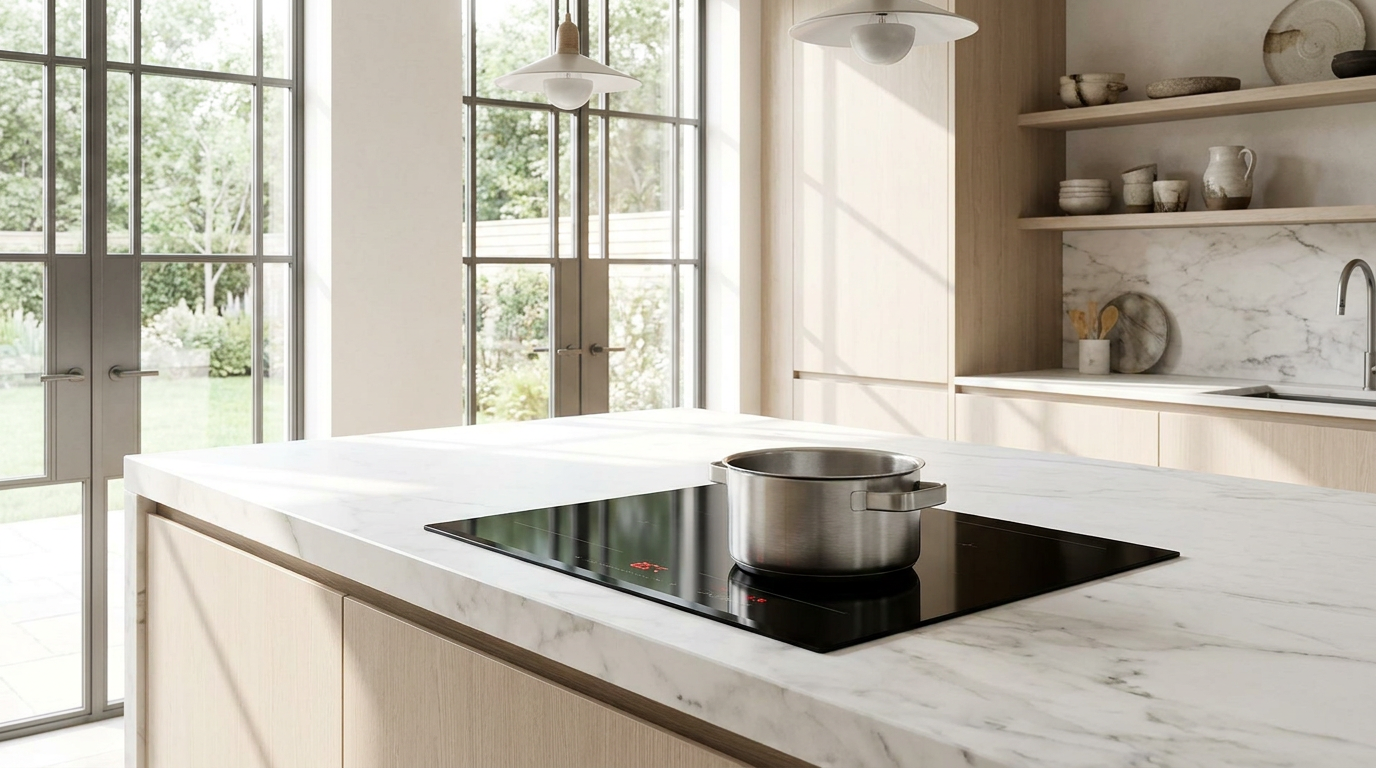
Induction, by contrast, uses electromagnetism. Coils beneath the glass surface generate a magnetic field that interacts directly with compatible cookware. Instead of heating the glass, the field turns the pot or pan itself into the heat source.[3][5]
This fundamental difference in heat generation creates a cascade of trade-offs across every aspect of the cooking experience. By examining the arguments for and against each technology, alongside the supporting evidence, a clear picture emerges of where each system excels.[8]

When evaluating speed and cooking performance, the argument for induction centers on raw power and precision. High-output induction burners can now reach up to 7,400 watts, allowing them to boil a gallon of water in approximately three minutes.[2]
The argument against induction in the performance category is its lack of visual feedback and its inability to perform certain traditional techniques. Home chefs cannot char peppers directly on an induction surface or easily flambé, and tossing food in a pan breaks the magnetic connection, temporarily halting the heat transfer.[3][5]
The evidence clearly favors induction for speed and low-end temperature control, as it can hold a steady, delicate simmer without the risk of a flame blowing out. However, gas remains the undisputed champion for wok cooking and techniques that require ambient heat wrapping around the sides of a vessel.[1][2]
In the realm of energy efficiency, the argument for induction is overwhelming. Because the electromagnetic field heats the cookware directly, very little energy is lost to the surrounding environment.[4][7]
The argument against gas is its inherent inefficiency. A significant portion of the heat generated by a gas burner escapes around the sides of the pan and dissipates into the air.[1][5]
A significant portion of the heat generated by a gas burner escapes around the sides of the pan and dissipates into the air.
The evidence, backed by the United States Department of Energy, shows that induction cooktops operate at 85 to 90 percent efficiency, converting nearly all their energy into cooking power. Gas cooktops, meanwhile, operate at just 40 to 55 percent efficiency. In warmer climates, this wasted heat forces air conditioning systems to work harder, further compounding the energy loss.[1][6]

Safety and indoor air quality present another major dividing line. The argument for induction highlights its cool-to-the-touch surface and the complete absence of combustion byproducts. Because the glass only absorbs residual heat from the pan, the risk of severe burns is dramatically reduced, making it highly appealing for households with young children or aging adults.[2][4]
The argument against gas focuses on the risks associated with open flames and emissions. Gas stoves release nitrogen dioxide and other pollutants into the home, necessitating high-quality, externally vented range hoods to maintain safe indoor air quality.[2][5]
The evidence strongly supports induction as the safer choice for respiratory health and burn prevention. However, it is worth noting that induction cooktops can interfere with certain medical devices; manufacturers advise individuals with pacemakers to consult their doctors and maintain a distance of at least two feet from active induction zones.[2]
Upfront cost and installation requirements often serve as the deciding factor for many buyers. The argument for gas is its lower initial purchase price and straightforward replacement process if a home is already plumbed for a gas line.[1][4]
The argument against induction centers on the hidden costs of electrical upgrades and cookware replacement. Transitioning from gas to induction often requires hiring an electrician to install a dedicated 240-volt circuit, which can add thousands of dollars to the project. Furthermore, induction requires magnetic cookware; aluminum, copper, and glass pots will not work.[2][5]
The evidence shows that while induction ranges carry a higher retail price—often starting around $898 compared to $698 for gas—the long-term operating costs can offset the initial premium, depending on local utility rates.[4]

Finally, daily maintenance and cleaning reveal stark differences. The argument for induction is its perfectly smooth glass surface. Because the cooktop itself does not get blazing hot, spills and splatters are far less likely to bake onto the glass, allowing for a quick wipe-down with a damp cloth.[2][4]
The argument against gas is the labor-intensive cleaning process. Gas cooktops feature heavy cast-iron grates, burner caps, and crevices that collect grease and require regular, thorough scrubbing to maintain their appearance and functionality.[1][3]
The evidence from consumer testing confirms that induction saves significant time on daily cleanup, though the glass surface does require specific non-abrasive cleaners to prevent scratching over time.[4]
Synthesizing these trade-offs leads to clear recommendations. Induction fits well when your primary goals are energy efficiency, rapid heating, and maintaining a cool, safe kitchen environment. It is the ideal choice for households prioritizing indoor air quality, families with small children, and those who value effortless cleanup after every meal.[1][5][8]
Conversely, induction does not fit well when a home has limited electrical capacity and the cost of upgrading the panel is prohibitive. It is also less suitable for cooks who rely heavily on non-magnetic specialty cookware or those who use medical devices sensitive to electromagnetic fields.[2][5]

How we got here
Early 1900s
Gas stoves become widely adopted in urban areas, replacing wood and coal ranges.
1970s
Induction cooking technology is first introduced to the consumer market, though high costs limit its adoption.
2010s
Induction technology becomes more affordable and reliable, gaining significant market share in Europe.
2023
Growing awareness of indoor air quality and emissions sparks renewed consumer interest in transitioning from gas to induction in the US.
2026
Induction ranges reach near price-parity with premium gas models, offering advanced features like flexible cooking zones and rapid boiling.
Viewpoints in depth
Efficiency & Safety Advocates
Argues that the environmental and health benefits of induction make it the superior modern choice.
This perspective emphasizes the stark contrast in energy waste between the two technologies. Proponents point to Department of Energy data showing induction's 85 to 90 percent efficiency rate, arguing that gas cooktops needlessly heat the surrounding kitchen and strain HVAC systems. Furthermore, they highlight the elimination of indoor air pollutants like nitrogen dioxide, framing induction not just as a cooking upgrade, but as a crucial step for respiratory health and household safety.
Traditional Culinary Enthusiasts
Maintains that gas provides an irreplaceable tactile experience and versatility for serious cooks.
Chefs and traditionalists argue that cooking is an inherently sensory experience that induction cannot fully replicate. They value the immediate visual feedback of an open flame and the ability to intuitively adjust heat without interacting with digital touchpads. This camp also points out that gas allows for specialized techniques—such as charring vegetables directly on the grates or using round-bottomed woks—and accommodates all types of cookware, including copper and pure aluminum, which induction rejects.
Pragmatic Homeowners
Focuses on the total cost of ownership, installation hurdles, and daily convenience.
For this group, the decision comes down to practical logistics rather than pure performance. They note that while induction is easier to clean, the hidden costs of upgrading a home's electrical panel to support a 240-volt circuit can make the transition financially unviable. Conversely, if a home lacks an existing gas line, installing one can be equally prohibitive. This perspective advises buyers to heavily weigh their current kitchen infrastructure before committing to either technology.
What we don't know
- How future local regulations might impact the availability and cost of new residential gas line installations.
- Whether the price of entry-level induction ranges will drop enough to completely replace standard electric radiant stoves in budget kitchen remodels.
Key terms
- Induction Cooking
- A cooking method that uses electromagnetic coils to generate heat directly within compatible cookware, rather than heating the cooktop surface.
- BTU (British Thermal Unit)
- A traditional measure of heat output used to rate the power of gas burners.
- Electromagnetic Field
- The invisible field of energy created by an induction cooktop that reacts with magnetic metals to produce heat.
- Radiant Electric Cooktop
- A standard electric stove that uses heated metal coils under a glass surface to transfer heat to the pot, which is slower and less efficient than induction.
- Combustion Byproducts
- Gases and particles, such as nitrogen dioxide, released into the air when natural gas is burned.
Frequently asked
Do I need special pots and pans for an induction cooktop?
Yes. Induction requires cookware with a magnetic base, such as cast iron or magnetic stainless steel. Aluminum, copper, and glass will not work unless they have a magnetic plate built into the bottom.
Is induction actually faster than gas?
Yes. Because induction transfers electromagnetic energy directly into the cookware, it can boil water up to 20 to 40 percent faster than a high-output gas burner.
Will an induction cooktop heat up my kitchen?
No. Induction generates very little ambient heat because the energy goes directly into the pan. Gas cooktops, by contrast, lose nearly half their heat to the surrounding air.
Do I still need a range hood with induction?
Yes. While induction does not produce combustion byproducts like gas does, cooking food still releases grease, smoke, and odors that need to be properly ventilated.
Can an induction cooktop interfere with a pacemaker?
It is possible. Manufacturers generally advise individuals with pacemakers or ICDs to consult their doctor and maintain a distance of at least two feet from the active induction surface.
Sources
Source coverage
8 outlets
3 viewpoints surfaced







[1]Stahl KitchensTraditional Culinary Enthusiasts
Induction vs Gas Cooktops: Which One Is the Better Choice in 2026?
Read on Stahl Kitchens →[2]Yale AppliancePragmatic Homeowners
Induction vs Gas 2026: Pros & Cons
Read on Yale Appliance →[3]KitchenAidTraditional Culinary Enthusiasts
Gas vs. Induction: how to choose the best option for your kitchen
Read on KitchenAid →[4]CNETEfficiency & Safety Advocates
Induction vs. Gas vs. Electric Ranges: Which Is Best for You?
Read on CNET →[5]BrevilleEfficiency & Safety Advocates
Induction Cooktop vs. Gas Stove
Read on Breville →[6]South FL Kitchen and BathEfficiency & Safety Advocates
Induction vs gas cooktop comparison for Florida homes
Read on South FL Kitchen and Bath →[7]Alabama AppliancePragmatic Homeowners
Induction vs. Gas Cooktop
Read on Alabama Appliance →[8]Factlen Editorial TeamPragmatic Homeowners
Synthesis by Factlen editorial team
Read on Factlen Editorial Team →

More in shopping
See all 7 stories →Display Tech
OLED vs. Mini-LED: The 2026 Gaming Monitor Trade-Off Analysis
6 sources

Used EVs
The 2026 Guide to Buying a Used EV: Battery Health, Tax Credits, and What to Know
8 sources

Induction Tech
The Complete Guide to Induction Cooking: How It Works and Why It's Replacing Gas
8 sources
Nursery Gear
Smart Bassinets vs. Traditional Sleepers: The 2026 Trade-Off Analysis
8 sources

Every angle. Every day.
Get shopping stories with full source coverage and perspective breakdowns delivered to your inbox.