
How AI is Revolutionizing Natural Disaster Prediction
New artificial intelligence models are predicting hurricanes, flash floods, and wildfires with unprecedented accuracy and speed, shifting disaster response from reaction to prevention.
By Factlen Editorial Team
- Tech Innovators
- Focused on rapid iteration and the power of machine learning to solve complex climate variables.
- Meteorological Agencies
- Cautiously optimistic, valuing the speed of AI while maintaining reliance on physics-based models.
- Emergency Responders
- Prioritizing actionable, localized intelligence to execute evacuations and allocate resources.
- Climate Resilience Advocates
- Emphasizing that advanced prediction must be paired with physical infrastructure improvements.
What's not represented
- · Local municipalities lacking funding for AI integration
- · Insurance industry risk actuaries
Why this matters
By giving emergency responders days instead of hours to prepare, these AI-driven forecasts are poised to save thousands of lives and billions of dollars in infrastructure damage as extreme weather events intensify globally.
Key points
- AI weather models can generate highly accurate 10-day global forecasts in under a minute, drastically reducing computational costs.
- Google's GraphCast model successfully predicted Hurricane Lee's landfall location nine days in advance, outperforming traditional systems.
- New AI systems can predict urban flash floods up to 24 hours ahead by simulating water flow through concrete landscapes.
- Researchers are combining satellite data with physics simulations to forecast the real-time spread and intensity of wildfires.
- Meteorologists emphasize that AI will supplement, rather than replace, traditional physics-based forecasting models.
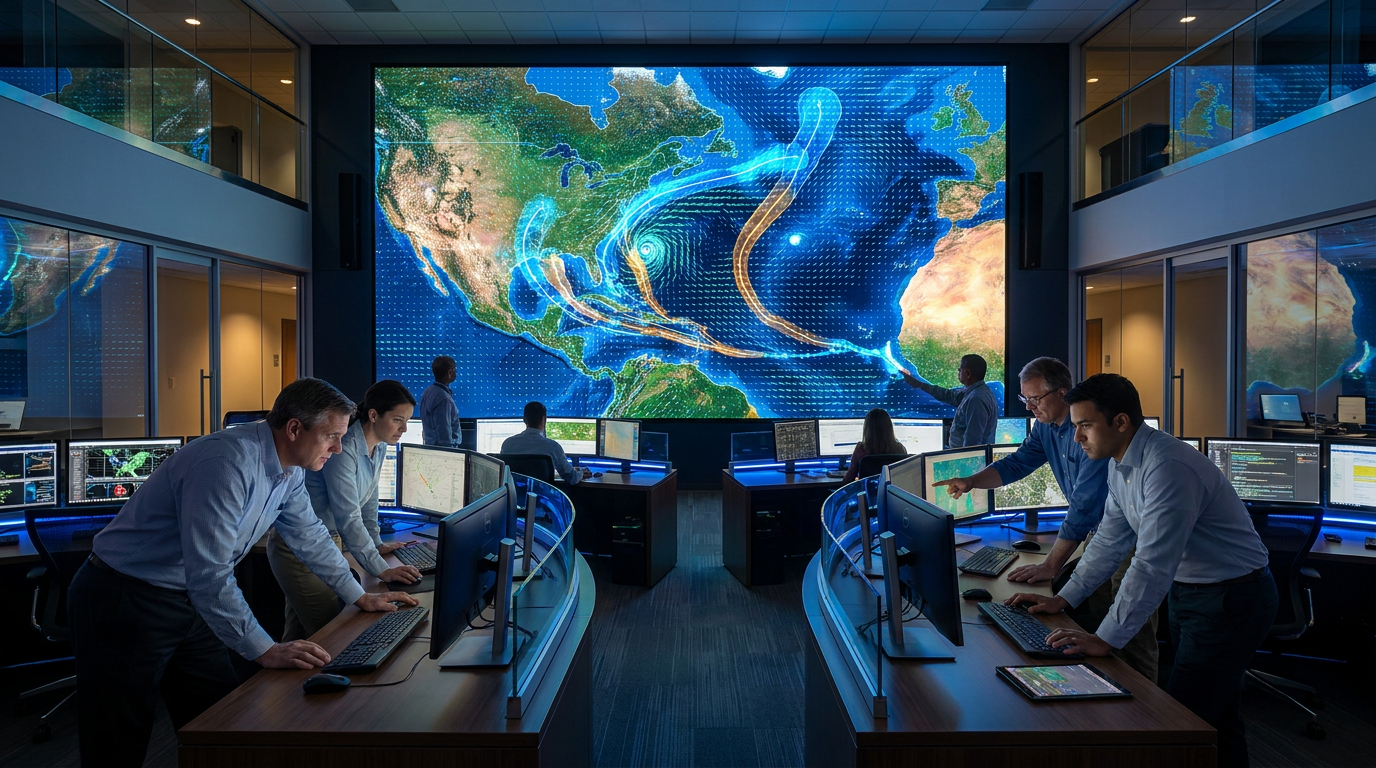
For decades, predicting the exact path of a hurricane, the sudden inundation of a flash flood, or the erratic spread of a wildfire has been a race against the limits of human computation. Meteorologists and emergency planners have relied on physics-based models that require massive supercomputers to crunch complex fluid dynamics equations. While these traditional systems have steadily improved, they remain computationally expensive and often struggle to provide the localized, long-range certainty needed to execute massive evacuations. Now, a quiet revolution is shifting the paradigm from reaction to proactive resilience. Artificial intelligence is fundamentally rewriting the rules of disaster prediction, offering forecasts that are not only vastly faster but, in many cases, significantly more accurate.[3]
The breakthrough lies in a completely different approach to forecasting. Instead of calculating the physical laws of the atmosphere from scratch every time, AI models are trained on decades of historical global weather data. By analyzing millions of past atmospheric states, these machine learning algorithms learn to recognize the intricate patterns that precede extreme weather events—patterns that classical physics-based models have never been able to fully encode. Once trained, the AI can look at the current state of the weather and instantly predict what will happen next, bypassing the grueling calculations that traditionally take supercomputers hours to complete.[2][3]
The speed advantage is staggering. Google DeepMind’s GraphCast model can generate a highly accurate 10-day global weather forecast in under one minute using a single specialized processor. By comparison, a traditional 10-day forecast requires hours of computation across hundreds of machines. This efficiency is transforming how national agencies operate. In late 2025, the National Oceanic and Atmospheric Administration (NOAA) officially deployed a new suite of AI-driven global weather prediction models. According to the agency, a single 16-day forecast using their new AI system requires only 0.3 percent of the computing resources of their traditional operational model, finishing in approximately 40 minutes.[1][2]

This reduced latency means forecasters receive critical data significantly earlier, a crucial advantage when tracking fast-moving storms. The accuracy of these systems was thrust into the spotlight during the 2023 Atlantic hurricane season. Days before Hurricane Lee made landfall in Nova Scotia, traditional ensemble models offered a wide spread of potential paths. GraphCast, however, accurately placed the storm's landfall location nine days in advance—a lead time that traditional models struggled to match with consistent confidence. Independent evaluations have since confirmed that AI models demonstrate a significant reduction in tropical cyclone track errors at longer lead times compared to traditional systems.[1][2][3][8]
Beyond hurricanes, AI is tackling one of the deadliest and most notoriously difficult natural hazards to predict: urban flash floods. Traditional flood forecasting relies heavily on physical river gauges, which are sparse in many parts of the world and virtually non-existent in dense urban grids. To bridge this data gap, researchers had to get creative. Google Research launched an initiative called Groundsource, utilizing large language models to scan and extract data from unstructured global news reports. This effort generated an open-access dataset tracking 2.6 million historical urban flash flood events across multiple countries.[4]
Armed with this unprecedented dataset, alongside satellite imagery, terrain data, and rainfall forecasts, AI systems can now simulate water flow through concrete landscapes. In June 2026, Google announced that its AI can now deliver flash flood predictions for urban areas up to 24 hours in advance. This marks a monumental shift for city planners and emergency responders, providing a critical window to deploy sandbags, clear drainage systems, and evacuate vulnerable neighborhoods before the first drop of rain falls.[4][9]

In June 2026, Google announced that its AI can now deliver flash flood predictions for urban areas up to 24 hours in advance.
The push for localized, actionable intelligence is also driving innovations at the city scale. Researchers at the Discovery Partners Institute (DPI) recently introduced a breakthrough in urban flood prediction using GPU-accelerated computing. Traditional flood models are often too slow for real-time decision-making during a sudden deluge. DPI’s new model compresses simulations that used to take hours into mere minutes, predicting flooding at the city scale 80 percent faster than traditional methods without losing physical accuracy. This shifts flood forecasting from static risk maps to dynamic, real-time intelligence that tells responders exactly who will be impacted and how quickly.[5]
Wildfires present a uniquely volatile challenge, driven by sudden shifts in wind, dry vegetation, and complex topography. Once a fire ignites, its behavior can change in seconds, making it incredibly dangerous for frontline crews. To combat this unpredictability, researchers at USC Viterbi have developed a computational model that merges high-resolution satellite data with physics-based simulations. The generative AI system continuously ingests real-time environmental data to forecast a wildfire’s path, intensity, and growth rate.[6]
This hybrid approach is critical for fire management. By combining the speed of AI pattern recognition with the physical constraints of combustion and fluid dynamics, the model provides a realistic simulation of how a fire will spread across specific terrain. As climate change drives longer and more severe fire seasons, the goal is to put these predictive tools directly into the hands of first responders, allowing them to optimize evacuation routes and position firefighting resources where they will be most effective.[6]

State and local governments are already recognizing the operational benefits of these technologies. In Louisiana, a state intimately familiar with the devastating impacts of extreme weather, AI is being integrated into both storm preparation and long-term coastal resilience. AI-powered geospatial software is being used to map and predict coastal erosion before it happens, allowing engineers to design customized restoration projects that bolster the coastline against future storm surges. As one policy institute noted, AI is fundamentally shifting the timeline for preparation, empowering communities to weather storms with unprecedented resilience.[7]
Despite these remarkable advances, meteorologists caution that AI is not a silver bullet. Machine learning models still carry inherent weaknesses, particularly when forecasting fine-scale local events or unprecedented weather extremes that fall outside their historical training data. Because they learn from past patterns, a completely novel atmospheric event could potentially confuse an AI system. Furthermore, AI models currently depend on traditional physics-based models to provide the initial state data—the starting snapshot of the atmosphere—required to generate a forecast.[3]

The consensus among atmospheric scientists is that the future of disaster prediction is not a complete replacement of traditional methods, but a powerful synthesis of both. The next frontier involves fully coupled hybrid models that integrate AI's speed and pattern recognition with the rigorous physical boundaries of traditional fluid dynamics. By embedding land and ocean interactions into AI frameworks, researchers believe they can further enhance forecast accuracy and physical interpretability.[3][8]
As these tools transition from experimental research to operational deployment, the focus is shifting toward equitable access. International organizations and tech companies are partnering to ensure that AI-driven early warning systems reach data-poor regions and vulnerable populations globally. The ultimate promise of this technological leap is not just a better weather forecast, but a fundamental transformation in global disaster management—buying humanity the most precious resource of all when nature strikes: time.[4][9]
How we got here
Sept 2023
Google DeepMind's GraphCast accurately predicts Hurricane Lee's landfall nine days in advance.
July 2024
USC Viterbi researchers publish a breakthrough AI model for real-time wildfire prediction.
Dec 2025
NOAA officially deploys a new generation of highly efficient AI-driven global weather models.
April 2026
The Discovery Partners Institute introduces a GPU-accelerated model that predicts urban floods 80% faster.
June 2026
Google announces its AI can predict urban flash floods up to 24 hours in advance using newly extracted historical data.
Viewpoints in depth
Meteorological Agencies
Cautiously optimistic, valuing the speed of AI while maintaining reliance on physics-based models.
National weather services like NOAA and the ECMWF view AI as a transformative tool that drastically reduces computational load and improves long-range track accuracy. However, they emphasize that AI models currently rely on traditional physics-based systems for their initial data inputs. Meteorologists advocate for a hybrid future, ensuring that AI's pattern recognition is grounded in the established laws of atmospheric physics to prevent errors during unprecedented extreme events.
Tech Innovators
Focused on rapid iteration and the power of machine learning to solve complex climate variables.
Organizations like Google DeepMind and university research labs see AI as the ultimate solution to the latency problem in disaster forecasting. By training models on decades of historical data, they argue that AI can uncover atmospheric relationships that classical equations miss. Their primary goal is pushing these models into operational use as quickly as possible, expanding capabilities from global hurricane tracks to hyper-local urban flash floods and real-time wildfire spread.
Emergency Responders
Prioritizing actionable, localized intelligence to execute evacuations and allocate resources.
For frontline crews and city planners, the underlying architecture of a weather model matters less than its lead time and local accuracy. Emergency management agencies are championing the shift from broad, regional risk maps to dynamic, city-scale intelligence. Tools that can predict a flash flood 24 hours in advance or forecast a wildfire's growth rate in real-time allow responders to transition from reactive rescue operations to proactive, life-saving evacuations.
What we don't know
- How AI models will perform when confronted with unprecedented, extreme weather events that fall completely outside their historical training data.
- Whether local municipalities in developing nations will have the infrastructure and funding to integrate these advanced early warning systems.
Key terms
- Artificial Intelligence-based Numerical Weather Prediction (AI-NWP)
- Weather forecasting models that use machine learning algorithms trained on historical data rather than calculating physical equations from scratch.
- Deterministic Forecast
- A weather forecast that provides a single, specific prediction of a future event, rather than a range of probabilities.
- GPU-Accelerated Computing
- The use of specialized graphics processing units to perform thousands of complex calculations simultaneously, drastically speeding up data processing.
- Large Language Model (LLM)
- An AI algorithm trained on massive amounts of text data, used in disaster prediction to extract historical flood records from unstructured news reports.
- Ensemble Model
- A traditional forecasting method that runs multiple simulations with slight variations to generate a range of possible weather outcomes.
Frequently asked
How do AI weather models differ from traditional forecasts?
Traditional models use supercomputers to calculate complex fluid dynamics equations from scratch. AI models, instead, are trained on decades of historical weather data to instantly recognize patterns and predict future atmospheric states.
Can AI predict exactly where a hurricane will hit?
While no model is perfect, AI systems like Google DeepMind's GraphCast have demonstrated significant improvements in long-range track accuracy, successfully predicting Hurricane Lee's landfall nine days in advance.
Why are urban flash floods so difficult to predict?
Flash floods happen rapidly and urban areas often lack the physical river gauges used to monitor water levels. AI solves this by simulating water flow using terrain data, rainfall forecasts, and historical flood records.
Will AI completely replace human meteorologists?
No. Experts view AI as a powerful supplementary tool. AI models still rely on traditional physics-based systems for their initial data and require human oversight to interpret unprecedented extreme events.
Sources
Source coverage
9 outlets
4 viewpoints surfaced









[1]NOAAMeteorological Agencies
NOAA deploys new generation of AI-driven global weather models
Read on NOAA →[2]Google DeepMindTech Innovators
GraphCast: AI model for faster and more accurate global weather forecasting
Read on Google DeepMind →[3]ArticsledgeClimate Resilience Advocates
AI Weather Forecasting 2026: Models, Accuracy & Results
Read on Articsledge →[4]AI for Good Global SummitEmergency Responders
AI for early warnings for all: From innovation to impact
Read on AI for Good Global Summit →[5]Discovery Partners InstituteTech Innovators
DPI's GPU-driven model can predict floods faster, more accurately
Read on Discovery Partners Institute →[6]USC ViterbiTech Innovators
The Fire Forecast: AI Model Accurately Predicts the Spread of Wildfires in Real Time
Read on USC Viterbi →[7]Pelican InstituteClimate Resilience Advocates
Artificial Intelligence Takes Hurricane Season by Storm
Read on Pelican Institute →[8]arXivMeteorological Agencies
Ocean Weather.Gov: AI-NWP models improving hurricane track forecasting
Read on arXiv →[9]Boston Institute of AnalyticsEmergency Responders
Google AI Predicts Flash Floods 24 Hours Ahead
Read on Boston Institute of Analytics →
Every angle. Every day.
Get environment stories with full source coverage and perspective breakdowns delivered to your inbox.