
The June 2026 AI Policy Reset: EU Delays High-Risk Rules While US Pushes Federal Preemption
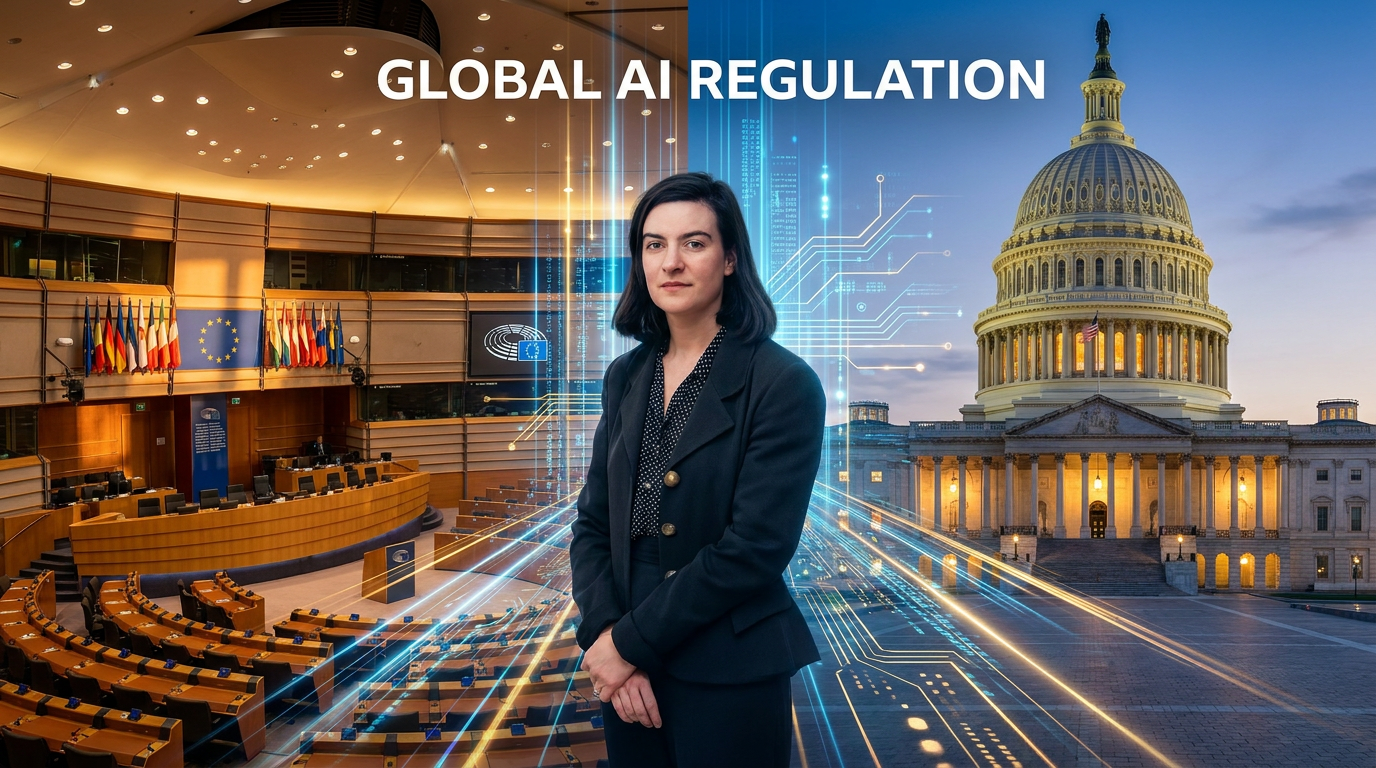
The European Parliament has officially delayed the EU AI Act's strictest compliance deadlines to late 2027, while the US federal government launches an aggressive campaign to preempt state-level AI regulations.
By Factlen Editorial Team
- Federal Standardization Advocates
- Argue for a unified national AI policy to prevent a fragmented regulatory landscape.
- State-Level Protectors
- Defend local AI regulations as necessary safeguards against algorithmic harm.
- EU Regulatory Pragmatists
- Support adjusting compliance timelines to match technical and operational realities.
What's not represented
- · Open-source AI developers affected by frontier model thresholds
- · Non-Western regulatory bodies observing the EU/US divergence
Why this matters
The rules governing the world's most powerful technologies are being rewritten this month. For businesses, the EU's delay offers a temporary lifeline, while the US federal government's push to override state laws will determine whether companies face a single national standard or a chaotic web of local regulations.
Key points
- The European Parliament passed the Digital Omnibus package, delaying the EU AI Act's high-risk system compliance deadline to December 2027.
- The EU maintained its December 2026 deadline for watermarking AI-generated content and enacted an immediate ban on non-consensual intimate imagery generators.
- The US Department of Justice is actively litigating to preempt state-level AI laws, contributing to the repeal of Colorado's stringent AI deployment statute.
- A new US Executive Order establishes a voluntary national security review framework for advanced frontier AI models prior to public release.
- A bipartisan US congressional draft, the Great American AI Act, proposes a unified federal framework that would override state AI development laws.
The landscape of artificial intelligence regulation has fractured into two distinct realities this month. In Europe, lawmakers have officially delayed the most stringent requirements of the EU AI Act, granting enterprises a 16-month reprieve. In the United States, the federal government has launched an aggressive campaign to preempt a chaotic patchwork of state-level AI laws.[8]
The primary evidence for the European shift comes from the European Parliament, which on June 16, 2026, passed the "Digital Omnibus" package with 423 votes in favor. This legislation formally postpones the application of Annex III high-risk AI system obligations, which were originally slated to take effect on August 2, 2026.[1][7]
This delay provides critical breathing room for global enterprises. Under the revised timeline, stand-alone high-risk systems face a December 2, 2027 deadline, while AI embedded in regulated safety products has until August 2028. Legal analysts note that the delay was practically necessary, as harmonized technical standards and enterprise compliance frameworks were severely lagging behind the original statutory timeline.[1][7]

However, the Omnibus package does not represent a complete regulatory pause. The Parliament maintained the December 2026 deadline for watermarking AI-generated content and introduced an immediate, binding ban on AI systems that generate non-consensual intimate imagery, often referred to as "nudifier" apps.[1]
Across the Atlantic, the evidence points to a federal government actively intervening to dismantle state-level AI regulations. Without a comprehensive federal AI statute in place, individual US states introduced over 1,500 AI-related bills by early 2026. In response, the US Department of Justice launched an AI Litigation Task Force in January 2026 to contest these state laws on interstate-commerce and constitutional preemption grounds.[5]
The Justice Department's intervention is no longer theoretical. When tech companies moved to block Colorado's stringent AI deployment law, the federal government joined the fight, arguing that the state's requirements conflicted with federal anti-discrimination frameworks. This coordinated pressure contributed to Colorado repealing and replacing the law with a significantly narrower statute in May 2026.[5][6]

The Justice Department's intervention is no longer theoretical.
Simultaneously, a new US Executive Order shifts federal oversight toward voluntary national security reviews for frontier models. On June 2, 2026, the White House issued an order titled "Promoting Advanced Artificial Intelligence Innovation and Security." The directive establishes a framework for developers of advanced "covered frontier" AI models to provide the government with access prior to public release.[2][4]
This marks a strategic pivot in US federal policy. Earlier executive actions focused heavily on eliminating regulatory barriers and asserting federal preemption over state laws. The June 2026 order signals a growing recognition within the administration that advanced AI capabilities present acute cybersecurity and national security risks that require coordinated government engagement.[2][4]
On the legislative front, bipartisan efforts are underway to establish the first comprehensive federal AI governance regime. On June 4, 2026, lawmakers released a 269-page discussion draft of the "Great American Artificial Intelligence Act of 2026." The bill targets "large frontier developers"—defined as companies with over $500 million in annual revenue that train frontier models—imposing binding development and transparency obligations.[3]

Crucially, the draft legislation includes a preemption clause that would override state laws specifically regulating the development of AI models for a three-year period. This preemption measure has drawn immediate scrutiny from civil society organizations, who argue it could strip away vital consumer protections recently enacted by states like California and New York.[3][6]
Uncertainty remains regarding the US legislative path. While polling shows broad bipartisan appetite for AI regulation—with 65% of Americans stating the government has done too little—the draft bill must navigate a deeply polarized Congress. The bill's sponsors have explicitly called for feedback, indicating the text will likely undergo significant revisions before any formal introduction.[3]
For global enterprises, the compliance landscape remains a moving target. The EU's 16-month delay offers a temporary reprieve for high-risk systems, but the underlying obligations remain intact and require extensive engineering preparation. Meanwhile, companies operating in the US must navigate a complex web of state laws, such as California's Transparency in Frontier AI Act, while anticipating potential federal preemption.[6][7]

The divergence between the EU and US approaches highlights a fundamental tension in global AI governance. The EU continues to rely on a comprehensive, risk-based legislative framework, adjusting timelines only when implementation realities force their hand. The US, conversely, is relying on executive actions, targeted litigation, and nascent legislative drafts to balance innovation with national security.[1][4][5][8]
Ultimately, the evidence suggests that 2026 will not be the year of unified global AI regulation. Instead, it is a year of recalibration, as both major regulatory blocs adjust their strategies to the rapid pace of AI development and the practical challenges of enforcement.[8]
How we got here
August 2024
The EU AI Act officially enters into force, establishing a phased implementation schedule.
January 2026
The US Department of Justice launches an AI Litigation Task Force to challenge state-level AI regulations.
May 2026
Under federal pressure, Colorado repeals and replaces its stringent AI deployment law with a narrower statute.
June 2, 2026
The White House issues an Executive Order creating a voluntary security review framework for frontier AI models.
June 16, 2026
The European Parliament approves the Digital Omnibus, delaying high-risk AI compliance to December 2027.
Viewpoints in depth
Federal Standardization Advocates
Tech companies and federal lawmakers arguing for a unified national AI policy.
This camp, which includes major frontier model developers and bipartisan federal lawmakers, argues that a patchwork of 50 different state laws will stifle American innovation. They support federal preemption clauses, like those in the draft Great American AI Act, to create a single set of rules. They contend that national security and global AI dominance require a coordinated federal approach rather than fragmented state-level enforcement.
State-Level Protectors
Civil society groups and state attorneys general defending local AI regulations.
Advocates for state-level regulation argue that the federal government has moved too slowly to protect consumers from algorithmic bias, deepfakes, and automated discrimination. Organizations like Public Citizen and various state legislatures view federal preemption as a corporate loophole designed to strip away hard-won local protections. They point to laws in California and Colorado as necessary safeguards that should not be overridden by a weaker federal standard.
EU Regulatory Pragmatists
European policymakers and enterprise compliance officers adjusting to implementation realities.
This perspective acknowledges that the original EU AI Act timeline was overly ambitious. With harmonized technical standards arriving late and enterprises struggling to build compliance frameworks, pragmatists argue the 16-month delay to December 2027 is necessary to prevent market disruption. They emphasize that the delay is not a rollback of safety standards, but a practical adjustment to ensure the law can be effectively enforced.
What we don't know
- Whether the US Congress can pass the Great American AI Act before the end of the 2026 legislative session.
- How federal courts will ultimately rule on the DOJ's efforts to preempt state-level AI regulations.
- Whether the European Council will formally adopt the Digital Omnibus package without further amendments.
Key terms
- Digital Omnibus
- A legislative package passed by the European Parliament that amends the EU AI Act, primarily by delaying compliance deadlines for high-risk systems.
- High-Risk AI System (Annex III)
- Under the EU AI Act, AI systems used in critical areas like employment, credit scoring, and law enforcement, which face the strictest regulatory requirements.
- Frontier AI Model
- Highly capable, cutting-edge artificial intelligence models that require massive computational power to train and potentially pose national security risks.
- Federal Preemption
- A legal doctrine where federal laws or regulations override and invalidate conflicting state or local laws.
Frequently asked
Does the EU delay mean companies can stop their AI compliance efforts?
No. Legal analysts advise that building required quality management systems and technical documentation takes significant time, and the underlying obligations remain fully intact for the new December 2027 deadline.
What does the new US Executive Order require from AI developers?
The June 2026 order establishes a voluntary framework for developers of advanced frontier models to provide the federal government with access for cybersecurity and national security assessments prior to public release.
Will the Great American AI Act override state laws like California's?
If passed in its current draft form, the bill includes a preemption clause that would override state laws specifically regulating the development of AI models for a three-year period.
Sources
Source coverage
8 outlets
3 viewpoints surfaced







[1]European ParliamentEU Regulatory Pragmatists
AI Act: EP approves simplification measures and 'nudifier' app ban
Read on European Parliament →[2]The White HouseFederal Standardization Advocates
Executive Order on Promoting Advanced Artificial Intelligence Innovation and Security
Read on The White House →[3]Tech Policy PressFederal Standardization Advocates
Bipartisan 'Great American AI Act' Draft Released
Read on Tech Policy Press →[4]Holland & KnightFederal Standardization Advocates
President Signs Executive Order on Advanced AI Innovation and Security
Read on Holland & Knight →[5]Epstein Becker GreenState-Level Protectors
How Is U.S. AI Regulation Evolving? What Should Businesses Be Paying Attention To?
Read on Epstein Becker Green →[6]VerifyWiseState-Level Protectors
State of AI governance regulations in the United States
Read on VerifyWise →[7]Gibson DunnEU Regulatory Pragmatists
EU Institutions Reach Political Agreement on Digital Omnibus on AI
Read on Gibson Dunn →[8]Factlen Editorial TeamEU Regulatory Pragmatists
Synthesis by Factlen editorial team
Read on Factlen Editorial Team →


Every angle. Every day.
Get ai stories with full source coverage and perspective breakdowns delivered to your inbox.