
How Kevin Warsh is Rewriting the Federal Reserve's Playbook
In his first meeting as Fed Chair, Kevin Warsh held interest rates steady but delivered a hawkish shock by stripping away forward guidance and launching five task forces to overhaul the central bank.
By Factlen Editorial Team
- Traditional Monetary Hawks
- Value price stability above all else and support a return to orthodox policy with a smaller balance sheet and less forward guidance.
- Equity Investors
- Concerned about the impact of higher borrowing costs on corporate earnings and the removal of the Fed's communication safety net.
- Currency & Bond Traders
- Focused on yield differentials and the strengthening U.S. dollar as the Fed diverges from other global central banks.
What's not represented
- · Small Business Owners
- · Mortgage Seekers
Why this matters
The Federal Reserve dictates the cost of borrowing for everything from mortgages to corporate expansions. Chair Kevin Warsh's new framework means investors and consumers can no longer rely on the Fed to telegraph its moves months in advance, ushering in an era of higher market volatility and a stronger U.S. dollar.
Key points
- The Federal Reserve held interest rates steady at 3.50% to 3.75% during Kevin Warsh's first meeting as Chair.
- Nine of 18 Fed officials now project at least one interest rate hike by the end of 2026.
- Warsh removed explicit forward guidance from the Fed's policy statement, signaling a shift toward data dependency.
- Five new task forces were established to review the central bank's communications, balance sheet, and inflation mandate.
- Financial markets reacted with higher Treasury yields, a stronger U.S. dollar, and a drop in equities.
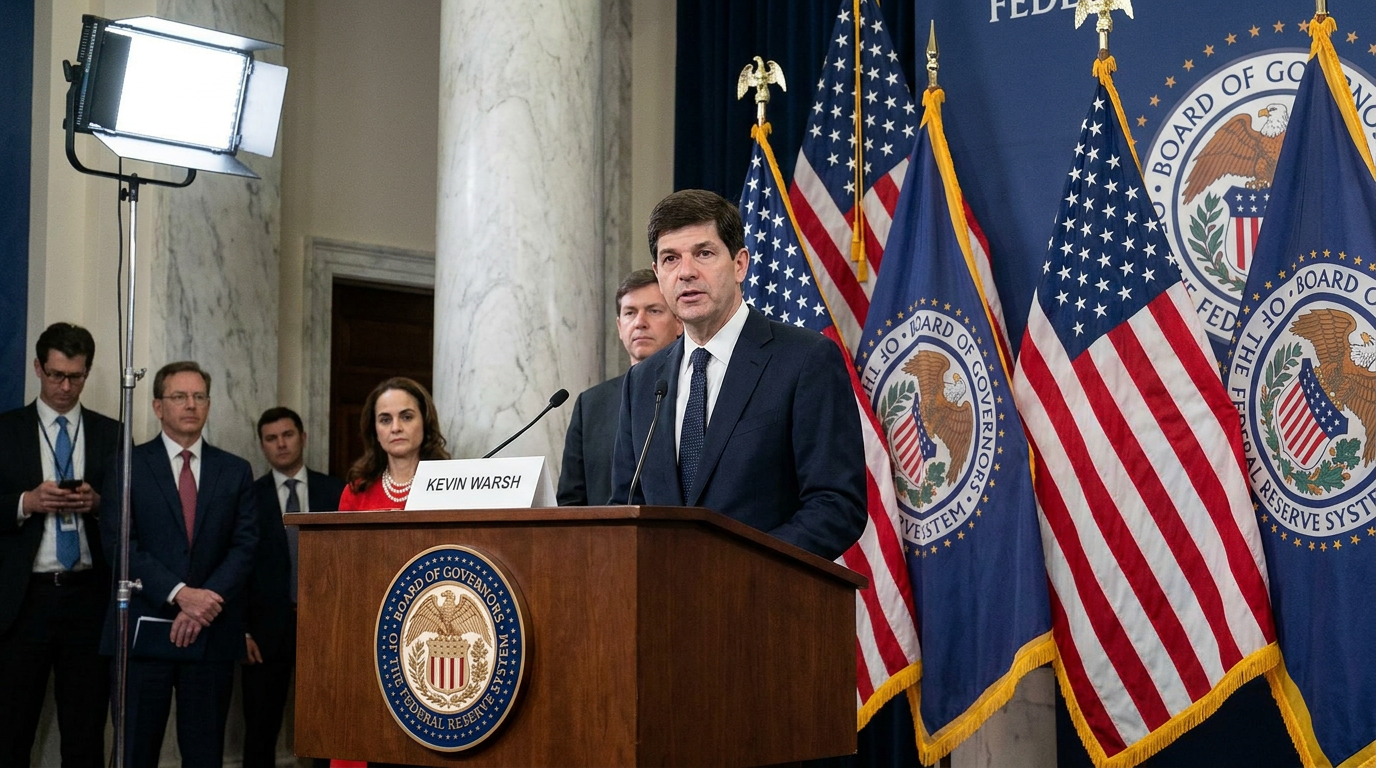
The era of Kevin Warsh at the Federal Reserve has officially begun, and it arrived with a jolt to the financial system. In his highly anticipated debut as Fed Chair, Warsh presided over a unanimous decision to hold the benchmark federal funds rate steady at a range of 3.50% to 3.75%. While the rate hold was universally expected by markets, the underlying message delivered by the central bank was anything but routine.[4][5][7]
Instead of the dovish pivot some investors had hoped for earlier in the year, the Federal Open Market Committee (FOMC) delivered a decidedly hawkish shock. The central bank's updated Summary of Economic Projections—widely known as the "dot plot"—revealed that nine of the 18 committee members now project at least one interest rate hike before the end of 2026. This marks a dramatic reversal from March, when the median projection still implied rate cuts were on the horizon.[3][5][6][7]
The shift in expectations is deeply rooted in the complex macroeconomic environment Warsh has inherited. U.S. consumer prices rose 4.2% annually in May, marking the highest inflation rate in three years. This inflationary surge has been heavily driven by a spike in global energy costs following the recent conflict involving Iran, which sent oil prices soaring and disrupted supply chains through the Strait of Hormuz.[3][4][5][8]

"Persistently high prices are a burden for the American people," Warsh stated during his inaugural press conference, emphasizing the phrase "price stability" repeatedly. He made it clear that while energy prices have begun to moderate slightly following a weekend ceasefire deal, the broader inflationary risks remain too elevated to justify loosening monetary policy.[3][4][7]
Beyond the immediate rate trajectory, Warsh used his first meeting to signal a structural overhaul of how the Federal Reserve operates and communicates. He announced the formation of five distinct task forces designed to review the central bank's entire policy framework. These working groups will examine the Fed's communications strategy, the size of its balance sheet, its reliance on traditional data sources, the economic impact of artificial intelligence on productivity, and the fundamental drivers of inflation.[1][6][7][8]
The creation of these task forces effectively buys the Fed time, giving the committee "wiggle room" to delay any definitive rate changes until later in the year while the groups conduct their reviews. Most of the task forces are expected to deliver their findings by December, aligning with a potential window for the Fed's next major policy move.[1][6]

One of the most immediate changes under Warsh's leadership is a stark departure from the communication style of his predecessor, Jerome Powell. The FOMC's post-meeting policy statement was drastically shortened, stripping out the "forward guidance" that Wall Street has relied upon for the better part of a decade. Warsh has long been critical of providing markets with explicit roadmaps, preferring a system where financial markets react dynamically to incoming economic data rather than central bank hand-holding.[4][6][7][8]
One of the most immediate changes under Warsh's leadership is a stark departure from the communication style of his predecessor, Jerome Powell.
In a move that underscored his skepticism of forward guidance, Warsh confirmed that he personally abstained from submitting a dot to the committee's rate projections. He noted that the dots are submitted "with a pencil and an eraser," emphasizing the inherent uncertainty of economic forecasting. This abstention sends a powerful signal that the new Fed Chair intends to maintain maximum flexibility.[4][5][6][8]
The financial markets reacted swiftly to the realization that the central bank's communication safety net is being pulled back. Equities tumbled during the press conference, with the Dow Jones Industrial Average dropping 500 points and the S&P 500 shedding 1.2%. Investors are quickly recognizing that the Warsh era will require them to do more of their own heavy lifting when it comes to interpreting economic data.[1][4][5]

In the bond market, the reaction was equally pronounced. The yield on the two-year U.S. Treasury note—which is highly sensitive to near-term interest rate expectations—surged to its highest level in 16 months. Traders are now pricing in a roughly 60% probability that the Fed will actually execute a rate hike by the fourth quarter of 2026.[3][5][7]
The hawkish stance is also triggering a step-change in global currency markets, providing a massive bullish impulse for the U.S. dollar. The combination of higher-for-longer interest rates, strong domestic growth prospects, and immense capital demand from the artificial intelligence sector is drawing global investment into dollar-denominated assets.[2]
This dollar strength complicates the picture for global central banks, many of which had already begun easing their own monetary policies earlier in the year. As the Fed holds firm—or potentially tightens further—divergence in global monetary policy could place intense pressure on emerging markets and allied economies alike.[7]

The political backdrop of Warsh's hawkish debut cannot be ignored. President Donald Trump nominated Warsh with the explicit expectation of securing lower interest rates. However, the June dot plot and Warsh's unwavering focus on inflation serve as a direct assertion of the Federal Reserve's institutional independence.[3][8]
One of the most intriguing elements of Warsh's agenda is his focus on the supply side of the economy, particularly the role of artificial intelligence. By dedicating a specific task force to AI and productivity, the Fed is acknowledging that technological advancements could eventually serve as a powerful disinflationary force. However, Warsh cautioned that while AI is currently driving massive demand for data centers and energy, its broader productivity benefits may take years to fully materialize.[6][8]
For everyday consumers and investors, the message from the Warsh Fed is clear: the era of ultra-accommodative, highly predictable monetary policy is over. Navigating this new landscape will require a deeper understanding of fundamental economic indicators and a tolerance for higher market volatility as the central bank prioritizes long-term price stability over short-term market comfort.[1][2][6][7]
How we got here
December 2025
The Federal Reserve cuts rates, establishing the 3.50%–3.75% range.
March 2026
The Fed's dot plot implies that interest rate cuts are expected by year-end.
May 2026
Kevin Warsh is sworn in as the 17th Chair of the Federal Reserve.
May 2026
U.S. inflation surges to 4.2% amid global energy shocks tied to the Middle East.
June 17, 2026
Warsh holds his first FOMC meeting, holds rates steady, and signals a hawkish shift.
Viewpoints in depth
Traditional Monetary Hawks
Advocates for strict price stability and a return to orthodox central banking.
This camp views Warsh's debut as a necessary and long-overdue correction to the Federal Reserve's operational framework. They argue that the central bank's decade-long reliance on forward guidance and massive balance sheet expansion created moral hazard, encouraging excessive risk-taking by investors who assumed the Fed would always provide a safety net. By stripping away explicit promises about future rate paths and establishing task forces to review the balance sheet, traditionalists believe Warsh is restoring market discipline and properly prioritizing the fight against sticky inflation.
Equity Investors
Market participants concerned about the removal of policy predictability and higher borrowing costs.
For equity markets, the Warsh era introduces a challenging new dynamic. Investors had spent the early part of 2026 positioning for rate cuts, only to be confronted with a dot plot suggesting hikes are back on the table. Beyond the immediate threat of higher borrowing costs compressing corporate profit margins, this camp is deeply unsettled by the loss of forward guidance. Without the Fed telegraphing its moves months in advance, investors face a higher-volatility environment where every monthly inflation or jobs report could trigger sharp, unpredictable market swings.
Currency & Bond Traders
Financial professionals focused on yield differentials and global capital flows.
Bond and currency markets are rapidly adjusting to the reality of U.S. exceptionalism in monetary policy. While central banks in Europe and Canada have begun easing, the Fed's hawkish stance creates a stark divergence. Traders in this camp note that higher U.S. yields are acting as a magnet for global capital, driving the U.S. dollar significantly higher. While this is profitable for dollar-bullish positions, traders warn that a relentlessly strong dollar could eventually strain emerging markets that hold dollar-denominated debt and complicate the earnings of U.S. multinational corporations.
What we don't know
- Whether the Fed will actually execute a rate hike in 2026, or if the hawkish dot plot is merely a contingency plan.
- What specific policy changes will emerge from the five newly established task forces when they report in December.
- How quickly the artificial intelligence sector's productivity gains will offset its current inflationary energy demands.
Key terms
- Dot Plot
- A chart published quarterly by the Federal Reserve summarizing the interest rate projections of its 18 committee members.
- Forward Guidance
- The central bank's practice of telling the public what it intends to do with interest rates in the future, which Warsh is now scaling back.
- Hawkish
- A monetary policy stance that prioritizes controlling inflation, typically by keeping interest rates high or raising them.
- Federal Funds Rate
- The target interest rate set by the Fed that determines how much it costs banks to borrow money, which ripples out to consumer mortgages and credit cards.
- Summary of Economic Projections (SEP)
- A detailed report released by the Fed four times a year outlining officials' forecasts for inflation, unemployment, and economic growth.
Frequently asked
Will the Federal Reserve cut interest rates in 2026?
It is highly unlikely. Half of the Fed's committee members now project at least one rate hike by the end of 2026 due to sticky inflation.
Why did the stock market drop after the Fed meeting?
Investors reacted negatively to the prospect of higher interest rates and the Fed's decision to stop providing predictable 'forward guidance' on future policy.
What are the new Fed task forces doing?
Chair Kevin Warsh established five groups to review how the Fed operates, including how it communicates, measures inflation, and accounts for AI's impact on the economy.
Why is the U.S. dollar getting stronger?
Higher U.S. interest rates attract global investors seeking better returns, which increases demand for the dollar relative to other currencies.
Sources
Source coverage
8 outlets
3 viewpoints surfaced







[1]MarketWatchEquity Investors
Warsh’s task forces give the Fed wiggle room to put off changing rates until December
Read on MarketWatch →Why the Fed’s hawkish stance signals a step-change in U.S. dollar sentiment — and a new direction
Read on MarketWatch →[3]Financial TimesCurrency & Bond Traders
Kevin Warsh vows to deliver 'price stability' in hawkish Fed debut
Read on Financial Times →[4]The GuardianEquity Investors
US stock markets drop after Fed signals possible rate hike
Read on The Guardian →[5]ForbesEquity Investors
Fed Holds Interest Rates Unchanged In Kevin Warsh's First Meeting—But Higher Rates Are Expected
Read on Forbes →[6]PIMCOTraditional Monetary Hawks
Hawkish-Leaning Committee, Reform-Minded Chair: Warsh's First Fed Meeting
Read on PIMCO →[7]U.S. BankCurrency & Bond Traders
Fed holds rates steady as new Chair Kevin Warsh commits to price stability
Read on U.S. Bank →[8]KPMGTraditional Monetary Hawks
Fed funds rate unchanged; Warsh tenure begins
Read on KPMG →

More in finance
See all 5 stories →

Every angle. Every day.
Get finance stories with full source coverage and perspective breakdowns delivered to your inbox.