
The Rise of Senolytics: How Clearing 'Zombie Cells' Could Transform Aging
Scientists are moving beyond treating individual age-related diseases to targeting cellular senescence itself. A new class of drugs called senolytics aims to clear damaged "zombie cells" from the body, with multiple clinical trials now testing their ability to extend human healthspan.
By Factlen Editorial Team
- Geroscience Researchers
- Argue that targeting the root biological mechanisms of aging is more efficient than treating individual age-related diseases as they arise.
- Clinical Trial Investigators
- Focus on translating senolytics into safe, measurable interventions for specific frailties, such as post-chemotherapy decline or HIV-associated aging.
- Precision Medicine Advocates
- Emphasize that senescence is highly complex and that therapies must be targeted to specific 'senotypes' rather than broadly clearing cells.
What's not represented
- · Regulatory Agencies
- · Bioethics Scholars
Why this matters
For decades, medicine has treated aging by fighting individual diseases—heart disease, cancer, dementia—one by one. Senolytics represent a paradigm shift: targeting the underlying biological decay that causes these conditions in the first place, potentially allowing people to live healthier, more capable lives well into old age.
Key points
- Cellular senescence occurs when damaged cells stop dividing but refuse to die, secreting inflammatory toxins.
- Senolytics are drugs that selectively clear these 'zombie cells' to reduce tissue inflammation.
- Early animal studies showed senolytics can restore physical function and extend healthspan.
- Human clinical trials are now testing senolytics for conditions like HIV-related frailty and chemotherapy recovery.
- Recent data suggests senolytics work best when targeted to patients with a confirmed high burden of senescent cells.
- The NIH recently published the first Human Senescence Atlas, mapping how these cells vary across different organs.
The traditional approach to human aging resembles a game of whack-a-mole. A patient develops high blood pressure, and they are prescribed a pill. Years later, their joints degrade, requiring a replacement. Then comes a metabolic disorder, or cognitive decline. Medicine has historically treated these as separate, inevitable failures of a decaying machine.[7]
But over the last decade, geroscience—the study of the biology of aging—has coalesced around a different idea. What if these disparate diseases are actually symptoms of a single underlying process? If scientists can target the root mechanisms of biological aging, they might be able to delay or prevent multiple chronic conditions simultaneously.[2][7]
At the center of this research is a phenomenon known as cellular senescence. When normal cells experience severe stress, DNA damage, or reach the end of their natural division cycle (the Hayflick limit), they are supposed to undergo apoptosis—a programmed self-destruction. But sometimes, they refuse to die.[2][6]
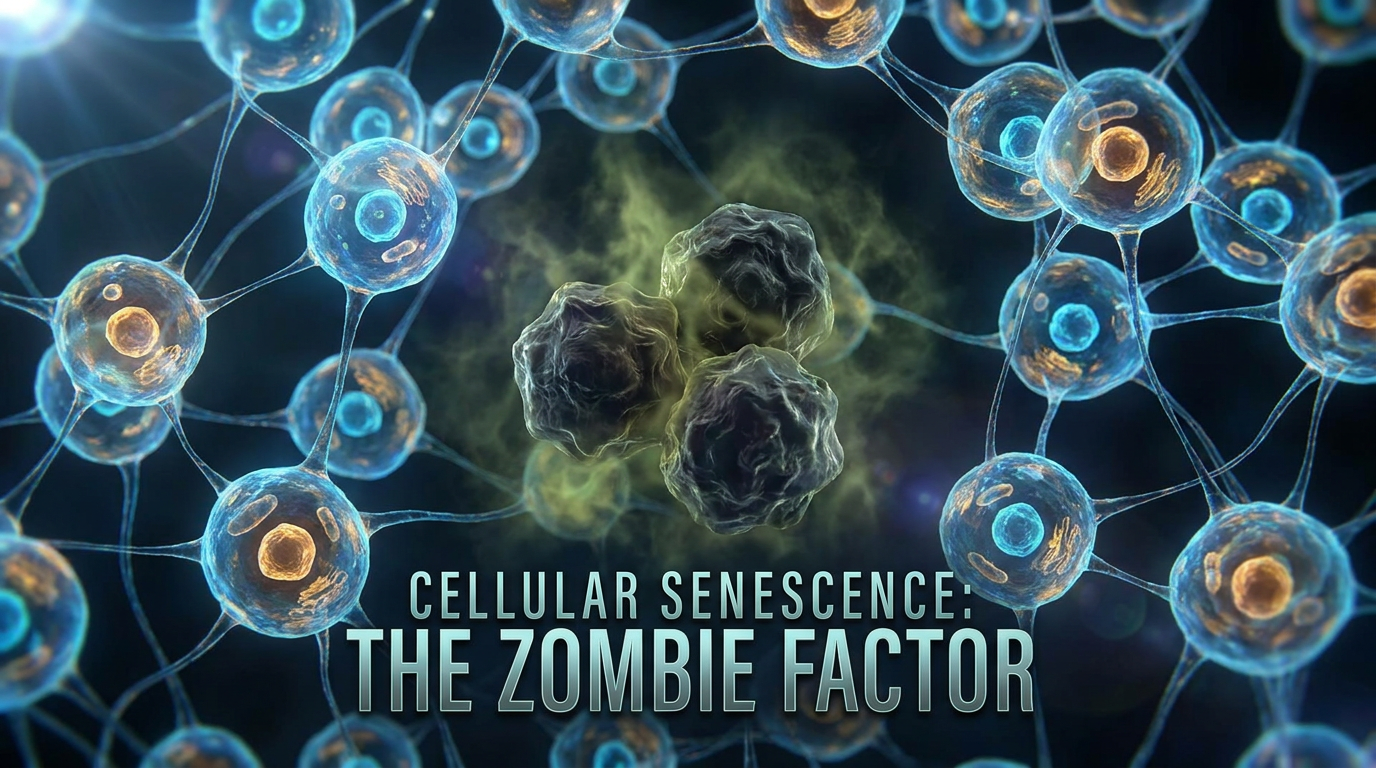
Instead, these cells enter a state of permanent dormancy. They stop dividing but remain metabolically active, earning them the nickname "zombie cells." While this arrest mechanism originally evolved to prevent damaged cells from multiplying and forming tumors, the accumulation of these zombie cells over decades becomes highly toxic.[1][6]
Senescent cells do not suffer in silence. They secrete a toxic cocktail of pro-inflammatory cytokines, chemokines, and tissue-remodeling enzymes known as the Senescence-Associated Secretory Phenotype (SASP). This inflammatory localized environment damages neighboring healthy cells, degrades tissue function, and drives the chronic, low-grade inflammation that characterizes human aging.[2][6]

Enter senolytics: a new class of drugs designed to selectively hunt and destroy these zombie cells. By transiently disabling the anti-apoptotic pathways that keep senescent cells alive, senolytics force them to finally complete their programmed cell death, allowing the immune system to clear the debris and healthy cells to regenerate the tissue.[2][6]
The foundational proof-of-concept arrived when researchers at the Mayo Clinic demonstrated that a combination of two compounds—dasatinib (a leukemia drug) and quercetin (a plant flavanol)—could clear senescent cells in mice. The results were striking: the treated mice exhibited restored physical function, delayed age-related dysfunction, and a 36 percent increase in post-treatment survival.[1][2]
The results were striking: the treated mice exhibited restored physical function, delayed age-related dysfunction, and a 36 percent increase in post-treatment survival.
Now, in 2026, the field has decisively moved from animal models into human clinical trials. Researchers are no longer just asking if senolytics work in theory; they are testing whether clearing zombie cells can reverse specific, measurable frailties in vulnerable populations.[4][7]

One major ongoing study is the IPACE-HIV trial, conducted by the global ACTG network. People living with HIV often experience accelerated biological aging and frailty, even when their viral loads are perfectly controlled by antiretroviral therapy. The trial is testing whether the dasatinib and quercetin (D+Q) combination can improve physical function and walking speed in older patients by clearing the senescent cells driving their premature frailty.[4]
Similar trials are targeting the aftermath of cancer treatments. Chemotherapy is notorious for inducing a massive wave of cellular senescence, which is why many survivors experience persistent physical decline long after their cancer is cured. Studies are currently evaluating whether senolytics like fisetin can clear this chemotherapy-induced senescence and restore physical function in breast cancer survivors.[7]
However, as human data rolls in, scientists are discovering that senolytics are not a universal fountain of youth. A recent Mayo Clinic trial focused on bone metabolism in older women found that the D+Q combination successfully increased bone formation—but only in women who already had a high burden of senescent cells.[1]
This finding underscores a critical pivot in the field toward precision medicine. Taking over-the-counter supplements marketed as "senolytics" without knowing one's actual senescent cell burden is likely ineffective and potentially risky. The future of the field relies on "gerodiagnostics"—tests that can accurately measure a patient's zombie cell load before prescribing a targeted clearance drug.[1][7]
The complexity of senescence was further illuminated in June 2026, when the NIH's Cellular Senescence Network (SenNet) published the first comprehensive Human Senescence Atlas. Led by researchers at the Yale School of Medicine, the massive open-source project mapped aged cells across the brain, liver, skin, and lymph nodes.[3]

Crucially, the SenNet data revealed that senescence is not a single, uniform state. There are diverse "senotypes" that vary wildly depending on the organ and the disease. For instance, the Yale team discovered localized hotspots of dysfunctional B-cells in aging lymph nodes, providing a direct mechanistic explanation for why the human immune system weakens so dramatically in old age.[3]
Because senotypes vary, therapies are becoming more localized. In May 2026, researchers demonstrated that applying a topical senolytic drug (ABT-263) directly to aging skin dramatically accelerated wound healing. By clearing the localized zombie cells that stall the body's repair process, the topical treatment activated collagen production without exposing the rest of the body to systemic drugs.[5]

This localized approach is vital because cellular senescence is a double-edged sword. While persistent zombie cells drive aging, transient senescence is actually required for normal wound healing and tissue repair. Broadly wiping out all senescent cells across the entire body could inadvertently impair the immune system's ability to heal acute injuries.[5][6]
The ultimate goal of senolytic therapy is not immortality, but "healthspan"—maximizing the number of years a person lives free from debilitating disease. By selectively pruning the damaged cells that drag down the body's regenerative capacity, medicine is inching closer to treating aging not as an inevitable decline, but as a manageable biological condition.[3][7]
How we got here
2015
Researchers at the Mayo Clinic publish the first study demonstrating that the dasatinib and quercetin (D+Q) combination acts as a senolytic.
2018
A landmark Nature Medicine study shows that clearing senescent cells extends both lifespan and healthspan in naturally aging mice.
2024
Mayo Clinic publishes human trial data showing senolytics improve bone metabolism, but primarily in women with high senescent cell burdens.
Jan 2026
The ACTG network launches the IPACE-HIV trial to test senolytics against premature frailty in older adults living with HIV.
Jun 2026
The NIH's Cellular Senescence Network publishes the first comprehensive Human Senescence Atlas, mapping 'zombie cells' across multiple organs.
Viewpoints in depth
Geroscience Researchers
Advocate for treating the biological root of aging rather than individual symptoms.
This camp argues that the current medical model—waiting for a disease to manifest and then treating its symptoms—is fundamentally flawed when it comes to aging. By targeting cellular senescence, geroscientists believe we can alleviate multiple comorbidities at once. They point to animal models where clearing senescent cells simultaneously improved cardiovascular function, delayed cataracts, and restored muscle stamina, suggesting a unified approach to extending human healthspan.
Clinical Trial Investigators
Focus on translating broad anti-aging concepts into measurable, disease-specific treatments.
Clinical investigators emphasize that the FDA does not recognize 'aging' as a disease. Therefore, to get senolytics approved, they must be proven to treat specific, measurable conditions. This camp is focused on designing rigorous trials for distinct populations—such as breast cancer survivors suffering from chemotherapy-induced frailty, or patients with idiopathic pulmonary fibrosis. They prioritize safety, optimal dosing schedules, and concrete functional endpoints over theoretical lifespan extension.
Precision Medicine Advocates
Warn against a one-size-fits-all approach, emphasizing the complexity of senescent cells.
This perspective, heavily informed by recent data from the Mayo Clinic and the NIH SenNet project, cautions that senescence is not universally bad. Because transient senescence is required for wound healing and tumor suppression, broadly wiping out all senescent cells could be dangerous. They argue the future lies in 'gerodiagnostics'—developing biomarkers to measure a patient's specific senescent burden and tailoring highly localized or cell-specific senolytics to clear only the harmful cells.
What we don't know
- The long-term safety of repeatedly clearing senescent cells in humans over decades.
- Whether over-the-counter supplements like quercetin achieve high enough concentrations in human tissue to act as effective senolytics.
- How the clearance of senescent cells affects the body's natural ability to heal acute wounds or suppress emerging tumors in the long run.
Key terms
- Cellular Senescence
- A state in which a cell permanently stops dividing but remains metabolically active, often in response to DNA damage or stress.
- Senolytics
- A class of drugs designed to selectively induce death in senescent cells, clearing them from the body.
- Apoptosis
- The natural, programmed process of cell death that safely removes damaged or unnecessary cells without causing inflammation.
- Healthspan
- The period of a person's life during which they are generally healthy and free from serious or chronic illness.
- Hayflick Limit
- The maximum number of times a normal human cell population will divide before cell division stops.
Frequently asked
What are 'zombie cells'?
Zombie cells, scientifically known as senescent cells, are damaged cells that have stopped dividing but refuse to die. They linger in tissues and secrete inflammatory chemicals that accelerate aging.
Can I buy senolytics right now?
While some compounds like quercetin and fisetin are available as dietary supplements, clinical researchers warn against taking them for anti-aging purposes outside of a trial, as improper dosing can be ineffective or interfere with normal tissue repair.
Will senolytics make people live forever?
No. The goal of senolytics is to increase 'healthspan'—the portion of life spent in good health, free from chronic disease and frailty—rather than simply extending maximum lifespan.
What is the SASP?
SASP stands for Senescence-Associated Secretory Phenotype. It is the toxic cocktail of inflammatory molecules that zombie cells release, which damages surrounding healthy tissue.
Sources
Source coverage
7 outlets
3 viewpoints surfaced







[1]Mayo ClinicPrecision Medicine Advocates
Senolytic drugs may benefit older women with high senescent cells
Read on Mayo Clinic →[2]National Institute on AgingGeroscience Researchers
Targeting senescent cells extends healthspan in mice
Read on National Institute on Aging →[3]Yale School of MedicinePrecision Medicine Advocates
Scientists Develop First Comprehensive Atlas of Human Cellular Senescence in Aging
Read on Yale School of Medicine →[4]ACTG NetworkClinical Trial Investigators
ACTG Announces Opening of IPACE-HIV Trial Evaluating Senolytics
Read on ACTG Network →[5]AgingClinical Trial Investigators
Topical ABT-263 treatment reduces aged skin senescence and improves subsequent wound healing
Read on Aging →[6]npj AgingGeroscience Researchers
Senolytic compounds reduce epigenetic age of blood samples in vitro
Read on npj Aging →[7]Factlen Editorial TeamPrecision Medicine Advocates
Synthesis by Factlen editorial team
Read on Factlen Editorial Team →


Every angle. Every day.
Get health stories with full source coverage and perspective breakdowns delivered to your inbox.