
Reconnecting the Rockies: How North America's Largest Wildlife Corridor is Saving Species
The Yellowstone to Yukon initiative is successfully reversing decades of habitat fragmentation, using innovative green infrastructure like the new Peter Lougheed Wildlife Overpass to reduce animal-vehicle collisions and reconnect isolated populations.
By Factlen Editorial Team
- Conservation Scientists
- Argue that reconnecting fragmented habitats is the single most effective intervention for species survival.
- Infrastructure Designers
- Focus on the engineering challenge of blending structural integrity with ecological needs.
- Public Safety Officials
- Value the crossings primarily as a highly effective method to reduce costly and dangerous collisions.
What's not represented
- · Commercial Trucking Industry
- · Local Tourism Boards
Why this matters
Habitat fragmentation is one of the leading causes of biodiversity loss globally. The success of these wildlife crossings proves that human infrastructure and natural ecosystems can coexist, offering a scalable blueprint for climate resilience and public safety.
Key points
- The new Peter Lougheed Wildlife Overpass is Alberta's first green crossing built outside a national park.
- The $17.5 million structure spans the Trans-Canada Highway and is 60 meters wide.
- Wildlife crossings have been shown to reduce animal-vehicle collisions by 80 to 96 percent.
- Trail cameras confirm that elk, deer, bears, and cougars are already using the new overpass.
- The project is part of the broader Yellowstone to Yukon initiative to connect a 2,100-mile wildlife corridor.
- The crossings also save money by preventing a portion of the $200 million in annual collision damages.
For decades, the Trans-Canada Highway has served as a vital economic artery, carrying up to 30,000 vehicles a day through the Bow River Valley. But for the wildlife of the Canadian Rockies, the ribbon of asphalt is a deadly barrier. Highways slice through ancient migration routes, isolating populations of grizzly bears, elk, and wolves. The resulting habitat fragmentation doesn't just cause localized starvation; it triggers genetic bottlenecks, as animals are cut off from the broader breeding pools necessary for long-term species survival.[2][4]
Reversing this fragmentation is the central mission of the Yellowstone to Yukon (Y2Y) Conservation Initiative, a decades-long effort to stitch together a 2,100-mile contiguous corridor from Wyoming to northern Canada. The premise is simple but ambitious: if animals have enough room to roam, ecosystems remain resilient. To achieve this, conservationists and engineers are increasingly turning to green infrastructure, building specialized bridges and tunnels that allow nature to safely bypass human development.[2][4]
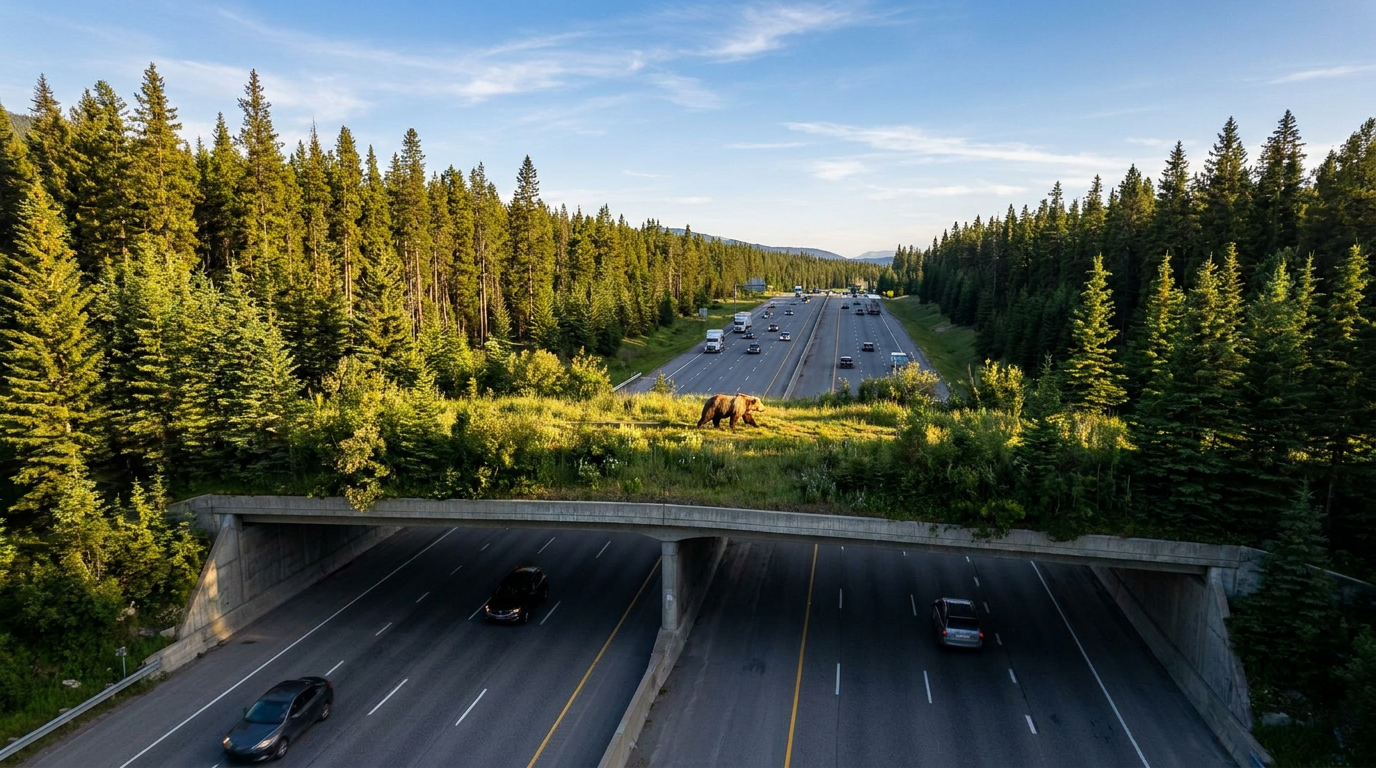
The latest and most significant milestone in this effort is the Peter Lougheed Wildlife Overpass (PLWO) in Alberta. Officially opened and named in June 2025 in honor of the province's former premier, the $17.5 million structure spans the Trans-Canada Highway just east of Banff National Park. Crucially, it is the first wildlife overpass in Alberta constructed entirely outside of a national park, signaling a shift from localized park management to broad, landscape-level connectivity.[1][3]

Building a bridge for a multi-ton grizzly bear or a skittish herd of elk requires a fundamentally different engineering approach than building one for cars. The PLWO is a massive 60-meter-wide (197-foot) structure built on twin corrugated steel plate arches. These arches were selected for their durability and ability to support thousands of tons of locally sourced granular soil. The goal is to make the overpass indistinguishable from the surrounding forest floor.[3][5]
To achieve this illusion, the design incorporates three continuous earth berms planted with native trees, shrubs, and grasses. These vegetated barriers serve a critical psychological function for the animals: they block the blinding headlights and deafening roar of the transport trucks passing below. By reducing noise and light pollution, the berms create a quiet, naturalized corridor that encourages even the most cautious predators to cross.[3][5]
But an overpass is useless if animals simply walk around it. The crossing is integrated into a 12-kilometer (7.5-mile) network of specialized wildlife fencing that runs parallel to the highway. This fencing acts as a massive funnel, gently guiding roaming wildlife toward the safe passage. Because no system is perfect, the fencing also features 22 strategically placed "jump-outs"—sloped earthen ramps that allow any animal that accidentally wanders onto the highway to easily leap back to safety without letting new animals in.[3][4]
But an overpass is useless if animals simply walk around it.
The results have been immediate and striking. Trail cameras mounted on the PLWO captured a wide range of species using the crossing less than a year after its structural completion in late 2024. Elk, which are notoriously slow to adapt to new infrastructure, began using the bridge much earlier than expected. They have been joined by deer, cougars, black bears, and the region's apex indicator species: the grizzly bear.[4][5]

For conservation scientists, the grizzly bear is the ultimate benchmark of success. Grizzlies are an "umbrella species" with massive territorial needs; if a landscape is connected enough to support a roaming grizzly, it will naturally support dozens of smaller species. Thanks to the expanding network of crossings and protected lands, the isolation gap between grizzly populations in the Yellowstone ecosystem and those further north has shrunk dramatically, dropping from 150 miles to less than 50 miles over the last three decades.[2][4]
Beyond the ecological victories, the crossings represent a massive win for public safety and economics. Animal-vehicle collisions are a severe hazard in the Bow River Valley, causing injuries, fatalities, and up to CAD $200 million in property damage across Canada annually. Transportation officials view the $17.5 million price tag of the PLWO not as an environmental charity project, but as a highly cost-effective infrastructure upgrade that pays for itself by keeping multi-ton animals off the windshields of motorists.[1][3]
The data backs up this economic calculus. In the nearby Banff National Park system, which began installing crossings in the late 1990s, wildlife-vehicle collisions have plummeted by over 80 percent, and by 96 percent for hooved animals like elk and deer. Over 150,000 safe animal crossings have been documented in the park to date. The PLWO extends this proven safety record into the heavily trafficked commercial corridors outside the park boundaries.[2][4]

The success of the PLWO was heavily dependent on public-private collaboration and Indigenous leadership. The project was championed by the Ĩyãħé Nakoda (Stoney Nakoda) Nations of Bearspaw, Chiniki, and Goodstoney, whose traditional territories encompass the region. Their participation ensured that the infrastructure aligned with long-standing Indigenous principles of landscape stewardship and coexistence with the natural world.[4][6]
With the Peter Lougheed overpass now operational, the focus is shifting to the next major bottlenecks in the Rockies. The "Reconnect the Rockies" initiative is currently targeting Highway 3 in southern British Columbia and Alberta, another deadly corridor that severs critical north-south migration routes. Armed with GPS collar data and trail camera footage, conservationists are mapping the exact locations where future overpasses will save the most lives.[4][6]
Ultimately, the Yellowstone to Yukon project proves that human development and wilderness do not have to be mutually exclusive. By treating wildlife connectivity as a standard requirement of highway engineering—rather than an afterthought—North America is creating a blueprint for global climate resilience. As species are forced to migrate in response to changing temperatures, these green bridges will ensure they have a path forward.[2][6]

How we got here
1993
The Yellowstone to Yukon (Y2Y) Conservation Initiative is founded to connect a 2,100-mile wildlife corridor.
Late 1990s
Banff National Park begins installing its highly successful network of wildlife crossings along Highway 1.
April 2022
Ground is broken on the Peter Lougheed Wildlife Overpass, Alberta's first crossing outside a national park.
Fall 2024
Construction of the Peter Lougheed Wildlife Overpass is completed and animals begin using the structure.
June 2025
The overpass is officially opened and named in honor of former Alberta Premier Peter Lougheed.
Viewpoints in depth
Conservation Scientists
Focus on genetic diversity and landscape-level habitat connectivity.
For conservation biologists, the primary threat to North American wildlife isn't just habitat loss, but habitat fragmentation. When highways slice through ecosystems, they create isolated 'islands' of wildlife. This prevents animals from migrating to find food and cuts them off from broader breeding pools, leading to genetic bottlenecks. Scientists argue that building green infrastructure to reconnect these islands is the single most effective intervention for ensuring the long-term survival of wide-ranging species like grizzly bears and wolverines.
Infrastructure Designers
Focus on the engineering challenges of blending structural integrity with ecological needs.
Civil engineers and landscape architects view wildlife crossings as a unique design challenge: building a massive structure that animals don't realize is a structure. Designers must calculate the load-bearing requirements for thousands of tons of soil and mature trees, while simultaneously managing acoustics and light pollution. By using native vegetation berms to block the sensory impact of the highway below, engineers create a psychological safe zone that encourages skittish prey animals and cautious predators to cross.
Public Safety Officials
Value the crossings primarily as a highly effective method to reduce costly and dangerous collisions.
Transportation departments and public safety officials approach wildlife crossings through the lens of risk management and economics. Animal-vehicle collisions cause severe injuries, fatalities, and hundreds of millions of dollars in property damage annually. From this perspective, the multi-million-dollar price tag of an overpass is a highly cost-effective infrastructure upgrade. Officials point to the 80 to 96 percent reduction in collisions at crossing sites as proof that green infrastructure pays for itself by keeping motorists safe.
What we don't know
- How quickly more cautious species, such as certain packs of wolves, will fully adapt to using the new crossings outside the national parks.
- Whether future funding will scale fast enough to build necessary crossings along Highway 3 before further genetic bottlenecking occurs.
- The exact long-term impact of climate change on the migration routes these overpasses are designed to protect.
Key terms
- Wildlife Corridor
- A continuous swath of natural habitat that connects separated wildlife populations, allowing them to roam, mate, and find food.
- Genetic Bottleneck
- A sharp reduction in the size and genetic diversity of a population, often caused by habitat isolation, which increases vulnerability to disease.
- Green Infrastructure
- Engineering projects designed to mimic or incorporate natural ecological systems, such as vegetated overpasses.
- Jump-out
- A specialized sloped ramp built into wildlife fencing that allows animals trapped on the highway side to safely leap back into the wild.
- Umbrella Species
- A wide-ranging species, like the grizzly bear, whose conservation indirectly protects the many other species that share its vast habitat.
Frequently asked
Do animals actually know to use the overpasses?
Yes. While it can take a few years for some species to adapt, miles of wildlife fencing funnel them toward the crossings, and native vegetation makes the bridges feel like natural terrain.
How much do these crossings cost to build?
The Peter Lougheed Wildlife Overpass cost $17.5 million. However, officials note that wildlife-vehicle collisions cost Canada up to $200 million annually in damages, making the structures highly cost-effective over time.
Why are grizzly bears used as the benchmark for success?
Grizzlies are an 'umbrella species' with massive territorial needs. Conservationists have found that if a landscape is connected enough to support a grizzly bear, it will also support most other local wildlife.
Are there more crossings planned for the future?
Yes. The 'Reconnect the Rockies' initiative is currently mapping out future overpasses and underpasses along Highway 3 in southern British Columbia and Alberta to secure additional migration routes.
Sources
Source coverage
6 outlets
3 viewpoints surfaced






[1]CityNewsPublic Safety Officials
New Alberta wildlife overpass over Trans-Canada named in honour of Peter Lougheed
Read on CityNews →[2]Rewilding MagazineConservation Scientists
Y2Y is making way for grizzlies and more
Read on Rewilding Magazine →[3]ArchitizerInfrastructure Designers
Peter Lougheed Wildlife Overpass
Read on Architizer →[4]Yellowstone to Yukon Conservation InitiativeConservation Scientists
Alberta's first overpass outside a national park is now open
Read on Yellowstone to Yukon Conservation Initiative →[5]DIALOGInfrastructure Designers
The Peter Lougheed Wildlife Overpass designed by DIALOG getting lots of visitors!
Read on DIALOG →[6]Factlen Editorial TeamPublic Safety Officials
Synthesis by Factlen editorial team
Read on Factlen Editorial Team →
Every angle. Every day.
Get world stories with full source coverage and perspective breakdowns delivered to your inbox.