
Why Scientists Are Repurposing a Popular Muscle Supplement for Brain Health
Decades of research have proven creatine's physical benefits, but new clinical trials suggest the compound may also improve memory, processing speed, and cognitive resilience in older adults.
By Factlen Editorial Team
- Longevity & Aging Researchers
- Advocate for creatine as a neuroprotective tool to preserve mitochondrial function and delay age-related cognitive decline.
- Sports Nutritionists
- Highlight the supplement's dual ability to delay both physical and mental fatigue.
- Clinical Skeptics
- Urge caution regarding broad neurological claims until larger, long-term trials establish optimal brain dosing.
What's not represented
- · Primary care physicians managing polypharmacy in elderly patients
- · Plant-based dietitians focusing on baseline nutrient deficiencies
Why this matters
As the global population ages, finding accessible, low-risk interventions to preserve cognitive function is a public health priority. Creatine is cheap, widely available, and boasts a decades-long safety record, making its emerging neurological benefits highly actionable for the average adult.
Key points
- The brain consumes roughly 20% of the body's resting energy, making it highly sensitive to metabolic stress.
- Creatine helps regenerate ATP, the primary energy currency of cells, acting as a battery charger for neurons.
- A 2025 systematic review found that 83% of included studies showed positive cognitive effects in older adults.
- Vegetarians, vegans, and sleep-deprived individuals often experience the most pronounced benefits from supplementation.
- Creatine is one of the most extensively studied supplements in the world, with a strong safety profile.
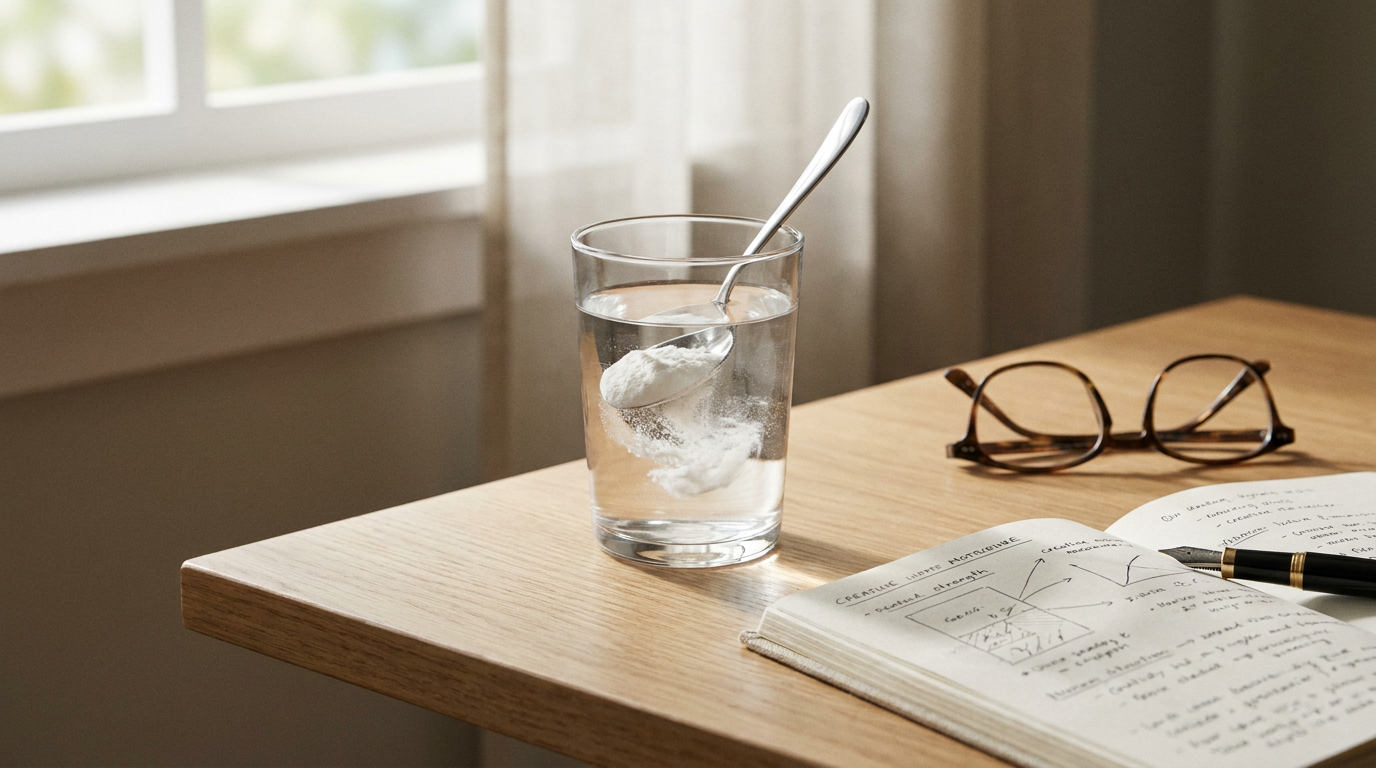
For decades, creatine monohydrate has been inextricably linked to weightlifting and athletic performance. Walk into any gym, and you will find people mixing the white powder into their water bottles to squeeze out an extra repetition or sprint a fraction of a second faster. But in recent years, the scientific consensus around creatine has undergone a quiet revolution.[1][7]
Researchers are increasingly viewing the supplement not just as a muscle builder, but as a critical tool for neurological health and healthy aging. The human brain is a notoriously needy organ; despite accounting for only about two percent of our body weight, it consumes roughly 20 percent of our resting energy. When the brain is subjected to stress—whether from sleep deprivation, intense mental exertion, or the natural aging process—its energy demands skyrocket.[1][7]
This is where creatine enters the picture. While 90 to 95 percent of the body's creatine is stored in skeletal muscle, the remaining 5 to 10 percent resides in the brain. By supplementing with extra creatine, scientists are discovering that we can effectively build a larger energy reserve for our neurons, helping them function more efficiently when they are under strain.[6][7]
To understand how this works, it helps to look at the cellular level. The primary currency of energy in the human body is a molecule called adenosine triphosphate (ATP). Every time a brain cell fires an impulse, it uses up ATP, stripping away one of its phosphate groups and turning it into a depleted molecule called adenosine diphosphate (ADP).[1][7]
Creatine acts as a rapid-response battery charger. It stores extra phosphate groups and donates them to the depleted ADP molecules, instantly turning them back into usable ATP. This instant charge-up happens billions of times per second. When the brain has higher stores of creatine, it can regenerate its energy supply much faster, preventing the cellular exhaustion that leads to brain fog and cognitive fatigue.[1][7]

As we age, this energy-buffering system becomes less efficient. The mitochondria—the power plants of our cells—start to wear down, and the brain becomes increasingly starved for energy. Inflammation and oxidative stress begin to overwhelm neurons, contributing to the gradual cognitive decline that many older adults experience.[1][2]
A 2025 systematic review published in Nutrition Reviews examined the effects of creatine on aging populations. The results were striking: 83.3 percent of the included studies reported a positive relationship between creatine supplementation and cognition in older adults, particularly in the domains of memory and attention. The researchers concluded that creatine may offer a significant neuroprotective benefit for generally healthy seniors.[3][5]
A 2025 systematic review published in Nutrition Reviews examined the effects of creatine on aging populations.
These findings are supported by a 2024 meta-analysis in Frontiers in Nutrition, which analyzed 16 randomized controlled trials. That review found that boosting brain creatine stores had significant positive effects on memory, attention span, and information processing speed. The benefits were not just limited to the elderly; younger adults subjected to metabolic stress also saw marked improvements.[4][7]
In fact, metabolic stress appears to be the key trigger that unlocks creatine's cognitive benefits. Healthy, well-rested individuals eating a protein-rich diet might not notice a dramatic difference from taking the supplement. But when the brain is pushed to its limits, the extra energy reserves become crucial.[1][7]

For example, studies have shown that young adults deprived of sleep for 21 hours performed significantly better on complex memory tests when they were given creatine. Researchers have also noted that the supplement can help counter the cognitive fog associated with jet lag, intense academic studying, and demanding professional work.[1][7]
Dietary habits also play a major role in how someone responds to the supplement. Because creatine is naturally found in meat and fish, vegetarians and vegans typically have much lower baseline levels of the compound in their bodies. Consequently, plant-based eaters often experience the most pronounced cognitive and physical benefits when they begin supplementing.[6][7]
Women, too, may see outsized benefits. Research indicates that females generally have lower natural creatine stores than males. During periods of hormonal fluctuation—such as pregnancy, postpartum, and menopause—the brain's energy demands shift dramatically, making the energy-buffering effects of creatine particularly valuable.[4][6]

Despite the promising data, clinical experts urge a measured perspective. Creatine is not a miracle cure for neurodegenerative diseases like Alzheimer's or dementia. While some small pilot studies have explored its use in Alzheimer's patients, the current evidence suggests that creatine is best viewed as a tool for maintaining processing speed and mental clarity in healthy aging, rather than a treatment for severe cognitive impairment.[1][2]
Dosing for brain health may also differ from traditional sports nutrition protocols. While athletes typically take 3 to 5 grams per day to saturate their muscles, the brain is protected by the blood-brain barrier, which makes it harder for creatine to enter. Some researchers suggest that higher doses—ranging from 10 to 20 grams per day—may be necessary to significantly elevate brain creatine levels, though optimal dosing is still being studied.[1][7]
What makes this research so compelling is the supplement's unparalleled safety profile. Creatine monohydrate is one of the most extensively studied dietary supplements in the world. Decades of clinical trials have consistently demonstrated that it is safe, affordable, and well-tolerated by the vast majority of people, with minimal side effects.[2][7]
As the scientific community continues to map the exact parameters of creatine's neurological benefits, the compound has already secured its place as a dual-purpose tool. For older adults looking to preserve their physical independence and maintain their mental sharpness, this simple white powder offers a rare combination of low risk and highly promising rewards.[5][7]
How we got here
1990s
Creatine monohydrate gains massive popularity as a sports nutrition supplement for muscle strength and endurance.
2010s
Researchers begin publishing early studies indicating that creatine may play a role in brain energy metabolism.
2024
A meta-analysis in Frontiers in Nutrition confirms significant positive effects on memory and processing speed.
2025
A systematic review in Nutrition Reviews highlights creatine's potential neuroprotective benefits for healthy older adults.
Viewpoints in depth
Longevity & Aging Researchers
Focus on preserving mitochondrial function and preventing age-related cognitive decline.
This camp views creatine primarily as a neuroprotective agent. As the brain ages, its mitochondria become less efficient at producing ATP, leading to an energy deficit that contributes to cognitive slowing and memory lapses. Longevity researchers emphasize that by buffering this energy supply, creatine can help maintain the brain's structural integrity and processing speed. They advocate for its use as a preventative measure, often combining it with resistance training to simultaneously combat age-related muscle loss (sarcopenia) and cognitive decline.
Sports Nutritionists
Focus on the transition of creatine from a muscle-building tool to a holistic health supplement.
Sports dietitians and nutritionists have championed creatine for decades based on its physical performance benefits. They are now expanding their recommendations to include cognitive health, noting that the same mechanisms that delay muscle fatigue also delay mental fatigue. This group frequently highlights that the supplement is particularly useful for athletes who need to maintain sharp decision-making and focus during exhausting competitions, or for active individuals recovering from mild traumatic brain injuries.
Clinical Skeptics
Emphasize the need for more rigorous, large-scale trials before making broad neurological claims.
While acknowledging creatine's impeccable safety record, clinical skeptics caution against overhyping its brain benefits. They point out that while small trials and systematic reviews show promise for healthy aging and sleep deprivation, there is currently insufficient evidence to suggest creatine can treat or reverse diagnosed neurodegenerative conditions like Alzheimer's disease. This camp stresses that the blood-brain barrier makes it difficult to significantly raise brain creatine levels without taking very high doses, and they call for more long-term studies to determine the optimal dosing protocols for cognitive health.
What we don't know
- The optimal daily dosage required to effectively cross the blood-brain barrier and maximize cognitive benefits.
- Whether long-term creatine supplementation can meaningfully alter the trajectory of severe neurodegenerative diseases.
- The exact differences in cognitive response between men and women across various stages of life.
Key terms
- Adenosine Triphosphate (ATP)
- The primary molecule that stores and transfers energy within cells; often referred to as the cellular energy currency.
- Mitochondria
- The structures within cells that generate most of the chemical energy needed to power the cell's biochemical reactions.
- Metabolic Stress
- A physiological state where the body's energy demands exceed its supply, often caused by sleep deprivation, intense exercise, or aging.
- Blood-Brain Barrier
- A highly selective semipermeable border of cells that prevents many substances in the blood from crossing into the brain.
- Sarcopenia
- The age-related, involuntary loss of skeletal muscle mass and strength.
Frequently asked
Is creatine safe for older adults to take?
Yes, creatine monohydrate is one of the most extensively studied supplements available and has a strong safety profile for healthy older adults, though individuals with pre-existing kidney issues should consult a doctor.
How much creatine is needed for brain health?
While 3 to 5 grams daily is standard for muscle health, some researchers suggest that higher doses (10 to 20 grams) may be necessary to effectively raise creatine levels in the brain.
Can creatine cure Alzheimer's disease?
No. While it may help preserve processing speed and memory in healthy aging, there is currently no evidence that creatine can treat or reverse Alzheimer's disease.
Do I need to take creatine if I eat meat?
Meat and fish contain natural creatine, but cooking degrades some of it. While omnivores have higher baseline levels than vegans, they may still experience cognitive benefits from supplementation during periods of stress or fatigue.
Sources
Source coverage
7 outlets
3 viewpoints surfaced







[1]TimeClinical Skeptics
Supplementing to protect the aging brain
Read on Time →[2]The Washington PostClinical Skeptics
This is what the science says about which supplements work for the brain
Read on The Washington Post →[3]Nutrition ReviewsLongevity & Aging Researchers
Creatine and cognition in older adults: a systematic review
Read on Nutrition Reviews →[4]Frontiers in NutritionSports Nutritionists
Effects of creatine supplementation on cognitive function: a systematic review and meta-analysis
Read on Frontiers in Nutrition →[5]National Institutes of HealthLongevity & Aging Researchers
Creatine is a well-studied dietary supplement that is known to benefit aging muscle and bone
Read on National Institutes of Health →[6]Nutrition InsightSports Nutritionists
Expanding beyond energy metabolism, creatine can potentially improve brain health
Read on Nutrition Insight →[7]Factlen Editorial Team
Synthesis by Factlen editorial team
Read on Factlen Editorial Team →


Every angle. Every day.
Get health stories with full source coverage and perspective breakdowns delivered to your inbox.