
UK Announces Sweeping Ban on Social Media for Under-16s
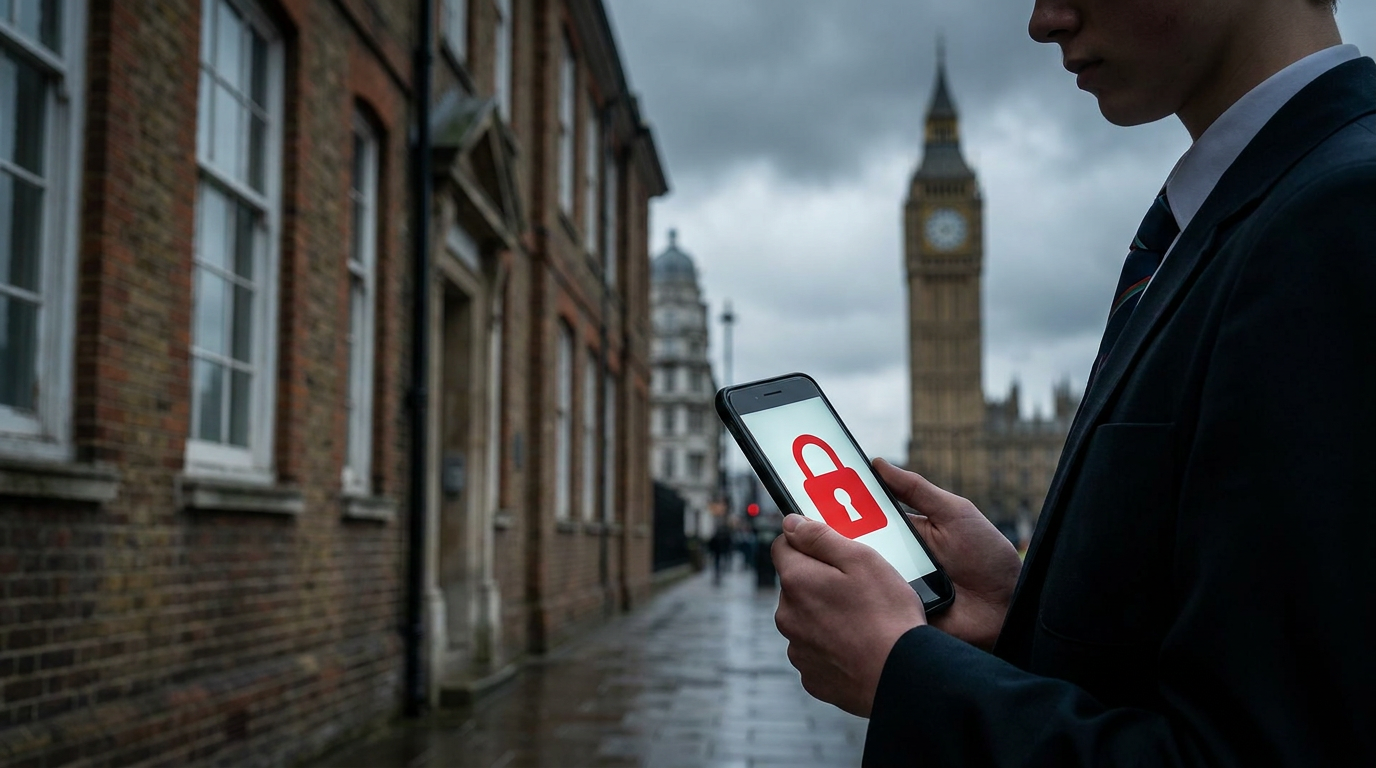
Prime Minister Keir Starmer has unveiled plans to ban children under 16 from major social media platforms, following a similar move by Australia and signaling a global shift in digital regulation.
By Factlen Editorial Team
- Government Regulators
- Focus on enforcing age limits and holding platforms accountable for child safety.
- Child Safety Advocates
- Split between supporting the ban and worrying it isolates vulnerable youth.
- Tech Industry
- Concerned about compliance, age verification privacy, and regulatory fragmentation.
- Digital Rights Groups
- Argue bans are easily bypassed and infringe on teenagers' rights to access information.
What's not represented
- · Teenagers directly affected by the ban
- · Educators navigating the transition in schools
Why this matters
This sweeping legislation fundamentally alters how millions of families will navigate the internet, shifting the burden of child safety from parents to tech companies. It also cements a growing global consensus that social media requires public-health-style regulation, setting a precedent that could force Silicon Valley to redesign its platforms worldwide.
Key points
- The UK government will ban children under 16 from accessing major user-to-user social media platforms.
- Messaging apps, educational services, and e-commerce platforms are exempt from the prohibition.
- Users aged 16 and 17 will face default restrictions on livestreaming and stranger communication.
- The policy follows a similar ban in Australia and coincides with new age-gating legislation in Canada.
- Tech companies will be legally responsible for implementing highly effective age verification systems.
In a sweeping regulatory move that fundamentally alters the digital landscape for millions of families, the United Kingdom has announced a comprehensive ban on social media access for children under the age of 16. Prime Minister Keir Starmer unveiled the policy on June 15, 2026, declaring the measure necessary to protect youth mental health and preserve childhood in an increasingly online world. The decision marks a dramatic escalation in the UK's approach to tech regulation, shifting from the content-moderation focus of the 2023 Online Safety Act to an outright prohibition on access for minors.[1][2]
The proposed legislation specifically targets "user-to-user" platforms whose primary purpose is enabling social interaction and the public posting of user-generated content—a definition that captures giants like TikTok, Instagram, and Snapchat. However, the government has carved out notable exemptions to ensure children are not entirely cut off from the digital world. Mobile messaging applications like WhatsApp, educational services, e-commerce sites, and music streaming platforms will remain accessible to under-16s, drawing a regulatory line between private communication and algorithmic social broadcasting.[1][4]
Beyond the hard ban for younger teens, the UK is introducing strict new guardrails for 16- and 17-year-olds to prevent a regulatory "cliff edge" when they age into platform access. For this older cohort, social media companies will be legally required to disable potentially harmful functionalities by default. These include livestreaming capabilities and "stranger communication" features that allow unknown users to contact minors. The government is also exploring the implementation of overnight curfews and mandatory breaks in "infinite scrolling" to combat behavioral addiction among older teenagers.[1][4]

The timeline for implementation is aggressive. The government plans to publish its full response to a massive public consultation—which garnered over 116,000 responses—in July 2026. Enacting legislation is expected to pass through Parliament before Christmas, with the ban slated to come into force in early 2027. To prepare for enforcement, Secretary of State Shabana Mahmood has directed Ofcom, the UK's communications regulator, to conduct an urgent review of its enforcement capabilities and develop a clear strategy for holding tech companies accountable.[1][4]
The technical linchpin of the entire policy rests on age assurance technology. Critics have long argued that age bans are easily circumvented by tech-savvy teenagers using Virtual Private Networks (VPNs) or simply lying about their birth dates. To address this, Ofcom is currently studying what constitutes "highly effective" age verification, with a definitive report expected in October 2026. Tech companies will bear the legal burden of proving their age-gating systems work, shifting the responsibility away from parents and onto the platforms themselves.[4][5]

The technical linchpin of the entire policy rests on age assurance technology.
The UK's decision is part of a rapidly accelerating global trend toward age-gating the internet. The Starmer administration explicitly modeled its approach on Australia, which enacted a world-first social media ban for under-16s in December 2025. The momentum is spreading to North America as well; just days before the UK announcement, the Canadian government introduced Bill C-34, the Safe Social Media Act, which establishes a 16-year-old minimum age requirement for social media accounts across Canada.[4][6]
Despite the political momentum, the ban has faced significant pushback from digital rights groups and even some child safety advocates. Andy Burrows, chief executive of the Molly Rose Foundation—a charity established after the social media-linked suicide of a teenager—expressed dismay at the policy. Burrows argued that the evidence does not support a blunt ban, warning that it could isolate vulnerable youth who rely on online communities for support, while failing to address the underlying algorithmic harms that affect users of all ages.[2][3]

The policy has also triggered international diplomatic friction. The White House has publicly urged the UK not to impose a blanket social media ban, reflecting concerns from the US tech industry about regulatory fragmentation and the feasibility of strict age verification without compromising user privacy. The divergence between the US and its closest allies on digital regulation highlights a growing transatlantic rift over how to manage the outsized influence of Silicon Valley platforms.[2][7]
For the tech industry, the UK's move represents a formidable compliance challenge. Companies are already grappling with a wave of multi-district litigation in the United States, where thousands of claims allege that platforms are intentionally designed to capitalize on teen psychology and trigger dopamine production. Culture Secretary Lisa Nandy dismissed industry complaints about the tight timeline, stating that tech companies have had "more than enough time to get their house in order" ahead of the legislative crackdown.[3][5]
Ultimately, the UK's ban reflects a profound societal shift in how social media is categorized. No longer viewed merely as a neutral communication tool, algorithmic platforms are increasingly being regulated with the same public-health frameworks applied to tobacco or gambling. Whether the UK and its international peers can successfully enforce these digital borders—or whether teenagers will simply find new ways to circumvent them—will define the next era of the internet.[5]
How we got here
October 2023
The UK passes the Online Safety Act, establishing initial content-moderation rules for tech platforms.
December 2025
Australia implements a world-first nationwide ban on social media for children under 16.
March 2026
The UK government opens a massive public consultation on children's online safety.
June 10, 2026
Canada introduces Bill C-34, seeking to establish a 16-year-old minimum age for social media.
June 15, 2026
UK Prime Minister Keir Starmer officially announces the under-16 social media ban.
Viewpoints in depth
Government Regulators
Regulators argue that strict age bans are the only effective way to protect children from algorithmic harm.
Officials like Culture Secretary Lisa Nandy maintain that tech companies have failed to self-regulate despite years of warnings. By shifting the legal burden of age verification entirely onto the platforms, regulators aim to treat social media with the same public-health severity as tobacco or gambling. They argue that exemptions for educational and messaging apps ensure children remain connected without being exposed to the addictive loops of user-to-user broadcasting.
Child Safety Advocates
Advocacy groups are divided on whether a blunt ban helps or harms vulnerable youth.
While many parents' groups strongly support the ban, organizations like the Molly Rose Foundation argue the evidence does not support a total prohibition. They warn that cutting off access could isolate marginalized teenagers who rely on online communities for support. Instead of age-gating, these advocates push for fundamental redesigns of the algorithms themselves, arguing that platforms should be made safe for all users rather than simply walled off from the youngest.
Tech Industry & Digital Rights Groups
Platforms and privacy advocates warn that the ban is technically unworkable and threatens user privacy.
Industry representatives argue that implementing 'highly effective' age assurance requires collecting sensitive identification data from all users, fundamentally altering the privacy landscape of the internet. Digital rights groups echo these concerns, adding that tech-savvy teenagers will easily bypass the restrictions using VPNs. Furthermore, the US tech sector—backed by the White House—has expressed frustration over regulatory fragmentation as different countries adopt conflicting digital borders.
What we don't know
- Exactly what age assurance technology Ofcom will deem 'highly effective' without violating user privacy.
- Whether tech-savvy teenagers will easily bypass the restrictions using VPNs or other workarounds.
- How the UK will enforce the ban on platforms headquartered outside its jurisdiction.
Key terms
- User-to-User Platforms
- Online services designed to enable social interaction and the sharing of user-generated content, such as TikTok and Instagram.
- Age Assurance Technology
- Systems and software used to verify or estimate a user's age before granting them access to age-restricted content or services.
- Infinite Scrolling
- A design feature that continuously loads new content as a user scrolls down, which regulators argue encourages addictive behavior.
- Ofcom
- The UK's government-approved regulatory and competition authority for the broadcasting, telecommunications, and postal industries.
Frequently asked
Will messaging apps like WhatsApp be banned for children?
No. Mobile messaging apps, educational services, and e-commerce platforms are explicitly exempt from the prohibition.
How will social media companies verify a user's age?
The exact methods are still being determined. Ofcom is conducting a study on highly effective age assurance technology, which is due in October 2026.
What happens to 16- and 17-year-olds?
They will retain access to social media, but platforms must disable harmful features like livestreaming and stranger communication by default.
Is the UK the first country to do this?
No. The UK modeled its policy on Australia, which passed a similar under-16 ban in December 2025. Canada is also advancing similar legislation.
Sources
Source coverage
7 outlets
4 viewpoints surfaced







[1]UK GovernmentGovernment Regulators
The UK government will ban social media for under 16s
Read on UK Government →[2]BBC NewsGovernment Regulators
Prime Minister Keir Starmer announces Australian-style ban for teenagers under 16
Read on BBC News →[3]The GuardianChild Safety Advocates
Tech companies given 'more than enough time' as UK bans under-16s from social media
Read on The Guardian →[4]DLA PiperTech Industry
UK ban on social media for under 16s
Read on DLA Piper →[5]Clyde & CoTech Industry
UK Government to ban under 16's from social media
Read on Clyde & Co →[6]Global NewsDigital Rights Groups
Canada introduces Bill C-34 to ban social media for kids under 16
Read on Global News →[7]Fox NewsDigital Rights Groups
White House urges UK not to impose social media ban for teenagers
Read on Fox News →


Every angle. Every day.
Get news politics stories with full source coverage and perspective breakdowns delivered to your inbox.