
How Japan is Turning 9 Million Abandoned Homes into a Rural Renaissance
Faced with a record number of vacant properties, Japanese municipalities and a new wave of investors are transforming decaying heritage homes into boutique hotels, co-working hubs, and affordable retreats.

Share this story
In short
- Japan currently has an estimated 9 million vacant homes, representing 13.8% of its total housing stock.
- A 2015 law allowed municipalities to hike taxes on neglected properties, prompting owners to sell cheaply.
- Local 'Akiya Banks' list homes for as little as $6,500 to attract new residents to rural towns.
Across the serene valleys and shrinking rural towns of Japan, a quiet architectural transformation is underway. For decades, the country has grappled with a mounting demographic crisis that has left millions of homes abandoned. These vacant properties, known as "akiya," have long been viewed as a symbol of rural decay, driven by an aging population and the relentless migration of young people to mega-cities like Tokyo and Osaka.[1]
Today, Japan's housing stock includes an estimated 9 million akiya, representing nearly 13.8 percent of all homes in the country. Entire streets in some provincial towns feature dark windows and overgrown gardens, posing safety hazards and straining local government finances. Yet, what was once considered a silent liability is increasingly being recognized as a strategic resource for regional regeneration.
The root of the akiya crisis lies in a complex web of post-war economic policies and inheritance laws. Historically, Japan's tax system heavily favored land with a standing structure over empty lots. If a family demolished an inherited, dilapidated home, their property taxes could multiply. Consequently, heirs who had moved to the city simply left their ancestral homes to rot, trapped by the financial disincentives of clearing the land.
The turning point arrived with the 2015 Vacant House Special Measures Law, which empowered municipalities to designate dangerous or severely neglected properties as "Specifically Vacant Houses." This designation strips the property of its residential tax benefits, causing land taxes to spike by up to six times. Faced with soaring holding costs or government-mandated demolition, owners are now highly motivated to offload these properties, often for a fraction of their original value.
To connect motivated sellers with potential buyers, local governments across Japan have established "Akiya Banks"—municipal databases listing vacant homes for sale or rent. In some depopulated towns, homes are offered for as little as ¥1 million to ¥10 million (roughly $6,500 to $65,000), and occasionally for free, provided the new owner commits to renovating the property and living in the community.
This unprecedented affordability has sparked a wave of interest from a diverse new demographic. Young Japanese families seeking an escape from the high costs and hyper-density of urban centers are relocating to the countryside. Simultaneously, a growing contingent of digital nomads and foreign investors are drawn by the weak yen and the romantic appeal of restoring a traditional Japanese home.[1]
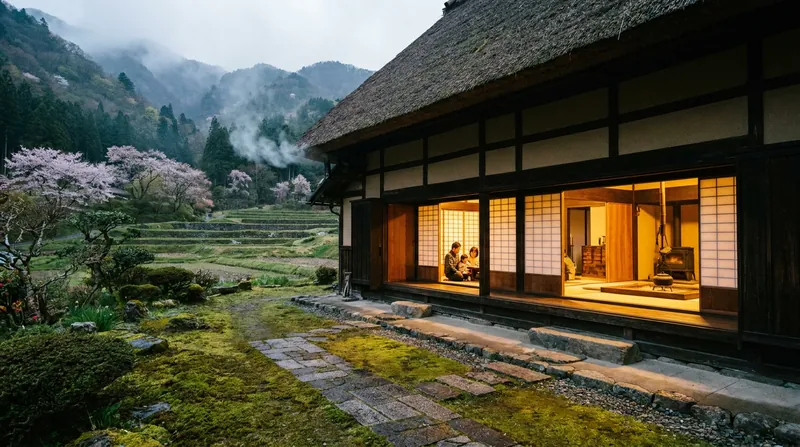
The revitalization goes far beyond simple residential use. Many akiya are being adaptively reused as commercial hospitality ventures. Renovated traditional wooden townhouses, or "kominka," are being transformed into boutique inns, cafes, and co-living retreats. This shift is particularly pronounced in scenic regions like Kansai and Okinawa, where the blend of heritage architecture and natural beauty offers a unique draw for tourists.
One of the most innovative models emerging from this trend is the "albergo diffuso," or scattered hotel concept. Rather than building a single massive resort, hospitality entrepreneurs are restoring multiple akiya spread across a single village. Guests sleep in one restored heritage home, dine in another, and visit a centralized reception area, effectively turning the entire hamlet into a decentralized, immersive hotel experience.
This decentralized approach ensures that tourism revenue flows directly into the local community while preserving the village's historic aesthetic. Projects like the NIPPONIA initiative in Sasayama have successfully demonstrated how blending heritage preservation with sustainable tourism can breathe new economic life into towns that were on the brink of disappearing.
Beyond economics, the adaptive reuse of akiya offers significant environmental and social benefits. Academic studies highlight that renovating existing structures drastically cuts the carbon emissions associated with demolition and new construction. Socially, transforming these properties from eyesores into vibrant community hubs reduces local crime rates, improves neighborhood safety, and restores a sense of civic pride.
Despite the uplifting momentum, the akiya renaissance is not without its hurdles. Purchasing an abandoned home requires rigorous due diligence. Buyers frequently encounter hidden costs, including extensive termite damage, structural rot, and the need to upgrade plumbing and electrical systems to meet modern codes. Furthermore, navigating fragmented ownership—where a single property might be legally tied to dozens of distant relatives—can delay acquisitions for months.
Experts caution that while the hospitality and remote-work models are thriving in picturesque or transit-accessible regions, they are unlikely to solve the vacancy crisis in Japan's most remote, economically isolated pockets. The sheer scale of 9 million empty homes means that strategic demolition will still be necessary for properties that are beyond repair.
Nevertheless, the successful transformation of thousands of akiya represents a profound cultural shift. The post-war Japanese dream of a newly constructed suburban home is gradually making room for a more sustainable, intentional lifestyle. By viewing their aging infrastructure not as a burden, but as a canvas for innovation, Japan's rural communities are proving that decline does not have to be permanent.[2]
Terms to know
- Akiya
- The Japanese term for a vacant or abandoned home, typically located in rural or suburban areas affected by depopulation.
- Kominka
- A traditional Japanese wooden house, highly valued by investors for its historic architecture and craftsmanship.
- Akiya Bank
- A municipal database or registry that lists vacant homes for sale or rent at extremely low prices to attract new residents.
- Albergo diffuso
- A 'scattered hotel' concept where guest rooms and services are distributed across multiple restored buildings within a single village.
- Specifically Vacant House
- A legal designation in Japan for a property deemed dangerous or a nuisance, which can result in severe property tax increases.
Questions readers ask
Can foreigners buy an abandoned house in Japan?
Yes. There are no nationality-based restrictions on land or building ownership in Japan, allowing foreigners to purchase and renovate akiya legally.
Why are these houses so cheap?
Many are located in depopulated areas, require extensive structural renovations, and carry the threat of high property taxes if left neglected by their current owners.
What is the catch to buying an akiya?
Buyers often face hidden costs such as termite damage, outdated plumbing, strict building codes, and complex legal processes to track down multiple heirs for ownership transfer.
Are all 9 million empty homes suitable for renovation?
No. Experts estimate that a significant portion of these homes are located in deeply isolated areas with no economic viability and will ultimately need to be demolished.
Different angles
Rural Municipalities
Local governments view akiya revitalization as a lifeline for shrinking tax bases and community survival.
For provincial mayors and city planners, the 9 million vacant homes represent both a severe hazard and a unique opportunity. Decaying homes lower surrounding property values and pose fire and collapse risks during earthquakes. By launching 'Akiya Banks' and offering generous renovation subsidies, municipalities aim to attract young families and entrepreneurs who will pay local taxes, enroll children in local schools, and stimulate the rural economy.
Heritage Investors & Nomads
Buyers see abandoned homes as affordable entry points into a high-quality, intentional lifestyle.
Foreign investors, digital nomads, and young Japanese professionals are drawn to akiya by the rock-bottom acquisition costs and the architectural beauty of traditional kominka. For this group, the appeal lies in escaping the hyper-dense, expensive urban grind of Tokyo. They view the extensive renovation process not just as a financial investment, but as a cultural project—preserving historic craftsmanship while integrating modern amenities for boutique hospitality or remote work.
Urban Planners & Academics
Researchers emphasize the environmental and macro-demographic realities of the housing surplus.
Academics studying sustainable development praise the adaptive reuse of akiya for its low carbon footprint compared to new construction. However, they caution that the 'albergo diffuso' and remote-work trends are highly localized to scenic or transit-accessible regions like Kansai and Okinawa. Planners argue that while revitalization is a success story for specific villages, the broader national strategy must still include funded, large-scale demolition for millions of homes in deeply isolated areas with no economic viability.
- Heritage Investors & Nomads
- Focused on the cultural preservation, lifestyle benefits, and affordability of traditional homes.
- Rural Municipalities
- Focused on repopulating towns, increasing local tax revenue, and removing safety hazards.
- Urban Planners & Academics
- Focused on the macro-demographic challenges, sustainable development, and limits of the revitalization trend.
Perspectives this story doesn't cover
- Elderly rural residents who may feel overwhelmed by the influx of foreign tourists and digital nomads.
- Construction and demolition firms tasked with managing the millions of homes that cannot be saved.
Sources
Source coverage
2 outlets
3 viewpoints surfaced


- [1]CNA InsiderRural Municipalities
Japan's 9 million empty houses and the push for rural revitalisation
- [2]Factlen Editorial TeamUrban Planners & Academics
Synthesis by Factlen editorial team
Read on Factlen Editorial Team →
More in World
See all →Semiconductor Supply Chain
South Korea Unveils $1.2 Trillion Investment Drive for AI and Semiconductor Industries
2 sources

Export Controls
China Adds 40 Japanese Defense and Tech Entities to Export Control Lists
4 sources
ASEAN Power Grid
Southeast Asia Doubles Cross-Border Clean Energy Trade in Major Step Toward an Integrated Grid
2 sources
Akiya Market
The Truth About Japan’s $500 Abandoned Homes: How the 'Akiya' Boom is Actually Working
2 sources
Comments
Every angle. Every day.
Get World stories with full source coverage and perspective breakdowns, free every day.