
China Adds 40 Japanese Defense and Tech Entities to Export Control Lists
Beijing has restricted the export of dual-use goods to dozens of Japanese research institutes and corporations, citing concerns over Tokyo's defense buildup.

Share this story
The Chinese Ministry of Commerce (MOFCOM) has significantly escalated its economic pressure on Tokyo, announcing strict export controls targeting 40 Japanese government institutes and corporations. The measures, which took immediate effect on June 29, are designed to choke off the flow of "dual-use" items—materials and technologies that have both civilian and military applications—to entities Beijing accuses of fueling Japan's military expansion.[1]
The latest action is split into two distinct tiers. Twenty entities were placed on a hard export control list, which outright prohibits Chinese exporters from supplying them with dual-use goods. This list includes Japan's National Institute for Defense Studies, research centers for ground, naval, and air systems, and multiple defense-affiliated units of Mitsubishi Heavy Industries and Mitsubishi Electric.[1][2]
Another 20 entities were added to a "watch list" that requires enhanced licensing and strict compliance hurdles. Companies on this secondary list—which includes marine engine manufacturer Mitsui E&S, industrial drone maker Terra Drone, and various nuclear fuel processors—can only receive Chinese dual-use goods if exporters submit comprehensive risk assessments and written pledges guaranteeing the items will not contribute to Japan's military capabilities.[1][4]
The mechanism of these controls extends far beyond direct bilateral trade. MOFCOM's directive includes an extraterritorial clause that prohibits overseas organizations and individuals from transferring Chinese-origin dual-use items to the blacklisted Japanese entities. This effectively forces third-party multinationals in Europe, North America, and Southeast Asia to audit their supply chains and ensure no Chinese components end up in products sold to the targeted Japanese firms.[1][2]
For specific sectors, the supply chain substitution pressure is immediate. Industrial drone manufacturers like Terra Drone and ACSL rely heavily on globalized component networks. With Chinese-made electric motors and sensors reclassified under these dual-use restrictions, Japanese tech firms must rapidly source alternative components, likely at higher costs, to maintain production lines.
Beijing has been explicit about its geopolitical rationale. A MOFCOM spokesperson stated the measures are "completely justified, reasonable and lawful," framing them as a necessary step to curb Japan's "reckless pursuit of 'new militarism'" and its alleged attempts to acquire nuclear weapons. Chinese officials argue that Japan has consistently moved down the "wrong path" by deploying offensive weapons and launching missiles outside its territory.[3]
Tokyo's response has been swift and sharply critical. Chief Cabinet Secretary Minoru Kihara condemned the export curbs as "unacceptable and extremely regrettable," formally urging Beijing to retract the measures. Kihara indicated that the Japanese government is thoroughly assessing the economic impact of the sanctions and is prepared to take necessary countermeasures to protect its domestic industries.[4]
The diplomatic rift driving these economic maneuvers widened significantly in late 2025. Following her inauguration, Japanese Prime Minister Sanae Takaichi suggested that an attack on Taiwan could trigger the deployment of Japan's self-defense forces if the conflict posed an existential threat to the nation. Beijing, which claims the self-governing island democracy as its own territory, viewed the remarks as a severe interference in its domestic affairs.[3]
In the months since Takaichi's comments, the bilateral relationship has deteriorated across multiple fronts. China suspended high-level diplomatic meetings, reduced commercial flights, and maintained a strict ban on Japanese seafood imports. Concurrently, Japan has accelerated a historic defense buildup, moving away from its post-war pacifist posture by increasing military spending and deploying missile launchers to its easternmost islands.[3]
The June 29 listings represent the second major wave of such sanctions this year. In February 2026, China placed an initial batch of 20 Japanese companies on the export control list and another 20 on the watch list. With the latest additions, a total of 80 Japanese entities—spanning shipbuilding, aerospace, heavy machinery, and advanced materials—are now operating under severe Chinese supply chain restrictions.[4]
The military posturing surrounding the economic dispute has also intensified. Just as the export controls were announced, Tokyo formally protested joint exercises conducted by Chinese and Russian bombers near Japanese airspace. Additionally, Japan reported incursions by the Chinese coast guard into its Exclusive Economic Zone, prompting a rare joint statement from the UK, Germany, and France condemning Chinese activities in the waters east of Taiwan.[3]
Despite the escalating tit-for-tat retaliation, the two nations remain deeply economically intertwined. Bilateral trade between China and Japan topped $322 billion in 2025, and business exchanges have continued to grow in the first half of 2026 despite the political chill. MOFCOM emphasized that the new restrictions target only a "minority" of entities and will not disrupt "normal Sino-Japanese economic and trade exchanges."[3]
However, trade analysts warn that the administrative burden of compliance will inevitably chill broader commerce. Because dual-use items encompass a vast array of basic industrial inputs—from specialized alloys and rare earth minerals to standard semiconductors—exporters may preemptively halt shipments to Japan rather than risk running afoul of Beijing's opaque risk assessment requirements.[2]
The long-term consequence of these export controls is a structural decoupling in the defense and high-tech sectors. As Japan modernizes its military to counter what it views as a deteriorating security environment, it can no longer rely on the region's largest manufacturing hub for foundational components. The coming months will test whether this economic interdependence acts as a brake on further escalation, or if the supply chain war becomes the new normal in East Asia.[3]
Key points
- China added 20 Japanese entities to a strict export control list and 20 to a watch list.
- The restrictions target dual-use items that have both civilian and military applications.
- Beijing cited concerns over Japan's 'neo-militarism' and defense expansion as the primary justification.
- The rules prohibit third-party overseas companies from transferring Chinese-origin components to the listed entities.
Open questions
- How strictly China will enforce the extraterritorial ban on third-party companies transferring goods to Japan.
- What specific economic countermeasures the Japanese government will implement in retaliation.
- Whether the upcoming APEC summit will provide an off-ramp for the escalating trade dispute.
Timeline
Nov 2025
Japanese PM Sanae Takaichi suggests Japan could intervene if Taiwan faces an existential military threat.
Jan 2026
China issues its first preparatory restrictions on dual-use exports to Japanese military end-users.
Feb 2026
China places an initial 40 Japanese entities on export control and watch lists.
Jun 2026
China adds another 40 entities to the lists, bringing the total to 80 sanctioned organizations.
- Beijing Security Planners
- Argue that Japan's military buildup and rhetoric regarding Taiwan represent a dangerous resurgence of militarism that must be deterred.
- Tokyo Defense Establishment
- Maintains that Japan is adopting a necessary defensive posture in response to an increasingly aggressive China and a nuclear-armed North Korea.
- Supply Chain Analysts
- Focus on the economic fallout, noting that the weaponization of dual-use goods creates massive compliance burdens for global multinationals.
Perspectives this story doesn't cover
- Multinational compliance officers navigating the new third-party transfer rules
- Japanese civilian tech sectors inadvertently affected by dual-use definitions
Sources
Source coverage
4 outlets
3 viewpoints surfaced




- [1]XinhuaBeijing Security Planners
China adds 20 Japanese entities to export control list
- [2]The Japan TimesTokyo Defense Establishment
China blacklists more Japanese entities as row deepens
Read on The Japan Times → - [3]The GuardianTokyo Defense Establishment
Japan defence minister rebuffs claims of ‘new militarism’ levelled by China
Read on The Guardian → - [4]Al JazeeraSupply Chain Analysts
China slaps export controls on dozens of Japanese entities
Read on Al Jazeera →
More in World
See all →Pacific Diplomacy
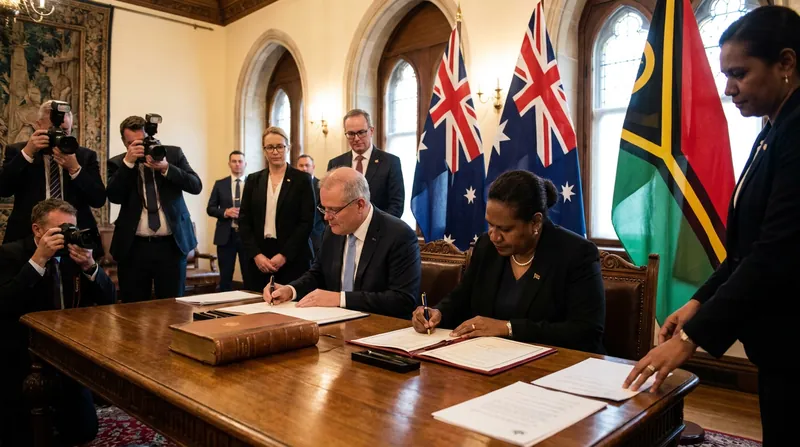
Australia and Vanuatu Sign Security Pact Banning Foreign Military Bases
5 sources
Semiconductor Supply Chain
South Korea Unveils $1.2 Trillion Investment Drive for AI and Semiconductor Industries
2 sources

ASEAN Power Grid
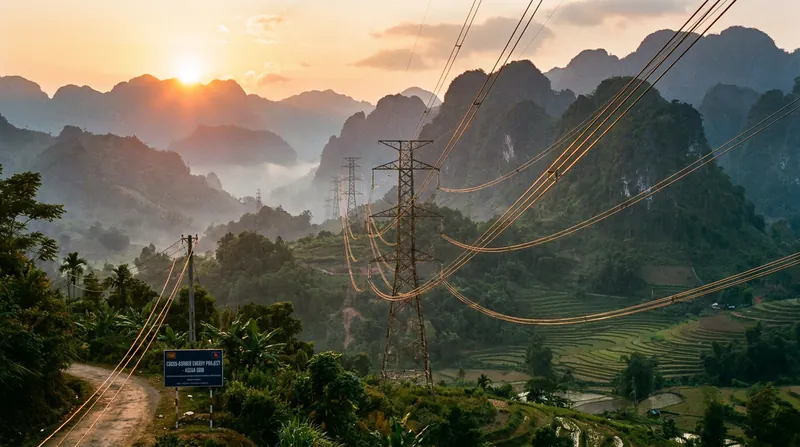
Southeast Asia Doubles Cross-Border Clean Energy Trade in Major Step Toward an Integrated Grid
2 sources
Akiya Market
The Truth About Japan’s $500 Abandoned Homes: How the 'Akiya' Boom is Actually Working
2 sources

Comments
Every angle. Every day.
Get World stories with full source coverage and perspective breakdowns, free every day.