
China and Russia Begin Joint Naval Drills in Pacific, Signaling Deepening Military Ties
The Chinese and Russian navies have launched the 'Joint Sea-2026' exercises off the coast of Qingdao, testing combat interoperability before embarking on a joint Pacific patrol.

Share this story
The Chinese and Russian navies have officially commenced "Joint Sea-2026," a major bilateral military exercise taking place in the waters and airspace off the coast of Qingdao in eastern China.
The drills, which run from July 6 to July 13, represent the latest iteration of an annual military cooperation plan that has steadily grown in complexity over the past decade.[2]
Following the harbor and coastal phases, a contingent of the combined fleet will detach to conduct a joint maritime patrol across unspecified areas of the broader Pacific Ocean.[1]
For defense analysts, the exercise is less about posturing and more about testing the mechanical reality of interoperability between two distinct command structures.[3]
The Russian Pacific Fleet has deployed a heavy-hitting task force led by the Slava-class guided-missile cruiser Varyag.
Joining the Varyag are the frigate Rezkiy, the large diesel-electric submarine Ufa, and the rescue vessel Igor Belousov, all of which arrived in Qingdao to a formal port welcome from the Chinese navy.
China’s Northern Theater Command Navy has matched this deployment with its own advanced surface combatants, including the guided-missile destroyers Kaifeng and Anshan.
The Chinese contingent is rounded out by the guided-missile frigate Wuhu, the comprehensive supply ship Kekexilihu, a submarine rescue ship, and an attack submarine.
The exercise is structured around three distinct phases, beginning with force assembly and harbor-based planning, where commanders from both nations establish shared communication protocols and tactical rules of engagement.
The core of the event is the at-sea operational phase, which focuses heavily on joint reconnaissance, integrated air and missile defense, and coordinated maritime strike operations.
By practicing anti-submarine warfare and surface strikes as a combined formation, the two navies are working to iron out the friction that naturally occurs when different radar systems, data links, and tactical doctrines overlap.
The inclusion of shipborne helicopters and specialized marine units further expands the scope of the drills, allowing for cross-deck landing exercises and joint search-and-rescue simulations.
The "Joint Sea" framework is not new; Beijing and Moscow have held these bilateral naval exercises annually since 2012, rotating the host location between Russian and Chinese waters.[1][2]
However, the geopolitical weight of the drills has shifted dramatically in recent years, particularly as Western capitals scrutinize the deepening ties between the two nations amid the ongoing war in Ukraine.[3]
The exercises arrive roughly two months after Russian President Vladimir Putin visited Beijing, where he described the bilateral relationship as having reached an "unprecedentedly high level."[1][2]
Chinese President Xi Jinping echoed that sentiment, characterizing the strategic partnership as "unyielding" and framing the military cooperation as a stabilizing force against Western dominance.[1][2]
For regional neighbors like Japan and South Korea, the post-exercise joint patrols in the Pacific Ocean are the most closely watched element of the operation.
Previous joint patrols have seen Chinese and Russian vessels navigate through sensitive maritime chokepoints, prompting Tokyo and Seoul to scramble monitoring aircraft and track the fleets' movements.[1]
Viewpoints in depth
Sino-Russian Strategic Command
Framing the exercises as a stabilizing force in a multipolar world.
For Beijing and Moscow, Joint Sea-2026 is a demonstration of a partnership that both sides describe as 'unyielding.' Military officials emphasize that the drills are part of an annual cooperation plan aimed at jointly responding to maritime security threats, rather than targeting any specific third country. By integrating their command structures and sharing tactical data, the two navies aim to project a united front capable of safeguarding regional peace and countering what they view as Western hegemony in the Indo-Pacific.
Western Defense Analysts
Interpreting the drills as a hardening anti-Western military axis.
Western observers view the exercises through the lens of the ongoing war in Ukraine and broader strategic competition. Analysts argue that while the drills are annual, their increasing complexity—moving from basic maneuvers to integrated air and missile defense—demonstrates a shift from diplomatic signaling to genuine combat interoperability. For these analysts, the joint patrols in the Pacific are a deliberate attempt to stretch US and allied naval resources by forcing them to monitor a unified Sino-Russian presence across multiple maritime theaters.
Indo-Pacific Neighbors
Monitoring the operational footprint of the combined fleet.
Regional powers, particularly Japan and South Korea, focus heavily on the geographic scope of the exercises. The transition from coastal drills near Qingdao to joint patrols in the broader Pacific often involves navigating through sensitive maritime chokepoints. Defense ministries in Tokyo and Seoul routinely scramble aircraft and deploy monitoring vessels to track these movements, viewing the expanding operational radius of the Sino-Russian fleet as a direct complication to their own national security calculations.
Key points
- China and Russia have launched the 'Joint Sea-2026' naval exercises off the coast of Qingdao.
- The drills focus on joint reconnaissance, air and missile defense, and maritime strike operations.
- Following the coastal exercises, a combined task force will conduct a joint patrol in the Pacific Ocean.
- The exercises test real-world combat interoperability between the two distinct command structures.
What we don’t know
- The exact route and duration of the joint maritime patrol in the Pacific Ocean following the Qingdao drills.
- Whether the exercises will involve live-fire missile tests near sensitive international shipping lanes.
- How closely US and allied naval forces are shadowing the combined fleet during the at-sea phase.
How we got here
2012
China and Russia launch the first 'Joint Sea' bilateral naval exercises.
May 2026
Russian President Vladimir Putin visits Beijing, declaring ties at an 'unprecedentedly high level.'
July 4, 2026
Russian Pacific Fleet vessels arrive at the military port in Qingdao.
July 6, 2026
The Joint Sea-2026 exercises officially commence with harbor planning.
Mid-July 2026
A combined task force departs for a joint maritime patrol in the Pacific Ocean.
- Sino-Russian Strategic Command
- Views the drills as a necessary mechanism to safeguard regional stability and deepen their comprehensive strategic partnership.
- Western Defense Analysts
- Views the deepening interoperability as a direct challenge to the US-led global order and a sign of material support amid the Ukraine war.
- Indo-Pacific Neighbors
- Views the expanding footprint of joint Pacific patrols as a regional security concern requiring heightened monitoring.
Perspectives this story doesn't cover
- Commercial shipping operators navigating the Yellow Sea
- Taiwanese defense officials monitoring regional naval movements
Sources
Source coverage
3 outlets
3 viewpoints surfaced



- [1]Straits TimesSino-Russian Strategic Command
China and Russia to hold joint naval drills
Read on Straits Times → - [2]Al JazeeraIndo-Pacific Neighbors
China and Russia to hold annual joint naval drills
Read on Al Jazeera → - [3]Brussels TimesWestern Defense Analysts
China and Russia to conduct joint naval exercise
Read on Brussels Times →

More in World
See all →Pacific Diplomacy
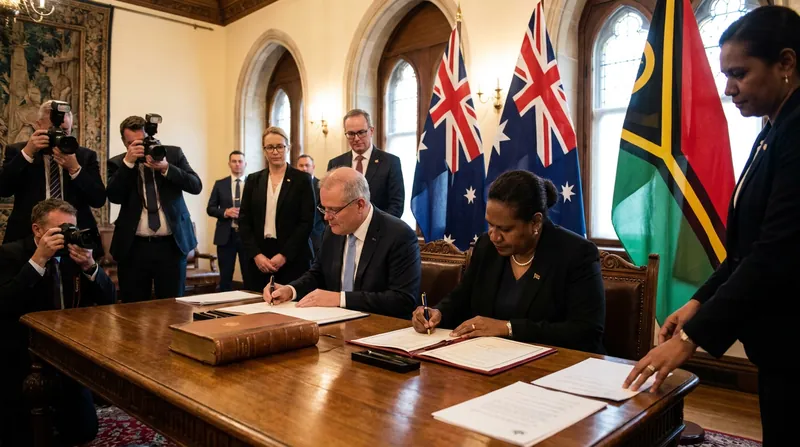
Australia and Vanuatu Sign Security Pact Banning Foreign Military Bases
5 sources
Semiconductor Supply Chain
South Korea Unveils $1.2 Trillion Investment Drive for AI and Semiconductor Industries
2 sources

Export Controls
China Adds 40 Japanese Defense and Tech Entities to Export Control Lists
4 sources
ASEAN Power Grid
Southeast Asia Doubles Cross-Border Clean Energy Trade in Major Step Toward an Integrated Grid
2 sources

Comments
Every angle. Every day.
Get World stories with full source coverage and perspective breakdowns, free every day.