
Federal Judge Orders Trump to Sit for Deposition in $10 Billion BBC Defamation Lawsuit
A federal judge has directed President Donald Trump to sit for a sworn deposition by December 11 in his civil lawsuit against the BBC. The ruling rejects the plaintiff's attempts to avoid direct questioning over his claims of reputational damage.
By Adel Khoury
Share this story
A federal judge has ordered President Donald Trump to sit for a sworn deposition by December 11 in his $10 billion defamation lawsuit against the British Broadcasting Corporation. The ruling forces the president to answer questions under oath regarding his claims that the network maliciously damaged his reputation.[1][2]
The directive follows a week of legal maneuvering in which Trump's legal team attempted to shield him from financial discovery and direct questioning. The presiding judge rejected those arguments on Thursday, stating that the plaintiff must comply with standard pre-trial procedures.[3][4]
"The plaintiff initiated this litigation and must participate in discovery," the judge wrote in the four-page order. The court emphasized that holding the highest office does not grant immunity from the procedural requirements of a civil lawsuit the president himself filed.[2][3]
Trump filed the $10 billion suit earlier this year, alleging the BBC published false statements with actual malice. The network has consistently defended its reporting as accurate and protected under the First Amendment, moving to dismiss the case entirely.[4]
Escalating Court Tensions
The deposition order represents a sharp escalation after Trump abruptly canceled a previously scheduled interview. On October 16, the judge threatened to impose financial sanctions on the president's legal team if they continued to delay the discovery phase.[5]
Attorneys for the BBC argued that they cannot mount a proper defense without questioning the plaintiff about the specific damages he claims to have suffered. They requested the court compel Trump's appearance or dismiss the $10 billion claim with prejudice.[2][4]
Trump's attorneys had countered that the president's schedule and executive duties made a wide-ranging deposition impractical. They proposed submitting written answers to the network's questions, a substitute the court explicitly rejected in Thursday's ruling.[3]
The December 11 deadline places the deposition squarely in the middle of the presidential transition period, assuming the ongoing election cycle concludes normally. Legal experts note that scheduling a multi-hour sworn interview during this window presents unprecedented logistical challenges for the Secret Service and White House counsel.[1][2]
The Defamation Threshold
Defamation lawsuits filed by public figures require the plaintiff to prove "actual malice," meaning the publisher knew the information was false or acted with reckless disregard for the truth. The BBC maintains its journalists followed rigorous editorial standards.[4]
To justify the $10 billion damage figure, Trump's legal team must demonstrate specific, quantifiable financial harm resulting directly from the broadcast. During the upcoming deposition, defense attorneys are expected to demand detailed accounting of how the president arrived at that unprecedented sum.[2][3]
"A plaintiff cannot seek billions in damages while refusing to answer how those damages were calculated," the network's legal team argued in their motion to compel. The judge agreed, noting that financial discovery is central to resolving the dispute.[4][5]
If Trump fails to appear for the December 11 deposition, the court possesses several enforcement mechanisms. The judge could hold the president in civil contempt, impose daily financial penalties, or dismiss the lawsuit entirely.[1][5]
Broader Legal Strategy
The BBC lawsuit is one of several civil actions Trump has initiated against media organizations over the past five years. Most of these cases have been dismissed by federal judges before reaching the discovery phase, making this deposition order a rare procedural milestone.[3]
Media advocates are watching the case closely, viewing the $10 billion demand as an attempt to drain the network's legal resources. The BBC, funded primarily by British television license fees, has hired a prominent Washington law firm to handle the defense.[4]
Trump's legal spokespeople did not immediately confirm whether they will appeal Thursday's order to a higher appellate court. An appeal would likely focus on executive privilege and the separation of powers, though the lawsuit involves personal rather than official conduct.[2][3]
The court has mandated that the deposition take place in a secure location in Washington, D.C., rather than at the president's private residences. The proceedings will be videotaped, though the judge has temporarily sealed the recording from public release.[1][2]
Next Steps in Discovery
Beyond the deposition, the discovery order requires the Trump Organization to turn over internal communications regarding the BBC broadcast. The network's lawyers have requested emails and text messages from the days immediately following the publication.[3][4]
The judge gave Trump's team until November 15 to produce the requested documents, setting up another potential clash over executive privilege. If the documents are withheld, the court will review them privately to determine if they must be surrendered.[2]
The BBC has already submitted thousands of pages of reporter notes and editorial emails to demonstrate their reporting process. The network asserts these documents prove their journalists acted in good faith and without malicious intent.[4]
Key points
- A federal judge ordered Donald Trump to sit for a sworn deposition by December 11 in his defamation case against the BBC.
- The ruling follows an October 16 warning where the court threatened sanctions after the president's legal team canceled a previously scheduled interview.
- Trump's attorneys had proposed submitting written answers instead, an alternative the presiding judge explicitly rejected.
- The BBC argues it needs to question the plaintiff directly to understand how he calculated the $10 billion in alleged damages.
What we don’t know
- Whether Trump's legal team will attempt to appeal the discovery order to a higher court before the December 11 deadline.
- How the Secret Service and White House counsel will handle the logistics of a multi-hour deposition in a secure Washington location.
- If the judge will ultimately release the videotaped deposition to the public or keep it permanently sealed.
How we got here
Early 2026
Donald Trump files a $10 billion defamation lawsuit against the BBC over its broadcast reporting.
Oct 16, 2026
The presiding judge threatens financial sanctions after Trump's legal team backs out of a scheduled deposition.
Oct 22, 2026
The court issues a formal order compelling the president to sit for a sworn deposition.
Nov 15, 2026
Deadline for the Trump Organization to produce internal communications related to the broadcast.
Dec 11, 2026
The final deadline set by the court for the deposition to take place.
- Defense Counsel
- Demands full participation in discovery to justify the massive financial claims.
- Plaintiff's Counsel
- Seeks to limit the president's exposure to direct questioning, citing executive duties.
- Legal Analysts
- Focuses on the procedural norms of civil litigation and First Amendment protections.
Perspectives this story doesn't cover
- Independent First Amendment scholars
- Secret Service logistical planners
Sources
Source coverage
5 outlets
3 viewpoints surfaced





- [1]Associated PressLegal Analysts
Judge orders Trump to sit for a deposition in his defamation lawsuit against the BBC by Dec. 11
Read on Associated Press → - [2]The GuardianLegal Analysts
US judge orders Trump to sit for deposition in $10bn lawsuit against BBC
Read on The Guardian → - [3]NBC NewsLegal Analysts
Judge directs Trump to sit for deposition in his $10 billion lawsuit against the BBC
Read on NBC News → - [4]BBC NewsDefense Counsel
Trump ordered to sit for deposition in BBC lawsuit
Read on BBC News → - [5]ForbesLegal Analysts
Judge Threatens To Sanction Trump After He Backs Out Of Deposition In $10 Billion BBC Case
Read on Forbes →
More in News & Politics
See all →Venezuela Transition
Venezuelan Interim President Meets Trump at UN to Launch $200 Billion Debt Restructuring Talks
9 sources
Korean Peninsula
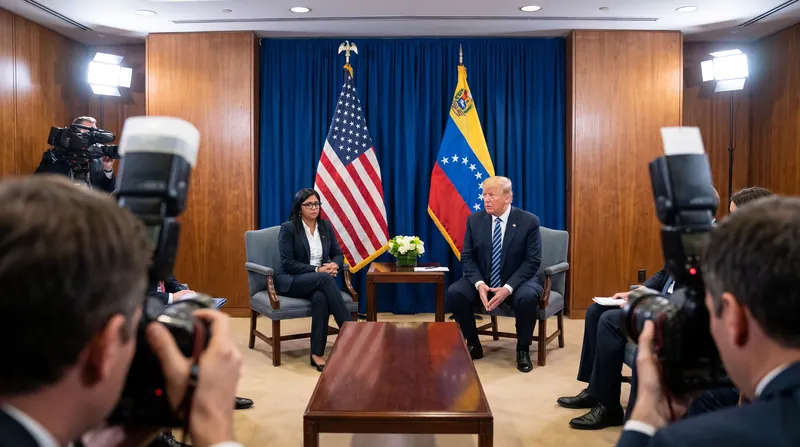
North Korea Prepares Border Loudspeaker Redeployment Following Warning From Kim Yo Jong
5 sources
Protest Rights
Indian Police Release Cockroach Movement Leader Dipke and File FIRs Over Protests
5 sources

Electoral Systems
Compulsory Voting Eliminates the Socioeconomic Participation Gap Without Altering Government Spending Patterns
8 sources
Comments
Every angle. Every day.
Get News & Politics stories with full source coverage and perspective breakdowns, free every day.