
The 2026 Filibuster Showdown: Why the SAVE America Act is Dividing Senate Republicans
President Trump is pressuring Senate Republicans to abolish the 60-vote legislative filibuster to pass sweeping new federal voting restrictions. The standoff pits the White House against GOP leadership over the fundamental rules of the Senate.

Share this story
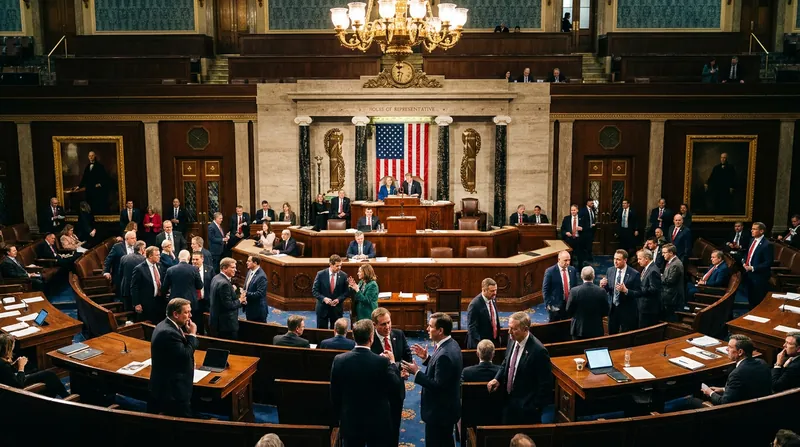
President Donald Trump is heading to Capitol Hill on Wednesday for a closed-door meeting with Senate Republicans, setting the stage for a fundamental clash over the rules of the upper chamber. The president is demanding that lawmakers abandon the legislative filibuster to pass a sweeping package of federal voting restrictions ahead of the midterm elections.[1]
The legislation at the center of the standoff is the Safeguard American Voter Eligibility (SAVE) America Act. The bill, which has already cleared the House, would mandate that Americans provide documentary proof of citizenship—such as a passport or an original birth certificate—when registering to vote. It would also require photo identification at the ballot box and heavily restrict mail-in voting.[2][3]
Trump has made the bill his top legislative priority, threatening to veto unrelated national security and funding packages unless the voting restrictions are attached. However, the bill faces unified Democratic opposition and currently lacks the 60 votes required to overcome a Senate filibuster.
The impasse has triggered a high-stakes pressure campaign from the White House. Trump is urging Senate Majority Leader John Thune and the Republican conference to invoke the 'nuclear option'—a parliamentary maneuver that would eliminate the 60-vote threshold for legislation and allow the bill to pass with a simple 51-vote majority.[1]
Proponents of the SAVE America Act argue that the strict requirements are necessary to combat noncitizen voting and restore faith in the electoral system. Conservative lawmakers and allied groups maintain that the current honor system of swearing citizenship under penalty of perjury is insufficient, particularly given the recent influx of migrants at the southern border.[3]
Voting rights advocates and Democratic lawmakers strongly oppose the measure, characterizing it as a massive voter suppression effort. They point to multiple studies and state audits demonstrating that noncitizen voting is statistically non-existent, as it is already a federal felony that carries the severe risk of deportation.[2]
Critics also warn of the collateral damage the bill would inflict on legal voters. Research indicates that upwards of 21 million American citizens do not have easy access to a passport or an original birth certificate. Obtaining these documents can cost hundreds of dollars and require navigating complex state bureaucracies, creating a significant barrier to the ballot box for low-income, rural, and elderly voters.[2]
To pass the bill, Republicans must navigate the Senate filibuster—a defining procedural tool that essentially grants the minority party veto power over most legislation. Under current rules, ending debate on a bill requires a 'cloture' vote of 60 senators. With Republicans holding 53 seats, they cannot advance the SAVE America Act without Democratic defectors.[2]
The filibuster has been steadily eroded over the past decade, though never for regular legislation. In 2013, Democrats eliminated the 60-vote threshold for lower-court judges and executive nominees. In 2017, Republicans followed suit, abolishing the filibuster for Supreme Court nominees to confirm Justice Neil Gorsuch.
Despite this history, Senate GOP leadership has fiercely resisted Trump's demand to scrap the legislative filibuster. Majority Leader Thune has publicly and privately told the president that the votes to change the rules simply do not exist. Thune and other institutionalists argue that the 60-vote threshold forces bipartisan consensus and protects conservative laws from being easily repealed when Democrats inevitably reclaim the majority.[1]
'Power changes hands, but principles shouldn't,' one Republican senator noted recently, echoing a sentiment widely held among the chamber's veterans. Lawmakers like Susan Collins, Lisa Murkowski, and Thom Tillis have consistently voted against advancing the SAVE America Act in various forms, signaling deep reluctance to upend the Senate's traditions for a partisan election bill.
However, the White House's pressure is beginning to fracture the conference. Senator John Cornyn of Texas recently announced his support for scrapping the filibuster if necessary to pass the voting restrictions, a marked reversal from his longtime defense of the rule. Cornyn, who is facing a competitive primary challenge, argued that Democrats had already dealt the filibuster a 'fatal blow' during previous rule-change attempts.
Other Trump allies, such as Senator Mike Lee of Utah, are pushing for a 'talking filibuster.' Under this older model, the minority party would be forced to physically hold the Senate floor and speak continuously to block the bill. While Trump has embraced the idea, parliamentary experts note that a talking filibuster still ultimately requires 60 votes to cut off debate once the talking stops.
Recognizing the gridlock, some Republicans are exploring procedural workarounds. A new legislative effort attempts to repackage parts of the SAVE America Act into a budget reconciliation bill. Reconciliation is a special process designed for tax and spending measures that bypasses the filibuster entirely, allowing passage with a simple 51-vote majority.
The alternative bill, dubbed the 'SAVE America Through REAL ID Act,' would authorize $50 million in federal grants to help states issue REAL ID-compliant driver's licenses. By structuring the bill around federal spending, sponsors hope it will survive the strict rules of reconciliation.
This strategy faces its own hurdles. The Senate Parliamentarian—the nonpartisan official who interprets the chamber's rules—must rule on whether the provisions are genuinely budgetary or merely policy changes disguised as spending. Experts widely expect the parliamentarian to strip out the core proof-of-citizenship mandates, rendering the reconciliation route ineffective for Trump's primary goals.
The standoff leaves Senate Republicans caught between the institutional guardrails of their chamber and a president demanding immediate action. As Trump arrives on Capitol Hill, the debate over the SAVE America Act has transformed from a fight over election mechanics into a defining test of the Senate's future as a consensus-driven body.[1]
Key points
- President Trump is pressuring Senate Republicans to abolish the 60-vote legislative filibuster to pass the SAVE America Act.
- The legislation would require documentary proof of citizenship, such as a passport or birth certificate, to register to vote.
- Senate Majority Leader John Thune and other institutionalist Republicans are resisting the demand, arguing the filibuster protects the minority party.
- Voting rights advocates warn the bill would disenfranchise millions of legal citizens who lack the required documents.
What we don’t know
- Whether Senate Majority Leader John Thune can maintain enough Republican opposition to block the filibuster rule change.
- How the Senate Parliamentarian will rule on efforts to attach voting restrictions to a budget reconciliation bill.
- If the standoff will result in a government shutdown or the stalling of other critical national security legislation.
How we got here
2013
Senate Democrats eliminate the filibuster for lower-court judicial nominees and executive appointments.
2017
Senate Republicans eliminate the filibuster for Supreme Court nominees to confirm Neil Gorsuch.
2022
Senate Democrats attempt to alter the filibuster for voting rights legislation but are blocked by centrist members.
March 2026
The SAVE America Act stalls in the Senate after failing to reach the 60-vote threshold.
June 2026
President Trump visits Capitol Hill to directly pressure GOP senators to abolish the legislative filibuster.
- Voting Rights Defenders
- Argue the bill is a voter suppression tactic that will disenfranchise millions of legal citizens who lack expensive documents.
- Institutionalist Republicans
- Support election security but refuse to destroy the Senate's 60-vote threshold, warning it will backfire when the party is in the minority.
- Election Security Advocates
- Argue that strict proof-of-citizenship requirements are necessary to restore public trust and prevent noncitizens from voting.
Perspectives this story doesn't cover
- State and local election administrators who would have to implement the new ID requirements
- Naturalized citizens who might face additional scrutiny at the polls
Sources
Source coverage
3 outlets
3 viewpoints surfaced



- [1]The New York TimesInstitutionalist Republicans
Trump to Meet With G.O.P. Senators Amid New Divisions
Read on The New York Times → - [2]NPRVoting Rights Defenders
Tension builds between Trump and Senate Republicans, putting GOP agenda on the line
Read on NPR → - [3]Fox NewsElection Security Advocates
McCarthy says Trump will use 'everything he can' to force Senate action on SAVE America Act
Read on Fox News →

More in News & Politics
See all →Legislative Standoff
GOP Rebellion Over Trump's 'SAVE Act' Forces House to Recess Early, Stalling Defense Bill
2 sources
Defense Industrial Base
Trump Orders Plan for First New Public Navy Shipyard in 80 Years as Part of Major Overhaul
7 sources

Immigration Enforcement
Emails Reveal ICE and Iran Coordinated to Deport Iranians from U.S.
4 sources

Federal Grantmaking
OMB Proposes Rule Mandating Federal Grants Align With Presidential Priorities
2 sources
Comments
Every angle. Every day.
Get News & Politics stories with full source coverage and perspective breakdowns, free every day.