
The Biomechanics Behind MLB's 104 MPH Fastball Revolution
As Major League pitchers shatter velocity records, teams are turning to high-tech 'pitching labs' to understand the science of the throw. By optimizing the body's kinetic chain, biomechanists are helping athletes throw harder than ever while racing to protect the human elbow from unprecedented stress.
By Factlen Editorial Team
- Biomechanists & Performance Coaches
- Focus on optimizing the kinetic chain to maximize velocity safely.
- Orthopedic Surgeons
- Focus on the anatomical limits of the elbow and the rising tide of UCL injuries.
- Major League Front Offices
- Focus on the competitive necessity of velocity and the ROI of pitching labs.
What's not represented
- · Amateur Youth Coaches
- · Major League Batters
Why this matters
The explosion of pitching velocity is fundamentally changing how baseball is played, scouted, and trained at every level from Little League to the Majors. Understanding the biomechanics behind a 100 mph fastball reveals the incredible intersection of human anatomy and modern sports science, while highlighting the growing injury risks facing young athletes.
Key points
- Major League pitchers are throwing harder than ever, with starters now capable of reaching 104.5 mph.
- Teams are utilizing high-tech 'pitching labs' equipped with motion capture and force plates to analyze throwing mechanics.
- Velocity is generated through the 'kinetic chain,' transferring energy from the legs and hips up through the core and into the arm.
- The arm acts as a whip, delivering the accumulated power of the entire body into the baseball.
- High-velocity pitching places extreme varus torque on the elbow, pushing the structural limits of human ligaments.
- Biomechanists aim to optimize mechanics to reduce elbow stress while maintaining elite pitch speeds.
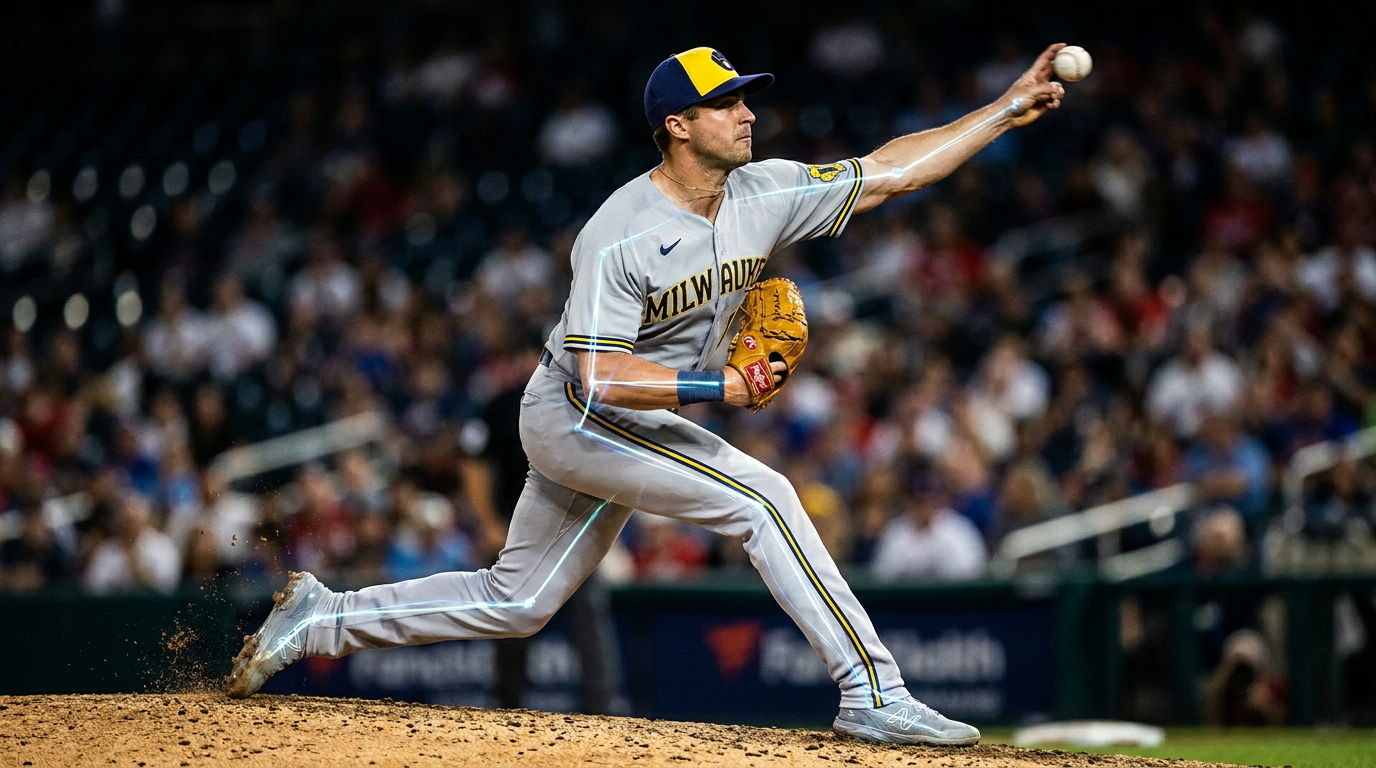
On June 12, 2026, Milwaukee Brewers right-hander Jacob Misiorowski unleashed a 104.5 mph fastball, the fastest pitch recorded by a starting pitcher in the tracking era. A week later, he routinely hit 104.2 mph against the Atlanta Braves, throwing a staggering 47 pitches over 101 mph in a single outing. For fans, it is a breathtaking spectacle of human athletic capability. For the batters facing him, it leaves virtually no time to react.[1][2]
Misiorowski's record-breaking heat is the most extreme example of a broader revolution in Major League Baseball. A century ago, a 90 mph fastball was considered legendary; today, it is a baseline requirement for professional prospects. The modern game is defined by unprecedented velocity, with teams actively hunting for arms that can consistently threaten the triple-digit mark on the radar gun.[1][7]
But how are human bodies generating this much force? The answer lies far beyond traditional weightlifting or raw arm strength. Today's elite velocity is born from the precise, coordinated application of sports science. Major League organizations and elite collegiate programs have turned to biomechanics—the study of human motion and physical forces—to deconstruct and optimize the pitching delivery.[4][7]
The epicenter of this revolution is the "Pitching Lab." These state-of-the-art facilities look more like Hollywood special-effects studios than baseball training centers. Inside, pitchers are surrounded by dozens of high-speed motion-capture cameras, markerless tracking systems, and specialized radar units that capture thousands of data points per second.[3][6]

The mound itself is instrumented with multi-axis force plates. These plates measure the exact amount of ground reaction force a pitcher generates when they push off the rubber and when their lead foot strikes the dirt. By synchronizing this ground-force data with 3D skeletal tracking, biomechanists can map exactly how energy travels through the pitcher's body.[4][5][6]
This energy transfer is known as the "kinetic chain." Despite the natural assumption that throwing is an arm-centric action, a 104 mph fastball actually originates in the legs and hips. The pitching delivery is a whip-like sequence of movements where energy is transferred sequentially from the ground to the legs, through the core, into the shoulder, down the arm, and finally to the fingertips.[4][5]
It begins with the lower body. The back leg generates the initial forward momentum, but the front leg acts as the crucial braking mechanism. When the lead foot lands, it must rapidly decelerate the body's forward motion. This abrupt stop acts like a catapult, transferring the accumulated kinetic energy violently upward into the torso.[5][7]
The back leg generates the initial forward momentum, but the front leg acts as the crucial braking mechanism.
Next comes the core, which acts as the transmission. Elite pitchers exhibit a highly specific "kinematic sequencing," characterized by a slight delay between the rotation of their pelvis and the rotation of their upper torso. This separation stretches the abdominal muscles like a tightly coiled spring, creating massive torsional force.[4][5]

When that spring finally releases, the upper body whips around, dragging the arm behind it. By the time the energy reaches the shoulder and elbow, the arm is moving at extraordinary angular velocities. The arm itself is merely the final conduit—the tip of the whip—delivering the accumulated power of the entire body into the baseball.[5][7]
However, weaponizing the human body to throw 104 mph comes with severe physiological risks. The primary bottleneck in the kinetic chain is the elbow, specifically the ulnar collateral ligament (UCL). Fastballs are the most stressful pitch in baseball, generating massive "varus torque"—an outward bending force—on the medial side of the elbow during the cocking phase of the delivery.[4][7]
Medical researchers note that the forces generated by modern high-velocity pitching are pushing the absolute structural limits of human ligaments. If the kinetic chain is inefficient—if the hips open too early or the core is weak—the arm must artificially generate force to compensate, drastically increasing the load on the elbow and the risk of catastrophic injury.[4][5]

This has led to a complex debate surrounding velocity-enhancement tools, such as weighted-ball throwing programs. While these programs can successfully increase pitch speed by altering joint stress and mechanics, sports scientists warn that viewing them as a "magic shortcut" without holistic mechanical optimization significantly elevates injury risk.[4][7]
Consequently, the true value of the modern pitching lab is not just building faster pitchers, but building safer ones. By identifying microscopic inefficiencies in a pitcher's delivery, biomechanists can help athletes tweak their mechanics to decrease shoulder rotation moments and elbow varus torque while maintaining or even increasing their velocity.[3][4][6]
As pitchers like Misiorowski continue to redefine what is physically possible on a baseball diamond, the marriage of sports science and raw talent will only deepen. The quest for the perfect fastball is no longer just a physical pursuit; it is a triumph of biomechanical engineering, pushing the boundaries of human performance one frame of data at a time.[1][7]
How we got here
2008
MLB introduces widespread pitch-tracking technology, establishing a baseline for velocity data.
2010
Cincinnati reliever Aroldis Chapman throws a 105.8 mph fastball, the fastest overall pitch ever recorded.
2019
Wake Forest University opens its state-of-the-art Pitching Lab, setting a new standard for data-driven collegiate development.
June 2026
Brewers starter Jacob Misiorowski throws a 104.5 mph fastball, setting the record for the fastest pitch by a starting pitcher.
Viewpoints in depth
Biomechanists & Performance Coaches
Focus on optimizing the kinetic chain to maximize velocity safely.
This camp views the pitching delivery as an engineering problem. By using motion capture and force plates, they aim to eliminate wasted movement and ensure energy flows perfectly from the ground to the fingertips. They argue that velocity itself isn't the enemy; rather, poor mechanical sequencing that forces the arm to do the work of the lower body is what causes injuries.
Orthopedic Surgeons & Medical Staff
Focus on the anatomical limits of the elbow and the rising tide of UCL injuries.
Medical professionals emphasize that the human ulnar collateral ligament has a hard structural limit. No matter how perfect a pitcher's mechanics are, throwing a baseball 104 mph generates varus torque that flirts with the tearing point of human tissue. They advocate for pitch-count limits and caution against the widespread use of weighted-ball programs in youth athletes.
Major League Front Offices
Focus on the competitive necessity of velocity and the ROI of pitching labs.
For team executives, velocity is the ultimate competitive advantage. A 100 mph fastball significantly reduces a batter's reaction time and margin for error. Front offices are investing millions in proprietary pitching labs because the data-driven development of just one elite arm provides massive surplus value on the field.
What we don't know
- Whether the human ulnar collateral ligament can adapt over generations to withstand the forces of 105 mph fastballs.
- The long-term joint health implications for pitchers who begin high-velocity, lab-optimized training in early adolescence.
- If Major League Baseball will eventually implement rule changes (like lowering the mound) to counteract the dominance of triple-digit velocity.
Key terms
- Kinetic Chain
- The sequential transfer of energy through the body's joints and segments, from the ground up through the legs, core, and arm.
- Biomechanics
- The study of the mechanical laws relating to the movement or structure of living organisms.
- Force Plates
- Specialized sensors embedded in a pitching mound that measure the exact amount of force a pitcher exerts against the ground.
- Varus Torque
- An outward bending force placed on the elbow joint during a throwing motion, which stresses the ulnar collateral ligament.
- Kinematic Sequencing
- The specific order and timing of body part rotations (pelvis, then torso, then arm) to maximize energy transfer.
Frequently asked
Why are pitchers throwing so much harder today?
Modern pitchers utilize advanced biomechanical analysis and pitching labs to optimize their mechanics, allowing them to transfer energy from their lower body more efficiently than previous generations.
Does throwing 100 mph guarantee an arm injury?
Not necessarily, but it significantly increases the risk. The key to staying healthy at high velocities is maintaining a perfectly efficient kinetic chain so the elbow doesn't absorb excess stress.
What exactly does a pitching lab do?
A pitching lab uses motion-capture cameras, radar, and force plates to create a 3D biomechanical model of a pitcher's delivery, identifying both performance inefficiencies and injury risks.
Can any pitcher learn to throw 100 mph?
While biomechanics can help any pitcher maximize their individual potential, reaching elite triple-digit velocity still requires a rare baseline of natural anatomical structure and fast-twitch muscle fiber.
Sources
Source coverage
7 outlets
3 viewpoints surfaced







[1]ForbesMajor League Front Offices
Milwaukee Brewers Right-Hander Jacob Misiorowski May Be MLB's Best Pitcher
Read on Forbes →[2]SportsnetMajor League Front Offices
Brewers' Misiorowski hits 104.2 m.p.h., gives up two runs vs. Braves
Read on Sportsnet →[3]MLB.comBiomechanists & Performance Coaches
Inside the Pitching Lab that built a top Draft prospect
Read on MLB.com →[4]Mass General BrighamBiomechanists & Performance Coaches
How Biomechanics Can Improve Baseball Performance
Read on Mass General Brigham →[5]National Institutes of HealthOrthopedic Surgeons
Kinematics and Velocity in Baseball Pitching
Read on National Institutes of Health →[6]UNO Pitching LabBiomechanists & Performance Coaches
UNO Pitching Lab: Biomechanics Evaluations
Read on UNO Pitching Lab →[7]Factlen Editorial TeamMajor League Front Offices
Synthesis by Factlen editorial team
Read on Factlen Editorial Team →

More in sports
See all 7 stories →MMA Viewership
MMA Shatters Viewership Records as Netflix and Paramount+ Usher in the Streaming Era
7 sources

Snowboard Tech
How Quick-Entry Bindings Are Revolutionizing Snowboarding and Keeping Aging Riders on the Mountain
9 sources

Sports Tech
The Data-Driven Pool: How AI and Wearables are Decoding Swimming Biomechanics
7 sources
Endurance Physiology
The Lactate Revolution: How the 'Norwegian Method' Rewrote the Rules of Endurance
8 sources

Every angle. Every day.
Get sports stories with full source coverage and perspective breakdowns delivered to your inbox.