
The Rise of the 'Cozy Web': Why Internet Users Are Retreating to Digital Dark Forests
Exhausted by algorithmic feeds and AI-generated noise, users are increasingly abandoning public social media for private, invite-only digital spaces.
By Factlen Editorial Team
- Digital Intentionalists
- Advocates who view the retreat to private spaces as a healthy reclamation of human connection.
- Open Web Defenders
- Critics concerned about the loss of discoverability and the rise of echo chambers.
- Technological Realists
- Analysts who see the shift as an inevitable evolutionary response to a hostile digital environment.
What's not represented
- · Brand Marketers
- · Cybersecurity Experts
Why this matters
As the public internet becomes flooded with synthetic content and algorithmic noise, understanding the shift to private digital spaces is crucial for anyone looking to build authentic connections, protect their mental health, or reach an audience in 2026.
Key points
- Users are increasingly abandoning public social media feeds in favor of private group chats and invite-only servers.
- The 'Dark Forest' theory suggests users are hiding from digital predators like bots, trolls, and algorithmic advertisers.
- The 'Cozy Web' offers a depressurized environment for authentic, un-gamified human connection.
- Generative AI has accelerated this trend by flooding the open web with synthetic, hard-to-verify content.
- While this shift protects mental health, it risks fracturing the internet into isolated echo chambers.
- Platforms like Discord are pivoting their business models to cater to this desire for bounded digital spaces.
The internet feels simultaneously more crowded and more empty than ever before. While global connectivity metrics continue to climb, the actual human experience of the web has fundamentally shifted. The loud, chaotic public squares of the 2010s—where users freely broadcast their thoughts, photos, and daily lives to anyone who would listen—are falling silent. In their place, a quieter, more intentional digital landscape is emerging, driven by a collective exhaustion with algorithmic feeds and the relentless pressure of public visibility.[1][8]
This migration is not a technical failure of the open web, but a social retreat. Users are moving away from giant public forums and into smaller, more controlled spaces: Discord servers, private Slack channels, WhatsApp group chats, and invite-only subreddits. According to recent industry polling, nearly a third of all social media users now post less frequently than they did just a year ago, opting instead to consume public content passively while saving their authentic interactions for closed groups.[1][5]
To understand why the public internet is emptying out, cultural theorists point to a concept borrowed from science fiction: the "Dark Forest Theory." Originally coined by author Liu Cixin to explain why the universe seems devoid of alien life, the theory posits that the cosmos is a dark forest filled with predators. The only way for a civilization to survive is to stay completely silent and hidden.[2][4]

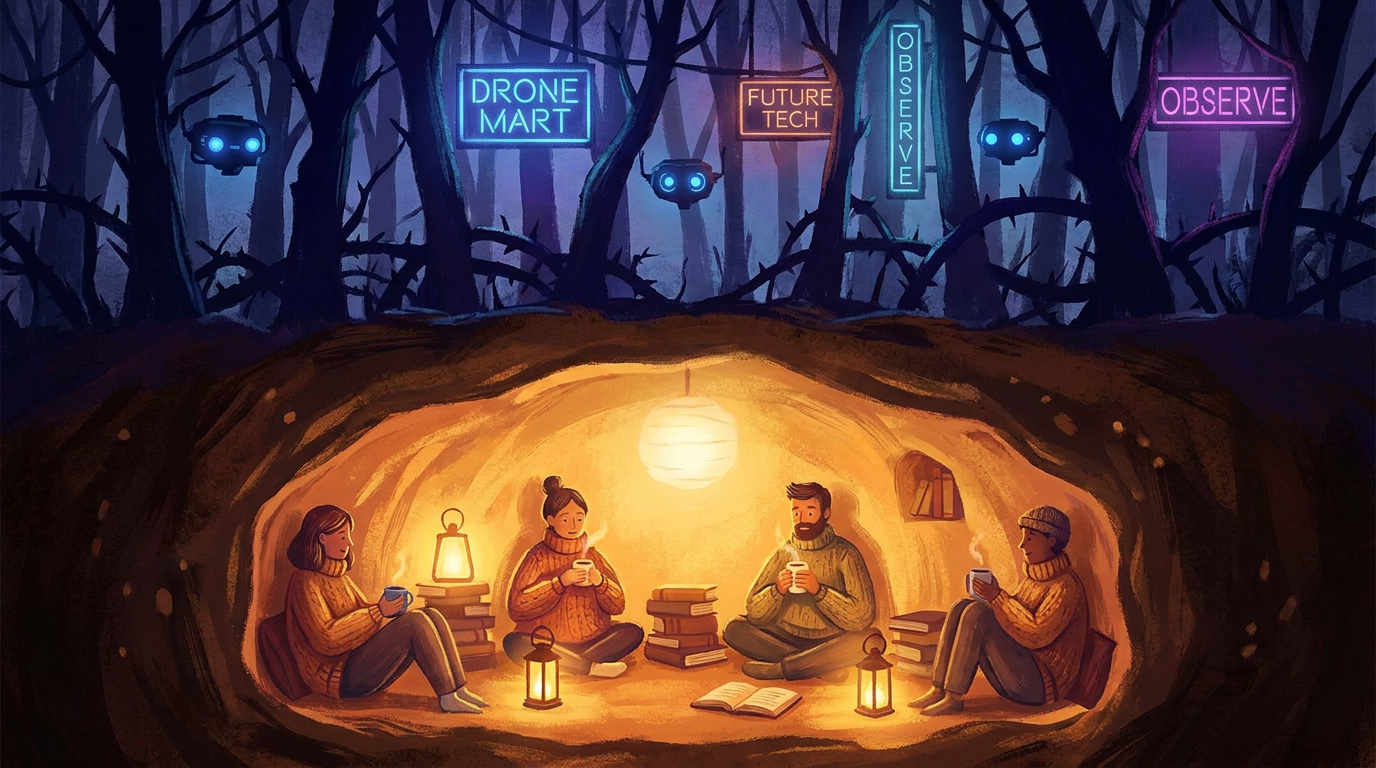
When applied to the modern internet, the metaphor is strikingly apt. The public web has become a hostile environment. The "predators" in this digital forest are not extraterrestrials, but tracking bots, algorithmic advertisers, engagement-hungry influencers, trolls, and, increasingly, generative AI. For the average user, stepping into the public feed means risking harassment, data extraction, or simply being drowned out by synthetic noise.[2][4]
"In response to the ads, the tracking, the trolling, the hype, and other predatory behaviors, we're retreating to our dark forests of the internet," wrote Yancey Strickler, who first popularized the internet application of the theory. By refusing to ping the heavens with our personal data, we protect our psychological well-being. We stay quiet to survive.[2]
But humans are inherently social creatures, and the desire for connection does not disappear just because the public square has become hostile. Instead of logging off entirely, users have built what researcher Venkatesh Rao and designer Maggie Appleton call the "Cozy Web." If the Dark Forest is the terrifying expanse above ground, the Cozy Web is the network of warm, illuminated burrows dug safely beneath the surface.[3][7]
The Cozy Web is defined by its high-gatekeeping, informal, and messily human nature. It operates on private servers, encrypted messaging apps, and shared digital documents. Crucially, these spaces are non-indexed and non-optimized. Because search engines cannot scrape a private Discord channel and an algorithm cannot gamify a family WhatsApp group, these environments allow for depressurized, authentic conversation.[3]

The Cozy Web is defined by its high-gatekeeping, informal, and messily human nature.
This shift is fundamentally altering how platforms operate. Discord, originally built as a voice-chat utility for PC gamers, has recognized this broader cultural movement. The company recently pivoted its focus away from being a general-purpose communication app, leaning heavily into its role as a sanctuary for shared interests and intimate community building. By prioritizing smaller, reliable group chats over massive public broadcasting, platforms are capitalizing on the desire for bounded digital spaces.[6]
The rise of the Cozy Web is also driving a counterintuitive trend known as "friction-maxxing." For years, the primary goal of major tech platforms was to remove all friction from the user experience—making it as easy as possible to scroll, click, and share. Now, communities are intentionally reintroducing friction as a defense mechanism to protect their digital borders.[5]
Joining a Cozy Web community often requires passing a vibe check, answering entry questions, or receiving a direct invitation link from a trusted friend. This friction acts as a filter, keeping out bots and passive consumers while ensuring that everyone inside the space shares a baseline of context and commitment. It is the digital equivalent of a speakeasy door, ensuring that those who enter actually want to be there.[3][5]
Psychological research supports the necessity of these bounded spaces. Studies on online community formation highlight that humans seek digital companionship to fulfill a fundamental need for belonging. When public platforms prioritize viral reach over meaningful interaction, they strip away the shared context required for genuine empathy and support. The Cozy Web restores that context, allowing users to communicate using shorthand, inside jokes, and shared cultural norms without fear of being misunderstood by a global audience.[7][8]

The explosion of generative AI has acted as a massive accelerant for this migration. As synthetic text, AI-generated images, and automated video content flood the open web, the baseline trust in public digital spaces has plummeted. When you cannot verify if a viral post was written by a human or a machine, the value of the public feed degrades rapidly.[1][8]
In contrast, the Cozy Web offers cryptographic-level proof of humanity, not through blockchain, but through intimacy. You know the people in your group chat are real because you have shared history with them. The messy, unpolished nature of these interactions becomes a premium feature rather than a bug, serving as a beacon of authenticity in a sea of synthetic perfection.[3][8]
However, the retreat into digital dark forests is not without significant trade-offs. As the internet becomes socially smaller, the open web risks losing the serendipity and discoverability that made it revolutionary in the first place. If everyone is hiding in private burrows, it becomes exponentially harder for new artists to find an audience, or for marginalized voices to build a public coalition.[1][8]

Furthermore, the Cozy Web can easily curdle into echo chambers. While private spaces protect users from trolls, they also insulate them from dissenting opinions and shared realities. Misinformation can spread rapidly within closed WhatsApp groups or Telegram channels, completely shielded from the scrutiny of journalists, researchers, or fact-checkers. The very walls that keep the predators out also keep the light from getting in.[1]
Despite these risks, the migration appears irreversible. The era of the monolithic public square is ending, replaced by a fragmented archipelago of private communities. For millions of users, this is not a tragedy, but a reclamation. By stepping out of the algorithmic spotlight and into the Cozy Web, they are finally building the internet they actually want to inhabit—one conversation at a time.[5][8]
How we got here
2019
Yancey Strickler publishes the essay applying the sci-fi 'Dark Forest' theory to the internet.
2020
Venkatesh Rao and Maggie Appleton popularize the concept of the 'Cozy Web' as a refuge from public platforms.
2023
Generative AI tools flood the public internet with synthetic content, accelerating the retreat to private spaces.
2024
Platforms like Discord pivot their branding to focus specifically on shared interests and intimate communities.
2026
Polling reveals a massive cultural shift as users actively reduce public posting in favor of private group chats.
Viewpoints in depth
Digital Intentionalists
Advocates who view the retreat to private spaces as a healthy reclamation of human connection.
For digital intentionalists, the Cozy Web is the antidote to a decade of toxic, gamified social media. They argue that human beings were never psychologically equipped to broadcast their every thought to a global audience of millions. By retreating to private group chats and Discord servers, users are prioritizing their mental health and fostering genuine empathy. In this view, the death of the public square is not a loss, but a necessary evolution toward a more sustainable, human-centric internet where quality of connection matters more than viral reach.
Open Web Defenders
Critics concerned about the loss of discoverability and the rise of echo chambers.
Those defending the open web worry that the Dark Forest migration fractures society into isolated, impenetrable silos. If all meaningful conversation happens behind closed doors, the internet loses its power as an engine for serendipity and democratic exchange. Open web advocates point out that marginalized creators rely on public feeds to build audiences and bypass traditional gatekeepers. Furthermore, they warn that private spaces are fertile ground for unchecked misinformation, as closed groups lack the friction of public scrutiny and fact-checking.
Technological Realists
Analysts who see the shift as an inevitable evolutionary response to a hostile digital environment.
Technological realists view the Cozy Web neither as a utopia nor a tragedy, but as a simple matter of digital survival. Drawing on the Dark Forest theory, they argue that as the public internet became overrun by data-scraping bots, algorithmic advertisers, and generative AI, human users naturally adapted by seeking cover. In this framework, the shift to encrypted messaging and private servers is a rational defense mechanism against an ecosystem that actively penalizes authenticity. The technology simply evolved to make hiding the most logical choice.
What we don't know
- Whether new platforms will successfully bridge the gap between public discoverability and private safety.
- How the economics of the creator industry will adapt when audiences are hidden in un-trackable group chats.
- If the influx of AI agents into private group chats will eventually compromise the safety of the Cozy Web.
Key terms
- Cozy Web
- The informal, private, and gatekeeper-bounded spaces of the internet, such as group chats and private forums, where users retreat for authentic conversation.
- Dark Forest Theory
- A concept borrowed from sci-fi suggesting that intelligent life hides in silence to avoid predators; applied to the internet, it explains why users retreat from public platforms.
- Friction-maxxing
- The intentional choice to engage in digital or physical experiences that require more effort, serving as a filter for authenticity and commitment.
- Synthetic Content
- Text, images, or videos generated entirely by artificial intelligence rather than human creators, which has degraded trust in public feeds.
Frequently asked
What exactly is the 'Cozy Web'?
The Cozy Web refers to private, invite-only digital spaces like Discord servers, WhatsApp group chats, and Slack channels. It is a reaction against public social media, offering a space for authentic, un-gamified human connection.
Why is it called the 'Dark Forest' theory?
The term comes from a sci-fi concept explaining why the universe seems empty: intelligent life hides to avoid predators. On the internet, users hide in private spaces to avoid 'predators' like bots, trolls, and advertisers.
Are public social networks dying?
They aren't dying, but their function is changing. Public platforms are increasingly becoming algorithmic entertainment feeds for passive consumption, rather than places for personal social interaction.
How does AI affect this trend?
The flood of AI-generated synthetic content on the public web has accelerated the retreat to private spaces. Users seek out closed groups because shared history and intimacy provide proof that they are interacting with real humans.
Sources
Source coverage
8 outlets
3 viewpoints surfaced








[1]TechBusinessNewsOpen Web Defenders
The cultural shift in how people use the internet
Read on TechBusinessNews →[2]Yancey StricklerTechnological Realists
The Dark Forest Theory of the Internet
Read on Yancey Strickler →[3]Maggie AppletonDigital Intentionalists
The Cozy Web
Read on Maggie Appleton →[4]Polity BooksTechnological Realists
The Dark Forest Theory of the Internet by Bogna Konior
Read on Polity Books →[5]MeyocksDigital Intentionalists
The cozy web and digital intentionality
Read on Meyocks →[6]How-To GeekTechnological Realists
Discord is changing its focus
Read on How-To Geek →[7]National Institutes of HealthTechnological Realists
How and why online communities form
Read on National Institutes of Health →[8]Factlen Editorial TeamDigital Intentionalists
Synthesis by Factlen editorial team
Read on Factlen Editorial Team →
Every angle. Every day.
Get culture stories with full source coverage and perspective breakdowns delivered to your inbox.