
The Science of Space: How Neuroaesthetics is Rewiring Interior Design
A growing field at the intersection of neuroscience and architecture is proving that interior design is not just about aesthetics, but a biological intervention that actively shapes our mental health.
By Factlen Editorial Team
- Neuroaesthetics Researchers
- Focus on empirical data and the biological mechanisms of how space affects the brain.
- Architectural Designers
- Focus on translating scientific findings into functional, beautiful, and emotionally intelligent spaces.
- Wellness Real Estate Developers
- Focus on market demand, scaling health-centric design, and the 'home biome'.
What's not represented
- · Low-income housing advocates
- · Traditional interior decorators
Why this matters
Understanding how our physical environments shape our brain chemistry empowers us to design homes that actively reduce stress, improve focus, and support our long-term mental health.
Key points
- Neuroaesthetics is an emerging field combining brain science and architecture to study how environments affect mental health.
- Aesthetically pleasing spaces can lower cortisol levels and activate the brain's neural reward pathways.
- Evolutionary concepts like 'prospect and refuge' explain why humans prefer cozy nooks with expansive views.
- The real estate industry is shifting focus from superficial luxury to the 'home biome,' prioritizing circadian lighting and biophilic design.
Have you ever walked into a room and felt an immediate, inexplicable sense of calm? Or conversely, stepped into an office and felt your heart rate tick upward? For decades, interior designers attributed these reactions to an elusive sense of "vibes" or personal taste. But modern science is proving that our response to a room is far more profound than mere preference. It is a rapid, involuntary biological intervention.[6]
This realization is the driving force behind neuroaesthetics, an emerging discipline that sits at the intersection of brain science and architecture. Coined in 1999 by neuroscientist Semir Zeki, the term originally described the cognitive neuroscience of aesthetic experience—how our brains process art and beauty. Today, it has expanded far beyond museum walls to encompass the built environments where we live, work, and heal.[4][5]
"Design isn't just an aesthetic choice. It's a biological intervention," explains the growing consensus among researchers. When we enter a space, our nervous system immediately begins scanning the environment, processing light, color, texture, and geometry before our conscious mind even registers the decor.[4][6]
To understand the mechanism, researchers utilize functional magnetic resonance imaging (fMRI) and biometric wearables to track how spatial configurations alter brain activity. They have discovered that aesthetically pleasing, well-balanced spaces trigger the same neural reward pathways as listening to a favorite song or connecting with a loved one.[5]
Specifically, environments that the brain interprets as beautiful or safe directly stimulate the orbitofrontal cortex, a region intimately linked with emotional regulation and decision-making. When this area is activated, the body's production of cortisol—the primary stress hormone—drops, fostering a measurable state of positive affect and relaxation.[1][5]

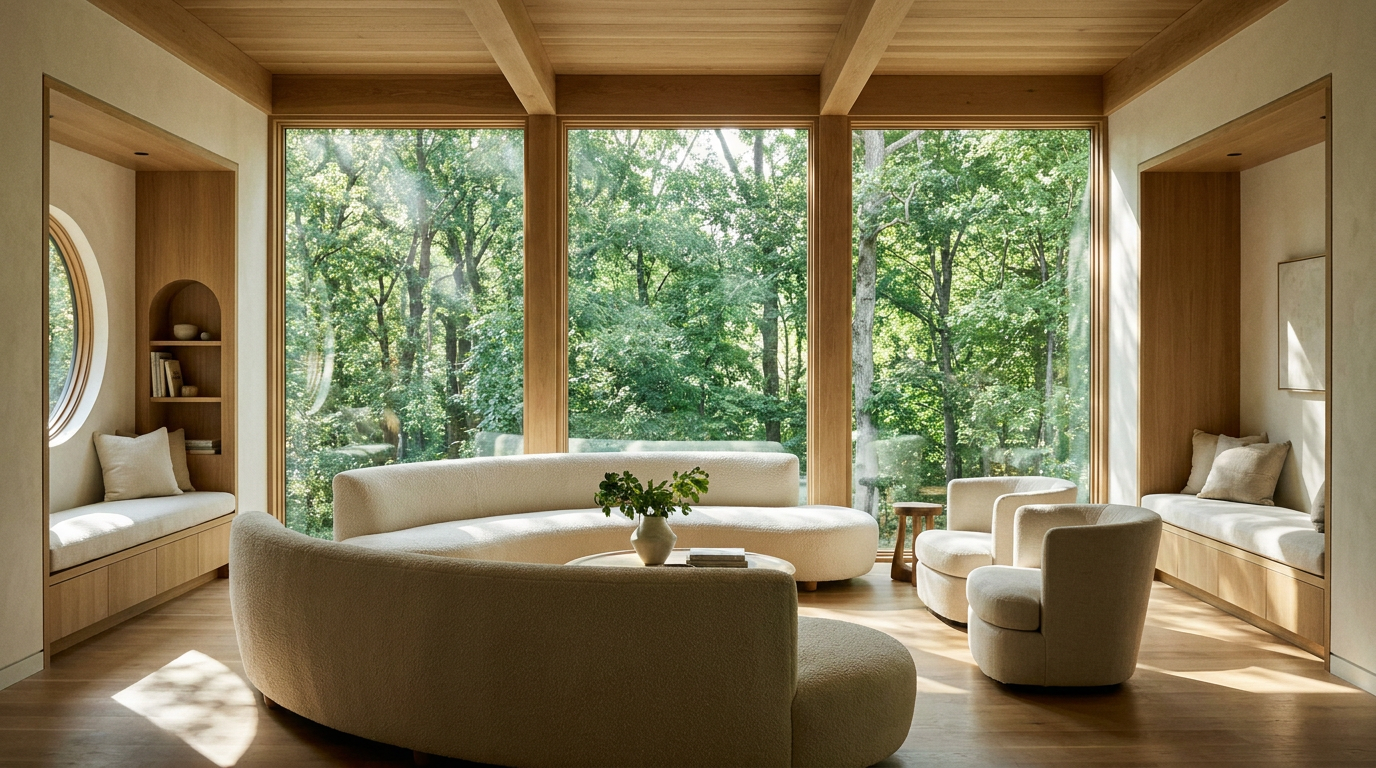
One of the most powerful evolutionary drivers of this response is the concept of "prospect and refuge." Originating in environmental psychology, this principle dictates that humans feel most secure in spaces that offer a clear, unimpeded view of their surroundings (prospect) while simultaneously providing a sense of enclosure and protection at their back (refuge).[1][6]
Translating prospect and refuge into interior design means creating cozy, sheltered nooks—like a high-backed reading chair in a corner or a lowered ceiling over a dining alcove—that look out over a larger, open room or through expansive windows. This spatial arrangement dramatically reduces the cognitive load required to monitor the environment for threats, allowing the nervous system to down-regulate.[6]
Geometry also plays a surprisingly outsized role in our emotional baseline. Neuroaesthetic studies consistently demonstrate that the human brain prefers curves over sharp angles. Curvilinear spaces and rounded furniture activate the brain's pleasure centers, while sharp, jagged edges can subtly trigger the amygdala, the brain's threat-detection center.[1][4]
Geometry also plays a surprisingly outsized role in our emotional baseline.
Then there is the profound impact of biophilia—our innate biological connection to the natural world. Biophilic design goes far beyond placing a potted pothos on a desk. It involves integrating natural patterns, organic materials like wood and stone, and fractal geometries that mimic the complexity of leaves or waves.[1]

The Johns Hopkins International Arts + Mind Lab (IAM Lab), a pioneering research center in this space, has extensively documented how these natural integrations lower blood pressure and improve cognitive function. Their research indicates that humans process natural textures and fractal patterns with remarkable ease, reducing visual fatigue and mental strain.[3][5]
Lighting, perhaps more than any other element, dictates the "home biome." The human circadian rhythm is deeply tethered to the shifting color temperature of the sun. Artificial lighting that remains static and cool-toned throughout the evening disrupts melatonin production, directly contributing to insomnia and chronic stress.[2][6]
In response, the design industry is rapidly adopting circadian lighting systems. These smart networks automatically transition from bright, blue-enriched light in the morning to warm, amber hues in the evening, actively supporting the body's natural sleep-wake cycles rather than fighting them.[2]
Historically, the most rigorous applications of neuroarchitecture were reserved for high-stakes public environments. Hospitals redesigned recovery wards with nature views and softer acoustics to accelerate patient healing, while progressive schools utilized specific color palettes to improve student focus and reduce behavioral disruptions.[1][4]
But the focus is now shifting decisively to the residential sector. The global events of the early 2020s fundamentally altered our relationship with our homes, transforming them into offices, gyms, and sanctuaries. Consequently, homeowners are demanding spaces that actively support their psychological resilience.[2][3]

This shift was a central theme at the 2026 Wellness Real Estate Symposium, where developers and architects noted that the era of prioritizing superficial luxury amenities is ending. Instead, the industry's new frontier is the "home biome"—creating environments optimized for nervous system regulation, environmental health, and intentional disconnection.[2]
The Intentional Space Roadmap, a comprehensive framework recently released by the IAM Lab, argues that neuroaesthetics should become a foundational pillar of all interior design, not just a niche luxury. The report calls for a cross-disciplinary approach, urging architects to collaborate closely with psychologists and neuroscientists.[3][5]
Ultimately, neuroaesthetics offers a profoundly empowering lens through which to view our living spaces. It strips away the intimidation of fleeting design trends—whether "quiet luxury" or "maximalism"—and replaces them with a single, grounding metric: how a space makes its inhabitants feel.[6]
By aligning the art of interior design with the hard science of human biology, we are learning to craft environments that do more than look beautiful in a magazine. We are building spaces that act as active allies in our mental health, proving that thoughtful design is one of the most accessible forms of daily self-care.[6]
How we got here
1999
Neuroscientist Semir Zeki officially coins the term 'neuroaesthetics' to describe the neural basis of aesthetic experience.
2010s
Hospitals and schools begin widely adopting neuroaesthetic principles to improve patient recovery times and student focus.
2019
Johns Hopkins University launches the International Arts + Mind Lab to accelerate applied neuroaesthetics research.
2026
Wellness real estate symposiums highlight the 'home biome' as the primary driver of future residential development.
Viewpoints in depth
Neuroaesthetics Researchers
Scientists studying the empirical biological effects of spatial environments on the human brain.
For researchers at institutions like the Johns Hopkins International Arts + Mind Lab, the focus is on quantifying the invisible. They utilize fMRI scans, heart-rate variability monitors, and skin-conductance sensors to prove that design is a biological intervention. Their data argues that poor architectural choices—such as harsh fluorescent lighting or sharp, aggressive geometries—act as chronic, low-level stressors that degrade mental health over time, while intentional design can actively accelerate healing and cognitive function.
Architectural Designers
Practitioners translating cognitive science into functional, livable spaces.
Designers view neuroaesthetics as a powerful tool to move past subjective trends. Instead of arguing over whether 'maximalism' or 'minimalism' is currently in vogue, they use evidence-based principles to craft spaces tailored to a client's specific psychological needs. They focus on the practical application of concepts like 'prospect and refuge,' using furniture placement, acoustic dampening, and tactile materials to create environments that subconsciously signal safety and comfort to the nervous system.
Wellness Real Estate Developers
Industry leaders scaling health-centric design for the residential market.
For developers, neuroaesthetics represents the next major evolution in the housing market. Moving away from superficial luxury amenities like golf courses or marble lobbies, they are investing in the 'home biome.' This includes integrating circadian lighting systems, advanced air purification, and biophilic architecture directly into the bones of new developments, betting that future buyers will pay a premium for homes that actively support their longevity and emotional well-being.
What we don't know
- How quickly neuroaesthetic building standards will be adopted into municipal building codes.
- The long-term, multi-generational psychological impacts of living in fully optimized 'home biomes'.
Key terms
- Neuroaesthetics
- The scientific study of how the brain processes and responds to aesthetic experiences, including art and architecture.
- Biophilic Design
- An architectural approach that seeks to connect building occupants more closely to nature through natural lighting, organic materials, and plant life.
- Prospect and Refuge
- A psychological theory suggesting humans prefer environments that offer expansive views for monitoring threats while providing a secure, enclosed space for safety.
- Home Biome
- The holistic environmental health of a living space, encompassing air quality, lighting, acoustics, and their combined effect on human wellness.
- Circadian Rhythm
- The body's internal 24-hour clock that regulates the sleep-wake cycle, heavily influenced by environmental light.
Frequently asked
What is neuroaesthetics?
Neuroaesthetics is a branch of cognitive neuroscience that studies how the human brain responds to beauty, art, and built environments.
How does interior design affect mental health?
Spaces that the brain perceives as safe and beautiful activate the orbitofrontal cortex, which helps regulate emotions and reduces the production of stress hormones like cortisol.
What is 'prospect and refuge' in design?
It is an evolutionary psychology concept where humans feel most relaxed in spaces that offer a clear view of their surroundings (prospect) while providing a sense of sheltered enclosure behind them (refuge).
What is circadian lighting?
Circadian lighting involves smart artificial light systems that change color temperature throughout the day—from cool blue in the morning to warm amber at night—to support the body's natural sleep-wake cycle.
Sources
Source coverage
6 outlets
3 viewpoints surfaced






[1]ArchDailyArchitectural Designers
Neuroesthetics: The Influence of Design on Human Experience
Read on ArchDaily →[2]BeautyMatterWellness Real Estate Developers
Wellness Real Estate's Next Chapter Is About How We Feel
Read on BeautyMatter →[3]Design MilkArchitectural Designers
An Argument for Interior Design with Neuroaesthetics in Mind
Read on Design Milk →[4]Untapped JournalArchitectural Designers
Neuroaesthetics Has Been Around for 25 Years. Are Architects Paying Attention Yet?
Read on Untapped Journal →[5]Johns Hopkins International Arts + Mind LabNeuroaesthetics Researchers
Center for Applied Neuroaesthetics
Read on Johns Hopkins International Arts + Mind Lab →[6]Factlen Editorial TeamArchitectural Designers
Synthesis by Factlen editorial team
Read on Factlen Editorial Team →
Every angle. Every day.
Get home stories with full source coverage and perspective breakdowns delivered to your inbox.