
SpaceX's Record-Breaking IPO Sets the Stage for OpenAI and Anthropic to Go Public
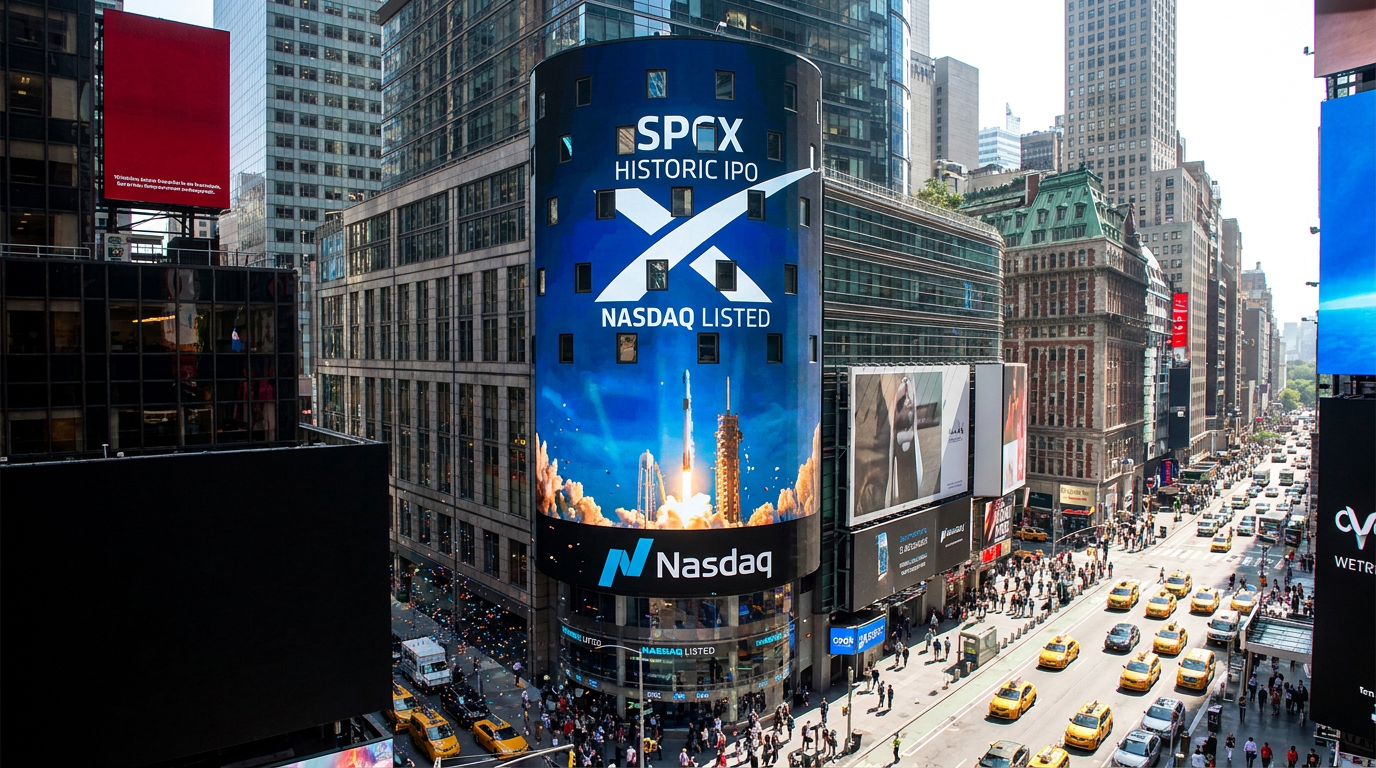
SpaceX's historic $75 billion public debut has surged 37% in its first week, proving massive market appetite for frontier technology. The successful listing is now accelerating plans for artificial intelligence giants Anthropic and OpenAI to enter the public markets later this year.
By Factlen Editorial Team
- Frontier Tech Bulls
- Believe AI and space technology will transform the global economy, justifying trillion-dollar valuations based on massive future total addressable markets.
- Market Pragmatists
- Focus on the unprecedented $200 billion liquidity drain, warning that these mega-IPOs could crowd out other sectors and concentrate index funds too heavily in a few speculative bets.
- Retail Advocates
- Celebrate the democratization of access, particularly SpaceX's historic 30% retail allocation, allowing everyday traders to participate in foundational tech growth.
What's not represented
- · Early-stage venture capitalists competing for the remaining capital
- · Competitors remaining private
Why this matters
The sheer scale of these public offerings is unprecedented, giving everyday retail investors their first direct access to the foundational companies building the next generation of space infrastructure and artificial intelligence.
Key points
- SpaceX went public on June 12, 2026, raising a record-breaking $75 billion at a $1.75 trillion valuation.
- The aerospace company's stock surged 37% in its first week of trading, signaling massive investor appetite.
- Anthropic confidentially filed for its IPO in June and is targeting an October 2026 listing.
- OpenAI is preparing for its own public debut, expected in late 2026 or early 2027 at a $1 trillion target valuation.
- Combined, the three tech giants are expected to pull over $200 billion in liquidity from public markets.
- SpaceX allocated an unprecedented 30% of its shares to retail investors, democratizing access to the offering.
On June 12, 2026, the financial markets witnessed an event investors had anticipated for more than two decades: SpaceX officially became a public company. Debuting on the Nasdaq under the ticker SPCX, the aerospace giant priced its shares at $135, raising a staggering $75 billion. The offering instantly valued the company at $1.75 trillion, shattering the previous global record set by Saudi Aramco's $29.4 billion debut in 2019 and cementing SpaceX as the largest initial public offering in history.[7]
The market's reception was overwhelmingly enthusiastic. SpaceX shares surged 19% on their first day of trading, closing at $161. By the end of its first week, the stock had climbed 37% above its initial offering price, trading comfortably above the $200 mark. This immediate post-IPO performance has sent a clear signal across Wall Street: institutional and retail investors alike are eager to deploy massive amounts of capital into frontier technologies.[1][7]
A defining feature of the SpaceX listing was its unprecedented democratization of access. Breaking from traditional Wall Street norms that heavily favor institutional buyers, SpaceX allocated an estimated 30% of its offering directly to retail investors. This structural shift allowed everyday traders to participate in the wealth creation of a foundational technology company from day one, a move that is already reshaping how future mega-IPOs are being structured.[3][7]

The flawless execution of the SpaceX debut is now serving as a blueprint for the broader tech sector. According to industry insiders, the preemptive playbook utilized by lead underwriter Goldman Sachs—which involved months of early investor education and massive retail coordination—is actively being replicated. The immediate beneficiaries of this proven model are the world's leading artificial intelligence companies, which are now accelerating their own timelines to go public.[4]
Anthropic, the AI research company behind the Claude large language model, is moving aggressively to capitalize on this momentum. The company confidentially filed its S-1 paperwork on June 1, just days after closing a funding round that valued the startup at $965 billion. With legal and financial teams working in parallel, Anthropic is reportedly targeting a Nasdaq listing as early as October 2026.[2][7]
Among the AI giants preparing for public scrutiny, Anthropic is widely considered to have the most compelling financial narrative. The company boasts an estimated $47 billion in annualized recurring revenue, positioning it as a highly mature business capable of withstanding the rigorous transparency requirements of the public markets. This strong revenue profile makes it a prime candidate to successfully follow in SpaceX's footsteps.[7]
Among the AI giants preparing for public scrutiny, Anthropic is widely considered to have the most compelling financial narrative.
OpenAI is also advancing toward the public markets, though on a slightly longer timeline. Currently valued at $852 billion in private markets, the ChatGPT creator is targeting a $1 trillion valuation for its eventual debut. Because of its massive capital expenditures—projected to reach $27 billion in cash burn for 2026 as it builds out unprecedented data center infrastructure—OpenAI is expected to list in late 2026 or early 2027.[2][7]

The sheer scale of capital required for this trio of listings is reshaping market dynamics. Combined, SpaceX, Anthropic, and OpenAI are expected to pull over $200 billion in liquidity from the public markets. To put this in perspective, this figure is more than four times the total amount raised by the entire U.S. IPO market in 2025, representing a generational shift in capital allocation.[5][6]
This massive influx of new equity will interact uniquely with major index funds. Because the S&P 500 requires a company to demonstrate consistent profitability before inclusion, funds tracking the index will not immediately absorb these mega-caps. However, the Nasdaq utilizes a fast-track inclusion process, meaning investors holding Nasdaq-heavy tech funds will gain exposure to these frontier companies within weeks of their respective listings.[3][5]
The historic valuations have naturally invited healthy market scrutiny. With the Shiller P/E ratio sitting above 41—its highest point since the late 1990s—some analysts warn of extreme market concentration. However, proponents argue that unlike the dot-com era, these companies are generating tens of billions in real revenue and are building the physical and digital infrastructure that will define the global economy for decades.[5][6]
SpaceX's own financial disclosures highlight this dynamic. The company generated $18.7 billion in revenue in 2025, driven heavily by $11.4 billion from its Starlink satellite internet constellation. While the company reported $2.6 billion in operating losses as it aggressively scales its Starship program, investors have clearly signaled they are willing to underwrite near-term losses in exchange for dominance in a multi-trillion-dollar space economy.[2][7]

Corporate governance has also been a focal point of the SpaceX listing. While CEO Elon Musk holds an estimated 42% economic stake in the company, a dual-class share structure grants him 82% of the voting power. Far from deterring investment, the "Musk effect" has been cited as a primary driver of retail enthusiasm, with shareholders betting heavily on his track record of disrupting legacy industries.[3][7]
Beyond the companies themselves, these mega-IPOs are providing a massive liquidity event for the broader technology ecosystem. Billions of dollars are being unlocked for early employees, venture capitalists, and institutional backers. Historically, this kind of capital recycling fuels the next wave of startup innovation, as newly minted millionaires leave to found or fund the next generation of tech enterprises.[6]
As the dust settles on SpaceX's historic first week of trading, the narrative has firmly shifted from anticipation to execution. The second half of 2026 is poised to be defined by the public debuts of Anthropic and OpenAI, fundamentally reshaping the stock market and cementing space exploration and artificial intelligence as the dominant pillars of the modern economy.[1][4]
How we got here
April 2026
SpaceX confidentially files its S-1 paperwork under the codename 'Project Apex'.
June 1, 2026
Anthropic confidentially files its S-1 ahead of a planned autumn listing.
June 12, 2026
SpaceX officially debuts on the Nasdaq at $135 per share, raising $75 billion.
June 19, 2026
SpaceX closes its first week of trading up 37%, trading above $200 per share.
Viewpoints in depth
Frontier Tech Bulls
Investors who believe AI and space technology will fundamentally transform the global economy.
This camp argues that traditional valuation metrics, such as price-to-earnings ratios, are insufficient for pricing companies that are building the infrastructure of the future. They point to SpaceX's $11.4 billion in Starlink revenue and Anthropic's massive $47 billion annualized recurring revenue as proof that these are not speculative dot-com era bets, but mature businesses with near-infinite total addressable markets. For these investors, the trillion-dollar valuations are entirely justified by the scale of the industries these companies are poised to disrupt.
Market Pragmatists
Analysts warning about the unprecedented liquidity drain and extreme market concentration.
Pragmatists are sounding the alarm over the sheer volume of capital these mega-IPOs demand. With SpaceX, Anthropic, and OpenAI expected to pull over $200 billion from the market, skeptics worry this will crowd out investments in other sectors and starve smaller companies of necessary capital. Furthermore, they note that the Shiller P/E ratio is at its highest point since 1999, suggesting that the market is pricing in perfection. They caution that any misstep in AI development or space commercialization could trigger a severe correction in index funds heavily weighted toward these names.
Retail Advocates
Market participants celebrating the democratization of access to foundational technology growth.
For decades, the most explosive growth in the technology sector occurred in private markets, accessible only to venture capitalists and institutional insiders. Retail advocates view the 2026 mega-IPO wave—particularly SpaceX's historic decision to allocate 30% of its offering to everyday investors—as a vital correction to this imbalance. They argue that allowing the public to participate in the wealth creation of companies building artificial general intelligence and interplanetary infrastructure is a necessary step in modernizing the financial system.
What we don't know
- Whether OpenAI can successfully reduce its massive cash burn before its public debut.
- How the broader stock market will react once all three mega-cap companies are actively trading and absorbing liquidity.
- The exact date OpenAI will formally file its S-1 paperwork with the SEC.
Key terms
- Initial Public Offering (IPO)
- The process of offering shares of a private corporation to the public in a new stock issuance, allowing the company to raise capital from public investors.
- S-1 Filing
- The initial registration form required by the Securities and Exchange Commission (SEC) for public companies that are based in the U.S. before they can list their shares.
- Liquidity Drain
- A market dynamic where massive new stock offerings absorb a large amount of available investor capital, potentially leaving less money for other investments.
- Annualized Recurring Revenue (ARR)
- A financial metric used to predict future revenue based on current subscriptions, commonly used to evaluate the health of software and AI companies.
Frequently asked
How much did SpaceX raise in its IPO?
SpaceX raised $75 billion by pricing its shares at $135, making it the largest initial public offering in history and surpassing Saudi Aramco's 2019 record.
When are Anthropic and OpenAI going public?
Anthropic confidentially filed its paperwork in June 2026 and targets an October listing, while OpenAI is expected to follow in late 2026 or early 2027.
Will these companies be added to major index funds?
Nasdaq's fast-track rules allow quick inclusion for funds tracking the QQQ, but S&P 500 inclusion requires a track record of profitability, which these companies have not yet achieved.
Sources
Source coverage
7 outlets
3 viewpoints surfaced







[1]BloombergFrontier Tech Bulls
SpaceX IPO Sparks Anticipation for OpenAI and Anthropic
Read on Bloomberg →[2]AP NewsMarket Pragmatists
A look at the biggest players moving toward initial public offerings
Read on AP News →[3]ForbesRetail Advocates
Ordinary People Can Invest In SpaceX—and Soon OpenAI And Anthropic
Read on Forbes →[4]AxiosFrontier Tech Bulls
SpaceX IPO is a model for Anthropic and OpenAI
Read on Axios →[5]Seeking AlphaMarket Pragmatists
SpaceX, Anthropic, And OpenAI: The $200B Liquidity Drain
Read on Seeking Alpha →[6]ION AnalyticsMarket Pragmatists
Record start for tech accentuates bubble fears
Read on ION Analytics →[7]Gradually.aiFrontier Tech Bulls
SpaceX IPO 2026: Valuation, Stock & Share Price
Read on Gradually.ai →


Every angle. Every day.
Get business stories with full source coverage and perspective breakdowns delivered to your inbox.