
Scientists Invent a Way to Brew Espresso With Ultrasonic Waves—Using 75% Less Energy
Researchers have developed a method to brew espresso-strength coffee at room temperature using high-frequency sound waves, matching the taste of traditional espresso while slashing energy consumption.
By Factlen Editorial Team
- Chemical Engineering Researchers
- Focuses on the physics of acoustic cavitation and the massive energy efficiency gains of bypassing thermal heating.
- Commercial Coffee Producers
- Views the technology as a highly scalable operational upgrade for industrial cold brew and ready-to-drink beverage manufacturing.
- Coffee Purists & Consumers
- Evaluates the breakthrough strictly on whether it can replicate the aroma, crema, and complex flavor profile of a traditional hot extraction.
What's not represented
- · Traditional espresso machine manufacturers
- · Independent cafe owners
Why this matters
Traditional espresso machines are highly energy-intensive due to their constant need to heat water. This breakthrough could drastically reduce the carbon footprint of the global coffee industry, particularly for large-scale commercial producers of ready-to-drink beverages.
Key points
- Researchers developed a way to brew espresso at room temperature using ultrasonic sound waves.
- The process uses acoustic cavitation to extract flavor, oils, and caffeine in under three minutes.
- Bypassing the need to heat water reduces energy consumption by 75 percent.
- In blind taste tests, 100 participants could not distinguish the ultrasonic espresso from a traditional hot shot.
- The technology could drastically reduce energy costs for industrial ready-to-drink coffee manufacturers.
The morning coffee ritual is defined by heat and pressure. For decades, the only way to extract a dense, aromatic shot of espresso was to force near-boiling water through a tightly packed bed of finely ground coffee at nine bars of pressure. But researchers at the University of New South Wales (UNSW) in Sydney have successfully stripped heat out of the equation entirely.[1][7]
Using high-frequency sound waves, the engineering team has developed an "ultrasonic espresso" that brews at room temperature in under three minutes. The resulting beverage matches the concentration, extraction yield, and flavor profile of a traditional hot espresso, but requires only a fraction of the electricity to produce.[2][8]
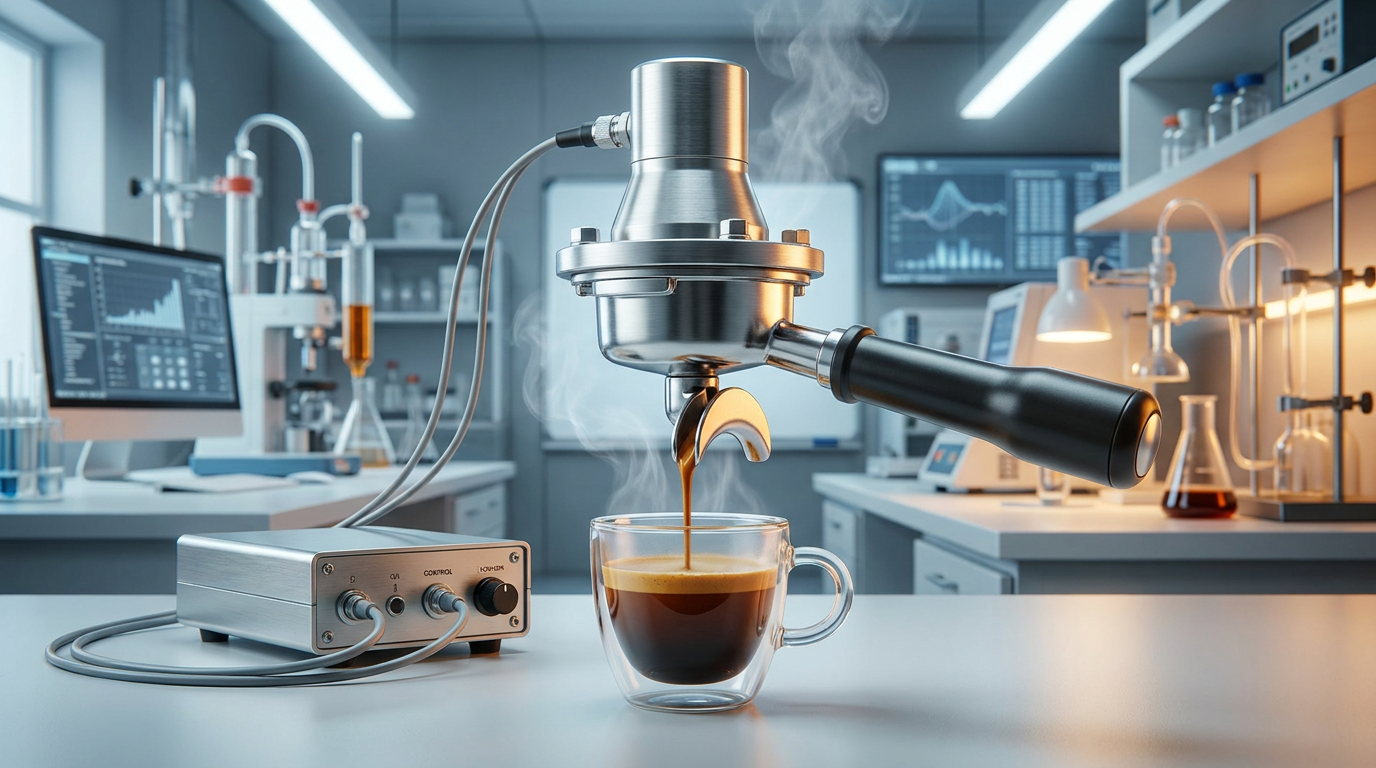
Instead of relying on a traditional boiler, the experimental system uses a bolt-clamped transducer attached directly to a standard espresso filter basket. This metallic horn blasts ultrasonic waves—sound frequencies far beyond the range of human hearing—through the mixture of room-temperature water and coffee grounds.[4][6]
The sound waves trigger a physical phenomenon known as acoustic cavitation. As the ultrasonic vibrations pass through the liquid, they cause billions of microscopic bubbles to rapidly form and collapse. This violent, microscopic activity generates intense localized forces without raising the overall temperature of the water.[3][8]

When these tiny bubbles collapse near the coffee particles, they generate microscopic jets of liquid. Lead researcher Francisco Trujillo describes these jets as acting like invisible scrubbing brushes. They pit and fracture the surface of the coffee grounds, rapidly extracting flavor compounds, emulsified lipids, and caffeine that would normally require near-boiling water to release.[1][3]
The primary benefit of this room-temperature extraction is a massive reduction in energy use. Traditional commercial espresso machines require constant, heavy power draws to maintain a stable boiler temperature of around 90 to 95 degrees Celsius—making them one of the most energy-intensive appliances in any cafe or restaurant.[5][7]
The primary benefit of this room-temperature extraction is a massive reduction in energy use.
The energy math is stark. The UNSW team measured their ultrasonic setup consuming just 0.020 kilowatt-hours to produce three espresso-strength beverages. A conventional single-group espresso machine required 0.0823 kilowatt-hours to produce the same output. That translates to a 75 percent reduction in energy consumption, even before accounting for the conventional machine's initial warm-up time.[2][8]

A major hurdle for any new coffee technology is the notoriously picky palate of coffee drinkers. To prove the concept's viability, the researchers conducted a blind sensory analysis with 100 participants, serving them both traditional hot-brewed shots and the new room-temperature ultrasonic versions.[1][5]
The participants could not reliably distinguish between the two methods. The sensory panel found no significant differences in aroma, flavor, bitterness, or overall liking. Chemical analysis backed up the taste test, showing no significant differences in caffeine levels or chlorogenic acid—a key antioxidant—between the two brews.[2][4]
Interestingly, when the team applied the same ultrasonic method to a lighter, filter-style coffee, the participants actually preferred the sound-wave version over a conventional pour-over. Sixty-one percent of the panel favored the ultrasonic filter coffee, rating its bitterness profile as significantly more pleasant.[2][5]
While home baristas might not be swapping their countertop machines for sonic reactors immediately, the technology holds massive potential for industrial scale. The researchers see immediate applications for companies manufacturing ready-to-drink bottled coffees and milk-based beverages, where cutting energy costs by 75 percent translates to massive operational savings.[4][6]
The system also dramatically accelerates cold brew production. A process that typically requires 12 to 24 hours of steeping in cold water can be compressed into just a few minutes using acoustic cavitation, producing a smooth, highly concentrated liquid that can be shipped globally and diluted later.[3][7]

UNSW currently holds a pending patent on the ultrasonic brewing sonoreactor. With the fundamental science now published and peer-reviewed, the research team is looking toward commercial partnerships to scale the technology, hoping to eventually bring low-energy, high-speed extraction to the global coffee industry.[2][8]
How we got here
May 2024
UNSW researchers publish their first study using ultrasonic waves to accelerate cold brew coffee.
June 2026
The team publishes new research demonstrating the technology can produce espresso-strength coffee using 75 percent less energy.
Viewpoints in depth
Chemical Engineering Researchers
Focuses on the physics of acoustic cavitation and the massive energy efficiency gains of bypassing thermal heating.
For the engineering team at UNSW, the breakthrough is fundamentally about physics and sustainability. By proving that mechanical energy—in the form of acoustic cavitation—can replace thermal energy, they have unlocked a way to perform complex chemical extractions at a fraction of the carbon footprint. Their data shows that the microscopic jets created by collapsing bubbles are just as effective at fracturing coffee grounds as nine bars of hydraulic pressure and near-boiling water, offering a new paradigm for low-energy food processing.
Commercial Coffee Producers
Views the technology as a highly scalable operational upgrade for industrial cold brew and ready-to-drink beverage manufacturing.
Industrial coffee manufacturers operate on massive scales where heating thousands of gallons of water represents a staggering utility cost. For these producers, the 75 percent energy reduction is a game-changer. Furthermore, the ability to compress a 24-hour cold brew steeping cycle into a three-minute ultrasonic pulse means factories can drastically increase their throughput and reduce the physical footprint required for massive steeping vats. The technology allows them to ship highly concentrated, room-temperature extracts globally for later dilution.
Coffee Purists & Consumers
Evaluates the breakthrough strictly on whether it can replicate the aroma, crema, and complex flavor profile of a traditional hot extraction.
The specialty coffee industry is notoriously protective of traditional brewing methods, where variables like temperature stability and tamping pressure are treated as an art form. For this camp, the success of the ultrasonic method hinges entirely on the cup profile. The blind sensory data showing that 100 participants could not tell the difference—and actually preferred the ultrasonic method for filter coffee due to reduced bitterness—is the crucial metric that elevates the technology from a laboratory novelty to a viable consumer product.
What we don't know
- It is unclear how much a commercial ultrasonic espresso machine would cost to manufacture compared to a traditional boiler-based unit.
- Researchers have not yet announced a timeline for when this technology might be available in consumer-facing cafes or home kitchens.
Key terms
- Acoustic cavitation
- The rapid formation and collapse of microscopic bubbles in a liquid, triggered by high-frequency sound waves.
- Transducer
- A device that converts electrical energy into high-frequency mechanical vibrations or sound waves.
- Portafilter
- The spoon-like handle and basket assembly that holds coffee grounds in a traditional espresso machine.
- Extraction yield
- The percentage of a coffee bean's mass that dissolves into the water during the brewing process.
Frequently asked
Does ultrasonic coffee taste different from regular espresso?
In blind taste tests with 100 participants, drinkers could not reliably tell the difference between traditional hot espresso and the room-temperature ultrasonic version.
How long does it take to brew?
The ultrasonic method produces an espresso-strength shot in two to three minutes.
Can this technology be used for cold brew?
Yes. The same acoustic cavitation technology can compress the traditional 12-to-24-hour cold brewing process into just a few minutes.
Why does it save so much energy?
Traditional espresso machines use most of their electricity heating water and maintaining boiler temperatures. The ultrasonic method brews at room temperature, using 75 percent less energy.
Sources
Source coverage
8 outlets
3 viewpoints surfaced








[1]WiredCoffee Purists & Consumers
Scientists Invent a Way to Brew Espresso With Ultrasonic Waves—No Hot Water Required
Read on Wired →[2]Daily Coffee NewsCoffee Purists & Consumers
Researchers Develop 'Ultrasonic Espresso' Using 75% Less Energy
Read on Daily Coffee News →[3]TechRadarChemical Engineering Researchers
Who needs hot water? Researchers made an ultrasonic espresso machine that brews coffee without heat
Read on TechRadar →[4]SlashdotCommercial Coffee Producers
Using Sound Waves To Make Espresso Could Cut Coffee-Brewing Energy Use By 75%
Read on Slashdot →[5]SprudgeCoffee Purists & Consumers
Ultrasonic Espresso Is Here, And It Uses 75% Less Energy
Read on Sprudge →[6]Anthropocene MagazineChemical Engineering Researchers
Sound waves can brew a great cup of espresso—with a fraction of the energy
Read on Anthropocene Magazine →[7]Food ManufactureCommercial Coffee Producers
Ultrasonic coffee brewing promises 75% energy saving
Read on Food Manufacture →[8]Journal of Food EngineeringChemical Engineering Researchers
Ultrasound enables espresso-strength coffee brewing in 2–3 minutes at low temperature with lower energy consumption
Read on Journal of Food Engineering →

More in technology
See all 7 stories →Mobile AI
Apple's iOS 27 Brings Conversational Siri and Smart App Integrations to iPhones
7 sources
Decentralized Web
How Decentralized Social Media Finally Connected the Internet in 2026
6 sources

Identity Tech
The Evidence for Passkeys: How Public-Key Cryptography is Finally Killing the Password
8 sources

Energy Storage
The 2026 Guide to Home Batteries: Costs, Chemistry, and Installation
7 sources
Every angle. Every day.
Get technology stories with full source coverage and perspective breakdowns delivered to your inbox.