
2026 Rivian R2 vs. Tesla Model Y: The Ultimate Electric SUV Trade-Off Analysis
The rugged new Rivian R2 challenges the aerodynamic Tesla Model Y 'Juniper' refresh in a battle for the mid-size electric SUV market.
By Factlen Editorial Team
- Utility & Adventure Buyers
- Prioritize cargo space, ground clearance, and traditional SUV aesthetics.
- Efficiency & Tech Pragmatists
- Focus on aerodynamic range, software integration, and daily commuting ease.
- Value & Timeline Analysts
- Weigh the actual availability dates and starting prices of the base models.
What's not represented
- · Traditional Dealership Networks
- · Independent EV Mechanics
Why this matters
For families and commuters looking to transition to electric vehicles, the mid-size SUV segment is the most practical entry point. Choosing between the aerodynamic efficiency of the Model Y and the rugged utility of the R2 dictates not just daily charging costs, but how the vehicle integrates into road trips, off-road hobbies, and family hauling.
Key points
- The 2026 Rivian R2 and refreshed Tesla Model Y 'Juniper' are battling for dominance in the $45,000 to $60,000 electric SUV market.
- Tesla's Model Y excels in aerodynamic efficiency, software integration, and immediate availability across all price tiers.
- The Rivian R2 offers superior off-road capability, 90.1 cubic feet of cargo space, and a traditional boxy SUV aesthetic.
- Despite weighing 800 pounds more, the Rivian R2 Performance matches the Model Y Performance's 105 MPGe efficiency rating.
- Rivian's heavily advertised $45,000 base model will not enter production until late 2027, leaving only premium trims available in 2026.
The 2026 electric SUV landscape is defined by a heavyweight title fight between the reigning champion and its most formidable challenger to date. Tesla has launched the highly anticipated "Juniper" refresh of its best-selling Model Y, bringing crucial refinements to a proven platform. Meanwhile, Rivian has introduced the R2, a mid-size SUV tasked with translating the brand's rugged, premium adventure ethos into a more accessible package. Both vehicles target the fiercely competitive $45,000 to $60,000 price bracket, aiming to serve as the primary vehicle for modern families.[3][4]
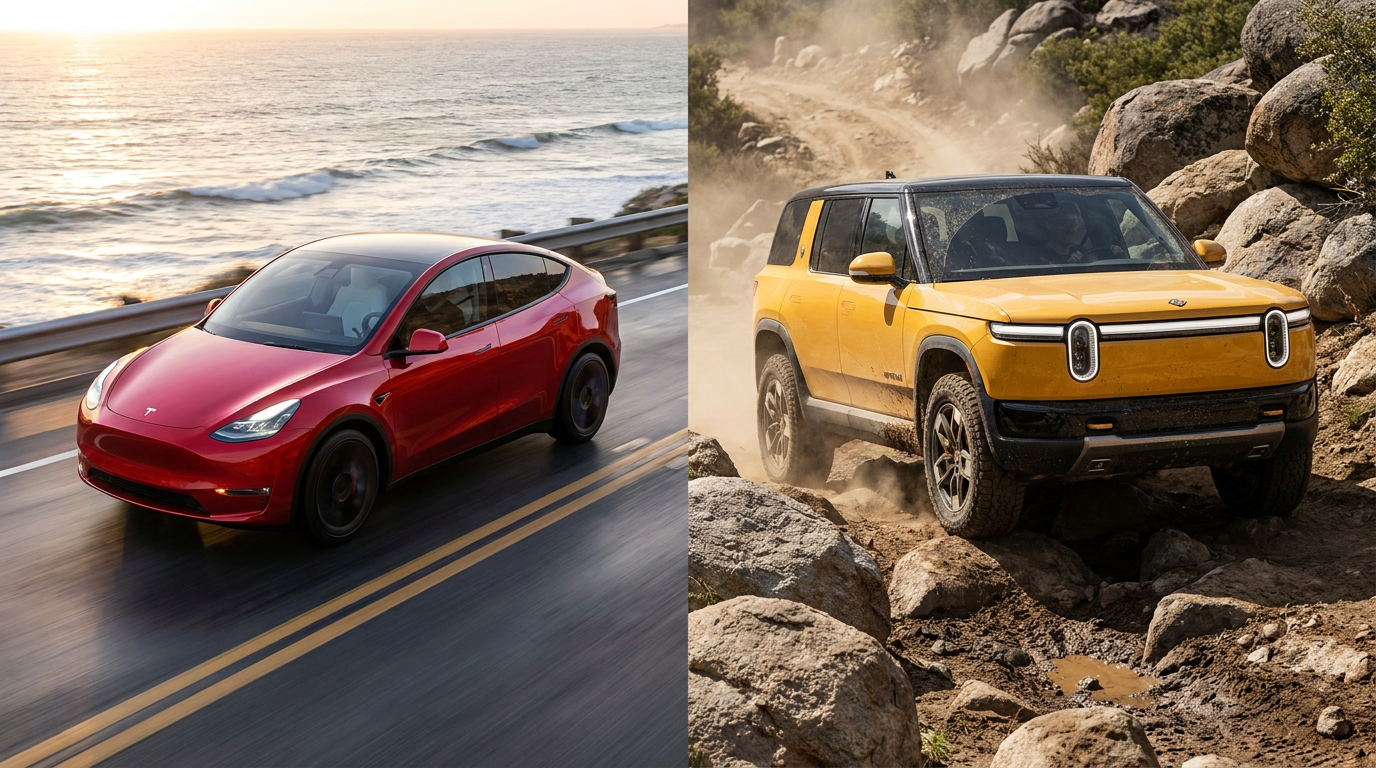
While they compete for the same driveway space, these two electric vehicles pursue vastly different design philosophies. The Tesla Model Y continues its legacy of sleek, aerodynamic curves, prioritizing a teardrop silhouette that cuts through the air with minimal resistance. In stark contrast, the Rivian R2 adopts a ruggedly handsome, boxy aesthetic that feels much closer to a traditional combustion-engine SUV. This fundamental divergence in shape dictates almost every trade-off between the two models, from highway efficiency to interior cargo volume.[6]
For the Tesla Model Y: The vehicle offers unmatched aerodynamic efficiency, a proven software ecosystem, and a sporty, car-like driving dynamic. The 2026 Juniper refresh elevates the cabin experience significantly, introducing acoustic glass, softer interior materials, and improved suspension damping that resolves the notoriously harsh ride of previous generations. It also benefits from immediate availability across all price tiers and seamless integration with the industry-leading Supercharger network.[2][11]
Against the Tesla Model Y: The sloping roofline inherently limits vertical cargo space, making it less practical for hauling bulky items. Furthermore, Tesla's aggressive minimalist approach has removed the steering column stalks entirely, forcing drivers to use steering wheel buttons for turn signals and the central touchscreen to shift gears—a counterintuitive ergonomic choice that continues to frustrate many users.[3]

Evidence: The Model Y Long Range achieves up to 391 miles of range on a highly efficient platform, with real-world testing of the Juniper refresh demonstrating energy consumption as low as 13.8 kilowatt-hours per 100 kilometers. The vehicle maintains a low 6.6-inch ground clearance optimized for highway aerodynamics rather than trail driving, and offers a maximum cargo capacity of 76 cubic feet with the rear seats folded.[6][8][11]
For the Rivian R2: The SUV delivers genuine off-road capability, massive interior volume, and a rugged aesthetic that traditional utility vehicle buyers crave. It features a highly versatile cabin where all seats fold completely flat, dual gloveboxes, and a dedicated 12.3-inch digital driver display directly behind the steering wheel. The suspension utilizes adaptive dampers and coil springs to provide a comfortable ride that effortlessly transitions from highway cruising to muddy trails.[5][6][7]
For the Rivian R2: The SUV delivers genuine off-road capability, massive interior volume, and a rugged aesthetic that traditional utility vehicle buyers crave.
Against the Rivian R2: The vehicle carries a significant weight penalty, tipping the scales at over 5,200 pounds—nearly 800 pounds heavier than the Model Y. Early adopters also face a steep price curve; while Rivian heavily advertises a $45,000 base price, that Standard model will not enter production until late 2027. Buyers in 2026 are limited to the $53,990 Premium and $57,990 Performance trims.[4][12]
Evidence: The Rivian R2 provides a cavernous 90.1 cubic feet of total cargo space and a towering 9.6 inches of ground clearance. Despite its heavier, boxier frame, the R2 Performance utilizes a slightly larger 86.8-kilowatt-hour battery to achieve an EPA-estimated 330 miles of range. Remarkably, this allows the Rivian to match the Model Y Performance's efficiency rating of 105 MPGe combined, proving that Rivian's powertrain engineering has closed the gap with Tesla.[5][6][12]

When it comes to charging infrastructure, the landscape has shifted dramatically in Rivian's favor. The R2 features a native North American Charging Standard (NACS) port, granting owners direct access to Tesla's sprawling Supercharger network without the need for cumbersome adapters. While the Model Y peaks at a 250-kilowatt charge rate on a 400-volt architecture, the Rivian R2 follows closely with a 210-kilowatt peak rate. Both vehicles can replenish their batteries from 10 to 80 percent in approximately 29 minutes under optimal conditions.[1][2]
The interior experiences cater to entirely different tastes. Tesla's Juniper update brings wrap-around ambient lighting and a metallic center console, creating a futuristic, European-inspired lounge that relies entirely on a 15-inch central screen for all vehicle functions. Rivian opts for a warmer, more tactile environment, utilizing extensive open-pore wood trim, pop-out cupholders, and a power-rolling rear window that allows for a breezy, open-air cabin feel.[6][7][11]

Fits well when: The Tesla Model Y is the ideal choice when the buyer prioritizes immediate availability at a lower starting price, maximum aerodynamic efficiency for long highway commutes, and a sportier on-road driving dynamic. It remains the undisputed king for drivers who want a frictionless, tech-forward appliance that excels at daily family transport while keeping energy costs to an absolute minimum.[8][11]
Does not fit when: The Tesla Model Y falls short when the driver frequently ventures off-road, needs to haul large, boxy items like furniture or camping gear, or simply prefers physical driver displays and traditional gear stalks. Its firm ride, even with the Juniper updates, and low ground clearance make it ill-suited for rugged terrain.[2][3][6]

Fits well when: The Rivian R2 is the perfect match when the buyer wants traditional SUV aesthetics, superior cargo volume, and genuine off-road capability without sacrificing electric efficiency. It is the vehicle of choice for outdoor enthusiasts who need a flat floor for car camping, a larger frunk, and a cabin that feels more like a premium adventure tool than a rolling smartphone.[5][8]
Does not fit when: The Rivian R2 is not the right fit when the buyer is strictly capped at a $45,000 budget in 2026, as only the more expensive dual-motor trims are available at launch. It also may not appeal to buyers who prefer the low-slung, agile handling of a crossover, or those who want the absolute highest highway range available, which Tesla's Long Range AWD still edges out.[4][8]
How we got here
2020
Tesla launches the original Model Y, which quickly becomes the best-selling electric vehicle in the world.
March 2024
Rivian officially unveils the R2 concept, promising a $45,000 starting price and native NACS charging.
Late 2025
Tesla rolls out the 'Juniper' refresh for the Model Y, introducing acoustic glass, ambient lighting, and improved suspension.
Summer 2026
Rivian begins initial deliveries of the R2 Performance and Premium trims to early reservation holders.
Late 2027
The highly anticipated $45,000 entry-level Rivian R2 Standard is scheduled to finally enter production.
Viewpoints in depth
Utility and Off-Road Enthusiasts
Buyers who prioritize cargo volume, ground clearance, and rugged capability.
This camp strongly favors the Rivian R2. They argue that an SUV should inherently offer utility, pointing to the R2's 90.1 cubic feet of cargo space, fold-flat seats, and 9.6 inches of ground clearance as evidence that Rivian understands the segment better than Tesla. They view the Model Y's teardrop shape as a compromise that sacrifices practicality for aerodynamics, and they value the R2's ability to handle muddy trails and deep snow without risking undercarriage damage.
Efficiency and Tech Pragmatists
Drivers focused on energy consumption, software reliability, and daily commuting ease.
This group champions the Tesla Model Y Juniper. They emphasize that for 95% of daily driving, aerodynamic efficiency and software integration matter far more than off-road ground clearance. They cite the Model Y's incredible 13.8 kWh/100km real-world efficiency and its seamless, proven infotainment ecosystem as the ultimate conveniences. To this camp, the Rivian's boxy shape is an unnecessary aerodynamic penalty for drivers who rarely leave paved roads.
Value-Conscious Families
Consumers weighing the total cost of ownership, immediate availability, and base pricing.
This perspective leans toward the Tesla Model Y due to its immediate availability across all price tiers in 2026. They point out that while Rivian advertises a $45,000 starting price, that Standard model won't arrive until late 2027. For families needing a vehicle today, the Model Y offers a lower barrier to entry, proven reliability, and a massive Supercharger network that guarantees stress-free road trips without the premium price tag of the R2's launch editions.
What we don't know
- Whether Rivian can scale production of the R2 quickly enough at its Normal, Illinois plant to meet the massive backlog of early reservations.
- The exact battery specifications and real-world range of the entry-level $45,000 Rivian R2 Standard, which remains tightly guarded.
- How Tesla will adjust Model Y pricing in late 2026 and 2027 to counter the arrival of the cheaper Rivian R2 trims.
Key terms
- NACS (North American Charging Standard)
- The charging plug design originally developed by Tesla, which has now been adopted by most major automakers, including Rivian, for seamless access to the Supercharger network.
- MPGe (Miles Per Gallon Equivalent)
- A metric used by the EPA to compare the energy efficiency of electric vehicles to traditional gas-powered cars.
- Juniper
- The unofficial industry code name for the major 2025/2026 design and engineering refresh of the Tesla Model Y.
- Torque Vectoring
- A technology that independently controls the power sent to each wheel, vastly improving grip and stability on slippery or uneven off-road terrain.
Frequently asked
When can I actually buy a $45,000 Rivian R2?
While Rivian has heavily advertised the $45,000 starting price, the entry-level Standard trim will not enter production until late 2027. Buyers in 2026 are limited to the Premium and Performance trims, which start at $53,990 and $57,990, respectively.
Can the Rivian R2 use Tesla Superchargers?
Yes. The Rivian R2 is built with a native North American Charging Standard (NACS) port, allowing it to plug directly into Tesla's Supercharger network without requiring an adapter.
Did Tesla fix the harsh ride in the new Model Y?
Yes. The 2026 'Juniper' refresh includes updated suspension with adaptive dampers and stiffer bushings, which significantly improves ride comfort and cabin refinement compared to older models.
Which SUV has more cargo space?
The Rivian R2 offers significantly more volume, providing 90.1 cubic feet of total cargo space with the seats folded flat, compared to the Model Y's maximum of 76 cubic feet.
Sources
Source coverage
12 outlets
3 viewpoints surfaced












[1]EdmundsValue & Timeline Analysts
2027 Rivian R2 Prices, Reviews, and Pictures
Read on Edmunds →[2]MaxxiaEfficiency & Tech Pragmatists
Tesla Model Y Juniper Performance 2026 Review
Read on Maxxia →[3]CinchEfficiency & Tech Pragmatists
Tesla Model Y Juniper review 2026 | Road-tested
Read on Cinch →[4]EVValue & Timeline Analysts
Rivian R2 Starts at $57,990 as Pricing and Specs Leak Before Official Reveal
Read on EV →[5]CarBuzzUtility & Adventure Buyers
All The Ways The Rivian R2 Performance Beats Tesla's Top Model Y
Read on CarBuzz →[6]Car ConfectionsUtility & Adventure Buyers
2027 Rivian R2 vs. 2026 Tesla Model Y: Trouble for Tesla?
Read on Car Confections →[7]Car and DriverUtility & Adventure Buyers
2027 Rivian R2 First Drive: From Normal, Is Normal
Read on Car and Driver →[8]CarwowValue & Timeline Analysts
Rivian R2 vs Tesla Model Y: which electric SUV does Mat Watson prefer?
Read on Carwow →[9]InsideEVsValue & Timeline Analysts
2026 Rivian R2: Everything We Know
Read on InsideEVs →[10]AutonocionValue & Timeline Analysts
The cheapest Rivian R2 you can buy in 2026 is $57,990
Read on Autonocion →[11]Henry ManEfficiency & Tech Pragmatists
2026 Tesla Model Y review
Read on Henry Man →[12]ElectrekValue & Timeline Analysts
Rivian R2 matches Tesla Model Y efficiency despite bigger, heavier body
Read on Electrek →
Every angle. Every day.
Get automotive stories with full source coverage and perspective breakdowns delivered to your inbox.