
Why Brazilian Jiu-Jitsu and Martial Arts Are Becoming the Ultimate 'Brain Game' for Adults
Researchers are increasingly pointing to complex martial arts like Brazilian Jiu-Jitsu and Tai Chi as potent interventions against age-related cognitive decline, citing massive boosts in neuroplasticity and memory.
By Factlen Editorial Team
- Neuroscience Community
- Focuses on empirical data, emphasizing how complex motor learning elevates BDNF and builds cognitive reserve.
- Adult Practitioners
- Values the immediate psychological benefits, stress relief, and the engaging 'physical chess' aspect of training.
- Public Health Experts
- Emphasizes holistic well-being, fall prevention, and scalable interventions for aging populations.
What's not represented
- · Adults with pre-existing physical disabilities who may face barriers to traditional martial arts training.
- · Instructors specializing in adaptive martial arts for elderly populations.
Why this matters
As the global population ages and dementia rates rise, finding engaging, sustainable ways to maintain cognitive function is critical. Complex motor learning offers a protective buffer against memory loss while simultaneously improving physical fitness and emotional resilience.
Key points
- Martial arts require complex motor learning, which forces the brain to build new neural pathways.
- Training elevates BDNF, a crucial protein for memory and neuronal survival.
- Practitioners show increased gray matter in the hippocampus and prefrontal cortex.
- The intense focus required acts as a powerful stress-relief mechanism.
- Soft arts like Tai Chi offer similar cognitive benefits without the physical impact.
The modern adult fitness landscape is heavily dominated by repetitive motions—running on treadmills, lifting static weights, or following choreographed spin classes. While excellent for cardiovascular health and muscular endurance, these routines eventually become second nature, allowing the mind to wander and the brain to operate on autopilot.[6]
But a growing cohort of adults is trading the treadmill for the tatami mat. Brazilian Jiu-Jitsu (BJJ), Judo, and Tai Chi are experiencing a surge in older demographics, driven not by a desire for self-defense or competition, but by a quest for cognitive longevity and mental clarity.[5][6]
Researchers and neurologists are increasingly viewing complex martial arts as a potent intervention against age-related cognitive decline. The combination of intense physical exertion, real-time problem solving, and social engagement creates a unique neurological stimulus that traditional solitary exercises struggle to match.[1][2]
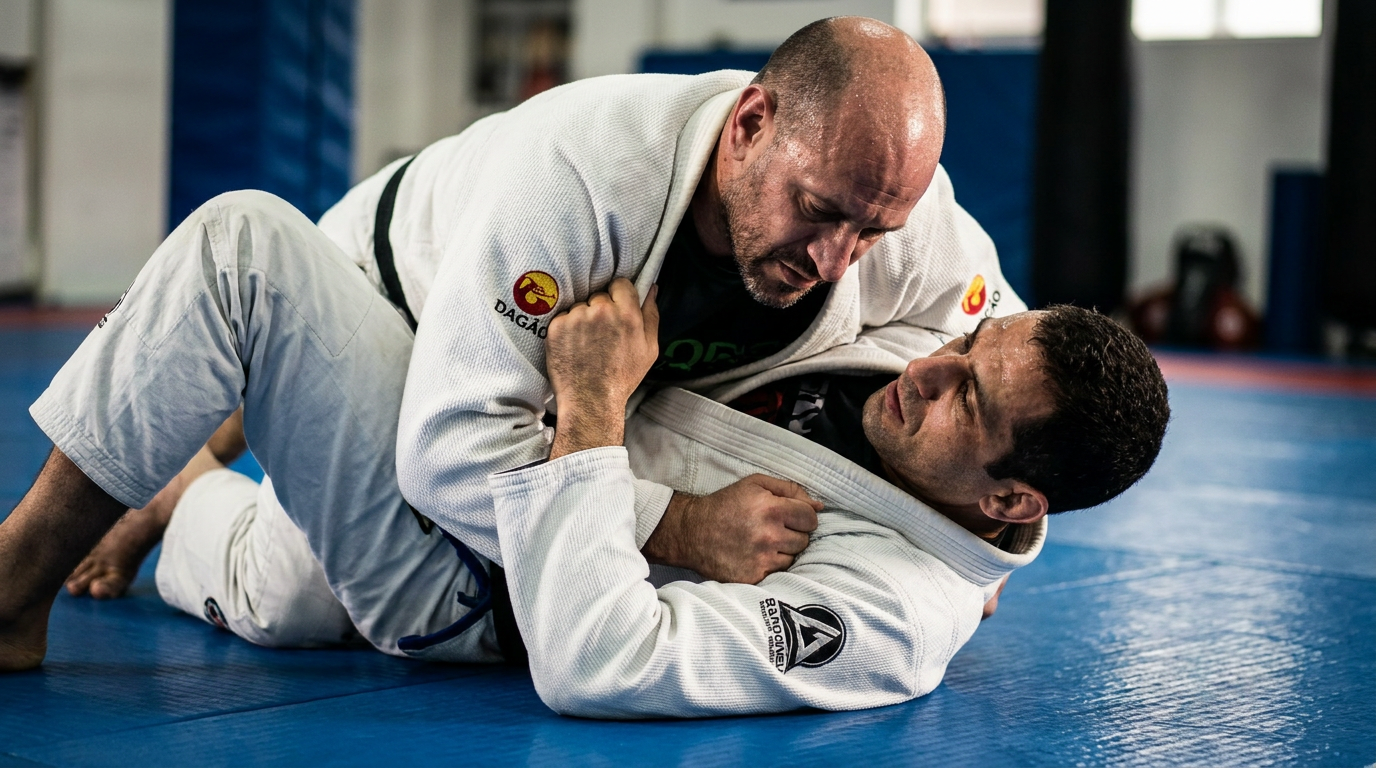
At the core of this phenomenon is the concept of "physical chess." In grappling arts like Brazilian Jiu-Jitsu, practitioners are constantly presented with dynamic, high-stakes puzzles that require immediate solutions.[5]

Every roll (sparring session) requires the brain to process spatial awareness, anticipate an opponent's movements, and execute multi-step techniques under physical pressure. This forces the brain into a state of hyper-focus, leaving absolutely no bandwidth for external stressors like work deadlines or personal anxieties.[5]
From a neurobiological perspective, this constant problem-solving triggers significant neuroplasticity—the brain's ability to form and reorganize synaptic connections. The brain is essentially forced to upgrade its own hardware to handle the new demands being placed upon it.[1][5]
When an adult learns a complex new motor sequence, such as a transition from a closed guard to a triangle choke, the brain builds entirely new neural pathways. This continuous, lifelong learning keeps the adult brain plastic, adaptable, and resilient against the natural decay of aging.[5][6]
The chemical catalyst for this adaptation is Brain-Derived Neurotrophic Factor (BDNF). Often referred to by neuroscientists as "Miracle-Gro for the brain," BDNF is a crucial protein responsible for neuronal survival, synaptic plasticity, and memory function.[1][2]

Studies on older adults engaging in martial arts have consistently demonstrated elevated peripheral BDNF levels. This biochemical boost directly counters the natural drop in BDNF that typically accompanies aging and contributes to memory loss and cognitive sluggishness.[1]
Studies on older adults engaging in martial arts have consistently demonstrated elevated peripheral BDNF levels.
Beyond neurochemistry, martial arts practice induces measurable structural changes in the brain. Neuroimaging studies reveal that regular training actually increases gray matter volume in critical areas responsible for higher-order thinking.[1][4]
Specifically, the hippocampus—the region responsible for the storage and retrieval of long-term memory—shows increased activity and density in martial artists compared to sedentary control groups.[1][4]
Similarly, the prefrontal cortex, which governs executive functions like decision-making, impulse control, and working memory, exhibits enhanced functional connectivity. This translates directly to better multitasking and faster information processing speeds in daily life.[1][2]

The benefits extend to perceptual skills as well. Research published in the European Review of Aging and Physical Activity found that older adults who practice martial arts possess superior visual and spatial cognition compared to their peers.[3]
Practitioners of fast-moving arts like Judo and Karate demonstrated better peripheral vision and a heightened ability to resolve details on moving objects—skills that are vital for fall prevention, spatial navigation, and safe driving in old age.[3]
Mental health and emotional regulation form another critical pillar of the martial arts brain-health matrix. The intense physical exertion of grappling helps regulate stress hormones like cortisol and adrenaline, which can be toxic to the brain in chronically high doses.[2][5]
Simultaneously, the practice floods the brain with endorphins, dopamine, and serotonin. Practitioners often report a profound sense of mental clarity and emotional resilience after training, a phenomenon rooted in the "stress inoculation" of surviving controlled physical combat.[5]

It is not only the "hard" martial arts that offer these benefits. "Soft" styles like Tai Chi and Baduanjin have been extensively studied for their neuroprotective effects, proving that high-impact collisions are not required to reap the cognitive rewards.[1][4]
These meditative practices emphasize slow, deliberate movements, balance, and deep mind-body connection. Clinical trials have shown that Tai Chi significantly improves memory and cognition in the elderly, offering a low-impact alternative with high neurological rewards.[4]
Furthermore, the theory of "embodied cognition" suggests that our cognitive functions are deeply rooted in sensorimotor experiences. Martial arts provide a rich tapestry of movement flow, attention management, and interpersonal interaction that solitary exercises simply lack.[2]

Viewpoints in depth
Neuroscientists & Researchers
Focuses on the measurable biomarkers and structural brain changes induced by complex movement.
For the scientific community, martial arts represent a highly efficient, multi-modal intervention. Rather than prescribing separate regimens for cardiovascular health, balance, and cognitive stimulation, researchers view martial arts as a unified package. The primary interest lies in the measurable elevation of Brain-Derived Neurotrophic Factor (BDNF) and the observable thickening of the cortical regions. By forcing the brain to constantly adapt to new spatial and tactical puzzles, practitioners build a 'cognitive reserve' that can delay the onset of dementia symptoms.
Adult Practitioners
Focuses on the immediate psychological benefits, stress relief, and the flow state.
For those on the mats, the neurochemical changes are felt as immediate psychological relief. Adult practitioners frequently cite the 'forced mindfulness' of the sport as its biggest draw. When an opponent is actively trying to apply a submission hold, it is impossible to ruminate on work deadlines or financial stress. This intense, immediate presence induces a flow state that flushes cortisol from the system and replaces it with endorphins, leaving practitioners feeling mentally reset and emotionally resilient after a session.
Public Health Advocates
Focuses on the scalable nature of these practices as preventative health measures.
Public health experts view the rise of adult martial arts through the lens of population-level aging. With the medical costs of cognitive decline projected to skyrocket, finding interventions that adults actually enjoy and stick with is a massive priority. Because martial arts academies foster strong social communities, adherence rates are often higher than traditional gym memberships. Advocates argue that promoting community-based Tai Chi, Judo, or BJJ could serve as a low-cost, high-yield public health strategy to keep aging populations physically independent and mentally sharp.
What we don't know
- The exact minimum dosage (minutes per week) of martial arts required to trigger optimal BDNF release is still being studied.
- How different styles of martial arts (e.g., striking vs. grappling) compare head-to-head in long-term neuroprotective efficacy.
- The degree to which the social community aspect of martial arts contributes to cognitive preservation versus the physical movement itself.
Key terms
- Neuroplasticity
- The brain's ability to reorganize itself by forming new neural connections throughout life in response to learning and experience.
- BDNF (Brain-Derived Neurotrophic Factor)
- A crucial protein that acts like fertilizer for the brain, supporting the survival of existing neurons and encouraging the growth of new ones.
- Prefrontal Cortex
- The part of the brain located at the front of the frontal lobe, responsible for complex behaviors, decision-making, and moderating social behavior.
- Hippocampus
- A complex brain structure embedded deep into the temporal lobe, playing a major role in learning and memory storage.
- Embodied Cognition
- The psychological theory that cognitive processes are deeply rooted in the body's interactions with the physical world.
- Physical Chess
- A colloquial term used to describe grappling arts like BJJ, highlighting the strategic, problem-solving nature of the sport.
Frequently asked
Am I too old to start Brazilian Jiu-Jitsu or Judo?
No. Many academies offer beginner or older-adult specific classes. Experts recommend starting slowly, focusing on technique over intensity, and communicating clearly with training partners to prevent injury.
How does martial arts differ from lifting weights for brain health?
While weightlifting is excellent for overall health, martial arts require complex, real-time problem solving and spatial awareness, which triggers higher levels of neuroplasticity and cognitive engagement.
What is BDNF and why does it matter?
Brain-Derived Neurotrophic Factor (BDNF) is a protein that promotes the survival of neurons and the growth of new synapses. It is crucial for learning and memory, and its levels naturally decline with age.
Do I have to spar to get the cognitive benefits?
Not necessarily. While live sparring (rolling) provides a high cognitive load, drilling complex techniques and practicing forms (like in Tai Chi) also significantly stimulate neuroplasticity and memory.
Sources
Source coverage
6 outlets
3 viewpoints surfaced






[1]National Institutes of HealthNeuroscience Community
Martial arts exercise as a multifaceted intervention for promoting mental health and cognitive vitality among older adults
Read on National Institutes of Health →[2]Psychology TodayPublic Health Experts
How Martial Arts Promote Mental Health and Successful Aging
Read on Psychology Today →[3]Medical News BulletinPublic Health Experts
Can Martial Arts Slow Down Cognitive Decline?
Read on Medical News Bulletin →[4]Frontiers in Aging NeuroscienceNeuroscience Community
Mind-Body Exercises and Memory Improvement in the Elderly
Read on Frontiers in Aging Neuroscience →[5]White Belt ClubAdult Practitioners
The Cognitive Benefits of Brazilian Jiu-Jitsu for Adults
Read on White Belt Club →[6]Factlen Editorial Team
Synthesis by Factlen editorial team
Read on Factlen Editorial Team →
Every angle. Every day.
Get fitness stories with full source coverage and perspective breakdowns delivered to your inbox.