
How the 'New Golden Route' is Solving Japan's Overtourism Crisis
A strategic bullet train extension and a discounted regional rail pass are funneling travelers away from crowded Kyoto and into Japan's culturally rich, lesser-known northern coast.
By Factlen Editorial Team
- Sustainable Tourism Advocates
- Focus on dispersing tourist crowds to protect the environment and infrastructure of Japan's mega-cities.
- Budget-Conscious Travelers
- Prioritize the significant cost savings of regional rail passes over the newly expensive nationwide options.
- Regional Economies
- View the redirected tourist traffic as a vital economic lifeline for depopulating rural prefectures.
What's not represented
- · Local residents in newly popular Hokuriku towns
- · Traditional Tokaido route hospitality businesses
Why this matters
For travelers, this route offers a cheaper, more authentic way to experience Japan without fighting through crowds. For Japan, it provides an economic lifeline to rural towns while saving its mega-cities from infrastructural collapse.
Key points
- Overtourism in Kyoto and Tokyo has forced Japan to promote alternative travel routes.
- The 'New Golden Route' takes travelers along the less-crowded Sea of Japan coast.
- A March 2024 Shinkansen extension to Tsuruga made the route seamlessly viable.
- The Hokuriku Arch Pass offers a cheaper alternative to the expensive nationwide JR Pass.
- The route provides a vital economic boost to rural, depopulating prefectures.
Japan is experiencing a tourism boom of unprecedented scale. After years of pandemic-era closures, the country is now hurtling toward an ambitious government target of 60 million inbound visitors by 2030—nearly double its pre-pandemic record. But this economic windfall has come with a severe geographic bottleneck. The vast majority of these visitors funnel directly into the traditional "Golden Route," a high-speed corridor linking Tokyo, Kyoto, and Osaka along the Pacific coast.[2]
The result has been a textbook case of overtourism. In Kyoto, local buses are frequently too packed for residents to use, and the serene atmosphere of historic neighborhoods has been replaced by gridlock. The strain on infrastructure, waste management, and local patience has forced the Japan National Tourism Organization (JNTO) to aggressively pivot its strategy toward dispersion. The goal is no longer just bringing people to Japan, but getting them off the beaten path.[1][2]
Enter the "New Golden Route." Instead of darting straight south from Tokyo to Kyoto, this alternative path forms a sweeping arch northward, traveling along the Sea of Japan coast through the Hokuriku region. It trades the hyper-efficiency of the southern Tokaido corridor for a slower, culturally immersive journey through mountainous prefectures and historic coastal towns.[3][4]

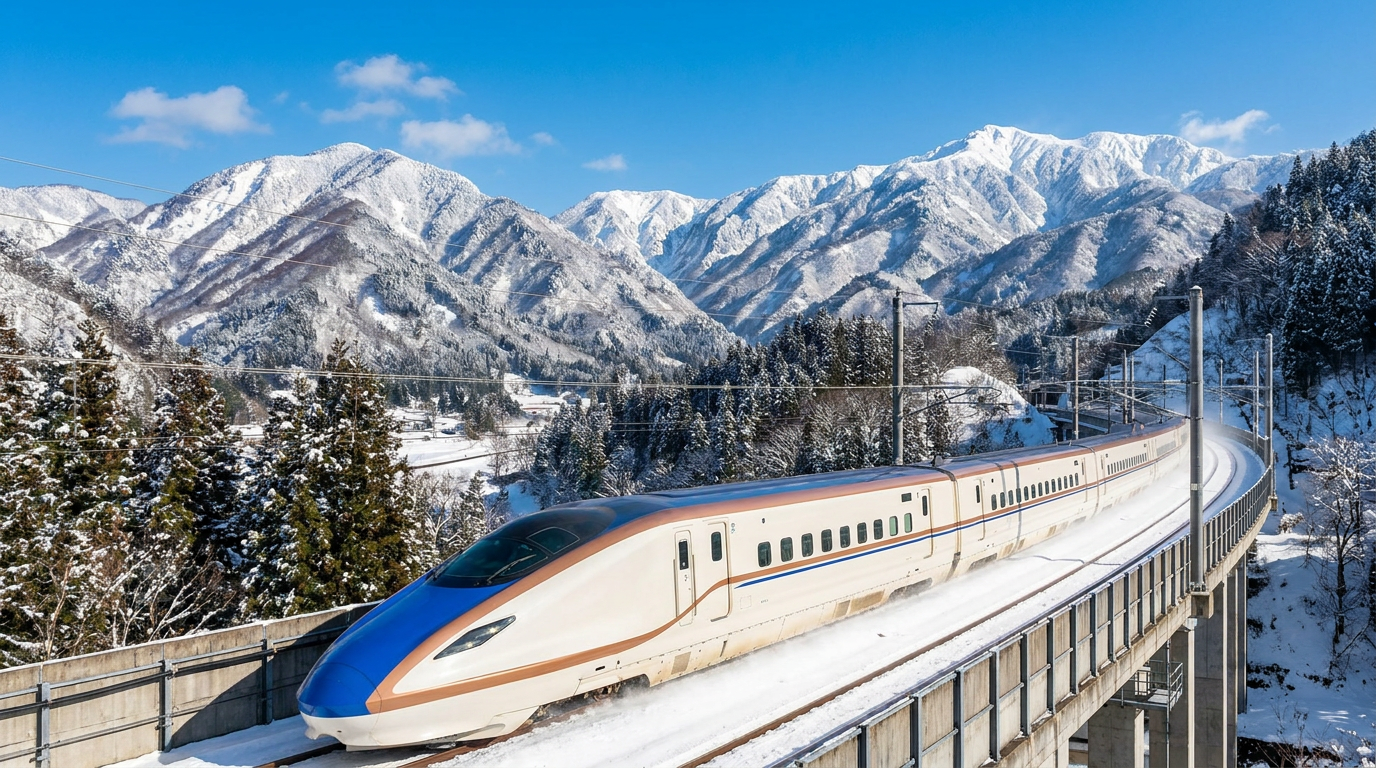
The catalyst that made this route viable for mainstream travelers was a major infrastructure milestone in March 2024: the extension of the Hokuriku Shinkansen. Previously, the bullet train line terminated in Kanazawa, requiring awkward transfers for travelers trying to continue south to Kyoto. The extension pushed the high-speed line down to Tsuruga in Fukui Prefecture, closing a crucial gap in the transit network.[4]
With the extension complete, travelers can now ride the Shinkansen deep into western Japan before making a single, streamlined transfer to the Thunderbird limited express train, which completes the final leg into Kyoto and Osaka. This seamless connectivity transformed the Hokuriku region from a remote detour into a highly practical travel corridor.[4][5]
The financial engine driving travelers to this new route is the Hokuriku Arch Pass. In late 2023, the nationwide Japan Rail (JR) Pass—long considered the ultimate cheat code for budget travel in Japan—underwent a staggering 70% price increase. The hike priced many tourists out of the nationwide pass, sending them scrambling for regional alternatives.[3][4]
The Hokuriku Arch Pass emerged as the perfect substitute. Valid for seven consecutive days, the pass costs significantly less than the nationwide equivalent while covering the entire journey from Tokyo's airports, through the northern coast, and down into the Kansai region (Kyoto, Osaka, and Nara). For travelers planning a one-way, multi-stop journey between Japan's two biggest urban hubs, the math heavily favors the Arch Pass.[3][4]

For travelers planning a one-way, multi-stop journey between Japan's two biggest urban hubs, the math heavily favors the Arch Pass.
Unlike the traditional route, which is designed to blur past the countryside at 300 kilometers per hour, the New Golden Route is explicitly designed for multi-day exploration. The first major stop out of Tokyo is Nagano, a mountainous prefecture famous for the 1,400-year-old Zenko-ji Temple and the wild snow monkeys that bathe in the hot springs of Jigokudani.[1][4]
Moving west, the train reaches Toyama, a gateway to the dramatic peaks of the Northern Japan Alps and the spectacular Kurobe Gorge. Here, travelers can ride open-air sightseeing trains through deep ravines, a stark contrast to the neon-soaked streets of Tokyo they left behind just hours earlier.[1][4]
The cultural crown jewel of the route is Kanazawa, the capital of Ishikawa Prefecture. Often referred to as "Little Kyoto," Kanazawa was spared from bombing during World War II, leaving its historic geisha teahouses and samurai districts immaculately preserved. It is also home to Kenrokuen, widely considered one of Japan's top three traditional landscape gardens.[1][4]

Further down the line lies Fukui Prefecture, a region that historically saw very little international foot traffic. Today, pass holders are stopping to explore Maruoka Castle—one of the few original wooden castles left in Japan—and Eiheiji, a sprawling, moss-covered Zen Buddhist temple complex nestled deep in the mountains.[4][5]
For the JNTO, funneling tourists into these specific prefectures is a matter of economic survival for rural Japan. As the country grapples with severe demographic decline, many traditional towns are shrinking. The influx of foreign capital to local ryokans (inns), sake breweries, and craft workshops provides a vital economic lifeline that simply isn't needed in wealthy mega-cities like Tokyo.[1][2]

However, the route does require a shift in traveler mindset. The total transit time from Tokyo to Kyoto via the Hokuriku Arch is roughly five hours, compared to just two and a half hours on the direct southern route. It is not built for those in a rush, and attempting to use the pass for a quick round-trip is logistically exhausting.[3][4]
Furthermore, while the train infrastructure is world-class, some of the rural stops along the route are still adapting to international tourism. English signage can be sparse outside the immediate vicinity of the train stations, and local bus schedules to remote shrines or gorges require careful planning.[2][5]
Despite these minor hurdles, the New Golden Route represents a necessary evolution in how the world experiences Japan. By trading the crowded, high-speed efficiency of the Tokaido corridor for the scenic, deliberate pace of the Hokuriku coast, travelers are discovering a quieter, more authentic side of the country—and helping to preserve it in the process.[1][5]
How we got here
Late 2023
The nationwide Japan Rail (JR) Pass sees a massive 70% price increase, prompting travelers to seek regional alternatives.
March 2024
The Hokuriku Shinkansen extension to Tsuruga opens, streamlining travel along the Sea of Japan coast.
May 2024
Japan records its highest monthly tourist arrivals in history, intensifying overtourism concerns in Kyoto and Tokyo.
2026
The 'New Golden Route' becomes a primary recommendation for sustainable, off-the-beaten-path travel in Japan.
Viewpoints in depth
Sustainable Tourism Advocates
Tourism boards and environmental groups view the route as a necessary pressure-release valve.
For organizations like the JNTO, the traditional Golden Route is no longer sustainable. The sheer volume of foot traffic in Kyoto and Tokyo is degrading the very cultural sites tourists come to see, while alienating local residents who can no longer use their own public transit. By heavily marketing the Hokuriku Arch, these advocates hope to disperse the environmental and infrastructural load across a much wider geographic area, proving that tourism can be managed responsibly.
Budget-Conscious Travelers
International visitors are utilizing the route primarily as a financial workaround to recent price hikes.
For decades, the nationwide JR Pass was an automatic purchase for anyone visiting Japan. When prices skyrocketed by 70% in late 2023, the math fundamentally changed. Travel forums and guidebooks quickly pivoted to regional passes. For these travelers, the New Golden Route isn't just about cultural immersion; it is a highly calculated financial decision. The Hokuriku Arch Pass allows them to visit Tokyo, Kyoto, and Osaka while saving hundreds of dollars, treating the northern coastal stops as a scenic bonus rather than the primary draw.
Regional Economies
Rural prefectures see the redirected traffic as a crucial tool for economic survival.
Prefectures like Fukui and Toyama have long struggled with the dual threats of an aging population and the migration of young people to Tokyo. The sudden influx of international tourists brought by the Shinkansen extension represents a rare injection of outside capital. Local governments are rapidly adapting, subsidizing English-language training for ryokan staff and expanding rural bus routes to ensure that tourist dollars reach local craftsmen, farmers, and hospitality workers who desperately need the revenue.
What we don't know
- Whether rural infrastructure in the Hokuriku region can handle a sustained, multi-year surge in international tourists.
- If the cost of the Hokuriku Arch Pass will eventually be raised to match the nationwide JR Pass pricing model.
Key terms
- Shinkansen
- Japan's network of high-speed railway lines, commonly known internationally as bullet trains.
- Overtourism
- A phenomenon where the volume of tourists in a destination causes significant disruption to local residents, infrastructure, and the environment.
- Tokaido Corridor
- The heavily urbanized, high-speed route along Japan's Pacific coast that connects Tokyo, Nagoya, Kyoto, and Osaka.
- Ryokan
- A traditional Japanese inn, typically featuring tatami-matted rooms, communal hot spring baths, and local multi-course cuisine.
Frequently asked
What is the New Golden Route?
It is a travel corridor connecting Tokyo and Kyoto/Osaka via the Hokuriku region on the Sea of Japan coast, offering a slower, less crowded alternative to the traditional southern route.
Is the Hokuriku Arch Pass worth it?
Yes, if you plan to spend several days exploring stops like Nagano, Kanazawa, and Fukui. It is significantly cheaper than the nationwide JR Pass for this specific route.
Do I have to transfer trains on this route?
Yes. The Hokuriku Shinkansen currently ends at Tsuruga. From there, travelers must transfer to the Thunderbird limited express train to reach Kyoto and Osaka.
Can I use the pass for a quick round trip?
While technically possible, the pass is best used for a one-way, multi-day journey. The five-hour transit time makes quick round trips between Tokyo and Kyoto inefficient.
Sources
Source coverage
5 outlets
3 viewpoints surfaced




[1]Japan National Tourism OrganizationSustainable Tourism Advocates
Sustainable Travel in Japan: Off the Beaten Track
Read on Japan National Tourism Organization →[2]The Japan TimesSustainable Tourism Advocates
As tourists return, Japan seeks to balance economic boon with sustainability
Read on The Japan Times →[3]Japan-GuideBudget-Conscious Travelers
Hokuriku Arch Pass
Read on Japan-Guide →[4]JR PassBudget-Conscious Travelers
Hokuriku Arch Pass: Your Guide to Japan's New Golden Route
Read on JR Pass →[5]Factlen Editorial TeamRegional Economies
Synthesis by Factlen editorial team
Read on Factlen Editorial Team →
Every angle. Every day.
Get travel stories with full source coverage and perspective breakdowns delivered to your inbox.