
The 2026 Guide to the 'Whole-Home Electrification' Remodel
As federal rebates finally roll out, homeowners are combining heat pumps, induction stoves, and smart electrical panels to bypass costly utility upgrades and future-proof their homes.
By Factlen Editorial Team
- Electrification Advocates
- Pushing for rapid adoption of electric appliances to meet climate goals.
- Pragmatic Installers
- Focused on building science, proper sizing, and cost-effective retrofits.
- Policy & Grid Planners
- Managing the rollout of rebates and the impact on electrical infrastructure.
What's not represented
- · Renters who cannot authorize structural upgrades to their homes
- · Fossil fuel industry representatives advocating for natural gas retention
Why this matters
Upgrading an older home to run entirely on electricity used to trigger a $5,000 utility service upgrade. New smart panel technology and 2026 federal rebates have eliminated that bottleneck, making it cheaper to ditch fossil fuels.
Key points
- The 2026 home remodeling trend has shifted toward utility upgrades, driven by heat pumps and smart panels.
- Installing a heat pump in an older home requires an 'envelope first' approach of air sealing and insulation.
- Smart electrical panels use dynamic load management to legally bypass costly 200-amp utility service upgrades.
- The federal HOMES and HEAR rebate programs are now active, offering up to $14,000 in point-of-sale discounts.
- Point-of-sale rebates eliminate the need for homeowners to wait until tax season to recoup their investment.
The great American home remodel has shifted its focus. While previous decades saw homeowners pouring budgets into granite countertops and open-concept living spaces, the defining renovation of 2026 is happening in the utility room. Driven by a combination of climate awareness, volatile fossil fuel prices, and a massive injection of federal funding, millions of households are undertaking the "whole-home electrification" remodel.[6]
This transition involves ripping out gas furnaces, gas stoves, and outdated breaker boxes in favor of high-efficiency heat pumps, induction cooktops, and smart electrical panels. According to data from Rewiring America, the United States needs to install 24 million new electric machines by 2026 to stay on a trajectory toward net-zero emissions by 2050. What was once a niche project for early adopters has rapidly become the standard path for modernizing an older property.[4]
At the center of this shift is the modern inverter heat pump. Unlike traditional furnaces that burn fuel to create warmth, heat pumps use electricity to move ambient heat from one place to another. Because the technology is reversible, a single unit provides both high-efficiency air conditioning in the summer and robust heating in the winter. In 2026, the question for most homeowners facing a failing HVAC system is no longer whether a heat pump works, but how to properly integrate it into an aging house.[1]
The reality of retrofitting older homes is complex. Dropping a state-of-the-art heat pump into a drafty, pre-1950s house with uninsulated walls is a recipe for skyrocketing electricity bills and reduced comfort. Building science experts emphasize an "envelope first" strategy: air sealing the attic and basement, followed by dense-pack wall insulation, must precede the HVAC installation. Dollar for dollar, sealing leaks provides significantly more energy savings than simply upgrading equipment.[5]

Even when the building envelope is secured, homeowners frequently hit a hard infrastructural wall: the electrical panel. A vast portion of the American housing stock still operates on 100-amp or even 60-amp electrical services. When a homeowner attempts to add a heat pump, an electric vehicle charger, and an induction stove to one of these older panels, the total potential power draw vastly exceeds the panel's physical capacity.[5]
Historically, the only solution to this bottleneck was a heavy-up—a full utility service upgrade to a 200-amp panel. This process is notoriously painful. It typically costs between $2,500 and $5,000, requires coordination with the local utility company, and often involves trenching up the front yard to lay thicker subterranean cables. For many homeowners, this hidden five-figure prerequisite killed the electrification project before it even began.[5]
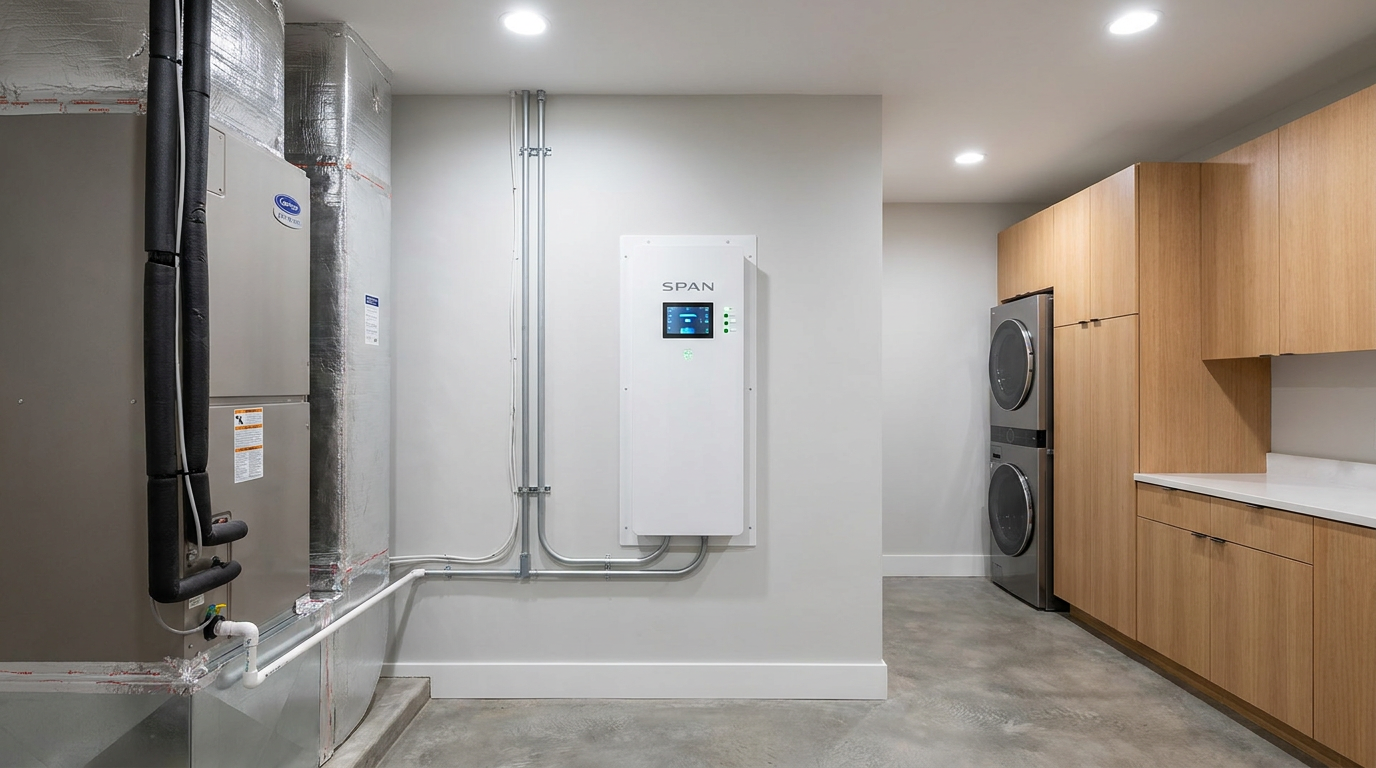
In 2026, technology has provided a legal and highly effective workaround. The smart electrical panel has emerged as the linchpin of the modern home retrofit. Companies like SPAN and Lumin have engineered internet-connected breaker boxes that replace traditional "dumb" panels, offering real-time circuit-level monitoring and control via a smartphone app.[5]
In 2026, technology has provided a legal and highly effective workaround.
The magic of these devices lies in a feature called dynamic load management. Because these smart panels hold a specific safety certification known as UL 3141, the National Electrical Code (NEC 2026 Article 705) allows them to legally substitute for a physical utility service upgrade. The panel acts as a digital traffic cop for the home's electricity.[5]
If a home has a 100-amp limit, the smart panel continuously monitors the total draw. If the homeowner is charging an electric vehicle and the heat pump suddenly kicks on to warm the house, the panel will automatically pause the EV charger for a few minutes to ensure the total demand never exceeds 99 amps. Once the heat pump cycles down, the car resumes charging. This micro-management happens invisibly, saving the homeowner thousands of dollars in utility upgrade fees.[5]

The financial equation for these upgrades has also shifted dramatically thanks to the Inflation Reduction Act. After years of administrative delays and legal battles, the Department of Energy's $8.8 billion Home Energy Rebates program is fully active across most states in 2026. These funds are finally flowing directly to consumers, fundamentally altering the return on investment for home electrification.[2]
The federal funding is split into two main tracks. The Home Electrification and Appliance Rebate (HEAR) program provides up to $14,000 in point-of-sale discounts for income-qualified households. This includes up to $8,000 specifically earmarked for heat pumps used for space heating and cooling, and up to $4,000 to cover the cost of upgrading electrical load service centers, which perfectly subsidizes the installation of a smart panel.[3]
Because these are point-of-sale rebates rather than end-of-year tax credits, the discount is applied directly to the contractor's invoice. This eliminates the need for homeowners to front the cash and wait until tax season to recoup their investment, removing a massive barrier to entry for middle- and low-income families looking to escape volatile natural gas prices.[3]

Despite the technological solutions and federal funding, the transition is not without friction. The industry is currently facing a severe contractor gap. Finding electricians who are certified to install and commission smart panels, paired with HVAC technicians who are willing to perform rigorous Manual J load calculations rather than simply swapping like-for-like equipment, remains a challenge in many regional markets.[1]
For the broader electrical grid, however, the rise of the smart panel is a massive relief. Utility operators are deeply concerned about the localized strain caused by entire neighborhoods plugging in EVs and heat pumps simultaneously. By managing loads behind the meter, smart panels prevent local transformers from blowing and reduce the immediate need for billions of dollars in grid infrastructure upgrades.[6]
Ultimately, the 2026 remodeling landscape proves that decarbonizing a home is no longer an exercise in sacrifice. By pairing high-efficiency heat pumps with the digital intelligence of smart panels, homeowners are achieving unprecedented control over their energy use. The all-electric home has transitioned from a futuristic concept into a highly practical, heavily subsidized reality.[6]

How we got here
2022
The Inflation Reduction Act passes, allocating $8.8 billion for home energy rebates.
2024
Smart panels begin gaining traction as a workaround for costly utility service upgrades.
2025
States begin submitting their rebate program designs to the Department of Energy.
2026
The HOMES and HEAR rebate programs officially launch at the state level, providing point-of-sale discounts.
Viewpoints in depth
Electrification Advocates
View the transition as an urgent climate and economic necessity.
Organizations tracking the energy transition argue that the U.S. must install tens of millions of new electric machines by the end of the decade to stay on the net-zero pathway. They view smart panels and heat pumps not just as individual home improvements, but as critical infrastructure that lowers carbon emissions, improves indoor air quality, and insulates homeowners from volatile fossil fuel prices.
Pragmatic Installers
Caution against rushing into full electrification without addressing the building envelope.
Many veteran HVAC installers warn that heat pumps are not simple drop-in replacements for gas furnaces in older, drafty homes. They emphasize that without proper load calculations and prerequisite air sealing, homeowners will experience higher utility bills and reduced comfort. They advocate for a building-science approach where insulation and smart load management take precedence over simply buying the most expensive equipment.
Grid Operators
Concerned about peak demand but optimistic about smart load management.
Utility companies face a massive challenge as millions of homes simultaneously add high-draw appliances like electric vehicle chargers and heat pumps. However, they increasingly view certified smart panels as a lifeline. By dynamically managing electrical loads behind the meter, these panels prevent local transformers from overloading and reduce the immediate need for billions of dollars in neighborhood grid upgrades.
What we don't know
- How quickly the contractor workforce can scale up to meet the demand for smart panel installations and Manual J load calculations.
- Whether the supply chain for smart electrical panels can keep pace with the surge in federal rebate utilization.
Key terms
- Heat Pump
- An HVAC system that moves heat rather than generating it, providing both heating in the winter and cooling in the summer.
- Smart Electrical Panel
- An internet-connected breaker box that monitors energy use in real-time and can automatically pause specific circuits to prevent overloads.
- Dynamic Load Management
- The ability of a smart panel to actively balance electricity draw across a home, ensuring the total demand never exceeds the physical limit of the main service line.
- UL 3141
- The safety certification standard for interactive Home Energy Management Systems, allowing them to legally substitute for a physical utility service upgrade.
Frequently asked
Do I need to upgrade my electrical panel to install a heat pump?
Not necessarily. While older 100-amp panels often lack the capacity for a heat pump alongside other electric appliances, installing a smart panel with dynamic load management can legally bypass the need for a costly 200-amp utility upgrade.
Are the federal energy rebates available now?
Yes, as of 2026, the Department of Energy's HOMES and HEAR rebate programs are actively rolling out across states, offering up to $14,000 in point-of-sale discounts for income-qualified households.
Can a heat pump replace both my furnace and air conditioner?
Yes. Because heat pumps can reverse their operation, a single unit provides high-efficiency air conditioning in the summer and heating in the winter.
Sources
Source coverage
6 outlets
3 viewpoints surfaced






[1]Foxes Sell FasterPragmatic Installers
Heat Pump vs Traditional HVAC in 2026: The $10,000 Decision
Read on Foxes Sell Faster →[2]Inside Climate NewsElectrification Advocates
Federal energy efficiency rebate programs reopen following legal challenges
Read on Inside Climate News →[3]U.S. Department of EnergyPolicy & Grid Planners
Home Electrification and Appliance Rebates
Read on U.S. Department of Energy →[4]Rewiring AmericaElectrification Advocates
Pace of Progress: The Electrification S-Curve
Read on Rewiring America →[5]NuWatt EnergyPragmatic Installers
Smart Electrical Panels and NEC 2026 Article 705
Read on NuWatt Energy →[6]Factlen Editorial TeamPolicy & Grid Planners
Synthesis by Factlen editorial team
Read on Factlen Editorial Team →

Every angle. Every day.
Get home stories with full source coverage and perspective breakdowns delivered to your inbox.