
The Dawn of the SMR Era: How Small Modular Reactors Are Rewiring the Clean Energy Grid
After decades of stagnation, advanced nuclear energy is moving from the drawing board to the construction site, driven by climate goals and the massive power demands of AI.
By Factlen Editorial Team
- Advanced Nuclear Developers
- Companies building SMRs argue that factory manufacturing will solve the nuclear industry's cost crisis.
- Tech Hyperscalers
- Data center operators view advanced nuclear as the only viable path to powering AI while meeting climate pledges.
- Policymakers & Regulators
- Focus on establishing standardized licensing frameworks and supply chains to ensure energy security.
- Market Analysts
- Market analysts warn that SMRs remain unproven at commercial scale and face a steep path to profitability.
What's not represented
- · Local communities living near proposed SMR sites and retiring coal plants
- · Environmental advocacy groups that oppose all forms of nuclear energy due to waste concerns
Why this matters
Small Modular Reactors promise to solve the biggest problem with renewable energy—intermittency—by providing 24/7 carbon-free baseload power that can be built in factories and deployed anywhere, potentially averting a looming energy crisis.
Key points
- TerraPower has officially begun construction on its Natrium plant in Wyoming, marking the first commercial non-light water reactor approved in the U.S. in 40 years.
- Rolls-Royce SMR secured a major contract in June 2026 to deliver three modular reactors to Sweden, adding 1,500 MWe to the grid.
- Tech hyperscalers like Meta are driving demand, seeking massive amounts of 24/7 carbon-free baseload power to sustain artificial intelligence data centers.
- SMRs aim to solve the nuclear industry's cost crisis by manufacturing standardized reactor modules in central factories rather than building them on-site.
- Advanced designs utilize 'passive safety' systems that rely on physics, such as gravity and natural convection, to cool the core during a power loss.
The global energy grid is buckling under a dual mandate: decarbonize rapidly while feeding the exponential power demands of artificial intelligence and electrification. As coal plants retire, grid operators are discovering the limits of wind and solar power, which cannot provide the 24/7 "baseload" electricity required by modern data centers and heavy industry. This tension has triggered a frantic search for firm, carbon-free energy, pulling a long-theorized technology off the drawing board and into the real world.[2][7]
Small Modular Reactors (SMRs) have been the nuclear industry's perpetual "next big thing" for two decades. But in the first half of 2026, the sector crossed a critical threshold from research and development into commercial deployment. Driven by billions in private capital and shifting government mandates, next-generation nuclear is finally breaking ground, promising to rewrite the economics and safety profile of atomic energy.[4][7]
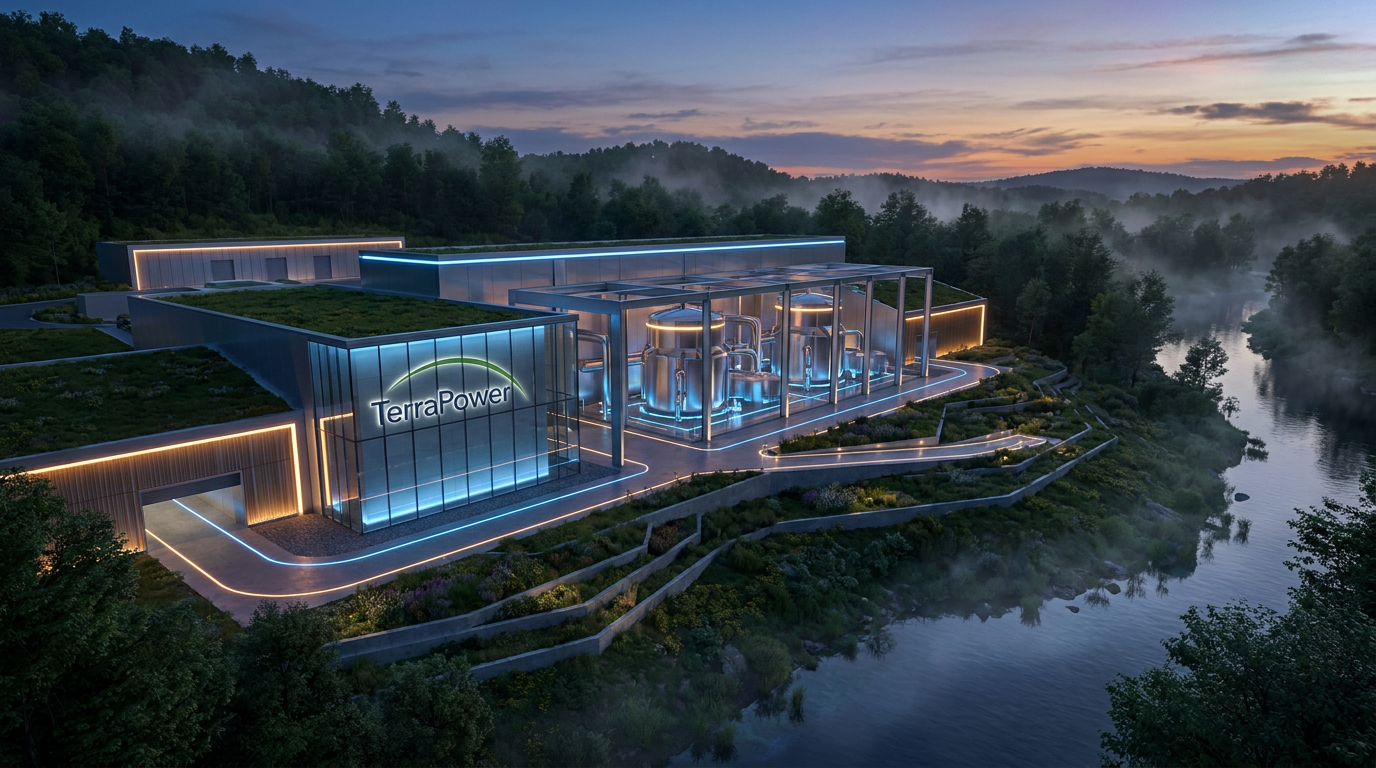
The most significant milestone arrived in April 2026, when TerraPower—the nuclear innovation company founded by Bill Gates—officially began construction on its flagship Natrium plant in Kemmerer, Wyoming. Built near a retiring coal facility, the project is the first commercial non-light water reactor approved for construction by the U.S. Nuclear Regulatory Commission in more than 40 years.[1][3]
To understand why the Natrium reactor is a breakthrough, one must look at its cooling mechanism. Traditional nuclear plants use water under immense pressure to cool the reactor core. The Natrium design is a sodium-cooled fast reactor. Liquid sodium has a much higher boiling point than water, allowing the reactor to operate at normal atmospheric pressure. This eliminates the need for the massive, expensive reinforced containment domes designed to hold in pressurized steam, fundamentally altering the plant's footprint and cost.[1][4]

But TerraPower's most crucial innovation is how it integrates with the modern, renewable-heavy grid. The Natrium plant features a patented molten salt-based energy storage system. While the reactor continuously generates a steady 345 megawatts (MW) of heat, the molten salt can store that thermal energy and dispatch it later. When solar panels go dark or peak evening demand hits, the plant can boost its electrical output to 500 MW, effectively acting as a massive, carbon-free battery.[1][3]
Beyond novel coolants, the defining feature of the SMR revolution is the "factory model." Historically, nuclear power plants were bespoke mega-projects, built entirely on-site. This approach is notoriously vulnerable to supply chain hiccups, weather delays, and staggering cost overruns. SMRs are designed to be manufactured as standardized modules in a central factory, shipped via standard trucks or rail, and assembled on-site like interlocking building blocks.[6][7]

This modular approach is rapidly gaining traction in Europe, where energy security has become a paramount geopolitical concern. In June 2026, Rolls-Royce SMR signed a landmark agreement with Videberg Kraft to deliver three reactors on Sweden's Värö peninsula. The project will add 1,500 MWe of clean baseload capacity to the Swedish grid. Rolls-Royce, leveraging its decades of experience building compact reactors for nuclear submarines, now holds multiple deployment contracts across the UK, Sweden, and the Czech Republic.[5][8]
This modular approach is rapidly gaining traction in Europe, where energy security has become a paramount geopolitical concern.
The European Commission has recognized this momentum, launching a comprehensive strategy in March 2026 to accelerate SMR deployment. The Commission projects that SMR capacity within the EU could reach between 17 and 53 gigawatts by 2050. The strategy focuses on mobilizing cross-border value chains, streamlining regulatory approvals, and positioning Europe as a dominant exporter in the global advanced nuclear market.[6]
In the United States, the regulatory moat remains formidable, but one company has successfully crossed it. NuScale Power holds the only SMR design currently approved by the NRC. The company is advancing a massive 6-gigawatt deployment pipeline with the Tennessee Valley Authority and international projects like Romania's RoPower. Because NuScale uses conventional light-water technology shrunk down to a modular scale, it relies on existing, proven fuel supply chains.[9]

The sudden urgency behind these deployments is inextricably linked to the tech sector. Artificial intelligence requires staggering amounts of electricity; a single AI training run can consume more power than a small town. In early 2026, Meta announced plans to back 6.6 GW of nuclear energy projects, including up to eight Natrium plants by 2035. Tech hyperscalers have realized that their net-zero climate pledges are mathematically impossible to achieve with wind and solar alone if they want to maintain 24/7 data center operations.[2]
SMRs also introduce a paradigm shift in nuclear safety through "passive safety" systems. In older reactors, active cooling requires electric pumps and human intervention. If the power fails—as it did in Fukushima—the reactor can overheat. Advanced SMRs are designed so that if all power is lost, the laws of physics take over. Gravity, natural circulation, and convection automatically cool the core, theoretically making a meltdown physically impossible.[6][7]

Despite the technological triumphs, significant uncertainties remain, primarily rooted in economics. The SMR business model relies entirely on economies of scale. To make the reactors cheap, companies must build them in factories; to build the factories, they need a massive backlog of firm orders. Financial analysts caution that early movers like NuScale are burning through cash, and true commercial profitability may not arrive until the early 2030s.[9]
Furthermore, the fuel supply chain for many advanced designs is precarious. Reactors like Natrium require High-Assay Low-Enriched Uranium (HALEU). Until recently, Russia was the only commercial supplier of HALEU. While the U.S. and Europe are aggressively funding domestic enrichment capabilities, a bottleneck in fuel production could delay the rollout of non-light water SMRs.[4][9]
Finally, the question of nuclear waste remains politically unresolved. While some advanced reactors are more efficient and generate less high-level waste per megawatt than traditional plants, they still produce radioactive byproducts that require secure, long-term geological storage—a hurdle that few nations have successfully navigated.[4][7]
Nevertheless, the events of 2026 mark a point of no return. With steel going into the ground in Wyoming, contracts signed in Sweden, and tech giants opening their checkbooks, Small Modular Reactors have transitioned from a theoretical climate solution to an active industrial reality. If the industry can deliver these first-of-a-kind plants on time and on budget, they will fundamentally rewire the global energy grid for the 21st century.[1][5][7]
How we got here
March 2026
The European Commission launches a comprehensive strategy to accelerate the deployment of SMRs across the EU.
April 2026
TerraPower officially begins construction on its Natrium plant in Wyoming, the first commercial non-light water reactor approved in the U.S. in 40 years.
June 2026
Rolls-Royce SMR is selected to build three modular reactors in Sweden, marking the country's first new nuclear power project in over four decades.
June 2026
TerraPower launches a UK subsidiary and begins the formal regulatory review process to deploy its Natrium technology in Britain.
Viewpoints in depth
Advanced Nuclear Developers
Companies building SMRs argue that factory manufacturing will solve the nuclear industry's cost crisis.
Firms like TerraPower, Rolls-Royce, and NuScale contend that the historical failure of nuclear energy was a construction problem, not a physics problem. By shifting construction from unpredictable outdoor sites to controlled factory floors, they argue they can achieve economies of scale similar to the aviation or automotive industries. They view SMRs as the only realistic way to provide the massive, uninterrupted baseload power required to decarbonize heavy industry and support the modern grid.
Tech Hyperscalers
Data center operators view advanced nuclear as the only viable path to powering AI while meeting climate pledges.
Companies like Meta, Google, and Microsoft are facing a mathematical impossibility: their artificial intelligence infrastructure requires 24/7, massive power draws, but their corporate mandates require them to reach net-zero emissions. Wind and solar, constrained by weather and battery storage limits, cannot provide this firm baseload. Consequently, tech giants are becoming the primary financial catalysts for SMRs, willing to sign long-term power purchase agreements to guarantee clean energy for their data centers.
Market Analysts
Market analysts warn that SMRs remain unproven at commercial scale and face a steep path to profitability.
Despite the engineering breakthroughs and regulatory approvals, financial analysts caution that the SMR sector is highly capital-intensive. The 'factory model' only reduces costs if there is a massive, guaranteed order book to keep the assembly lines running. Skeptics point to the high cash burn rates of early movers and warn that supply chain bottlenecks—particularly for specialized fuels like HALEU—could delay deployments and push profitability well into the 2030s.
What we don't know
- Whether the nuclear industry can overcome its historical legacy of massive cost overruns and deliver these first-of-a-kind SMRs on time and on budget.
- How quickly Western nations can scale up domestic enrichment of HALEU fuel to break reliance on Russian supply chains.
- The long-term political and geological solutions for storing the radioactive waste produced by this new generation of reactors.
Key terms
- Small Modular Reactor (SMR)
- A compact nuclear reactor designed to be manufactured in a factory and assembled on-site, offering lower upfront costs and greater flexibility than traditional nuclear plants.
- Baseload Power
- The minimum amount of electric power needed to be supplied to the electrical grid at any given time, requiring energy sources that can run continuously 24/7.
- Sodium-Cooled Fast Reactor
- An advanced reactor design that uses liquid sodium instead of water for cooling, allowing it to operate safely at normal atmospheric pressure.
- Molten Salt Energy Storage
- A system that stores excess thermal energy generated by a reactor in superheated liquid salt, which can later be converted to electricity during periods of peak demand.
- Passive Safety
- Engineering designs that rely on natural physical forces, like gravity and convection, to safely shut down and cool a reactor during an emergency without requiring external power.
- HALEU
- High-Assay Low-Enriched Uranium, a specialized nuclear fuel required by many advanced reactor designs that is currently facing global supply chain bottlenecks.
Frequently asked
What makes a nuclear reactor "modular"?
Unlike traditional nuclear plants built entirely on-site, modular reactors are manufactured as standardized components in a central factory. These modules are then shipped to the location and assembled, which significantly reduces construction time and cost overruns.
Why do AI data centers need nuclear power?
Artificial intelligence requires massive amounts of electricity to run 24/7. Wind and solar power are intermittent and depend on the weather, making advanced nuclear the only carbon-free energy source capable of providing the constant "baseload" power data centers demand.
Are Small Modular Reactors safer than older nuclear plants?
Yes. Most advanced SMRs utilize "passive safety" systems. In the event of a total power loss, they rely on the laws of physics—such as gravity and natural convection—to automatically cool the reactor core without the need for human intervention or electric pumps.
When will the first SMRs be operational?
TerraPower's Natrium plant in Wyoming, which began construction in early 2026, is targeting completion by 2030. Wider deployments across Europe and the U.S. are expected to come online in the early-to-mid 2030s.
Sources
Source coverage
9 outlets
4 viewpoints surfaced









[1]TerraPowerAdvanced Nuclear Developers
TerraPower Announces Start of Construction on Natrium Plant
Read on TerraPower →[2]NucNetTech Hyperscalers
Meta Announces 6.6 GW Of Nuclear Energy Projects To Power AI Revolution
Read on NucNet →[3]World Nuclear NewsPolicymakers & Regulators
US Regulator Clears Construction Permit For TerraPower Advanced Reactor In Wyoming
Read on World Nuclear News →[4]ASMEMarket Analysts
A realistic look at what's advancing in nuclear energy in 2026
Read on ASME →[5]Rolls-RoyceAdvanced Nuclear Developers
Rolls-Royce SMR selected to deliver Sweden's first new nuclear power for over 40 years
Read on Rolls-Royce →[6]European CommissionPolicymakers & Regulators
Strategy to accelerate the development and deployment of Small Modular Reactors
Read on European Commission →[7]IDTechExMarket Analysts
Small modular reactor market, SMR market, SMR forecast
Read on IDTechEx →[8]Construction BriefingMarket Analysts
Rolls-Royce to build three SMRs in Sweden
Read on Construction Briefing →[9]TIKRMarket Analysts
NuScale Power Gets First Mover Advantage as Nuclear Regulatory Commission Backs Small Modular Reactor Design
Read on TIKR →
Every angle. Every day.
Get energy stories with full source coverage and perspective breakdowns delivered to your inbox.